
State and local government organizations face a persistent challenge: adversaries operate at machine speed, while State, Local, and Education (SLED) security teams often operate with limited staff, constrained budgets, and highly distributed environments. Over the past decade, the Multi‑State Information Sharing and Analysis Center (MS‑ISAC) has become a cornerstone of SLED cybersecurity by providing timely, sector‑specific threat intelligence, advisories, and shared services.
Increasingly states are adopting expanded, state-coordinated MS‑ISAC membership models, where a single state‑level membership extends MS‑ISAC services and threat intelligence to a broad set of state agencies, local governments, and often K‑12 and higher‑education institutions.
These membership models exist for a simple reason: SLED organizations face many of the same cyber threats, but do not have the same resources. By centralizing access to threat intelligence at the state level, leaders can reduce duplication, improve coordination, and ensure that even the smallest agencies and school districts receive timely cyber threat information.
As a result, threat intelligence is now more widely available across SLED environments than ever before. The question many CISOs are asking is no longer “How do we get intelligence?” but rather:
How do we consistently turn shared intelligence into real-time, actionable protection across hundreds or thousands of SLED entities?
MS‑ISAC as a Foundational Layer
MS‑ISAC plays a critical role in the SLED cybersecurity ecosystem. Its advisories, vulnerability notifications, threat feeds, and services such as Albert sensors and Malicious Domain Block and Reporting (MDBR) provide a common baseline of awareness and visibility tailored to government and education environments.
State-coordinated memberships extend this foundation even further, enabling states to share threat intelligence broadly across counties, cities, and school districts – many of which lack dedicated security teams.
This model strengthens collective defense, and it also introduces a practical reality: intelligence alone does not stop attacks. Value is realized only when intelligence is operationalized and integrated into security controls that can automatically prevent, detect, and respond to threats.
The Operational Challenge: From Awareness to Action
Many SLED organizations receive MS‑ISAC intelligence in formats designed for broad distribution: email bulletins, PDFs, dashboards, or raw STIX/TAXII feeds. While this information is highly valuable, acting on it often requires manual review and configuration -tasks that are difficult to sustain 24/7, especially for smaller agencies and school districts.
Common challenges include:
- Indicators that are reviewed but not enforced in real time
- Alerts siloed across tools, agencies, or education systems
- Limited ability to correlate shared intelligence with local telemetry
- Inconsistent response across organizations with varying levels of cyber maturity
- Unsupported or outdated infrastructure
As these expanded, state‑coordinated MS‑ISAC memberships grow, states are increasingly looking for ways to standardize how intelligence is consumed and acted upon, without requiring every agency or district to operate a fully staffed security operations center.
Use Case: Turning Shared Intelligence into Automated Defense
Forward leaning states are addressing this challenge by treating MS‑ISAC intelligence as a shared input into automated security architectures that enforce protection consistently across SLED environments.
Rather than asking each organization to manually interpret indicators, these programs focus on:
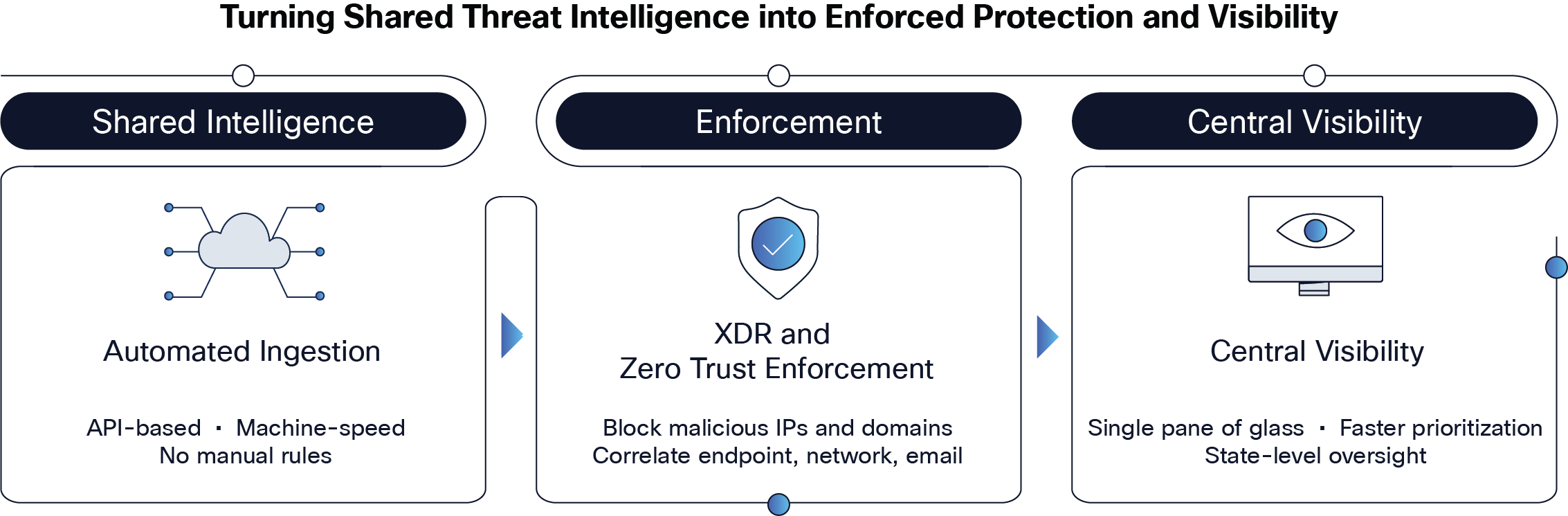
- Automated ingestion of threat feeds into network, DNS, and secure access controls
- Centralized correlation of alerts from sensors, endpoints, and email systems
- Policy based enforcement that scales across agencies and school districts
- Shared visibility for state‑level security teams supporting local entities
Cisco supports many SLED governments and education systems in this model by helping integrate intelligence into architectures built around extended detection and response (XDR) and Zero Trust principles. For example:
- MS‑ISAC STIX/TAXII feeds can be automatically consumed by network security and DNS‑layer controls to block known malicious IPs and domains in near real time.
- Alerts from Albert sensors can be correlated within an XDR platform alongside endpoint, email, network, and identity telemetry—helping teams prioritize what matters most.
- Zero Trust and Secure Access architectures help ensure that users and devices are continuously verified, even when threats originate from inside trusted networks.
The broader lesson is vendor agnostic: threat intelligence becomes far more effective when paired with automation, correlation, and policy‑driven enforcement.
Complementary Capabilities: Intelligence Plus Operations
The most effective state‑coordinated MS‑ISAC programs view intelligence sharing and security operations as complementary layers rather than overlapping services.
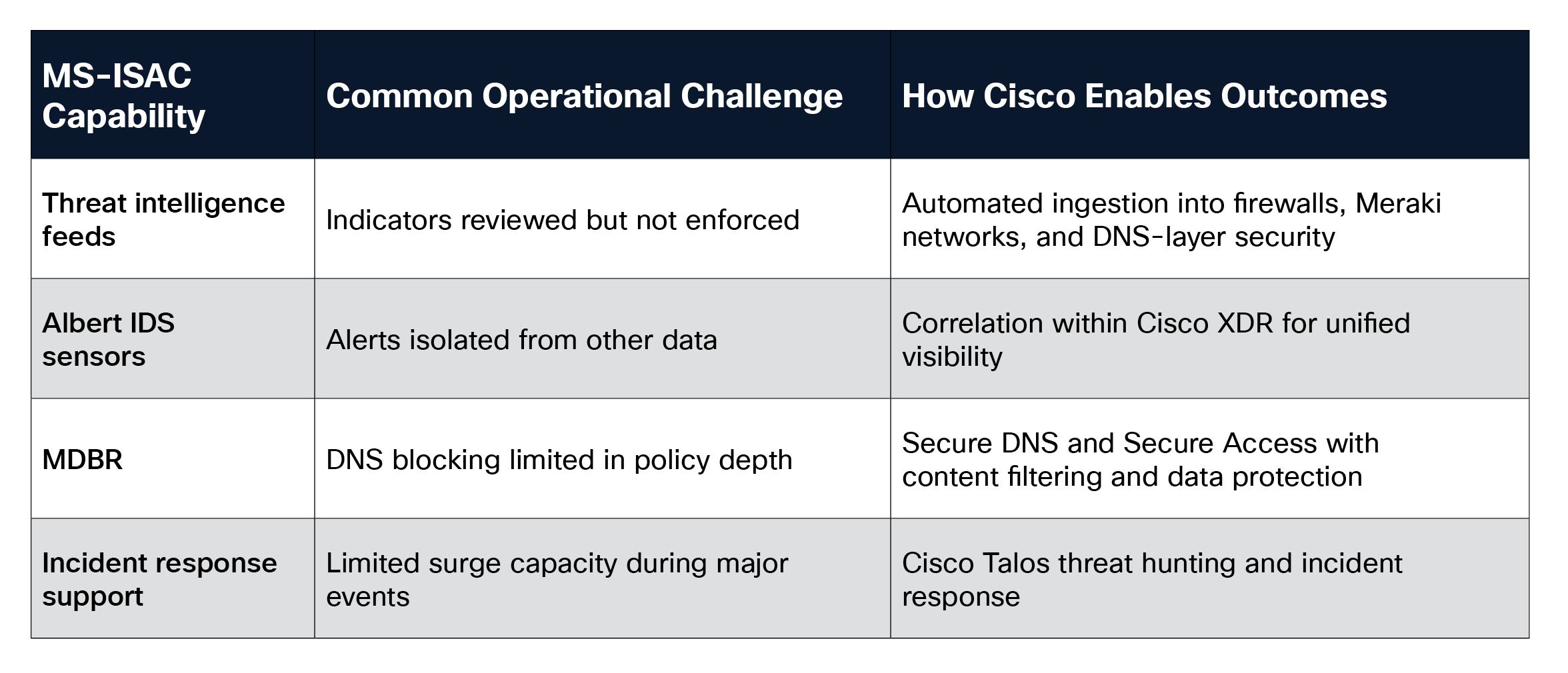
This approach allows MS‑ISAC to remain the trusted source of SLED‑specific intelligence, while platforms like Cisco’s help operationalize that intelligence across diverse and distributed environments.
Funding Alignment and Planning Considerations
Another factor shaping these conversations is funding alignment. As MS‑ISAC has transitioned to a fee‑based membership model, SLED leaders are planning more deliberately around how they fund both intelligence and operations.
While MS‑ISAC membership fees typically require state or local funding sources, many operational security capabilities, such as Zero Trust, XDR, vulnerability management, and security automation, may be eligible under federal programs like the State and Local Cybersecurity Grant Program (SLCGP).
Cisco works with SLED organizations to design architectures that align with these funding models, helping agencies layer shared intelligence with operational controls that reduce risk and improve resilience.
Using Maturity Models to Guide the Journey
To prioritize investments and measure progress, many SLED organizations use the CIS Critical Security Controls, which MS‑ISAC actively promotes, as a practical maturity framework. Controls such as Vulnerability Management and Network Monitoring help agencies and school districts move from ad hoc response to repeatable, measurable outcomes.
Cisco maps its security portfolio to widely adopted frameworks such as NIST CSF 2.0 and NIST SP 800‑53, helping SLED leaders align security architecture decisions with governance, compliance, and mission objectives.
Looking Ahead: Intelligence at Scale Requires Operations at Scale
MS‑ISAC remains a vital pillar of SLED cybersecurity. As state‑coordinated memberships expand, the next phase of maturity is operational, ensuring that shared intelligence leads to consistent, real‑time protection for every agency and education entity, regardless of size or staffing.
At Cisco, we see the most successful SLED programs treat intelligence sharing and security operations as two parts of the same system. When designed together using approaches like XDR and Zero Trust, they enable governments and education systems to reduce risk, respond faster, and make the most of limited resources.
In today’s threat environment, intelligence is essential. When combined with automation, visibility, and collaboration, it becomes a powerful catalyst for resilience and progress across the SLED community.