


Every few decades, infrastructure gets a new abstraction. We went from racking hardware to virtualizing it, then from clicking through consoles to writing infrastructure as code. Each shift changed who could build, how fast they could move, and what was possible to defend.
The next abstraction isn’t coming. It’s already here.
As Jeetu Patel captured, agentic AI is kicking off a networking supercycle — the era of managing critical infrastructure at human scale is over. What comes next has to be built for a workforce that is no longer entirely human.
Agents are about to become a permanent part of how enterprises run. Real, capable, reasoning agents that observe infrastructure, modify it, defend it, and extend it. The real question: is your infrastructure ready to let them in safely?
That’s the question Cisco Cloud Control was built to answer.
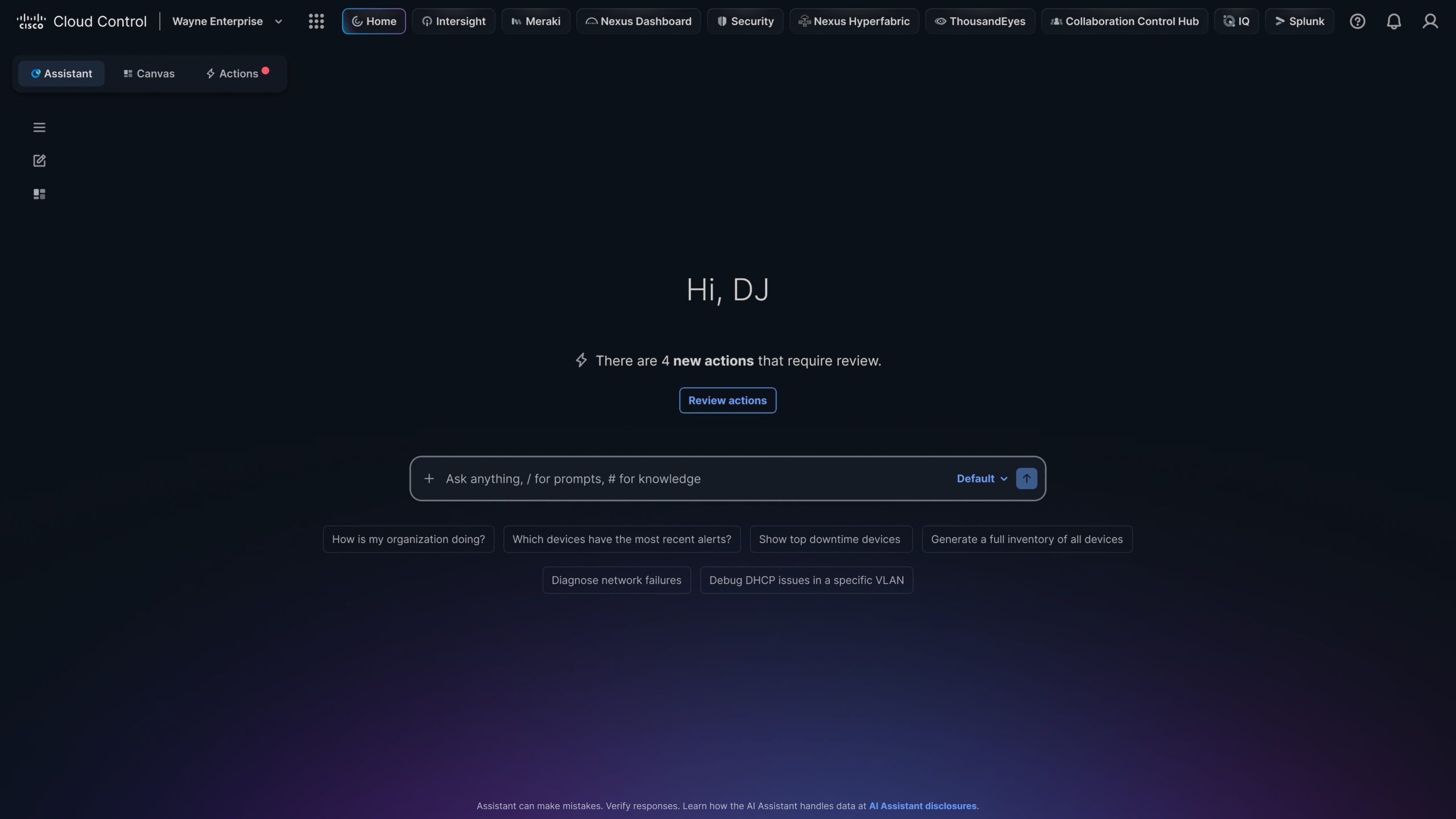 Above: Cisco Cloud Control homepage ▶️ Watch video
From infrastructure as code to infrastructure as a harness
Think about what made Codex and Claude Code feel like a step change for software developers. It wasn’t just the model, but the harness around the model: the repo, the terminal, the tests, the permissions, the feedback loop. The model was powerful, but the harness is what made it useful.
Infrastructure needs the same thing. Terraform, Ansible, and Python scripts made infrastructure programmable, but they all assumed a human was writing the logic, stitching the systems together, and deciding what to change. That assumption no longer holds. Agent-native infrastructure demands a different abstraction. It needs its own harness: a safe, governed, observable control surface that lets agents act on real systems without breaking them, exposing them, or taking them somewhere they shouldn’t go.
That is what Cisco Cloud Control was made to do: the unified operations platform that brings every Cisco domain (Networking, Security, AI Infrastructure, Observability, and Collaboration) and your third-party tools into one environment, with one login, one view, and one operating model for every team and every agent working across your estate. This isn’t a single pane of glass; glass is passive. Cisco Cloud Control is active execution, with policy and identity built into the control path itself.
What the harness actually does
A harness is a concrete set of capabilities that must be real, or none of this works.
Cisco Cloud Control gives agents — and the humans who direct them — six things at once:
- Trusted access to routers, switches, controllers, firewalls, clients, users, workloads, and applications that make up the modern enterprise.
- Normalized APIs and MCPs for observing and managing every domain.
- Identity, policy, and zero trust built directly into the control path, rather than bolted on top.
- Telemetry and operational context that show what is actually happening on the ground, in real time.
- Enforcement points that can block, isolate, reconfigure, or remediate at runtime.
- Governance that makes every agentic action transparent, auditable, bounded, reversible, and subject to human approval.
This is what “real” looks like. Six capabilities, working as one — the harness that makes agents safe to deploy, and powerful enough to matter. Dive deeper into how we’ve built the secure harness for the agentic era.
Where the work happens: AI Canvas
The harness is the engine. The workspace is where you actually drive. Cisco Cloud Control’s workspace is AI Canvas — the multiplayer, generative environment where human operators and AI agents investigate, correlate, and resolve complex issues together in real time.
Operators see the same live evidence that agents do. Agents build investigation plans, pull data across domains, and drive resolution end to end. Context persists across shifts and escalations, so nothing is lost and nothing is repeated. What used to require a war room now happens in a workspace.
Cisco Cloud Control is the platform; AI Canvas is where the work happens — learn how it has evolved since we first unveiled it last year.
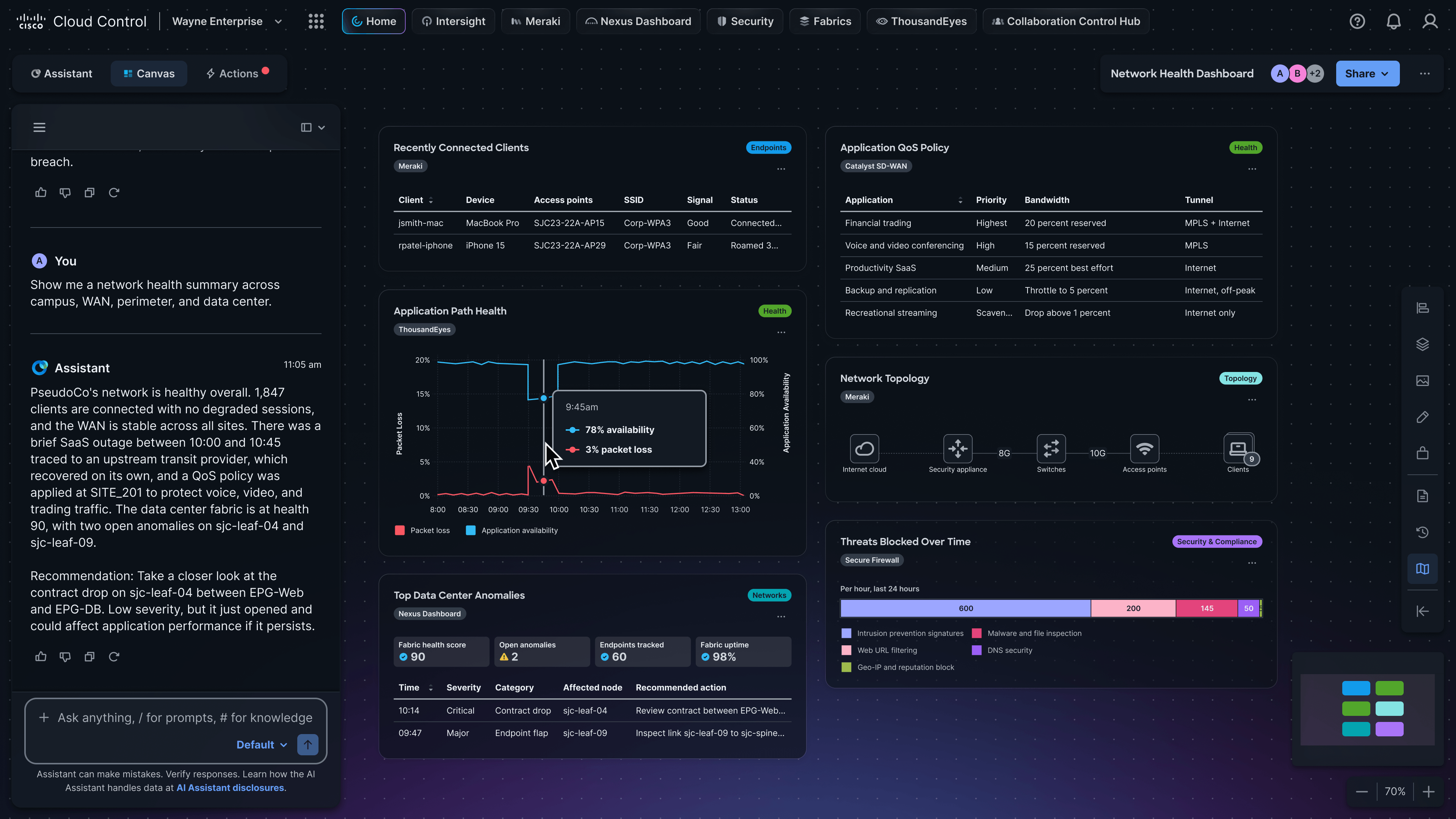 Above: AI Canvas workspace
Where customers build: The Studio in Cloud Control
AI Canvas makes agents useful. Cloud Control Studio is where you build them.
Cloud Control Studio is the design space — the factory floor — where customers and partners build and secure the agents, applications, and workflows their business depends on, on top of a substrate that’s already wired into Cisco’s data, policy, and control plane. Inside Studio, two capabilities do the heavy lifting:
-
- App Builder — where custom apps and workflows are developed for Cloud Control. Users build and publish from natural-language prompts, with built-in agentic coding assistants including OpenAI Codex.
- Agent Builder — where AI agents for Cloud Control are created. Customers and partners can build, train, bring, and secure their own agents.
Everything built in Cloud Control Studio can be discovered in the Cloud Control Marketplace: the open catalog where customers and partners find and extend what’s possible, so teams can find the right tools for the right task. Customers can build their own applications and agents using natural language directly within the platform, which also connects to a large partner ecosystem including AWS, Google Cloud, Linear and ServiceNow. Discover the new partner opportunity presented by Cisco Cloud Control.
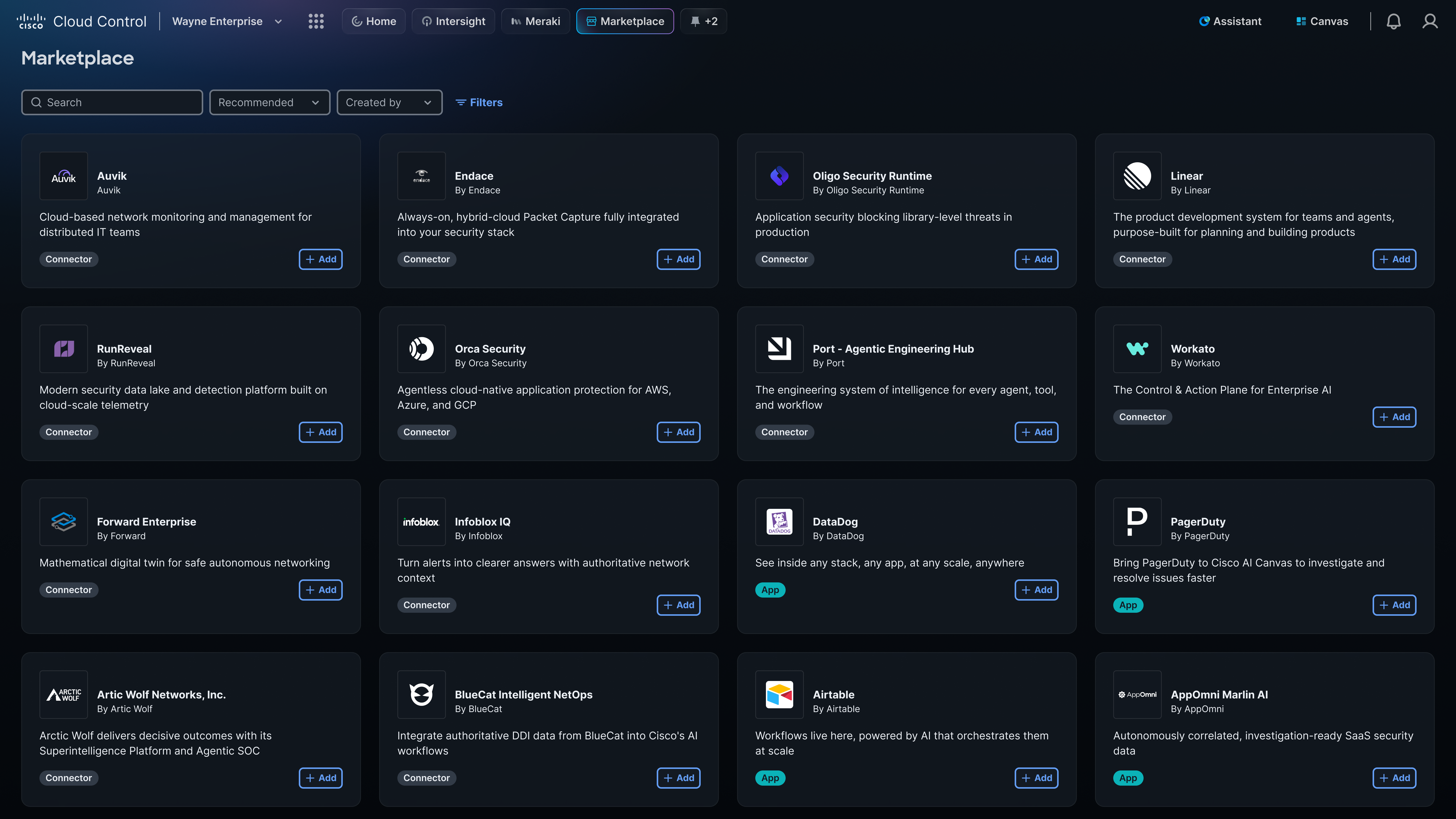 Above: Cisco Cloud Control Marketplace
The customer unlock
Picture this. An IT admin walks in on Monday morning to discover that the operations team has begun rolling out a new class of AI-enabled inspection cameras across the manufacturing floor. The devices are already on the network, but they sit outside every existing management tool. The vendor has an API, but no integration exists yet.
In the old world, the safe answer was no – wait for the roadmap, wait for the connector, wait for someone else to build it. In the new world, the answer changes. The admin opens a coding harness, builds a small Cisco Cloud Control application, connects to the device API, maps each camera to network location and identity context, pulls telemetry, and exposes policy actions through Cisco’s governed control surface. In hours, not quarters, those devices become observable, manageable, and defensible — under the same policy model as everything else in the estate.
That same pattern works for a new SaaS app, a custom internal system, a factory controller, a medical device, or a partner-managed appliance. Anything the business throws at IT before the vendor catalog catches up. The real unlock: customers can build their own workflows and inherit Cisco’s APIs, policy model, observability, enforcement, and governance for free.
Why this matters now
Powerful models are making software creation faster than it has ever been, and that is a gift for productivity. It also reshapes risk. If models can generate code at this speed, they can generate vulnerable code at this speed – new applications, new attack surfaces, and new runtime behaviors that traditional security workflows weren’t designed to catch in time. The window between vulnerability discovery and exploitation has collapsed from weeks to minutes.
What customers need is the ability to build custom shields around their own applications and infrastructure: agentic defenses that observe behavior, understand context, detect exploit patterns, reconfigure controls dynamically, block attacks at runtime, and verify the mitigation actually worked. This is where Cisco Cloud Control becomes more than an operations platform — it’s the command center for a post-Mythos security posture, the place where Live Protect, unified policy, and full vulnerability visibility come together.
Cisco can deliver this because Cisco owns the control points that matter – network, security, identity, clients, firewalls, controllers, telemetry, and policy boundaries – and the harness sits on top of all of them.
The superhuman admin
Let’s be clear: none of this is about replacing the people who run infrastructure. It’s about making them dramatically better at it. That’s what AgenticOps means in practice — Cisco’s operational system for the AI era, where governed AI agents monitor, reason, and act across your infrastructure with humans firmly in the loop. AgenticOps is the capability. Autonomous infrastructure is the outcome. Cisco Cloud Control is where it all comes to life.
In practice, that means coding tools help the admin write the custom app, Cisco Cloud Control gives that app secure access to the infrastructure, Cisco APIs and MCPs expose the operational capabilities, Cisco policy and identity govern what the app can do, and Cisco enforcement points make the app useful in the real world. The IT admin becomes a builder. The security admin becomes a rock star. The platform team starts shipping at the speed of the business. That’s what it looks like when strategy turns into reality.
The shift is happening now
Cisco has spent four decades building best-in-class solutions across every domain that matters in enterprise IT. Meraki. ThousandEyes. Security Cloud Control. Nexus. Intersight. Webex. Each one a leader. Our depth is unmatched — and there’s more to come.
We innovate from the silicon to the application — making our own chips, building the systems they power, writing the software that runs on them, and providing the security and observability that watches all of it. The opportunity lives in what becomes possible when every domain works together — when shared inventory, unified topology, and a single environment turn the portfolio into a platform.
That’s the architectural choice underneath Cisco Cloud Control: tightly integrated, loosely coupled, and built for an open ecosystem. The more Cisco you run, the more powerful the platform becomes — and the heterogeneous environment you already have keeps working alongside it.
We’re building the secure harness that lets every customer connect agents to their infrastructure, build their own applications on top of it, and defend their environments at the speed AI is moving.
That’s the shift. Dashboards giving way to agentic workflows. Infrastructure as code evolving into infrastructure as a harness. Fixed product features expanding into customer-built infrastructure apps. Static controls becoming custom runtime shields. Cisco evolving from a portfolio of products into the secure harness for enterprise infrastructure in the agentic era.
This is Cisco’s next big thing. We’re glad you’re here for it.
Some products or features described may be in various stages of development and offered on a when-and-if available basis.


Cisco Cloud Control + AI Canvas + Marketplace is going to transform how customers manage and interact with their infrastructure, this is amazing.