


Your first impression onboard an AIDA cruise ship was different from mine. Yours was taking in the serenity of the scenery: navy blue waters meeting the horizon, endless blue interrupted only by a golden sunset. The perfect Instagram moment.
Me? I was in awe. In my years as a Cisco CX Principal Architect, I have taken on challenging projects. Massive concert venues connecting thousands of people streaming content simultaneously, military agencies where security is paramount, and hospitals where network downtime can threaten lives. Yet, here in this utopia, I found an unmatched challenge; the need to connect a small city floating miles away from the nearest cell tower reliably and securely. And to top it off, this project needed to be completed within a strict 14-day window while the ship was docked.
How do we pull that off? What does it take to engineer architectural change in a floating city?
Step 1 in Engineering Utopia: Defining the Blueprint
Like all Cisco Customer Experience (CX) engagements, this one started with a meeting to understand what needed to be modernized within AIDA’s onboard and shoreside technology environment.
Together, we aligned on four core objectives:
- Infrastructure: Establishing a secure, scalable, multi-vendor interoperable IT environment that simplifies onboarding for new business-critical systems.
- Crew and Guest Experience: Elevating the onboard experience through intuitive tech that reduces operational friction and training needs.
- Future-proof Automation: Simplifying IT and OT operations to improve reliability and pave a clear path toward AIOps maturity.
- Next-gen technology: Creating new revenue-generating opportunities.
Step 2: Architecting a Reliable, Validated Network Infrastructure
With the objectives set, our team began to evaluate the architecture’s existing state. The underlying aim was to ensure interoperability, resilience, and long-term architectural flexibility of the environment. We deployed a standards-based EVPN-VXLAN fabric leveraging Cisco Catalyst 9000 switching and our latest wireless solutions.
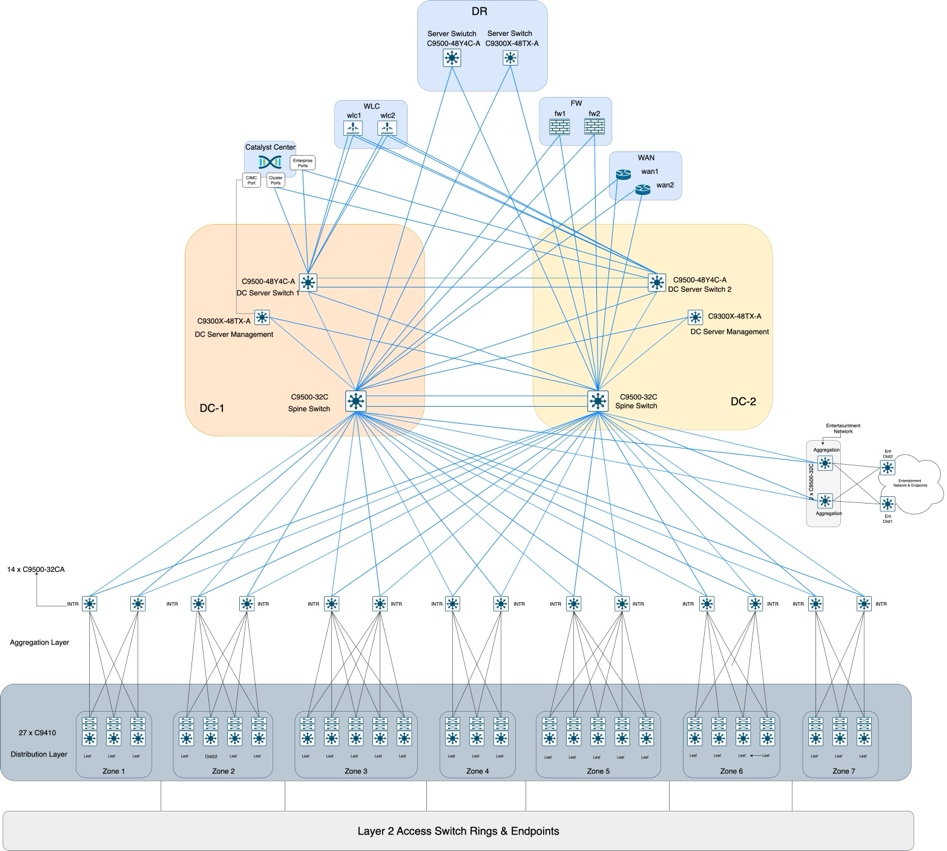
The standards-based network fabric design
To ensure reliable Wi-Fi onboard, we conducted a thorough wireless analysis during regular ship operations, which revealed certain challenges: Inconsistent roaming, coverage gaps, and limited network visibility.
Based on the findings, recommendations were made to improve the wireless infrastructure through the deployment of new Wi-Fi access points as well as optimization of existing access point placements, ensuring improved coverage, capacity, and seamless roaming across operational and guest areas.
But the real gamechanger was designing a shoreside validation environment. Leveraging Cisco Solution Validation Services (SVS), we built a digital twin, a minimal but representative version of the ship’s network on land. Here we benchmarked, tested integrations, and validated configuration changes before they touched the live production network, drastically reducing operational risk and offering AIDA high confidence in the deployment.
Step 3: Taking Onboard Experience Beyond Connectivity
We could have stopped there. But the CX team wanted to further elevate the technology experience onboard AIDA cruises to match their overall service standards. With that in mind, we designed three additional use cases:
- Wireless Open Roaming: Guests can now connect to Wi-Fi from anywhere onboard, without the frustration of repeated authentication.
- Location-Based Services (LBS): We support operational improvements like user/device tracking, indoor wayfinding, and occupancy detection for better space utilization.
- RFID and BLE Integration[1]: By integrating these technologies, we have enabled advanced asset tracking and critical safety features, including automated fire patrol monitoring, safety compliance tracking, and support for emergency scenarios like mustering and evacuation assistance.
Step 4: Leaping from Efficient Operations to AIOps
Cisco CX’s biggest differentiator is that we go beyond just the technology stack. For AIDA, we also reviewed their processes to improve the overall operating model, including governance, deployment, and lifecycle management.
As part of the recommendations, we proposed a new orchestration workflow that taps into the extensive API capabilities of our solutions, allowing for greater automation and consistency in configurations, service provisioning, and lifecycle operations. The game-changing pre-deployment validation we introduced in this project is now part of that workflow for all deployments, upgrades, and configuration changes.
Finally, we implemented a combination of Cisco and third-party assurance platforms. This gave AIDA continuous visibility into the health and performance of the infrastructure. With proactive insights, anomaly detection, and event correlation, the team can now identify and resolve issues based on emerging symptoms before they turn into service disruptions, opening the road to AIOps-driven network operations.
Enjoying a Floating Utopia
Upon reflection, a lot has happened since my first impressions onboard AIDA cruises: this team has turned a complex, isolated environment into a connected, resilient, and intelligent hub, supported by a proactive operational model.
This experience has taught me that technology is at its best when it is invisible; its value is the peace of mind we have delivered to the crew and the seamless, unforgettable experiences we have unlocked for every guest on board.
Learn more
- Read the Cisco Newsroom article.
- Watch the video.
[1] RFID stands for Radio-Frequency Identification. BLE stands for Bluetooth Low Energy


