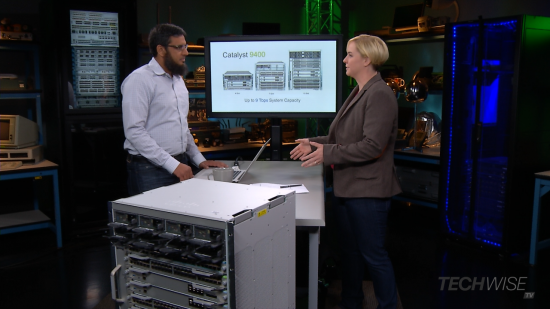
There are a number of key innovations within the new Catalyst 9000 series family, (Anand lists 9 of them).
Two of my favorite, often overlooked innovations in this hardware include the UADP Programmable ASIC that sets us years apart from any competitor, and the fact that the IOS-XE operating system is using the same binary across the entire family. This is the most significant move towards simplification of IOS that I have seen on this multi-year progression.
TechWiseTV: Catalyst 9000 Series Programmability and Software-Defined Access
https://youtu.be/hP2lDs_fm7Q
Not only is this the biggest single family roll out that Cisco has done in history, it was done to coincide with a completely new model for how enterprise networking should be done. Intent-based networking has certainly lead the Cisco news cycle lately but I fear it has also distracted from many of the real innovations present within these latest announcements.
Purpose-built Cisco Digital Network Architecture (DNA) with Software-Defined Access (SDA), the 9300 fixed access, 9400 modular access, and 9500 fixed core switch represent the pinnacle of power and programmability.
This episode explores the unique features that set them apart and the four principles of platform innovation—security, Internet of Things (IoT), cloud, and mobility—that bring them together.
All this, plus:
A brief history of the Cisco Catalyst switch
The new modularity of IOS-XE, and why it matters
FlexParser programmable pipeline with microcode updates to support any protocol
Micro Engines for process-intensive operations at wire speed, built-in radio frequency identification (RFID), container support, Bluetooth, storage options, and more.
Lauren Malhoit and Muhammed Imam review standout features of the Catalyst 9000 Family
Want to chat about this new stuff live with us? Don’t miss the Live Webinar July 19, 2017 at 10:00 am Pacific Time / 1:00 pm Eastern Time. (register or watch replay here)
Huge thank you to the Catalyst team for working with us on this and of course Muhammad Imam and Carl Solder specifically.
According to the Cisco 2017 Annual Security Report, security attacks on businesses have significant consequences with nearly quarter of these companies suffering lost business opportunities, 20 percent of them losing customers, and more than 30 percent of them losing revenue. For example, the recent rash of ransomware attacks around the globe are expected to cost businesses more than $5 billion and an unknown sum in their reputations. This doesn’t even count the attacks that happened just last week.
The reality is that security attacks are increasingly becoming a question of “when” not “if” for companies today. Therefore these organizations can no longer simply wish away gaps in security protection, they must take all active measures to defend themselves vigilantly from known and even unknown threats.
Compounding this challenge for businesses is that what constitutes a “security perimeter” is amorphous to say the least these days. Technologies and operational models such as IoT, public cloud, data center virtualization, enterprise mobility, outsourcing, extranets, open source software, etc., while useful, can all undermine the effectiveness of physical security protections. With real threats that can come from inside or outside the “corporate firewall”, companies need more than a trust-but-verify approach to defending themselves from security threats and attacks.
This requires companies moving beyond perimeter security when it comes to protecting their data and their data centers. Instead, security has to be comprehensive and pervasive on every network device (switches, routers, etc.) as hackers get more sophisticated and unpredictable and capable of exploiting both hardware and software vulnerabilities. These attackers, with cutting-edge techniques, can access memory chips, use tools to extract the contents of those chips and then use the content to build/configure systems to act as imposters on the customer’s network. Bottom line – Malware can be installed on a router or switch. Are you protected ?
Building Data Center Trustworthy Systems
What’s needed is a way to verify that all devices in your network and data center are authorized under your control. This is why the trust and transparency of building Cisco Trustworthy systems should be a foundation in a security architecture. These systems are mechanisms to help companies properly identify and validate users and behaviors as they should be. This is analogous to an effective airport security model, where identity verfication happens at multiple stages during the trip from ticketing to boarding. Verify, verify again, and then trust.
The Cisco Trustworthy data center systems are built on a comprehensive and pervasive set of security, data protection and privacy solutions delivering both network and infrastructure-level security, which can get as granular as ensuring that your software code is authentic and no physical or software tampering has taken place. The mechanisms for this are part of a full secure development lifecycle such as secure software delivery as well as secure boot, storage, and data recovery mechanisms.
This post comes from Stacy Shrader, an intern with the collaboration marketing team and a rising senior at Virginia Tech with a dual degree in business management and public relations.
“We don’t have the budget to bring the candidate in for that interview.”
Human resources professionals detest these cringe-worthy words, but they’re not something new to HR teams in the hiring process.
Travel costs often hinder the ability of HR executives to bring in a variety of new talent, which can result in inefficient hiring processes. These problems add pressures to recruiting and turn great talent away. If a company is tight on budget, it can’t afford to fly a qualified candidate across the country for an interview. Instead, companies often settle with local candidates who are “low-cost” and “good enough.”
But taking advantage of collaboration technology such as video conferencing can introduce a new age of HR solutions that can address the challenges of hiring the best talent.
Reaching Full Potential
As a Millennial, I want and expect everything quickly and automatically. Yes, I know that sounds a tad entitled, but that’s the world of technology that Millennials breathe from day one. Collaboration technology offers that fast, meaningful interaction during an interview. Phone interviews are quick, but nothing is more crucial than building a relationship with a candidate – something that video can provide.
HR executives now have the ball in their court. Take a hit on the travel budget or start taking advantage of digital collaboration. Video conferencing shortens the timeline for the hiring process, meaning less money spent. Bersin found in a recent study that 58% of HR professionals would be willing to hire a candidate through video interviews alone. Companies often feel so comfortable with face-to-face interaction, that one interview is enough to make a decision. That means quicker turnaround and happier applicants.
During my recent internship hunt, the HR departments served as the face of the companies I met with. My first impression affected my overall outlook. I basically determined whether I liked a company based on the interview process. So, the number one question is: Is your HR department giving prospective employees a positive impression of your company?
Change of Times
While tomorrow is always evolving, HR department goals must not only follow along but lead the way. A recent CEB Global survey found that 73% of recruiting teams have restructured over the past four years. Collaboration solutions will lead the way to restructuring HR and then eventually, the way a company functions internally and externally.
Explorer Pipeline moves fuels from the U.S. Gulf Coast to the Midwest in a productive way. The company currently uses Cisco Jabber, WebEx, and video conferencing to improve collaboration between headquarters and remote employees. Beyond day-to-day communications, Explorer Pipeline has created richer interview and training experience with collaboration technology.
“The telephone is not the same as face-to-face collaboration. Our employees benefit from a more personal connection, and we can solve problems quickly without flying people around.”
—Todd Golla, Director of IT, Explorer Pipeline
Recruiting and Retaining
The majority of professionals – regardless of the generation — use two to three work and personal devices in their daily lives, according to Cisco Connected World Technology Report. Since employees already use devices to complete tasks, then HR’s next steps include merging collaboration and these devices.
It’s no secret that keeping good employees means keeping them happy. Sometimes that requires more than just good benefits and a decent salary. (Or for me, just lots of chocolate.) It’s HR’s responsibility to support employee needs and wants during their job.
Potential applicants want that perfect work-life balance. No parent wants to miss a child’s first soccer game. Or when life takes a sudden turn, employees want the accessibility to handle personal needs while still working.
According to a recent Fortune survey, 95% of respondents said that work-life balance was important to them. More than a quarter of young workers said they were disappointed by the level of balance they were able to maintain.
WebEx and Cisco Spark are great examples of collaboration solutions that can help employees maintain that ever-so-wanted work-life balance. These tools give people the opportunity to work when and where they need to be. If a doctor appointment runs longer than expected, WebEx keeps you on time for that two o’clock meeting without missing a beat.
Much of a business’s success relies on the core of its HR processes. While HR departments all over the world scramble for bigger budgets, the deeper answers continue to lie in collaboration solutions.
Years ago, I had to talk a tattoo artist friend of mine into inking my wrist with a bright green shamrock. For all my other tattoos, he never hesitated. For this one though, it came with a warning.
Getting Inked for the 5th time.
“You realize companies may not hire you with a visible tattoo.”
Two years later, I stumbled upon a job posting that I thought was my “dream job” – I answered their questions accurately, and was immediately denied.
I knew why. They asked if I had any visible tattoos, and I had answered, “Yes.” My talents and skills were never even considered.
I didn’t want to work for a company that couldn’t even see that, perhaps, there’s more to the story than just a girl with a tattoo.
Of course, there’s a bit more to that story – but all you really need to know is that after a couple of years with a company that didn’t mind my tattoos one bit – I grew those talents and skills, and met a friend who would later introduce me to Cisco. And, that’s how I ended up here and now – confidently able to be my authentic self. Plus, I just added some new ink, and thought nothing of it, because Cisco embraces our uniqueness. 😊
But, I’m certainly not the only Inked Cisconian! Here’s a couple friends I’ve made recently who helped to inspire this post:
Alfredo Gutierrez – Cloud Admin Engineer | San Jose, California
I love art and was a graffiti artist growing up so naturally I love ink art, my favorite is my left forearm tat — it’s a turntable and record from my younger days of DJ’ing.
My Experience has been up and down with how people react to my tattoos in general, I tend to notice that older folks seem to be more judgmental, but all my ink has been well received.
People with ink are just people that don’t mind a little pain for a permanent piece of art, I think it’s great that Cisco as a company is encouraging this motto of being yourself.
When I first started working at Cisco I wore long sleeve shirts for the first four months because I didn’t see anyone in the building that had any ink, and wasn’t quite sure of if there was a policy in place. One day, I finally saw another inked colleague and asked about policy, but she told me that she didn’t know of one.
I asked my manager, and while it took some time to come to a conclusion, he said as long as they weren’t offensive they were okay and to use my best judgement. I’ve been rocking my ink ever since with no negative feedback or judgement around the office.
Yana Lipen – Candidate Experience Coordinator | Krakow, Poland
I have always loved tattoos, and it was always a dream to have one. When I was 18 I got a tattoo of a small rose on my left shoulder. I worked at an HR office at the time that had no issue with my tattoo.
In 2012, I decided to add tattoos of an old frame, and then a corset to my shoulder – more and more tattoos soon followed! I really like a pirate theme in my tattoos – so many adventures are in this big part of history. So, many of my tattoos are tied to that. On my right hand I have one big sleeve with an old pirate’s ship and underwater world.
So many people told me that I would have a problem finding a good job if I got tattoos, and for a while that scared me. But I still decided to go for it. At one of my first jobs, I was a receptionist and I worked with people a lot, so I wore sleeves every day – no matter the temperature! Some days, when it was warm, I looked a bit silly.
This is 2017, we should be progressing and accepting of others. The result of the job will not be worse, just better because the employee can truly be themselves! When the employee is happy – the results of the work are better and better! 😊
When I realized that I didn’t have to hide my tattoos at Cisco and that I can be myself here – I was so happy about it! My friends did not believe me that in such a big company like Cisco I can wear what I want – and my tattoos are not a problem at all. It is so cool that Cisco really cares about employees, I feel happy and comfortable here.
It is my hope that other companies will look to Cisco as an example and no one will be judged by the shell they wear, only by their true talents and skills. 😊
5th Tattoo – Unlocked!
Let’s change the world together ❤ Freedom for tattoos! 😊
————————-
I think I can speak for us all when I say we’re proud to work for a company that encourages us – and expects us – to be our true selves.
To tattoo or not to tattoo? Share your story in the comments below or employees, we’d love you to show us your ink on social media and tag #WeAreCisco!
Want to work for a company that allows you to be yourself?We’re hiring!
Lessons from history has shown that to succeed in any transition, they must adapt and rethink everything they do, and to do it quickly. But to do so, SPs must overcome some real complexity and fundamental challenges.
State of the Market
Our latest Cisco VNI IP traffic index, announced earlier this month, shows that the digital landscape is quickly maturing, with Asia Pacific IP traffic surging more than three-fold to 107.7 EB (exabytes)/month from 2016 to 2021.
By 2021, Asia Pacific will generate 39 per cent of global IP traffic, the highest share of any region, with non-PC devices driving 77 per cent of traffic. An average APAC user will consume 39 GB of data each month, about 2.5 times more when compared to 16 Gb in 2016.Global Internet traffic at the same time will be equivalent to 127 times the volume of the entire global Internet in 2005. This is a staggering development.
This surge in global and APAC IP traffic will lead to tremendous growth in M2M services, cloud, mobility and IoT adoption in the next few years. By 2021, APAC devices and connections will account for almost half (47%) of global M2M connections. Nearly half of this devices will also be video capable.
SPs Play a Key Role
SPs will play a key role in the transition and into the future. Enterprises do not have the structure and bandwidth for the increase in OPEX and will rely on their SPs to meet their business requirements.
On their part, SPs must move from a highly manual, time-intensive, often static approach to one that works with the future in mind.
Traditional approaches to network management will not be able to solve increasing network complexity. The future will see SPs driving more value through programmability and automation, which is integral to the success of next generation networks. Programmability will enable SPs to change automated processes and configure networks without manual control, freeing resources for high-value innovation. Automation also helps SPs to scale, improve the customer experience and prevent mistakes in network management.
At the core of the new era is also intent-based networking. This future will be based on business outcomes and the increasing speed at which they can build a network that can enable to move faster and be smarter.
The new network needs to be a fully integrated, single system that is both intelligent and highly secure. It will constantly learn and evolve to detect issues before they happen, and provide actionable insights to resolve them on its own.
How can SPs pivot to the innovation around them, and build a network that is adaptable, intuitive and continually learning?
Some of the key considerations include:
SP networks need to adapt to the increasing number of devices that will need to be authenticated to gain access to fixed/mobile. A comprehensive IPv6 strategy is required by SPs to accommodate the new growth.
Advanced video services and M2M applications will create new bandwidth and scalability requirements for SPs. To be profitable, SPs must continually improvement on quality, convenience and price.
Increasing business video adoption will lead to greater growth in network virtualization as more businesses leverage the Internet for video transmission
With more and global IP traffic coming from cellular and Wi-Fi connections, differentiated and monetizable mobile strategies will be important for all SPs.
With significant IoE adoption across many business verticals as well as connected home growth, new methods of billing may be required. This could mean a flat fee monthly billing for IoE services.
I believe that in this digital transition, the network will be an enabler and an accelerator of a whole new set of technologies and customer experiences.
For SPs to stay relevant, the need to innovate and embrace change is no longer a choice, but a business imperative.
For more information on the forecast and trends in APJ please visit our resource hub page to give you specific insights.
This year’s Cisco Live was like no other. There was so much excitement as we flew into Las Vegas. The momentum prior to Cisco Live (US) is always present with the anticipation of partners, customers and Cisco teams coming together for one large event. However, this year was different with The Network. Intuitive. launch. Since June, when we launched the New Era of Networking to our Partners, we have been moving at an incredibly fast pace. It takes a team, like the Architecture, Engineering and SSI team to bring their super powers together to create such a momentous launch and successful event like Cisco Live.
The event started with Inspirational speakers on Sunday at the Connected Women’s Event. Each year this event gets bigger and better. We heard how to LEAD and not let FEAR stop us from reaching our goals. We heard from Tania Katan, CEO of Creative Trespassing, and Carey Lohrenz, First female Tomcat Fighter in the US Navy as well as other dynamic Cisco leaders. Together, we all committed to big milestones in FY18.
The first ever Partner Days at Cisco Live was kicked off with Wendy Bahr’s keynote about market disruption and new opportunities for Cisco, partners and customers. Her message? We should all be having these 4 customer conversations: 1) Engagement 2) How to optimize the workforce 3) Infrastructure and 4) Managing risk and operations. Mike Koons, our global systems engineering leader, delivered a key message on tech transitions during this time when we are constantly being asked to do more with less.
I was even able to hear about the value of partnership with Cisco and the new Partner Days program when I conducted my first FaceBook Live interview with a couple of our great partners. It was a lot of fun – check it out!
The World of Solutions is the center of Cisco Live. This is where innovation, partnership and inspiration come together amongst partners, customers and Cisco engineers. My team had some great one on one meetings, made new partnerships, and experienced demos. These discussions have set the stage for what should be a great Cisco FY18.
As always, the Keynotes did not disappoint. Surprise guest Tim Cook, Apple CEO, joined the stage with Chuck Robbins to share the tighter Apple Partnership.
Thanks for joining me at #CLUS Tim! We are excited about our partnership and the future innovation we can drive together @Ciscohttps://t.co/e2yplocGGq
As I said, it truly takes a team of Super Heroes to pull off a Cisco Live event in Las Vegas. It is the synergy of our customers, partners and Cisco teams coming together that makes it innovative and unique.
I’m looking forward to the start of FY18 and the success we will drive by riding the momentum of Cisco Live.
No one today would dispute the importance of information technology in the modern world. But as federal IT budgets shrink and the threat of persistent cyber adversaries increases, we are seeing a tension between the need to reduce IT procurement costs and the imperative to remain agile and vigilant in the cyber fight. These stresses have resulted in an impulse to commoditize IT, often without fully incorporating a strong cyber posture and without considering the costs that will come after the procurement.
Risks in cyber abound, and as more devices are added to the network, the attack plane only grows wider.
Every federal government leader I have seen speak in the past 5 years has addressed this in some way. Their common message: We need agile IT procurement that lets us respond quickly to emerging threats.
The Dangers of Commodity
When we treat IT as a commodity, it rapidly falls to a common set of minimum requirements. When I want to buy a pen, my requirements are simple: I can hold it in one hand, it writes in black ink and will last five years. We don’t need a pen to do much more than that, and we can buy pens from almost any supplier because there isn’t much difference between them.
IT is different. Why treat IT — the necessary enabler for everything an organization does and which supports all of its decision-making —like a box of pens?
Buying a server or a router is more like buying fighter jets than pens. Sure, there are common capabilities within the product line. But the true value of IT infrastructure today lies in non-traditional outcomes that are now possible. Whether it is simplified and centralized management of the network, deep data packet visibility or the ability to reduce energy consumption, commodity buying never allows us to innovate to that level. Instead, we see the deployment of solutions that aren’t so different from what we saw in 2007.
Most importantly, unlike a pen, there are costs to IT that are borne immediately after the hardware is bought, and for the rest of its useful life. As a rule of thumb, 70 percent of an IT budget is usually allocated to operations and maintenance, while only 30 percent is allocated to new procurements. In many data centers today, power consumption is only now being measured and reported, even though it is clearly an associated cost. Cisco factors environmental impact and costs such as power into its overall approach to designing and building data centers.
The Death of Innovation
Too often, agency executives see the Lowest Price Technically Acceptable (LPTA) solution as an attractive prospect. It means they’ll get their needs met for a minimal expense. However, it also means they will get minimal work. LPTA means engineers are motivated to deploy hardware in the most cookie-cutter methods possible, resulting in little customization.
I recently spoke with a CXO-level executive who bragged of his work in driving affordability in IT by using a low cost evaluation model. But he also told me he expected he would get innovation from his systems integrator. He looked a bit taken aback when I explained that in the low cost model, the SI was motivated to deliver the minimum, and use the most basic engineering techniques to deliver the solution.
Moreover, OEM hardware and software providers are rated by how inexpensive their solutions are. Often the result is a solution that looks very similar to one requested years prior, and uses hardware nearing the end of its lifecycle.
Imagine if you bought a new car that sat in a warehouse for four years before you started using it? In LPTA, innovation dies because the SI is unlikely to take a risk for such a minimal return, nor is an equipment provider going to give away features for free.
What Does It Really Cost Me?
By working through the LPTA contracting model, which allows for commodity procurement, we rapidly see the pitfalls. My pens costs 25 cents each. It sounds like a bargain, but what if I have to throw out half of them because they don’t work for long?
Pen 2.0?
Now imagine a company introduces Pen 2.0, which can integrate with the older pens, brings new features and costs 75 cents per pen? Under an LPTA philosophy, the government will never see it. In fact, if only one manufacturer offers Pen 2.0, the government couldn’t even make 2.0 technology a requirement as it would be unfair to competition. The makers of Pen 2.0 could choose to bid Pen 2.0 at a lower price, often taking a loss, just to get it into the federal market — which has the added risk of making that the new normal pricing for Pen 2.0, eroding the maker’s profit margin, and therefore taking funds out of innovation.
Consider another example: The military needs trucks to carry personnel and equipment through combat zones. If the only requirement is at the commodity level — a truck needs to carry stuff — they will have a range of inexpensive options to choose from. But in reality, the truck needs to protect personnel against roadside explosives and snipers, and to be reliable. Thus, in the Joint Light Tactical Vehicle competition, the awardee (Oshkosh) was able to demonstrate that their vehicle had six times longer between breakdowns than their competitor. This is a critical factor that might not have been evaluated if we simply said “It’s a truck and we need to carry stuff on it.”
In IT speak the corollary is clear: If we remain focused on the most fundamental requirements — that the network has to be capable of transporting data — we ignore some crucial areas which should also be evaluated. For example, imagine if you could reduce 67 percent of your management costs through automation? In a recent deployment of our newest Software Defined Access portfolio, our management consoles and our automated management and policy enforcement, we were able to reduce a commercial company’s human involvement by just that number. Two-thirds of their IT employees are able to focus on things more important for the company now that we have automated the common tasks of network management. Imagine that efficiency boost as the Department of Defense is rapidly re-deploying personnel to fight the war on cyber threats.
But there are several other areas that we see routinely that arise from the commodity focus over a total cost of ownership. Factors including equipment lifespan, re-training of employees on different technologies, gaps created by OEM interoperation, and dozens of others all combine to create a significant red flag for IT and acquisitions leadership, and one which is likely to get a little worse before it gets better.
Lastly in the cost of acquisitions, we have attempted to decompose requirements into a siloed domain, where we look at individual aspects of IT, and recompile them in production in a hope that standards based engineering results in a “plug and play” model for users. While we are strict proponents of a standards-based architecture, many of the issues our users encounter involve connecting between OEMs.
To use an analogy I picked up from another customer, standards-based solutions are the right answer — but the standards are like a six-lane highway in which IT makers pick paths that don’t always align perfectly with others. This highway is where the gaps are found and where integration and troubleshooting costs can grow out of control.
The Solution is the Solution
When considering competing solutions, it’s not always obvious which is the best answer. Other major procurements can offer guidance, though. When we consider that JLTV example above, there were a minimum set of requirements which laid out and then a series of other ideas which would be of help to troops in dangerous remote locations. In this evaluation, Oshkosh clearly took their experience in the development of mine-resistant, ambush-protected (MRAP) vehicles, and in commercial trucking, and developed a solution that fused the minimum requirements with other benefits.
But the procurement team didn’t attempt to buy tires from one provider, an engine from another, transmission and frame from a third and then cobble it all together in a body shop. They bought the end-to-end solution instead.
We have to redefine how we look at IT today. It has to be comprehensive and capability-focused. Instead of simply buying a router or a computer or a server, we need to look holistically and evaluate IT like it was any other piece of complex equipment.
Imagine an Air Force base receiving an IT solution– routers, switches, servers, telephony all in a pre-configured package. It would replace their current solutions, many of which were probably developed incrementally — a router here, a switch there, a few servers added later. The solution clears up any friction, and allows a fresh start with fewer gaps. Moreover, by focusing on the base holistically, we are able to engineer a more capable solution, offer highly competitive pricing and monitor the costs of operating against stated objectives. Most importantly, this approach allows many OEM’s to compete. Through this we drive innovative solutions for the warfighters.
Moving Ahead
The reality is that we are in a time of change. We in the industry are pushing again and pushing back hard against our adversaries. We are developing comprehensive changes in how we work, live and play through what we are doing with IT. We are owning it from end to end.
Our government is also changing, looking at new and better ways to procure IT. Now is the time for federal organizations to assess the impact of commodity-based acquisitions against value-based purchases. They will quickly realize the positive budgetary impact with the value-based approach.
I’m still excited after Cisco Live Las Vegas. Cisco Security was everywhere. Our partners were enthused, our customers were engaged, and I couldn’t be more proud of our team and how we continue to deliver simpler, more effective security. I love Cisco Live. This event is unlike any other gathering and especially fun for our product and service teams as we unveil meaningful innovations for customers and solution providers.
In case you missed it, here are just three of the highlights:
1.John Stewart, Cisco Chief Security Officer, keynote. This presentation impressed me on a variety of fronts.
The intro video, based on real-life situations Cisco has worked on, showed how easy it is to hack into a network through an IoT vulnerability (in this case a thermostat!), launch a ransomware attack and bring an enterprise to its knees.
https://youtu.be/iSE6lFf_0EM
John quickly followed up with some powerful stats based on Cisco research, including:
Over 70% of execs Cisco interviewed said that the security risks of IoT are slowing them down and almost 2 out of 5 execs have stopped projects due to security.
30 million NEW devices connect to the Internet every week.
Through the efforts of Talos, our threat intelligence team, Cisco analyzes 10 terabytes of data a day, finding and protecting against 2 million pieces of new malware per day, and blocking 20 billion problems each day — about three for every single person on earth.
John explained how the need for visibility to see more and protect more isn’t just global – it’s also local. To that end, Cisco introduced two new solutions to protect this explosion of devices.
2.Cisco Encrypted Threat Analytics. You know how body language can tell you a lot about deception, even without hearing what the person has to say? Cisco has invented a way to apply that method, in effect using packet flow body language, to detect encrypted threats on the network without decryption.
Why does this matter? Encrypted traffic is growing rapidly so the ability to understand if anything bad is hiding in encrypted traffic — without the need for decryption — is crucial given volume. We look at the traffic using machine learning and analytics to actively learn what behavior is normal and what isn’t. Cisco Encrypted Threat Analytics automatically detects and can contain infected devices – saving you time and money. This blog by TK Keanini, one of the masterminds behind this innovation, digs into more detail.
3.Cisco IoT Threat Defense. Maintaining an effective security posture in the face of IoT vulnerabilities and threats is no easy task. Cisco IoT Threat Defense uses our security architecture that integrates multiple best-in-class platforms to help you detect and defeat IoT threats and keep your business running. Our aim is to keep IoT projects on track so you can take advantage of the digital value at stake! I recently wrote a blog for SC Magazine about the benefits of a security architecture and Cisco IoT Threat Defense demonstrates this in spades. Tested in our labs against real malware, the solution brings together: Cisco Identity Services Engine (ISE) for segmentation at scale, Cisco Stealthwatch for network visibility across the extended enterprise, Cisco Umbrella for a first line of defense against threats on the Internet, our Firepower next-gen firewalls for perimeter inspection and control, and Cisco AnyConnect for secure access. Learn more about this innovation in Marc Blackmer’s post here.
These are just a few of the security-specific highlights from a fantastic week at Cisco Live. I could go on and on about the awesome partner engagement, deep discussions with analysts, and the aha discussions with customers, but I’ll leave you with this…
As the largest and fastest growing security company, Cisco is on a mission to deliver security everywhere because as John pointed out, endpoints are everywhere in the IoT world. Only Cisco has the capability to combine the power of the network with our integrated security architecture to create a force multiplier of effectiveness and value against pervasive and constant threats that erode our collective opportunity in this ever changing digital world.
Cisco Live! It is my favorite Cisco event that is held every year for our customers. Being held in one of the big convention centers in Las Vegas, Mandalay Bay, everyone walked at least 3-5 miles every day between sessions, the show floor, and meetings. What was unique this year was that every attendee’s steps and miles were counting towards generating energy that would be donated to light up schools in Nepal! Related to social impact, another gratifying moment for me was to be one the hosts for Cisco’s Public Safety booth.
The booth displayed IoT solutions for Public Safety, and was visited by several government and law enforcement officials and employees. As eager as they were in seeing our solutions, we too were eager to hear from our customers. Improving public safety and creating safer cities while bringing speed and efficiency to their own operations was top of mind. City officials are eager to provide safe conditions to citizens through alerts and up-to-date information on road and weather conditions. On the show floor, we demonstrated that Cisco’s connected roadways solution provides exactly that, by securely connecting disparate intelligent transportation systems to improve traffic flow and reduce roadside incidents. Sensors installed along roads and traffic signals communicate through Cisco’s ruggedized IoT networking infrastructure to send alerts concerning road conditions such as fog, ice or congestion. The solution, which is enabled by the Cisco IOx edge computing capability on the IR829 router, results in quick and efficient incident response.
Cisco’s connected car for first-responders caught the attention of several fire, police, and emergency service personnel. We displayed how our solution, powered by the IR829 mobile router, delivered resilient and redundant connectivity for their mission critical operations, while complying with safety mandates and regulations. A single integrated platform that enables constant contact with dispatchers and fleet managers, it provides comprehensive intelligence and emergency management capabilities through using video and sensor information. Tracking the location, speed, fuel consumption, and other statistics that can be monitored to ensure all vehicles are running at their optimum levels saves the department significant maintenance costs over the life of vehicles.
Any guesses on what the most common giveaway at booths were this year? If you said fidget spinners, you are correct, and how cool would it be to have IoT-fidget spinners to record and compare the fastest one! While IoT-enabled fidget spinners can than be the cool new toy, there is nothing cooler than saving lives and protecting communities through Cisco’s IoT solutions for Public Safety.






 It’s no secret that keeping good employees means keeping them happy. Sometimes that requires more than just good benefits and a decent salary. (Or for me, just lots of chocolate.) It’s HR’s responsibility to support employee needs and wants during their job.









 Imagine an Air Force base receiving an IT solution– routers, switches, servers, telephony all in a pre-configured package. It would replace their current solutions, many of which were probably developed incrementally — a router here, a switch there, a few servers added later. The solution clears up any friction, and allows a fresh start with fewer gaps. Moreover, by focusing on the base holistically, we are able to engineer a more capable solution, offer highly competitive pricing and monitor the costs of operating against stated objectives. Most importantly, this approach allows many OEM’s to compete. Through this we drive innovative solutions for the warfighters.

 safety and creating safer cities while bringing speed and efficiency to their own operations was top of mind. City officials are eager to provide safe conditions to citizens through alerts and up-to-date information on road and weather conditions. On the show floor, we demonstrated that Cisco’s connected roadways solution provides exactly that, by securely connecting disparate intelligent transportation systems to improve traffic flow and reduce roadside incidents. Sensors installed along roads and traffic signals communicate through Cisco’s ruggedized IoT networking infrastructure to send alerts concerning road conditions such as fog, ice or congestion. The solution, which is enabled by the Cisco IOx edge computing capability on the
 Tracking the location, speed, fuel consumption, and other statistics that can be monitored to ensure all vehicles are running at their optimum levels saves the department significant maintenance costs over the life of vehicles.