Avatar

Healthcare costs are rising globally and making it increasingly difficult for patients to get the care they need. In the Netherlands, one very specific non-profit organization, VECOZO, was founded to maintain cost control in the Dutch Healthcare sector. VECOZO operates the national portal for data exchange (entitlement check and billing and other services) between healthcare providers and insurers.

Challenge: Network Insight Needed to Meet New Demands

In 2016, VECOZO processed over two billion digital messages across 30 services with 42,000 connected health providers (118,000 users) and processed digital invoices totaling €69 billion. As customers across the care chain demanded more access, VECOZO ran into a steep rise in new application needs and increased network traffic. A new IT model was needed. Key requirements included faster time to market and 24/7 uptime.

“Building out infrastructure could take many weeks depending on our specialists’ availability,” explains team leader, André Beerendonk. “Our services must run with zero interruption, but we had no real network insight. That made it harder to ensure uptime and control the user experience due to mission critical applications running on top of its IT infrastructure.”

VECOZO needed a new infrastructure solution with minimal cost increase to maintain business continuity.

The Solution

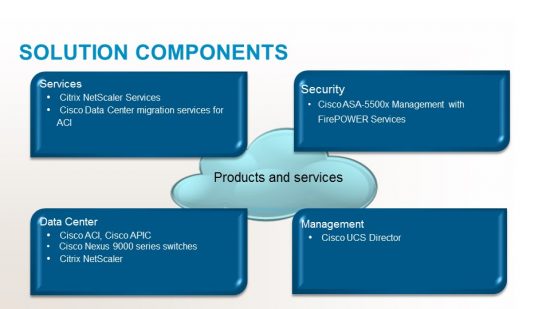
To meet the growing demand for applications and the network loads in its data center, VECOZO chose to deploy a joint solution based on Cisco Application Centric Infrastructure (Cisco ACI™) and Citrix® NetScaler as a next generation foundation. Spanning two data centers this joint solution combines Cisco and Citrix capabilities to enable rapid application deployment and services integration onto multi-tenant networks. Cisco ACI with Citrix NetScaler helped VECOZO boost application availability and performance through seamless integration of Citrix NetScaler’s programmable fabric with Cisco Application Policy Infrastructure Controller.

Deploy Apps faster with greater security and availability

For the highest levels of protection, VECOZO added Cisco next-generation firewalls, collapsing multiple security layers into one. In addition, through Cisco UCS Director integration with ACI, end users get a seamless experience for application deployment and orchestration.

Outcomes: Achieving 50% More Without Increasing Headcount

VECOZO is reaping the rewards of a fully programmable stack, achieved integrating Cisco ACI’s Layer 2-to-3 and NetScaler Layer 4-to-7 fabrics. This has made a profound difference. Applications are deployed with greater security and reliability—and up to five-times faster. Now they guide the network, rather than the other way around. Unlike before, VECOZO has a robust process to support compliance and can pull up reports and network charts on the fly. Total cost of ownership is lower, thanks to a smaller and greener data center footprint. The business is easier to manage with the elimination of operational silos and predictable IT costs.

Service creation no longer depends on specialists. Pretty much anyone here can do it with minimal effort,” says Beerendonk. “As a result, we’ve been able to grow our infrastructure and services by 50 percent with the same headcount thanks to Cisco ACI and its partner ecosystem.”

VECOZO has been able to deliver new services with the efficiency gained. For example, by enabling healthcare providers to combine several medical treatments into one declaration, while also extending contract negotiations between healthcare providers and insurers.

Meet user needs and improve their experience

Counting on Cisco ACI Ecosystem for Stress-Free Migration

“The commitment and vision shown by Cisco was unmatched. With pre-validated designs, jointly developed between Cisco and Citrix as strategic partners, we were confident the deployment would be fast and reliable,” says Beerendonk.

 “Our strategy was to simplify and automate everything,” adds ICT architect, Igor van Haren. “Cisco Services really helped. They shared valuable expertise and tools, helping us accelerate and complete the migration in just four months. Key steps, like ensuring proper documentation, cut down testing requirements by 90 percent.”

 

Accelerate and de-risk migration project


Products and Services Deployed
 

Results

  • Grew infrastructure and services by 50% without increasing staff or cost
  • Increased IT performance with greater reliability and up to 5X more speed
  • Improved security and compliance at lower total cost of ownership

Relevant links:

VECOZO Case Study: http://www.cisco.com/c/en/us/about/case-studies-customer-success-stories/vecozo.html

www.cisco.com/go/customerstories

www.cisco.com/go/aci

www.cisco.com/c/en/us/solutions/data-center/aci-ecosystem/index.html

www.citrix.com


Authors

Ravi Balakrishnan

Senior Product Marketing Manager

Datacenter Solutions

Avatar

Cisco ONE continues to see incredible success with customers and recognition from the industry and peers. Recently, the Cisco ONE Enterprise Cloud Suite (ECS) won the prestigious 2017 SIIA CODiE Award for Best Infrastructure as a Service — for the second year in a row.

The CODiE awards are highly regarded, as independent, third-party judges review all submissions of business software and technology products and services to determine the finalists in each category. This year’s Cisco submission was for a totally re-designed Enterprise Cloud Suite available as a 1-, 3- or 5-year software subscription. Cisco ONE ECS had tough competition for the award, but was selected for the breadth of its hybrid cloud automation vision and modular software approach.

Digital transformation is occurring everywhere and the cornerstone of digital transformation is automation. Cisco ONE ECS provides the automation tools both applications and infrastructure teams need in order to deliver on the promise of hybrid cloud.

The CODiE Awards are given by the Software & Information Industry Association (SIIA), the principal trade association for the software and digital content industries. Ken Wasch, President of SIIA, says “SIIA’s 2017 Business Technology CODiE Awards recognize the companies that are at the forefront of business innovation. These companies are shaping the future of how we conduct business.“

I’m proud of the great work we’re doing in software innovation at Cisco and want to congratulate everyone here who helped make the Cisco ONE Enterprise Cloud Suite such a success!  To learn more about the agility, efficiency and quicker ROI offered by Cisco ONE Enterprise Cloud Suite, please take a look at the Cisco web site.

Dan

Picture:  In San Francisco on July 26, with Cisco CODiE Award winners Ryan Baldwin, Lax Sakalkale, and Marianne Cali (left to right)

Authors

Dan Lohmeyer

Vice President

Product Management

Avatar

I was walking through an airport today and I saw the familiar sight: Two dozen Airmen checking in and loading out to some new destination, or maybe returning home from a tour of duty overseas.

I was taken back to my own former life as a leader in a far-off land – we were 30 guys depending on equipment built to meet the needs of a fight that might or might not be the fight I was in.

When US forces deployed to the Balkans in 1996, with the hope of being home for Christmas, we found that our intelligence platforms had been built for a conflict we weren’t fighting in a land where we were not. We looked for “red versus blue” dynamics and quickly realized those paradigms fell short in the stability operations model.

Six years later, as war raged in Iraq, my tools in Bosnia to track friendly forces had up to a 45-minute lapse in reporting – I’d pass a patrol and 45 minutes later they would show on my computer monitor.

There is nothing new in that – every war is fought initially with technology built after the last war, based on our best guesses about who will be our next enemy. Today, however, our systems are smarter at adapting than they were just a few years ago.

Today, industry is taking lessons from the commercial sector to help us build out infrastructure faster than ever before. As we look at banks who spin up a new branch, or a company that buys a new subsidiary, we are building networks that behave intelligently. These advanced networks meter access to critical resources when the time is right, rather than pulling a rip cord and hoping for the best in a flood of critical data.

These commercial sector actions bring challenges that are no different from an Army unit moving into an IT infrastructure owned by the Air Force. Our policies prohibit this, however, because the technology has historically been less than supportive of the idea.

Soldier with children and dog.
Military forces need to adapt faster to changing conditions. Intelligent networks provide a solution.

But imagine tomorrow an administrator who can look at a new group of users and resources and can bring them in with just the click of a mouse, providing access to some resources and blocking them from others, based on what they actually need to use. The Army unit might need to use internet gateways, but they have no reason to poke around in the Air Force’s firewall settings.

At the same time, the visiting Army unit doesn’t want their Air Force hosts seeing their operational plans or their manpower readiness, so with a few more clicks, the Army’s data is secure. All of this can happen with trusted hardware already in place on many garrisons today.

Two years ago, not long after I joined Cisco, I had the chance to attend a breakfast in Massachusetts where Larry Payne, our vice president for federal government, was talking to Air Force and industry leaders alike. We were enjoying the camaraderie of scrambled eggs and bacon, when Larry told the group, “we are finally in a place in our history, where we can do all of the things we’ve wanted to for years.” That statement holds even more true today.

With intelligent networking, we can test resources in a production environment after a shorter-than-ever evaluation cycle. Imagine if the next greatest infrared camera came to your FOB with claims of unheard of resolution and range. Or if you had vibration sensors capable of discerning between bears and humans. The time to market becomes measured in lives and with intelligent, software defined networks, we can limit the access of these new devices while allowing the right operators the right permissions to use the data those assets are providing.

With heuristic tools like Applications Dynamics, Stealthwatch and our full suite of security products, we can listen to the traffic being sent to and from those resources and compare them to expected behaviors — and quickly quarantine things which don’t behave as we expect them to — just in case the latest and greatest isn’t what we’d hoped for.

But here is the piece we miss: Our garrison Army should behave no differently that our warfighting Army. Our bases, posts, camps and stations here in the U.S. demand the ability to add new assets to the network — and perhaps here more than anywhere, we need the ability to adapt quickly. Adding an IP-controlled lathe in a depot shouldn’t demand months of testing when we need parts manufactured now.

Connection between the networks of industry partners and program offices should be the norm, as we grow to embrace those partnerships and require more transparency into program delivery. And connecting tenants on a base should be handled over common infrastructure. One joint base I visited was running 17 networks, most of which on the unclassified domain. If there was ever a case for intelligent consolidation to a handful of networks, this was the model.

We have to move beyond the handwringing of yesterday and embrace what our technology can deliver for us today, and meet tomorrow’s requirements against whatever threat the world throws at us. Most importantly, we have to recognize that our mission in the profession of national defense is critical — but our industry peers feel the same about banking, shipping, and human resources in their business.

When the next fight on the next front comes around, we need to be at a place where our networks and our other infrastructure assets exist as a force enabler and not just the pipes, as so many people consider it today. We must put in place a network that facilitates the fight and doesn’t just exist.

Authors

Jason Port

Enterprise Account Manager

Public Sector - Federal – US Air Force

Avatar

This is an exciting time to be in Media. You don’t always hear vendors cheering consolidation. Often because 1+1 = 1 less customer. But not in this case: our strategic customer Disney is purchasing a majority (75%) stake in our strategic customer BAMTech, gaining control of the direct-to-consumer OTT streaming platform.

This is a major industry inflection point – and we are very excited.

BAMTech gives Disney the cloud/data center architecture it needs to control distribution beyond traditional MVPDs. This is important, particularly as networks such as ESPN have been impacted by cord-cutting/OTT (over 12 million subs lost since 2011). But this architecture is meaningful beyond controlling distribution.

And Disney knows a thing or two about controlling one’s destiny.

The world of media is changing. More content needs to be created. Fast. In ever greater resolutions. The traditional network and infrastructure is not able to support these new requirements. It just can’t scale or move rapidly enough, while costs and complexity are too high.

But extend a cloud/IP data center architecture to the back of the production house and… voila – you have the foundations to accelerate and scale content production. Anywhere. Everywhere.

This is the next generation architecture we see media companies adopting around the world (NBCU, CANAL+, BBC). It allows them to accelerate global production and collaboration. Create more content in more formats faster. And engage audiences more deeply.

Industry transitions are hard. We know. We’ve been part of many. We’ve been working with our media customers and their ecosystem partners to lay the foundation for their transition to cloud and IP. When companies take major investments in the direction of an industry transition, we can appreciate the confidence they have in their foundation and partnerships to be successful.

We’ll have more to say about this industry transition at IBC 2017. Come visit us @ booth 1.A71, Hall 1.

Authors

Roger Sherwood

Sales Manager

Media & Entertainment

Avatar

The convergence of the Internet of Things (IoT), edge, and cloud has changed how enterprises balance core applications and processing capabilities between public clouds and the edge. Remote branch offices, manufacturing sites, and retail stores are no longer just connecting through a centralized WAN – a good majority of these connections are happening in the cloud. Making the most of this convergence could result in operational efficiencies, new experiences for customers, and new business opportunities. But the challenge comes in the form of added complexity with management and security across multiple data centers, clouds, and end points.

It might be manageable if we were talking about a homogenous environment, but the reality is that this is happening in a heterogeneous environment. Millions of IoT devices, applications, and endpoints are connecting to the network. To address this, resources are being migrated to different public clouds like Amazon, Google, Microsoft, and IBM to house and analyze data from everywhere. However, a big concern for customers is how they securely manage this growing cloud ecosystem. They could be using three or four cloud vendors to get the features and capabilities to meet their specific needs. Customers are asking for a unified approach to how they manage connectivity across the enterprise, provision infrastructure resources, and deploy applications – between the data center, private cloud, public cloud and edge environments.

The next wave of connectivity will bring tens of billions of devices online. All these devices, connections, and different clouds can create gaps in protecting the network and assets. Customers want to be able to enforce a strict, uniform security policy everywhere but highly-distributed infrastructures and connections are creating more security threats and vulnerabilities. Consistent, integrated security across their enterprise spanning from the data center, cloud, and to the edge is more critical than ever before.

Are you trying to manage across multiple data centers, clouds, and end points? What sort of  complexity are you encountering in your ecosystem?

For more information:

Authors

Kip Compton

No longer with Cisco

Avatar

Love them or hate them, meetings are important. They’re a big part of how we get work done, how we run our business, and how we collaborate. And if you’re like me, you’re in meetings a lot, which is OK by me since I run Cisco’s WebEx business!

But there is one thing that drives us here at Cisco crazy about meetings. In fact, we were bothered by it so much that we took it upon ourselves to do something about it.

What was it? Background noise: keyboard clicking, dog barking, doorbell ringing. And then there was the potato chip guy… munch, munch, munch. Incredibly annoying! Beyond being annoying, it turns out that background noise can affect your concentration.

“Researchers have found that environmental noise—background music, city sounds, people’s conversations—leads to a decrease in performance for most people,” according to Fast Company. “But the good news is that many of those sounds are easy to tune out, making even small reductions likely to improve our effectiveness.”

Certain types of background noise are OK depending on the situation. Nature sounds can actually help me focus on a specific task. But, add chirping birds to a meeting, and I will not have the same positive reaction. Unwanted background noise is very distracting. You can lose your train of thought. It can impact the point of your presentation. Or worse, you can come across as unprofessional.

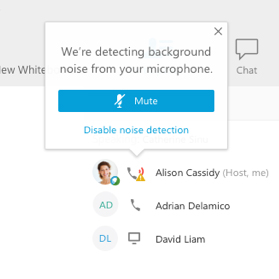
WebEx recognizes knocking, typing, sirens, and barking dogs. Once detected, it prompts you to mute your microphone. That’s it. Simple.

We wanted to fix this problem. Well, at least for WebEx participants – we can’t help you with the person sitting next to you with the potato chip obsession. So our engineers got to work. Using machine learning, WebEx can now detect background noise and prompt you to mute your microphone if you have called into the meeting from your computer. Lots of innovation for a small feature but with huge benefits!

Coming in the next couple of weeks, sounds like knocking, typing, sirens, and barking dogs are classified as background noise by WebEx. Once detected, you’re prompted with a pop-up message to mute your audio and microphone. That’s it. Simple.

With more people sending audio through WebEx than any other online meeting service, we have built up a thorough understanding of the most common (and annoying) forms of background noise. We use artificial intelligence to examine the meeting audio and pattern-match it against these known annoyances. The result is the simple, but powerful suggestion, that maybe you’d like to mute your microphone. You’re welcome.

So, when you’re “that guy” and you realize that you need to mute, do you mute your headset, or mute the WebEx app? And when you need to speak up – do you remember which one you used? We addressed that, too. Now you can mute and unmute your headset and desktop audio at the same time. With just one click, you can jump back into the conversation without any hassle. No more starting to talk and hearing someone say “are you still on mute?” just as you were getting to the good part.

By making meetings less distracting, meetings become more focused, and therefore, more effective. And since we all have plenty of other things to do, a focused, effective meeting experience can only help us be more productive.

What’s next you ask? Besides muting the potato chip guy, our engineers are finding new ways every day to leverage artificial intelligence (AI) to make meetings better. This is our humble – but extremely valuable – start to seeing a generation of “smart meetings.”

Learn more about WebEx and the new features.

https://youtu.be/gjzUbJUwaVk?list=PLCEC4D0A1FFB034E9


Authors

Jens Meggers

No Longer with Cisco

Avatar

Hackers have been around for a long time, and they are becoming more sophisticated every day. With more information added to the cloud, data centers, and the network, companies are exposed to greater vulnerabilities, and an increased risk of attacks.

As more customers turn to mobile payments, wearable devices, and use in-store Wi-Fi networks to look up product information, retailers need to be confident that their customers’ data is as safe as possible, and that they have a plan in the event that their company gets hacked. Associates are also embracing more digital tools to keep up with customer demands, such as mobile apps, inventory management technology, Virtual Reality (VR), Augmented Reality (AR), etc., because of the changing behavior of both customers and employees, having a secure network in place is more than needed, it’s a critical aspect to your digital business.

A retail breach can potentially be an enormous financial loss, but can also damage brand reputation and customer trust. This is a major concern for retailers, because when customers lose trust in a brand, they can easily turn to a competitor they believe is more secure.

According to the recent Cisco 2017 Midyear Cybersecurity Report, retailers are facing the following concerns today:

  • 54 percent said they’d dealt with public scrutiny due to data breaches
  • 32 percent lost revenue due to attacks in the past year
  • 25% lost customer or business opportunities due to attacks
  • When it comes to revenue loss and brand damage, retail security professionals said targeted attacks (38 percent) and insider exfiltration (32 percent) pose the highest security risks to their organizations
  • Twenty-four percent of the retail security professionals said they see a lack of trained personnel as a major obstacle to adopting advanced security processes and technology
  • Retailers also see a steady stream of security alerts that they can’t address in full: 45 percent see several thousand daily alerts, but only 53 percent of those are investigated
  • Retail security professionals said that operations, finance, and brand reputation were the areas of their business most negatively impacted by security breaches

So, how can retailers protect their customers and brand from data breaches, malware, and ransomware attacks?

To protect your retail business against security breaches, you need to stay abreast of new threats and vulnerabilities that your organization may face. You need a solid digital network foundation as a platform that can detect and stop threats before they take place.

Security is most effective when it is integrated into the network and not a standalone project for IT teams. We’ve introduced Cisco Digital Network Architecture (DNA) for Retail, our secure, intelligent, and automated network that is constantly learning and adapting to detect new breaches before they happen and resolve them as quickly as possible when they do occur.

With Cisco DNA for Retail, secure your customer and corporate data anywhere, in real-time, with continuous, faster threat detection and full visibility into malicious behavior. By embedding security everywhere with the industry’s best threat protection, IT can detect and contain threats over 1000 times faster than the industry average.

Retail businesses can be proactive about security breaches, rather than being reactive. Learn more about Cisco DNA for Retail

You can also download the full Cisco Midyear Cybersecurity Report


Authors

Brian McDonald

Global Retail & Hospitality Industries Marketing Lead

Private Sector Industry Marketing

Avatar

Written by Rishika Korada

Can you trust a Hacker during a ransomware attack?

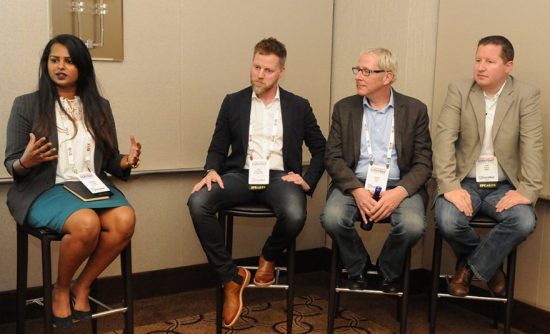
That was the question posed to me at SVG 11th Annual Forum held in NYC on the 27th of July. I was invited to join the Security and Content Protection panel along with some of
the best security experts in the industry – Guy Finley (CDSA, Executive Director), Ben Stanbury (The Walt Disney Studios, VP, Information Security), Dan Keene (WWE, VP, Systems Architecture), Dave Belt (Irdeto, Technology Evangelist). You can imagine my response: Hell No! 🙂 And if not already obvious, I will spell out the reasons for you below.

A little about me: I’m a daughter, sister, friend, Engineer, Athlete, Sports Enthusiast and live larger than life in my own little way. I joined Cisco’s Media Operation in 2016, and have since become #ThatCiscoSportsGirl supporting the Sports Vertical for all things Media Blueprint including my passion – Security. My clients represent the coolest leagues in the nation, inclusive of the NBA, MLB, NFL, NBC Sports, ESPN, NHL, PAC12, and MLS.

So back to the question – can you trust a hacker during a ransomware attack? My answer is obviously no, but there is confusion in the industry. Should you pay hackers during an attack or just disconnect from the network and ignore the threat?

I outlined the events that took place during the recent ransomware attack on Larson Studios which lead to 10 episodes of Orange Is The New Black being leaked online by the hackers – Dark Overlord – despite Larson making a payment of 50 bit coins.

There were two key takeaways from this incident – business transparency and basic security hygiene. Larson Studios is an audio post-production business. They did not notify their customers when the compromise was discovered. Dark Overlord also claimed to have stolen content from Netflix, ABC, CBS and Disney through Larson Studios which put their reputation at stake. After investigation Larson identified that there was an old PC running Windows 7, the hacker made use of the vulnerability and exploited it. Basic security hygiene is something we tend to ignore focusing on the more complex issues which leads into the broader discussion of the Before-During-After Attack Continuum.

Security is no more an IT team discussion but a boardroom discussion. It’s extremely crucial for the constructs of a network and a broadcasting infrastructure. The Before-During-After process helps companies like Cisco approach security challenges from a holistic point of view by identifying what’s on the network using strong network access control mechanisms to enforce policies and web security that acts as the first line of defense.

Once these threats are detected, they get blocked by an evasive prevention system and then get contained and remediated. The most critical part of this is being able to view telemetry and manage all of these multiple systems and solutions through one user friendly management interface and also reducing the time to detect a threat, remediating it and making sure this threat doesn’t show up on your network again.

Enter Talos – Cisco’s All-Star Quarterback!

Talos is Cisco’s threat intelligence team that ensures we have the latest security updates published on all security platforms irrespective of time and location.

The Before-During-After Attack Continuum is the best defense story an organization can have today. When an organization wants to take that steep turn towards growth or accelerate their business needs and services, you require a strong security system in place to ensure things don’t fall apart. The time has never been better in the industry for businesses to accelerate growth and reach out to the future. Cisco pioneered the internet and we have no intentions of stopping at just that. We are at the spearhead of innovation and map business challenges to technology solutions. We fall, we bleed, we cry, but we never stop till we’ve won!

#ThatCiscoSportsGirl

Authors

Roger Sherwood

Sales Manager

Media & Entertainment

Avatar

In this era of Digitization, cloud and IoT, the needs of the enterprise continue to evolve and Cisco’s recent launch of intent-based networking technologies showed the world that we continue to drive innovation in enterprise networking. In this new era of networking one of the technologies that serves as an enabler for intent-based networking, bridging between WAN and the cloud, is SD-WAN technology. We’re excited to have the frontrunners in this technology join our team through the acquisition of Viptela. We will be combining our best routing platforms with the Viptela SD-WAN portfolio and this is going to be instrumental in our implementation of next-generation SD-WAN technology. Read on for more.

What is SD-WAN? In a nutshell, it is a solution and an architecture that allows end users to connect to applications by virtualizing and simplifying WAN deployments through the use of a highly intuitive, policy-driven solution that helps IT abstract network complexity and design for business intent. SD-WAN is the first step in transforming enterprise infrastructure and, just like intent-based networking, it is the next generation of networking. They are both pieces of the same innovation puzzle that are showing us the way of the future.

An exciting development for Cisco in the area of SD-WAN is our acquisition of Viptela. Viptela has much to offer in this particular area of their expertise and the melding of our two approaches is going to boost Cisco’s SD-WAN offerings to a substantial degree. Viptela’s SD-WAN App Fabric is a cloud-delivered, open, secure and scalable solution, connecting users to applications across any transport either in the public, private or hybrid cloud. This solution allows customers to build a secure virtual IP fabric by elegantly combining routing, segmentation, security, policy, and orchestration. The resultant network is simple to manage and inherently secure, and provides any-to-any connectivity over IP or MPLS transport networks.

So, why is it so important? Primarily, SD-WAN allows for a layer of virtualization or abstraction on top of a physical network. This allows for enhanced controllability as well as the ability to run numerous, customized virtual networks. In addition, SD-WAN has clear advantages from a security perspective as well, providing a system with security woven into its very fabric. SD-WAN also allows for changes to be made to an entire system or network at one time with great ease. All this functionality makes the network more intuitive and easy to operate.

As we move forward into a new era of virtualization and digitization, SD-WAN is going to be a key player in ensuring that intent-based networking is available and functional for enterprises in a myriad of different applications. We are absolutely delighted to be moving forward in this journey with Viptela on the team to help us as we accelerate into this new era of networking.

If you want to learn more about SD-WAN click here.


Authors

Anand Oswal

No Longer with Cisco