Avatar

ACG Research, a well-known and respected analyst and consulting firm in the networking and telecom space, recently published a study of decision makers and influencers in companies across the globe who purchase various types of telecom equipment from vendors Cisco, Nokia, Huawei, Ericsson and Juniper.

I’m pleased to say that Cisco was the top-rated telecom vendor by a huge margin and number one in vendor performance. We also ranked highest or second-highest in reputation, innovation, quality, product features and performance, end-to-end solution, thought leadership, financing and sales team quality.
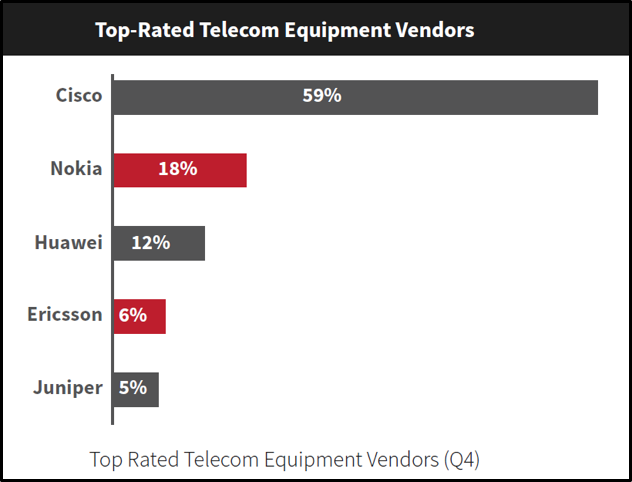
Figure 1: ACG Research, Telecom Vendor Equipment Selection 2017

We take great pride in being applauded for the following attributes:

  • High-end expertise in security solutions
  • Robust and high-quality networking equipment
  • Innovation
  • Product features and after-sales services are up to the mark

We also appreciate being described in the report findings like this:

“Cisco is the global service provider for cloud solutions and considered extraordinary in providing security & networking solutions. Robust and high-quality equipment with great service quality are the main reasons. Confident about its approach toward the satisfaction of its customers.”

It’s nice to be recognized for the work we’ve been doing to transform Cisco’s Service Provider Business over the past year.  I’d like to share with you some of the ways we are taking back leadership in the Service Provider space:

Leading routing platform:

  • Market-leading density in a 100GE routing platform (Cisco NCS 5500).
  • Leading the charge toward network operations modernization with model-driven interfaces, OpenConfig, and streaming telemetry with Cisco IOS XR.
  • The most flexible universal gateway (Cisco ASR 9000), bridging networks of today with those of tomorrow.
  • Cisco Access Solutions deployed at more than 200 operators, across more than 75 countries, with over 1 billion mobile subscribers.
  • Driving innovations in Segment Routing to help carriers, including Telefonica, COLT, and Softbank, offer new and differentiated network services. See blog on SR here.

Leading automation platform:

  • Broadest portfolio (Network Service Orchestrator, Virtual Topology System, WAN Automation Engine, EPN Manager) delivering automation across the network.
  • Foundation built upon high fidelity of network telemetry and collection, with open source contribution.
  • Deploying closed-loop automation in some of the world’s largest service delivery networks.
  • Industry’s most advanced and flexible service orchestration platform. More than 100 customers have adopted Cisco Network Services Orchestrator (NSO) technology including AT&T, Deutsche Telekom, Equinix, Level 3, NTT DOCOMO, SoftBank, Telecom Italia, Telefonica, Telstra, and Vodafone Hutchison.
  • Work in multi-vendor environments with the industry’s broadest set of proven orchestration interoperability capabilities, spanning over 50 network equipment vendors and up to 100 device models today.
  • Proven to automate more than 60 to 70 percent of customer operations workflows:
    • 70 percent operational efficiency increase
  • 60 percent reduced time to revenue with new services implemented in days /minutes
  • The market has voted Cisco NSO as the clear market leader in the LSO (Life Cycle Services Orchestration) & Next Gen OSS space according to a recent survey by SDxCentral.

Leading next generation cable access with fiber deep and Remote PHY:

  • First to market with end-to-end Remote PHY solution, Cisco Infinite Broadband.
  • First to market with automation for Remote PHY, Cisco SmartPHY Automation.
  • Leading the industry with Cable innovation such as Full Duplex DOCSIS 3.1 and Cloud Native virtualization for the CMTS

Leading data center interconnect:

  • #1 market share leader in small form factor DCI (ACG Research). In fact, Cisco is growing faster than the market itself!
  • “Solid financials, a growing client base in DCI, a focus on packet optical, and a good reputation for service and support, nudge Cisco over the line into the Leader category this year”  – IHS Markit.
  • #2 in modular market segment ranked by Cignal AI.

Leading optical and optics:

  • Top rankings by ACG Research for ease of integration and thought leadership in optical for Cisco.
  • Ranked highest for innovation in vendor scores by purchase criteria – ACG Research
  • #2 market share in Metro Optical – another very fast growing segment of the market – ACG Research.
  • Founding member of the QSFP-DD industry consortium seeking to drive down the cost, space, and power of 100G+ optics with QSFPP-DD form factor.

Leading mobile packet core and 5G:

  • Market share leader for Evolved Packet Core (25 percent per Synergy Research).
  • More than 1 billion subscribers currently served on a Cisco packet core platform, including 300 million virtual subs.
  • Active participant in multi-vendor trials leading to 5G with Intel, Samsung, Verizon.

Leading video in the cloud:

  • Market leading Cloud DVR Platform.
  • Leading end-to-end cloud IP video platform.
  • 15 percent of video software market share (per Synergy Research).
  • #1 market share in client software (per Synergy Research).
  • #2 market share in content security (per Synergy Research).
  • Awarded 250+ US patents, 340+ Non-US issued counterpart patents.

Leading in open source:

  • Active participants in multiple working bodies including OpenStack, Open Daylight, OPNFV, others.
  • More than 40+ Cisco Application Contributions to the Open Source Community.
  • More than 28 open source products.
  • Cisco VNF and Virtualization Ecosystem includes 21 active alliances and partners.
  • Created an open-source project called Community ICN in 2017.
  • Founding member of the Cablelabs-led OpenRPD open-source initiative for Remote PHY.

We have been executing a plan to be ranked number one in all areas that are important to our customers.  Stay tuned as we continue to lead the disruption in the industry with our cutting edge technology innovations so service providers can reduce cost and complexity, grow revenue, and secure their networks.

Click here to see me “On the Hot Seat” with Ray Mota of ACG Research talking about the industry transformation taking place today.


Authors

Yvette Kanouff

Senior Vice President/General Manager

Service Provider Business

Avatar

Social, environmental, and economic barriers are interconnected, and governments, companies, and nonprofits must work together to address global issues. Public-private partnerships (PPPs) can deliver meaningful and sustained outcomes to communities across the globe while accounting for differences in culture, society, and governing models.

Laura Quintana, VP of Corporate Affairs, helps shape and drive public-private partnerships (PPPs) at Cisco, including our longest-running PPP, Cisco Networking Academy. Laura recently led a #CiscoChat, “Developing Public-Private Partnerships to Achieve Large-Scale Impact,” during which she provided insight into her experience implementing successful PPPs across the globe.

She was joined by featured guests Sasha Kapadia, Director, International Development at Mastercard; Jane Jamieson, Senior Infrastructure Specialist at the World Bank; and Keith Davis, Executive Board Member of the Camden Dream Center; along with dozens of other organizations and individuals that shared their perspectives.

If you missed the conversation, take a look at the highlights and share your thoughts below.

What role do public-private partnerships play in addressing global challenges?

#CiscoChat participants and the World Food Program USA, a nonprofit dedicated to ending hunger, discussed the knowledge, expertise, and resources PPPs can provide to make progress on global societal issues such as economic development and education.

What are the most important pieces to determine before executing a PPP and why?

Participants agreed that executing a successful public-private partnership can be difficult. Sasha, Laura, and guest Colleen Wong offered ideas on how to ensure a PPP is effective, including the importance of being flexible and learning along the way.

What do you think is on the horizon for PPPs given the power of technology and innovation?

Digitization is connecting cities, companies, countries, and people, igniting growth in new ways. It is creating new jobs and offering new opportunities for nonprofits and businesses alike. #CiscoChat participants and guest partner NESsT offered insight into how they see and experience technology’s impact on public-private partnerships.

Can you share more about a real-world example of a PPP you’ve led that resulted in large-scale impact?

This was one of my favorite parts of the #CiscoChat – so inspiring! From debit cards that empower refugees, to bathrooms delivered to your door in Peru, to Cisco Networking Academy, participants showcased the inspiring ways they are working with partners to create long-lasting impact.

What would you say is the most important best practice to follow when developing and implementing successful PPPs?

The answers showed the importance of both knowledge and heart. For example:  determining mission alignment, ensuring that gaps are covered, listening, and letting oneself care about the success of the program.

We’re thrilled that such an experienced and inspiring group of leaders joined us to share their thoughts on public-private partnerships. We’d also like to thank everyone who contributed via Twitter. Have a best practice to share or a question that wasn’t answered? Leave us a comment below.

For more best practices on developing and implementing a successful public-private partnership, check out Laura Quintana’s five-part blog series on using PPPs to make progress on our world’s largest societal issues.

Authors

Austin Belisle

No Longer with Cisco

Avatar

At the Cisco Toronto Innovation Centre, we’re always looking to the future, including how the Internet of Things (IoT) industry is transforming. We see this firsthand as our centre provides a “home” for our Cisco sales teams to partner with customers, academia, and start-ups. Together, teams rely on our Toronto Centre, and other centres around the world, to co-develop scalable solutions with significant business outcomes that can be taken to a broader global industry.

It’s exciting to see IoT’s increased interconnection of devices as a means to the end of solving business problems, with specific solutions for each vertical. Companies that offer IoT can either be vendors with horizontal capabilities, such as Cisco with technology offerings like networking infrastructure and analytics, or vendors with market-specific solutions, such as remote asset management.

While there will likely be big disruptions in the consumer IoT market in the long run, IoT is mainly implemented on the business side today.

With the first wave of IoT, the increased data generated to be converted into solutions drove a shift in cloud architecture design. Instead of the old centralized cloud model, Cisco pivoted to use distributed clouds to process data close to the source.

Developments in networking technology, such as the adoption of 5G for greater bandwidth, and the incorporation of security into our technology and behaviour are needed to continue to grow the IoT solutions Cisco supports. With IoT technology, companies must work with the government to develop regulations and best practices.

What Does the IoT Market Look Like?

Comparing Canada to global markets’ adoption of IoT, leadership in Asia implemented IoT technologies on a greater scale by building smart cities from scratch, without having to deal with legacy infrastructures. Within North America, effective IoT leadership tends to come from a focus on productivity, specifically getting the most out of assets.

In terms of adoption, industrial verticals such as mining, gas, manufacturing, and transportation make up the majority of mature use cases and implementations for Cisco’s 14,000 IoT customers. Cisco has increasingly been working in the agricultural space with water and irrigation systems and management systems and, despite privacy challenges, in the healthcare space. We expect growth in the retail space as well as in smart cities, which are earlier in the adoption curve.

Without a doubt, every industry is becoming a technology industry. This is something established industries and companies need to pay attention as unlikely new competitors surround them.

IoT prompts corporations to think about what business they’re in and how to refigure their business around digital technology. A common pattern with the introduction of IoT was the migration from 20th century models of vertical integration into models of an ecosystem of customers and partners working together, driven by change in the cost and pace of technology.

Small to midsize companies often believe that only big companies with the resources to spend large amounts of money and effort can take advantage of IoT. However, these companies can focus on use cases to deploy IoT to solve business and operational technology problems. These companies benefit by identifying an integrator who knows the business case and market and can also deal with legacy infrastructure.

Emerging Technologies to Watch

We’re seeing an increased focus on two emerging technologies that will grow to support IoT solutions.

The first is blockchain—a distributed database architecture that allows you to prove immutability, the ability to transact value on top of the network with both privacy and the ability to trace all transactions. Potential applications include simplifying financial transactions and increasing supply chain transparency. For Cisco, blockchain is in a proof of concept stage with product deployment later this year.

Also, Artificial Intelligence (AI) can be combined with IoT to drive value in data analytics and the automation of human processes. AI is increasingly decentralized and can be incorporated into other technologies like drones for remote monitoring and inspection capabilities.

As your organization looks to the future, where will you end up? Ready to compete with new players in your industry, or scrambling to catch up. The choice is yours.

Authors

Wayne Cuervo

Director of Innovation

Cisco Canada

Avatar

There have been countless amounts of industry research and many volumes written about data visibility and analytics with the advent of the Big Data Era. However, these discussions rarely delve into visibility and analytics requirements for storage and storage networking technologies. This is somewhat ironic because Big Data term itself was invented as an expression of the challenges and opportunities associated with exponential growth in data storage.

In this blog, we’ll attempt to make good on this oversight with a look back and forward at the importance of visibility and analytics for optimizing storage networking. This importance cannot be understated as storage networking technologies have evolved dramatically in terms of scale and performance and as new technologies have emerged such as NVMe over fabrics. Today we operate in realms of millions of input/out per second (IOPS) and in response times measured in microseconds,  faster than a blink of an eye. As such, the need for deep visibility and advanced analytics has never been greater to overcome the risks of the “unknown”.

Paresh Gupta, in this video, walks us through the Past, Present and the Future of Storage Traffic Visibility and Analytics.

https://youtu.be/Is66zQn1GYM

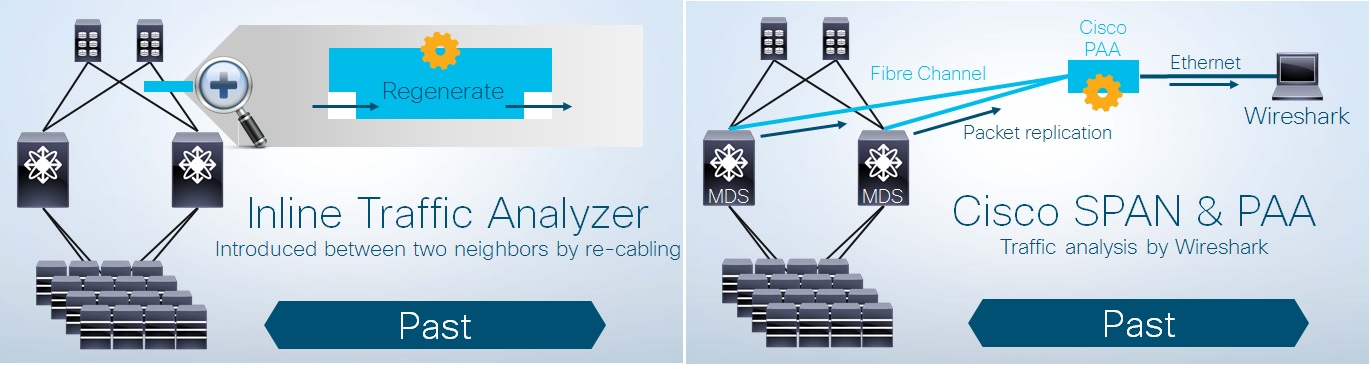
First, a look back at what was possible before. The very first offering in terms of storage traffic visibility was based on a reactive approach using inline traffic analyzers. This dates back to the same time as the launch of 1-Gbps Fibre Channel and these devices were designed to capture optical signal on one port and then regenerate the same signal on another port. Users could see all the Fibre Channel primitives at the physical layer of the network as well as the control and end-to-end data frames flowing between the initiator and the target.

As a problem was suspected, the storage admin could introduce an inline traffic analyzer between the two neighboring devices for further investigation. This could involve downtime of that network segment due to re-cabling until the signal regenerated and the two neighboring devices became agnostic of the analyzer’s presence. This admittedly primitive architecture worked great for more than two decades to attack hard problems, which can only be solved by inspecting every single bit on the wire. The limitations included incurring downtime of the network segment, high costs, scaling issues and the overall reactive approach.


Another offering was based on Fibre Channel frames replication on switch ports, which dates back to 2003 when Cisco launched MDS 9000 switches and was named Switch Port Analyzer, or SPAN. SPAN takes the frames from a switchport and replicates them to another port without any performance impact to the normal switching path. Cisco also made available special port adapters which could be connected to Cisco MDS Fibre Channel switches to receive SPAN traffic. This external port adapter then encapsulated the Fibre Channel frames into Ethernet framing to be consumed by a laptop or workstation via a NIC. The famous Wireshark, or Ethereal as it was known at that time, could be used to get deep visibility into control and data frames. This approach did not involve downtime of the network segment. However, it was still a reactive approach, and involved re-cabling and dedicated switch ports to send out traffic.

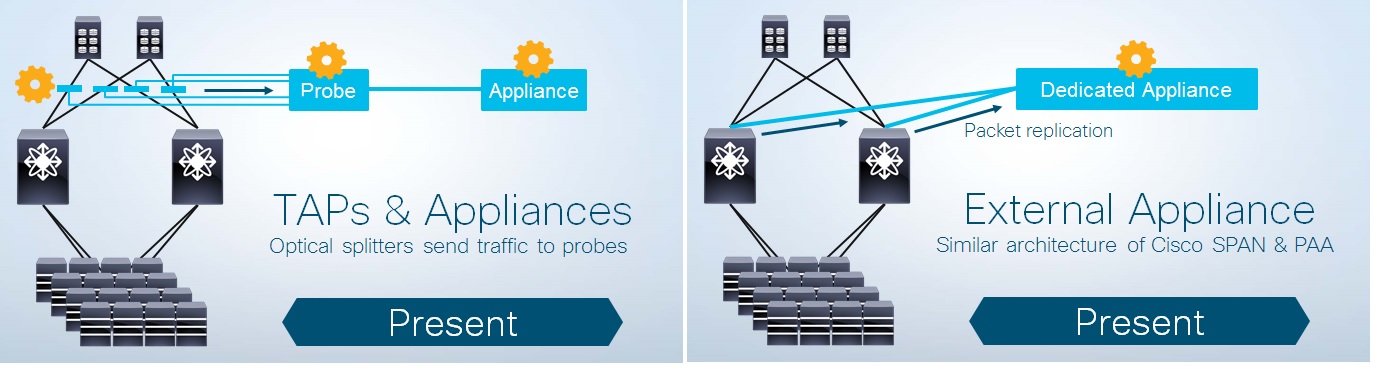
Now, let’s look at what is possible today. Today customers who require deep visibility into Fibre Channel traffic generally rely on the use of external hardware taps, analyzers, and appliances for visibility and analytics. Taps are connected inline in the data path by re-cabling the existing deployment and reflect a portion of the light to a dedicated analyzer while rest of the signal remains untouched.

Analyzers receive a complete copy of the flowing bits on the wire, which extracts information based on the control and data frames and also the Fibre Channel primitives. This solution offers end-to-end storage traffic deep visibility and analytics and provides storage admins key performance metrics such as how long a read or write command is taking to complete, how long a storage array is taking to respond to a read or write request, how many IO are completed per second, and error reporting and correlation.  Taps and Analyzers were good at provided deep visibility but at the expense of overhead of re-cabling as well as the costs and operational burdens of managing external devices.


The next approach was through visibility that’s integrated into the SAN switches themselves all the way into the SCSI data packet level. This allows storage admins to inspect an end-to-end flow between an initiator, target, and LUN. However, this approach is limited in terms of scale as the solution is enabled by an external device, which receives data traffic from existing switch ports via an approach similar to SPAN. Additionally, this approach still involves re-cabling to SPAN the traffic to an external device, which can result in high cost and other overhead factors. 

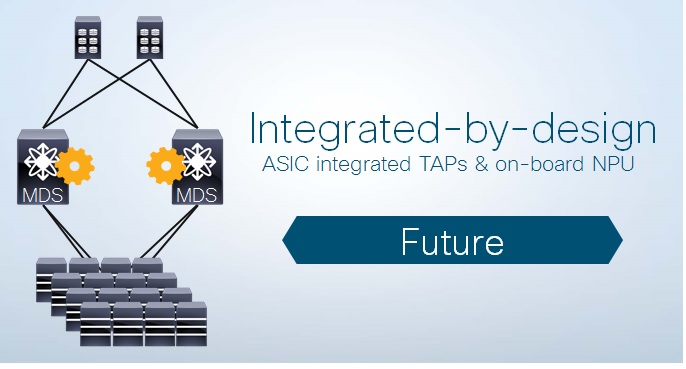
Now, let’s look at what will be soon possible. Cisco recently introduced an architecture that will eliminate the need for any external device through integrated-by-design capabilities on the SAN switches. The new analytics offerings will take advantage of recent advancements Cisco has made at the hardware level, enabling the port ASICs to tap traffic at line-rate of 32-Gbps and higher speeds without any performance or latency impact to the switched frames. These new switches also leverage on-board Network Processing Units or NPUs featuring dedicated multi-core and multi-GHz of computing power to extract intelligent metrics from the Fibre Channel and the SCSI headers.

This solution will arm storage admins with information spread across multiple frames by correlating on the switches using the on-board NPU. The solution is designed to be always-on while inspecting every frame of every flow at any speed. Admins can deploy the solution with a single-click and seamlessly scale to every end-device connected to their Fibre Channel fabrics. Finally, fabric-wide correlation and visualization will be provided by existing software and third-party tools.


Summary: As  technologies such as Flash arrays and NVMe over fabrics become even more prevalent, deep visibility and analytics will play an increasingly important role in meeting the strict service level agreements. Deep visibility will help to maintain peak performance while analytics will enable proactive and predictive operations. By integrating deep visibility and analytics in the MDS 9000 switches, Cisco is shaping the future of storage networking industry for now and many years to come.

For more info :  Cisco 32G Announcement

Tony Antony
Sr Marketing Manager


Authors

Tony Antony

Marketing

Solutions

Avatar

You’re walking down the sidewalk, headphones in your ears, music blasting, and your head is buried in your phone reading a text message.

CRUNCH.

You look down and you’ve just stepped in a pile of… (no, not that)… broken glass. A car parked on the street was broken-into, and the glass from the shattered window is strewn all over the sidewalk. If you live in a city, especially San Francisco, this is a familiar scene.

As seasoned city folk, we take all the necessary precautions to prevent our street-parked cars from being burglarized. Lock the car, set the alarm, and don’t leave items visible in the car. But despite our best efforts to prevent break-ins, they happen.

The same can be said when it comes to defending your laptops, servers and mobile devices from cyberattacks. Despite your best efforts to prevent an attack (using tools like antivirus and signature detection), you know that no prevention method will ever be 100% effective. Cybercriminals are too smart and too persistent—they want to get inside to steal your stuff.

So when hackers evade prevention measures and get into your endpoints, you need the ability to quickly identify the attack, and understand how the perpetrator got in and what they’ve been up to. Only then can you quickly stop an attack before they flee with your sensitive data. If you had a complete recording of the attack from start to finish – that could give you a really great contextual picture of everything that happened so you could mount a rapid, informed response.

The last time my car was burglarized, I thought I scored the jackpot – a recording of the devious act. One morning, I came across the sad scene of my driver’s-side window busted out, and then spotted a security camera on a nearby apartment building. I talked to the building manager and got a hold of the footage, which showed the shadow of a car pulling up alongside mine, and then a person hop out, smash my window and grab a whole bunch of nothing (a $6 USB car lighter charger adapter) in a matter of seconds. The footage was blurry, the make and model of the getaway car was outside of the camera’s field of view, and the perpetrator had done a very good job of masking their face. There was no way this footage would have helped police (not that a stolen USB charger was worth their effort anyway).

That security camera is an example of the problem with endpoint security solutions today. After preventative measures fail, they still don’t provide you and your security team with:

  1. the deep visibility you need to fully understand the attack and help you mount a rapid response
  2. a clear picture of what happened
  3. a wide enough field of view to capture every aspect of the attack

Advanced malware is also adept at masking itself, using techniques like polymorphism, to fool your endpoint security tools and evade detection.

But what if that camera worked? What if every endpoint deployed throughout your organization had a magic all-seeing eagle eye, watching and recording everything it saw? And at the first sign of trouble, could automatically block the attack and show you in crystal clear detail where the attack came from, when the threat entered your system, where else it’s been, and what it’s doing.

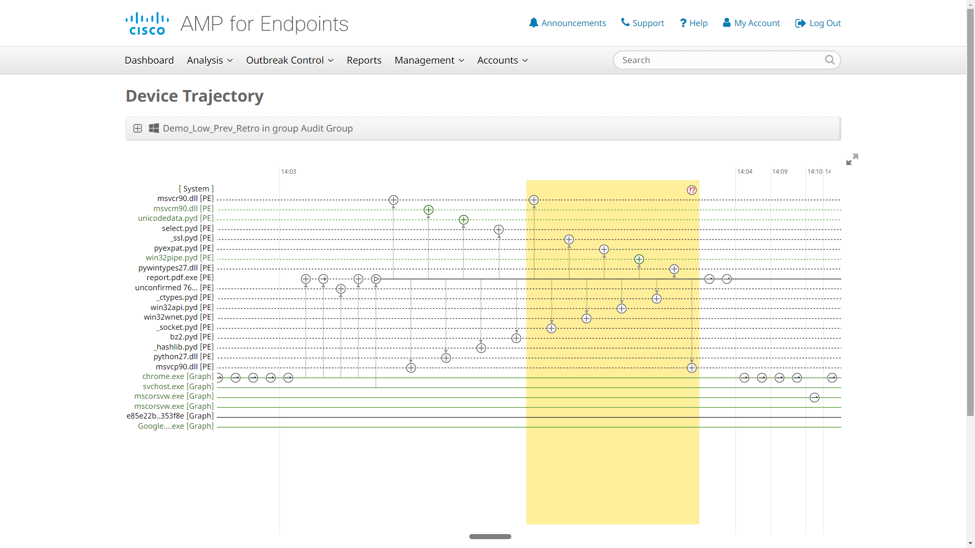
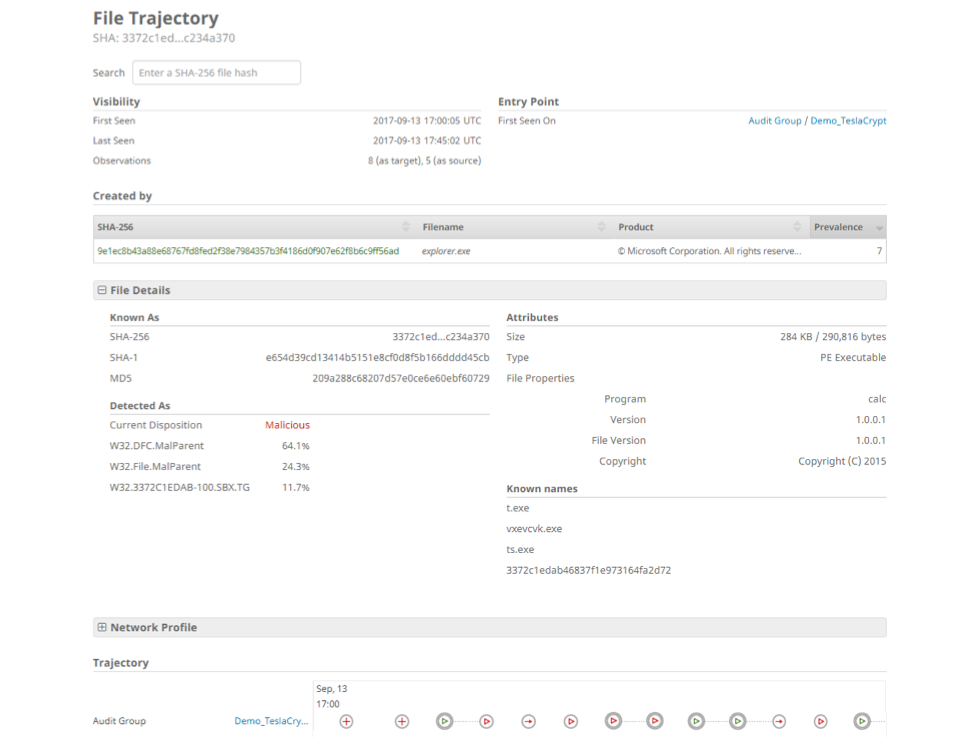
That’s what you get with Device and File Trajectory from Cisco AMP for Endpoints. In addition to a slew of preventative techniques, AMP continuously analyzes and records all file activity on endpoints, regardless of a file’s disposition. At the first sign of malicious behavior, AMP alerts you with an indication of compromise, can automatically block the file, and show you the complete recorded history of the threat across the entire environment.

Device Trajectory shows the origin of the threat on a single endpoint, how and when that file infiltrated the endpoint, and what it did.

Device Trajectory shows the origin of the threat on a single endpoint, how and when that file infiltrated the endpoint, and what it did.

File Trajectory then lets you expand your view from the first endpoint that saw the threat, to all endpoints across your entire environment that also saw the threat.

File Trajectory then lets you expand your view from the first endpoint that saw the threat, to all endpoints across your entire environment that also saw the threat.

For an in-depth look at the Device and File Trajectory features in Cisco AMP for Endpoints, watch the video below or check out our website.

https://youtu.be/8SHwegqD8bY


Authors

John Dominguez

Product Marketing

Cisco Security Business Group

Avatar

“How’s work going? How was your day?”

It’s what one of my closest friends asked me recently over coffee. Usually, people ask it casually, along with “What about this weather?” or “Did you see the game last night?” I don’t think she expected the complex, passionate reply she got from me.

“You must really love where you work!”

I smiled. Yes, yes I do. I’m having a blast at Cisco and love every day of what I get to work on!

To make a complex thing appear simple is one of the hardest things to do as an engineer, and yes, as a Cisco Software Engineer.

Cisco recently announced The Network Intuitive – a network that adapts and learns – as one of the biggest, industry-changing solutions ever. We had to make the solution simple for our customers.

I’m working on the Software Defined Access (SDA) solution built on the foundation of Digital Network Architecture (DNA), one of the pillars that defines this new era of networking.

When we started working on this project over two years ago, I never imagined the magnitude of what it would grow into and the impact it would create. I knew we had something great in the works – but to experience the launch of the solution,, and to see it adopted by customers was truly exciting.

To be able to do this work, it’s an opportunity that comes along once in a lifetime for an Enterprise Network Engineer. And to be one of the few that can say, “I worked on a disruptive technology that led to the future of networking!” is something I will carry with me forever.

Here’s how we disrupted the status quo:

  • Network deployments can now be fully automated, secured, segmented and policy controlled with real time analytics, which means IT and operations teams can save time. What took days now takes minutes!
  • Provide network access in minutes to any user, device or application without any security compromise – such as the recent WannaCry Ransomware attack.
  • SD-Access is the industry’s first policy-based automation from the network edge to the cloud.

Just thinking about working on technology like that gives me goose bumps, as I know that this is going to solve many networking challenges and truly change the world.

Right from the inception of this program, we had a 100% backing from all avenues – Engineering Leadership, Product Marketing, System and Sales Engineers , direct management  and peer teams. This facilitated divergent and creative flow of ideas, which helped us engineer the program successfully. It was always about “Do What Is Right For The Consumer” and make the adoption, well, simple!

Throughout the course of the project, I was pushed beyond my comfort zone. It helped me to take on a fearless approach, venture into areas I had no prior learning . Everything was new so it an experiment. Problems were not stop signs but guidelines. Looking back, it was the challenges that turned into the next opportunistic step and kept pushing us all along the way. And once we were able to achieve a goal, it felt like landing on a new planet and continue exploration from there on.

I am a working mother, and I think we tend to be extremely critical of ourselves. Being excited about what I do helps with that. It’s important to feel passion for what we do.

When I pick up my son, I ask him the same question. “How was your day?” He responds with so much enthusiasm and excitement showing off what he knows. We are the same that way.

As engineers we usually tend to live in our box, our safe space. Not everyone thinks of “innovation” as a core skillset. But innovating is simple, if you think about it in these ways.

  1. Keep an open mind. Serendipity happens all the time and that results is some great problem solving.
  2. It is not an option but a necessity to look at things differently, to get out of the box and be creative
  3. There are no boundary conditions. We create them in our mind and that perpetuates fear,which holds us back. Cross the boundaries and overcome the fear.

Tell me, how was your day?


Are you looking for a company that makes you this excited about your day? We’re hiring!


Authors

Shivangi Sharma

Technical Leader

Enterprise Networking Group

Avatar

This is the final article in a five-part series on how a company or organization can develop, implement, and sustain successful public-private partnerships (PPP) that achieve large-scale impact.

Click to read part one on determining who to work with, part two on determining when and how long to engage, part three on determining how to execute, and part four on ensuring long-term sustainability.


Leveraging technology and innovation is essential to build capacity, streamline programs, and further impact in successful public-private partnerships (PPPs). Technology can be leveraged in two ways: first through the use of technical tools and platforms, and second through the use of technical knowledge to ensure expertise and innovative practices are applied uniformly and consistently to community investment strategies.

At Cisco, we’ve developed our own robust learning platform for Cisco Networking Academy, a world-leading IT skills and career building program. Accessed from netacad.com, the platform delivers learning experiences to students through video and collaboration technologies, the use of simulation tools that closely proximate hands-on experience with network equipment, and the use of big data and assessment technology to provide continuous student feedback.

Cisco’s 16-year partnership with the United Nations Volunteers (UNV) programme is a great example of leveraging technological knowledge. Networking Academy students and recent grads help fill technology gaps at UN agencies, leveraging their digital skills to support development projects. Since 2016, seven graduates trained in IT have been building websites and mobile applications, designing programs using big data, and integrating online and offline activities at UN agencies.

Through this partnership, UN agencies receive technical products that help streamline their programs, as well as much-needed insights from the students on how to better use technology to increase efficiencies and scale solutions. At the same time, the students gain experience in a real work environment and are able to use their skills to contribute to societal and environmental progress.

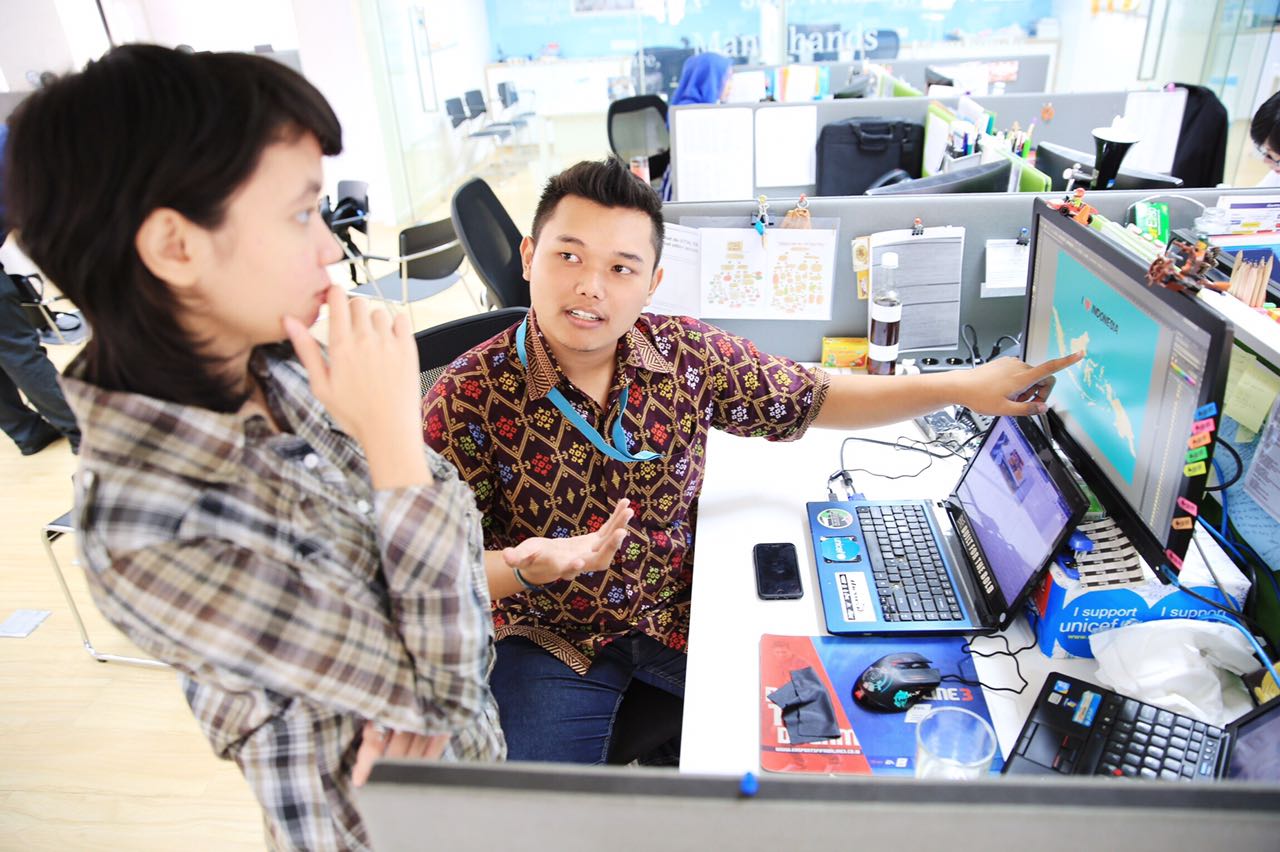
Photo credit: UNICEF, 2017

Mohammad Ilham Akbar Junior, above, is a Networking Academy alumnus and one of the UN Youth Volunteers serving in the UNICEF Indonesia Country Office. Mohammad is serving UNICEF by supporting ICT incubators and labs, undertaking institutional audits of networking and technology needs, and training others to develop their ICT and networking skills.

Mohammad highlighted the uniqueness of his experiences, commenting, “I learned that volunteering is the purest way to understand society because I can be part of it in a positive way and can approach challenges from different angles. Volunteerism is about making your vision of the future real. It is about the journey to become an innovator for an even better future.”

Public-private partnerships play a critical role in achieving global scale and local impact, and technology plays a critical role in helping PPPs streamline efficiencies and further impact. We have an opportunity to close the digital skills gap and promote equitable education – all by leveraging the strengths of the public, private, and nonprofit sectors and using technology to create value for everyone involved.

Authors

Laura Quintana

No Longer at Cisco

Avatar

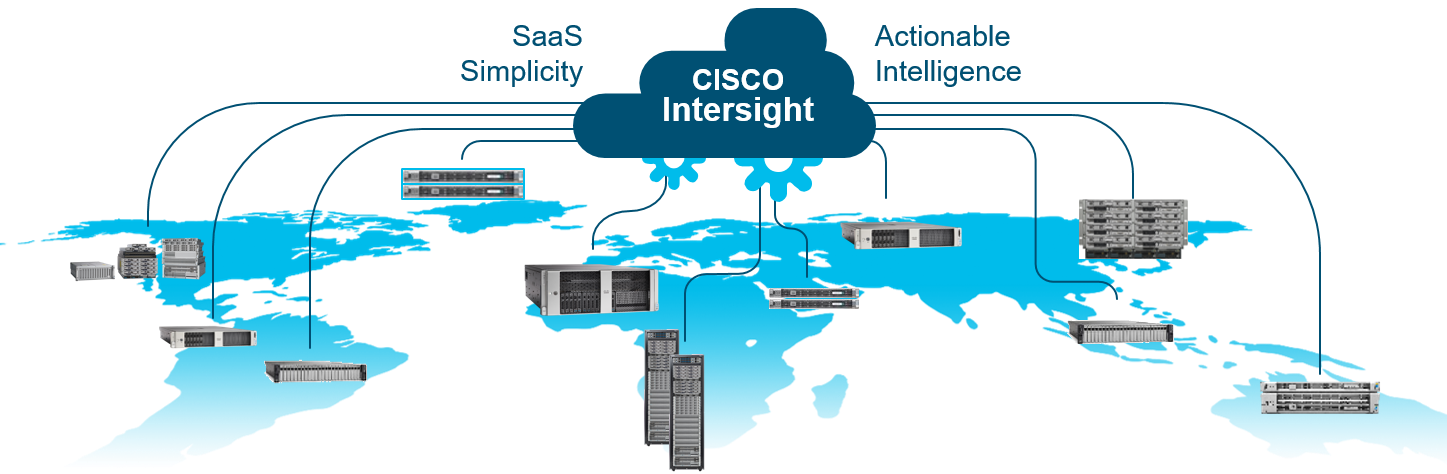
Cisco recently introduced Cisco Intersight, a revolutionary cloud-based systems management platform. Intersight was designed to deliver significant benefits while being easy to use and simple for Cisco UCS and HyperFlex customers to transition.

Non-Disruptive Transformation

Great innovations need to be revolutionary without being too disruptive. They should deliver compelling new benefits to users without being difficult to begin using. This was our goal, as we developed the architecture for Project Starship, our internal code name for the new Cisco Intersight cloud-based infrastructure management platform. We wanted to provide a transformative experience for our customers with no hassles, as they adopt software as a service (SaaS) to manage their infrastructure.

Cisco UCS and HyperFlex are designed as programmable infrastructure with a unified API. As a result, no hardware is required to allow Cisco UCS or HyperFlex systems to be supported by Intersight. We are simply moving the management plane to the cloud with Cisco Intersight. We’ve also added analytics and machine learning to provide actionable intelligence to daily operations.

All that is required to transition to Cisco Intersight is the latest releases of UCS Manager, Integrated Management Controller (IMC) or HyperFlex software plus a new innovation we call a device connector. The device connector is a lightweight and autonomous piece of software enabling secure communication between the system and the Intersight portal. It is bundled with the firmware as an embedded product feature.

Ensuring Secure Cloud-Based Management

When we started designing Cisco Intersight, we knew that security would be of paramount importance. IT organizations need to feel confident that Cisco would deliver systems management from the cloud that offers iron-clad security. Sebastien Rosset, the lead architect for Project Starship (the development code name for Intersight), provides more details of the security designed into Cisco Intersight in this Tech Field Day presentation recorded earlier this month.

Starting the Transformation for Free

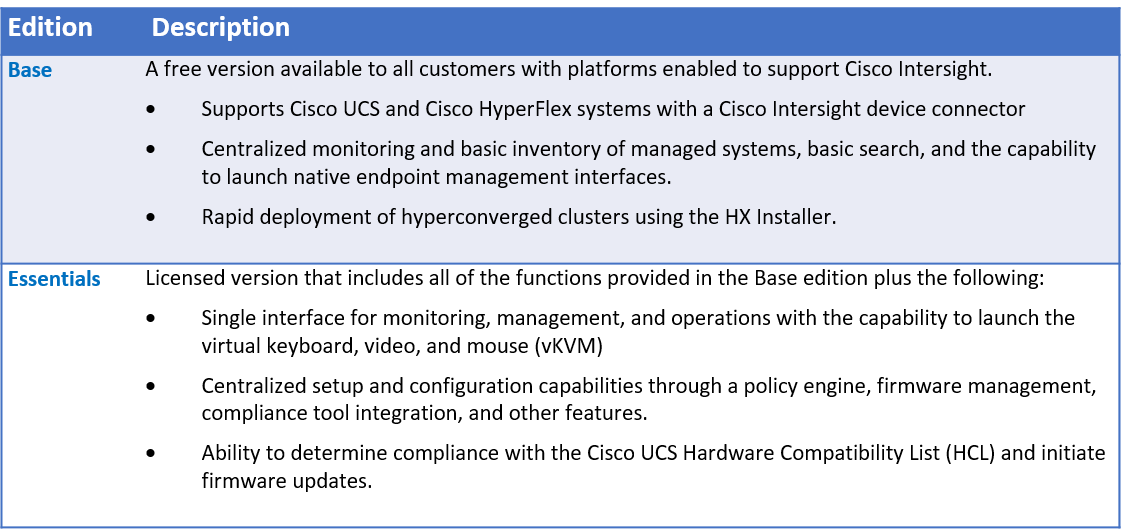
Cisco Intersight will initially be available in two editions: Base and Essentials. We wanted to encourage customers to begin using Intersight, so the Base edition of the product is available at no charge. The Base edition was released in a Tech Preview last month. If you’d like to participate in the Tech Preview, read this blog to learn more.

The Essentials edition is a licensed version that will be available in Q4CY17 with list prices starting as low as $12.49/server per month. The table below provides a comparison of the current functionality in the two editions.

Peaceful Coexistence and Transitions

We have designed Cisco Intersight to be a transformational management platform, and we’ve streamlined the path to adoption. Our base of over 60,000 Cisco UCS and HyerFlex customers can continue using the existing portfolio of UCS management tools. We will continue to support these tools, while gradually shifting our development efforts to Intersight over time. Cisco Intersight will coexist with these tools seamlessly, so customers can transition to Intersight in a way and at a pace that makes sense to them.

Over the past eight years we have developed a broad ecosystem of infrastructure and operations management tools partners. The Cisco Intersight architecture is extensible with an OData Restful API. We intend to work with our technology partners to develop integrations with Intersight. This will allow existing converged infrastructure solutions to be supported by Intersight. The integrations with operations management tools will preserve investments in software and processes while enabling greater levels of automation and DevOps.

Join the Revolution

If you’d like to learn more about how you can transition to Cisco Intersight, here are some options:

  • Watch a recent TechWiseTV episode where we explain Cisco Intersight in more detail.
  • If you’re a Cisco UCS or HyperFlex customer, this blog will explain how you can join the Tech Preview and take Cisco Intersight for a test drive.
  • You can read more by going to www.cisco.com/go/intersight

Authors

Ken Spear

Sr. Marketing Manager, Automation

UCS Solution Marketing

Avatar

Chew on this: Joshua McKenty started OpenStack at NASA. That’s right—started OpenStack at NASA. Then he started Piston, a company that sold an OpenStack distribution, which Cisco eventually bought. Now he works as the Field CTO at Pivotal Cloud Foundry, and boy does he have a lot of interesting things to say about the current state of IaaS, PaaS, containers, and culture change in the technology space. I don’t want to ruin the interview for you, so I’m not going to provide much detail, but a few of the things he explains include:

  • Why if you’re just finding OpenStack now, you’re too late
  • Why telcos are the happiest OpenStack users
  • Why measuring lines of code was a mistake by the OpenStack Foundation
  • Why sometimes open source projects need a good dictator
  • Why he’s a grouchy old man when it comes to containers
  • Why he doesn’t use the term “DevOps” anymore
  • Why it’s important for IT leaders to tolerate a certain amount of messiness

It’s an amazing interview. Absolutely critical information if you’re leading an IT organization of any size. Well worth 45 minutes of your time. See the video podcast on our YouTube page, or listen to the audio version on iTunes. And if you like what you hear, we invite you to subscribe to our channel so you don’t miss any of the other exciting podcasts we have scheduled over the next several months.


Authors

Ali Amagasu

Marketing Communications Manager