Avatar

Guest Blogger: David Soper, Technical Marketing Engineer

Our new cloud-based systems management platform, Cisco Intersight, leverages our expertise in security and cloud hosted management. It delivers secure management of your Cisco UCS and HyperFlex systems.

Building on Our Expertise

Cisco has several years of experience delivering infrastructure management from the cloud or Management as-a-Service (MaaS). Cisco Meraki is our hosted network management platform. There are currently over 1 million networks managed in the cloud by Meraki. We’ve learned a great deal along the way and earned the trust of our customers and partners.

Cloud-based systems management is relatively new, so IT operations staff and administrators have some concerns about security. We have leveraged the expertise we have gained from Meraki and other Cisco products as well as the Cisco IT organization, as we architected and developed Cisco Intersight.

This new brief explains the security we have designed into Intersight.

A Holistic, Pervasive Approach

Protecting customer infrastructure and data requires a close partnership between the Cisco IT and Information Security (InfoSec) organizations. Part of Cisco’s Security and Trust Organization (STO), InfoSec works with Cisco IT to help ensure that the products we build and the infrastructure we operate are secure. These groups work together to support business productivity while protecting our systems and data from internal and external threats.

Instead of focusing on security hardware and software alone, we take a holistic, pervasive approach to security by:

  • Fostering a security-conscious culture to reduce the attack surface and provide a robust security posture
  • Implementing security-focused policies and processes
  • Embedding security throughout our infrastructure
Securing the Connection

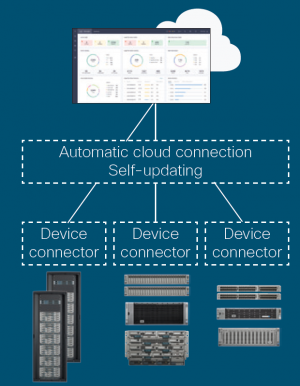
Cisco UCS and Cisco HyperFlex systems are connected to the Cisco Intersight portal through a device connector that is embedded in the management controller of each system. The device connector provides a secure way for connected devices to send information and receive control instructions from the Cisco Intersight portal, using a secure Internet connection.

Two-factor authentication is used to verify the identity and authenticity of each device being claimed. This authentication mechanism adds another layer of security to the device-claiming process.

Securing the Data Transmission

All data sent to Intersight is encrypted, and all connections are initiated outbound from the device. The out-of-band control plane in the Cisco Intersight platform separates management data from IT production and application data. Management data, such as configuration and monitoring information and statistics, flows from the devices to the Cisco Intersight portal. IT production and application data is sent directly to its destination on your production data network.

All data exchanged between Cisco UCS devices and the Cisco Intersight platform uses industry-standard encryption and security protocols. Connected devices communicate with Cisco Intersight exclusively using Transport Layer Security (TLS) with restricted ciphers and HTTPS on the standard HTTPS port 443.

Ensuring the Service

Cisco Intersight is a SaaS management solution delivered through the Cisco Intersight portal. Cisco personnel are available 24 hours a day, 7 days a week, for logistical security, operational, and change-management support. All services are replicated across multiple independent datacenters so that user services fail over rapidly in the event of a datacenter failure.

For a detailed look at Cisco Intersight security, watch this video from one of Intersight’s principal engineers.

Learn more:

Authors

Ken Spear

Sr. Marketing Manager, Automation

UCS Solution Marketing

Avatar

#CiscoChampion Radio is a podcast series by technologists for technologists. In this episode we’re talking to Ivor Diedricks about the Cisco Catalyst 9000 Series Switches.

Get the Podcast

  • Listen to this episode
  • Download this episode (right-click on the episode’s download button)
  • View this episode in iTunes

Cisco Guests

Cisco Champion Hosts

Podcast Discussion Topics

  • What’s different about the Cisco Catalyst 9000 platform
  • The role of the product manager
  • Key design elements that went into the Cisco Catalyst 9000 platform
  • Why the product management team used the team who helped design Ferraris to work on the box
  • Blue Beacon on Bluetooth console management
  • How the Cisco Catalyst 9000 platform provides operational consistency
  • The components from the 3850 platform that can be used in the Catalyst 9000 platform
  • The Cisco product management and engineering organization work
  • Containers: what can you do in them and how to manage them

Listen in and provide us feedback, we would love to hear from you!

Resources:


Authors

Andi Fisher

No Longer with Cisco

Avatar

Microsoft has released its monthly set of security advisories for vulnerabilities that have been identified and addressed in various products. This month’s advisory release addresses 53 new vulnerabilities with 19 of them rated critical, 31 of them rated important and 3 of them rated moderate. These vulnerabilities impact Microsoft Edge, Internet Explorer, Microsoft Scripting Engine, and more.

In addition, an update for Adobe Reader was released which addresses CVE-2017-16367 / TALOS-2017-0356 – Adobe Acrobat Reader DC PDF Structured Hierarchy ActualText Structure Element Code Execution Vulnerability which was discovered by Aleksandar Nikolic of Cisco Talos. This vulnerability manifests as a type confusion vulnerability in the PDF parsing functionality for documents containing marked structure elements. A specifically crafted PDF document designed to trigger the vulnerability could cause an out-of-bounds access on the heap, potentially leading to arbitrary code execution. More details regarding this vulnerability are available here.

Read More >>

Authors

Talos Group

Talos Security Intelligence & Research Group

Avatar

Craig Tranter is a former educator, and now serves as a technology presenter for Cisco. This blog is the sixth in his series on advancements and opportunities in education. All views are his own. 

Last time you were introduced to Cisco Spark, so I hope you followed the link and downloaded the free version? What do you mean “no?” Here’s the link again.

Go ahead and download the app. No, no, it’s fine, I’ll wait…

Now that you have the app, you can start using it straight away. And, for the “power users” out there, you’ll be interested in integrations and bots to really kick things up a notch and make your life easier.

So what is the difference between integrations and bots?

An integration with the Cisco Spark client basically works as a one-way street. You can link specific services and they will automatically update the selected Cisco Spark chat spaces with key information. For example, let’s say you have the Box File Sharing Integration. If you upload a file to a specific Box folder, the integration will automatically share a link to that document in the selected Cisco Spark chat space, meaning you don’t have to mess around with copying and pasting links.

Bots on the other hand are a two-way street. You can ask bots questions and they will go and retrieve that information for you. Here’s just a couple of examples that I’ve seen used in universities to date:

  • Study Assistant Bot
    – Simply add this bot to a chat space and type @studybot followed by your query. You could ask anything about your current courses, teachers’ availability, reading lists, timetables, room bookings etc.
  • Translate Bot
    – Simply add this bot to a chat space and type @tofrenchbot followed by ‘the text you want to translate’. This will automatically look up the translation on Google Translate and post the message into your chat.

These bots can be linked to any database to retrieve the desired data automatically.

You can find existing integrations and bots here, and if you’re a bit more ‘techy’ you can even develop your own here.

Remember that all of this can be linked to your LMS, so there’s no need to throw out the system that you know and love just yet. As my colleague and friend, Dr Lance Ford likes to say, it’s great to embrace new technologies, but don’t forget to “rock what you’ve got.”

The next step is Artificial Intelligence (AI). Stephen Hawking has said that true AI will inevitably take over the world, but you may not realize that we already have some basic forms of AI in our smart phones and other devices.

Siri, Cortana, Alexa, Google Assistant and Watson are the forerunners of this digital revolution and are quickly becoming an everyday part of people’s lives. I don’t think I could survive without saying “Hey Siri, remind me to buy milk today.”

As Siri is linked with all your native apps on your iPhone, students could take full advantage of this by asking something like “Hey Siri, what time does my French class start today?”

It’s the little things that make these personal assistants so powerful.

They are undoubtedly very clever programs, but fear not, none of these are going to pass the Turing Test, so Skynet is not going to be taking over the world any time soon (if you don’t know that reference, why not try asking Siri “What’s Skynet?”). There’s no doubt that, much like how the introduction of touch screen technology changed the way we interact with our devices, machine learning and artificial intelligence is likely to be the next major development that will reshape the digital world. However, until AI grows into its maturity, the next big thing that many large tech companies seem to be focussing on is virtual and augmented reality.

Watch out for the next post about virtual and augmented reality.

Authors

Craig Tranter

Technology Presenter at Cisco

Avatar

More than ever before, cybercrooks are now targeting medium and small businesses. It’s not just the blue chip companies or governments that are under fire. It’s now startups and small businesses of all stripes – retail shops, leisure activity businesses, hotels, health clinics, and even colleges are getting hammered by cybercriminals. And it’s pushing many entrepreneurs to the verge of bankruptcy.

These businesses may feel that they aren’t likely to be a target due to their size and that hackers couldn’t possibly be interested in what they do – but in reality the exact opposite is true. There is a growing need for security in small and medium-sized businesses. According to a survey conducted by Ponemon Institute for businesses with less than 1000 employees, 55% experienced a cyber-attack in the last year. However recovery from cyberattacks in many cases was slow and expensive.

Hackers prey on the knowledge that small businesses tend to have lower defenses than larger organizations, usually due to lack of financial and human resources. By their very nature, thriving small businesses are innovative and niche, which again is very attractive to the bad guys who may be interested in customer data and intellectual property and know exactly how to pick out the weak targets.

Companies of any size can be targeted by cybercriminals in today’s Internet-connected world.

Despite the rising vulnerability to cybersecurity breaches, a lack of awareness and high investment costs remain the two immense challenges faced by small and medium enterprises.

With the launch of Cisco Stealthwatch Cloud, small and medium enterprises can breathe a sigh of relief against cyberattacks.

Stealthwatch Cloud is a simple, automated and cost-effective solution for small businesses.

Stealthwatch Cloud provides its threat detection capabilities by way of actionable security alerts supplied with their supporting observation information. Details that are necessary to mitigate different kinds of malicious activities in real time – with minimal configuration or management. You can quickly respond before a security incident becomes a devastating breach.

With Stealthwatch Cloud, you can detect external and internal threats across your environment, from the private network to the branch office to the public cloud with no specialized hardware to purchase, no software agents to deploy, no expertise required.

Stealthwatch Cloud is a software-as-a-service (SaaS) solution delivered from the cloud, which means management is a breeze and there is no need for messy software patches.

Stealthwatch Cloud provides a stronger security posture with an automated platform to rapidly identify compromised and misused devices, facilitate faster remediation, and reduce the risk and cost associated with breaches.

Through machine learning, it models data from endpoints and network entities in real-time to significantly reduce the number of false positives. In fact, customers report 96 percent of Stealthwatch Cloud alerts as ‘helpful.’ These accurate, automated alerts help you protect your environment without wasting valuable time better spent growing your business.

Try this super cool security solution today with a free trial. To learn more, visit the Stealthwatch Cloud product page or contact your local Cisco account representative.

Authors

Sabiha Rouksana H.

Security Virtual Sales Specialist

Advanced Threat Solutions

Avatar

Cisco is well known for our flexible work environment, so it is not surprising that a large number of our employees work remotely on a regular basis! Working from your favorite coffee shop, avoiding rush hour traffic, increased time at home – the perk list for working remotely is quite lengthy.  Although there are numerous benefits to this perk, one downside is that it can be harder to network and maintain relationships outside of those on your immediate team since you aren’t having the typical “water cooler” interactions that you would have in an office environment.

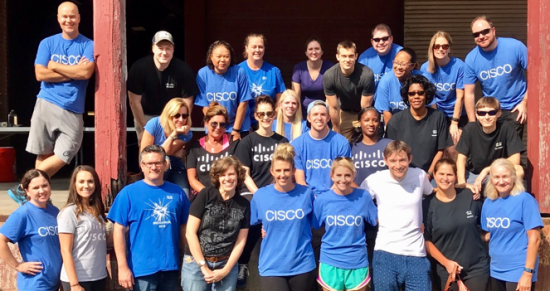
At our Raleigh Campus in North Carolina (What we Cisconians know as RTP), there are 150+ HR employees associated with our site! Everyone does a great job of hosting fun team-building events for their respective groups – but with a group as large as ours, there are dozens of different teams, so you could get very familiar with your immediate team, but not the larger RTP HR community.  After getting some feedback that our HR employees wanted to focus on improving our overall sense of community, a group of us volunteered to form a board and get innovative! Our goal was to think of creative events that would foster meaningful networking; as a result, four community tracks formed:

  1. Volunteerism
  2. Innovation & Problem Solving
  3. Learning and Development
  4. Social

Fast-forward two years, and our community involvement has really sparked!


Volunteerism 

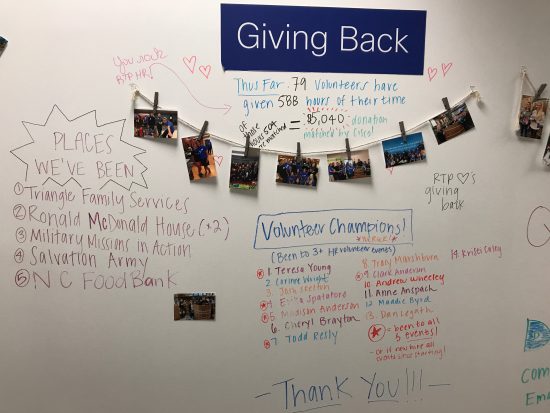
Each quarter our group looks forward to giving back to our community! Thus far, we have had 7 volunteer events and have contributed over 650+ hours of a service as a group.  We have been to a variety of places like Ronald McDonald House, Military Missions in Action, and Habitat for Humanity!

“For many years I have dedicated time to volunteering and am glad that Cisco is committed to have it as an integral part of Our People Deal. Recently my volunteer work hit close to home when we volunteered at the Ronald McDonald house in Durham.  My sister was diagnosed with cancer a few weeks after her sons’ cancer came back and their local Ronald McDonald offered them comfort during a time of great need. I knew personally the meaning of how much our simple assistance meant to the family’s in the Durham Ronald McDonald house.”  – Teresa Young, Sr. Compensation Analyst


Innovation & Problem Solving 
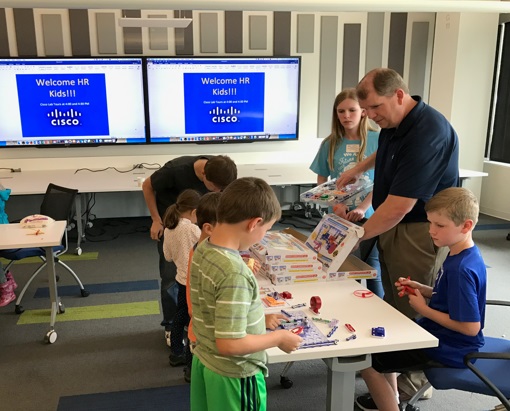
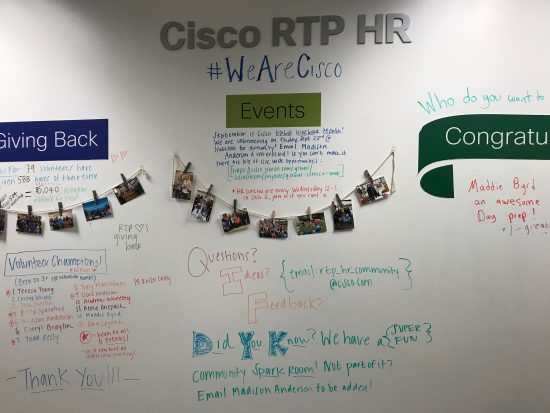
With a track name like this, you know our thinking caps were on full blast! This past year, we had our first ever “Bring Your Kid to Work Day” where we focused on STEM related activities and a fun guessing game about what parents do every day!  We also brought our capstone “People Deal Wall” to LIFE – a full 30 ft. long whiteboard wall where we highlight all of our upcoming events, celebrate birthdays, offer congratulatory kudos, and have fun with monthly motivational quotes and trending topics.  Anyone can contribute to or doodle on the wall and it’s fun to see how it changes each day.


Learning & Development 

This is where we partner with other functions on campus, like Finance, to maximize our cross-functional learning offerings! One of our most successful events was an “Earnings Call Overview” class.  During this class, Treasury helped us better understand Cisco’s Earning Call Results and we had some fun guessing what our new stock price would be! It was a great opportunity to learn and network with our colleagues in Finance while building our business acumen.

“We aspire to be the best HR organization in the world. To do so we have to understand what’s happening across all functions and in the industry at large. High tech is moving faster than ever, requiring a One Cisco approach to solving complex customer challenges. The Learning & Development track gets that. We know we need to arm our team with the right knowledge to be able to provide the best HR support. That starts with knowing the key market trends, priorities and strategies in Sales, Engineering, Services and Corporate Functions.” -Todd Resly, Sales HR Business Partner  

Social 

HR knows how to plan a great time, and we have two events that our employees look forward to all year long! We have an annual summer picnic with a kickball game and a seasonal holiday party with games to kick off our year-end shutdown.

Bigger Impact:

How do we know we are making a difference? We complete yearly reviews to ensure we are focusing on what is most important to our employees.  We solicit feedback, new ideas, and recruit new members to join our board!

The most rewarding moment is witnessing employees reconnect who haven’t seen each other in a while, or learning that a new hire or relocated Cisconian already feels like part of the community within their first month.

That is what I love about working at Cisco, we are passionate about innovating to create the best experience for our employees!


Want to join a team that grows together? We’re hiring!


Authors

Madison Embry

UKI P&C Country Consultant

EMEAR People & Communities

Avatar

Building Momentum for Cisco Kinetic for Cities

As I mentioned in my previous blog post, we’ve renamed our connected digital platform and smart solutions to Cisco Kinetic for Cities to fortify our alignment internally and deliver even better outcomes for our customers. What could be better than having more great minds and additional budgets focusing on city challenges?

Well, today at the Smart Cities Expo World Congress in Barcelona, we announced a number of new technology solutions and features, business models and financing options to help our customers reach their goals faster.

 New features in the platform technology include full policy automation and the display of data on an enhanced dashboard with integrated video. The system can now notify agencies and other city stakeholders using Cisco Spark—a powerful collaboration tool—and provide  a common view of the relevant information and maps to coordinate actions more effectively. (See the full list of new features.)

We have added two new solutions to our Cisco Kinetic for Cities portfolio that exploit the new functionality:

  • Cisco Kinetic for Cities Waste Management was just deployed in Granada, Spain, by our partner Ferrovial—a top urban services operator in Spain. The local government will begin in six districts of the city to improve the collection of urban waste—going from static to dynamic routes based on real-time information supplied by volumetric measurement sensors. So far, 210 of the total 420 sensors for the initial trial have been installed inside waste containers and the. Keeping the city clean, but doing so at lower cost, is very important to the city leaders. You can read more about the process and technologies put in place here.
  • Cisco Kinetic for Cities Safety and Security enables capture and aggregation of data—from cameras, sensors and other sources. Delivered to law enforcement and other first responders, it provides greater insight into public safety.

Bringing New Business Models to New Cities

The Cisco Kinetic for Cities Starter Solutions let cities test the platform with one or multiple solutions over a small area to make tangible how it will all work together once deployed more broadly.

As delighted as we for Cisco Kinetic for Cities to gain ground in larger municipalities—Copenhagen, Las Vegas, Jaipur and so on—we’re particularly pleased with the recent uptick in small and mid-sized city customers. It’s often easier for smaller cities to bring together key decision makers and reach consensus faster; also, citizens often have a closer involvement with how their cities are run. We’re highlighting Cary, North Carolina in our event press release as one of the newest examples of a medium-sized city using the Cisco Kinetic for Cities platform to address its challenges. (In this case, Cary is focused initially on lighting, but will add more domain solutions later.) But we are engaged with many other mid-sized cities worldwide at various stages of adoption: Schenectady, NY, and Pearland, TX; Adelaide and Ipswich, Australia; Mexico City, Panama City, and Chalkida, Greece (through partner Deutsche Telekom) to name just a few.

Likewise, state and regional agencies, such of the Departments of Transportation (DOTs), are recognizing the benefits of deploying our platform. We’ve recently struck a deal with the Tennessee DOT, to help them manage traffic issues, set toll pricing, and improve road safety. Similar agreements are underway across a number of state DOTs and other agencies. Ultimately, the real win is in the sharing of data across agencies, across regions and with citizens and visitors for greater insight and efficiency across a broader set of circumstances.

We are also expanding our partner ecosystem to include a wider variety of organizational types—many of whom are partnering together to bring integrated solution suites to customers. LUG Light Factory, for instance, a lighting company in Poland, is partnering with Cisco and with a regional urban services operator to package LUG’s and Cisco’s offerings and roll them out with its management services to enable an integrated lighting solution to a small city in Israel. Pretty powerful to be able to blend and extend our solutions and services to serve mutual customers. The approach makes us all stronger and more effective.

Building an Infrastructure of Financial Support

Funding does present a major stumbling block for cities of all sizes that want to begin their smart city transformation. So, Cisco is addressing this issue head on. Today we also announced the launch of an exciting new $1 billion City Infrastructure Financing Acceleration Program, which offers debt and equity capital to municipalities interested in undertaking smart city initiatives, but who are struggling to find the funding to get the ball rolling. The program will provide flexible financing through Cisco Capital, in partnership with private equity firm Digital Alpha Advisors and pension fund investors APG Asset Management (APG) and Whitehelm Capital. It is also available to urban services operators, organizations that help cities manage their services more effectively—whether that’s in transit efficiency, water leakage monitoring, energy optimization, asset management, or a combination, across regions or broader geographies. They often have a crucial role in getting cities and communities started on their way and keeping them moving forward. Check out a short video by Arvind Satyam on my team that further explains how the new City Infrastructure Financing Acceleration Program works, who can participate, and how.

Making a Plan

There are many options and variables to consider when beginning a smart city transformation initiative. In fact, our customers are teaching us new ways that Cisco Kinetic for Cities can be put to use!  I’m sure that the way you design your approach will be as unique as your city. And that’s the way it should be.

We’d be very happy to help you identify the best first steps and even how you can finance your journey. Let me know if you’d like to set up some time to talk about what you want to accomplish for your city!

If you’ll be in Barcelona for the Smart City Expo World Congress (Nov. 14 – 16), come visit our booth (#D445) and we’ll give you a tour, a demo and answer any questions you may have.

Hope to hear from and see you soon!

–Anil


Authors

Anil Menon

President

Smart+Connected Communities and Cisco Deputy Chief Globalisation Officer

Avatar

A technology guru explains his new podcast on industry trends in technology & infrastructure.

About Me

I’ve always loved technology and learning about how everything works.  When I’m not working you might find me learning how to fly a plane, designing a circuit board, or taking images of deep sky objects. I’m happiest when I’m either taking something apart, or putting something together. Learning, growing, keeping things interesting – that’s the role of technology in my life.

Changing Landscape of IT

That mindset is a great fit for my role as Cisco’s Chief Technology Evangelist, where my job is to talk to customers about how to bring Cisco technology to bear on their most pressing business problems. And if there’s one thing I’ve learned from years of talking to business and IT leaders, it’s that they have challenges with the complexity of our IT operations.

Complexity in IT infrastructure and operations has exploded as we build out new Digital capabilities for our organizations . I started at Cisco when people were just getting the email – the Web was still in early days. I’ve seen the Internet landscape grow through the WorldWide Web (remember when we called it that?), through VOIP, Video and Smart Devices, and now we’re getting whole new technologies, AI, IoT, wearable computing… the possibilities seem endless. It makes our IT yet more complex, and 90% of the average IT budget currently gets spent on keeping things running that we have built out over the years.

All About the Podcast

Lately I’ve been learning a lot about new tools to operate, manage, and deploy IT services in new ways. This podcast will focus on things I’m learning about technology, and how we’re realizing savings on those operations & personnel costs. I’ll have guests who’ll add valuable perspectives to the subject at hand, and often we’ll run through a dCloud demo of the technology at the end. (If you’re not already using dCloud, check it out at dCloud.cisco.com.) And finally, I’ll highlight a use case – either a digital transformation, or how we’re turning traditional IT groups into IT-as-a-service, or how industries are getting disrupted or are disrupting themselves before someone else can get there first.

The IT Resources Conundrum

Companies are beginning to build out digital capabilities, and they need a secure platform to build upon. One thing you can’t get wrong is security! Cisco has been putting significant resources into building out security automation, and visibility capabilities into our portfolio, both in our development work and with our acquisitions. This is where we can make real inroads toward decreasing the percentage of IT budget that gets spent on maintaining existing systems. CIOs that I talk to are looking to reduce that from 90% levels to 50%, or even down to 30%. Think about the amount of innovation that could take place if you suddenly freed up 50% of your IT budget for digitization.

The Network Intuitive

The strategy we’re talking about right now, and which we’ll talk about in future episodes of the podcast, is The Network, Intuitive – powered by intent, informed by context. This is where we use products like ACI and DNA Center to automate policy, and Tetration and the new Cisco Network Data Platform, to increase visibility into our IT infrastructures, drastically reducing investigation and troubleshooting times. Automation and visibility give us the tools to deploy new services and fix problems quickly.

WAN, Access, & Wireless Networks

WAN, Access, and Wireless networks are experiencing a fundamental change. Typically built on blacklist models, where all content was trusted until it was blacklisted, automation tools have allowed us to move to a whitelist model of network design. This takes us to an entirely new level of Zero-Trust security while allowing us to eliminate human error, letting policy drive the configuration.  Cisco innovations like the APIC-EM controller along with and Our Meraki and Viptela acquisitions have enabled us to be very competitive in this space, and future episodes of the podcast will feature the people who were part of the integration of these technologies into the Cisco DNA portfolio.

Internet of Things (IoT)

IoT is going to get its own podcast episode, or series of episodes. Sensor technology has duly obeyed Moore’s Law, becoming better, cheaper, and smaller at a rapid pace. I’ve said, and I truly believe, that eventually we’ll have sensors on everything. And this, again, increases network complexity. By 2020, we’ll be adding a million devices per hour to the Internet, and manual enrollment & configuration isn’t scalable. We’ve arranged for a guest from our IoT group to come on the podcast and talk about the Jasper acquisition and the Cisco Kinetic IoT platform. We’ll talk about security, data processing, storage Fog computing, and how we are deploying these in an IoT world, and what we’ll have to protect all of these sensors from the network side.

Cloud

And, of course, Cloud. The hybrid cloud environment is with us to stay for quite some time. We’ll talk about putting the workloads in place that make the most sense, and how CloudCenter, Cisco Secure Agile Exchange, and AppDynamics are changing application deployment and visibility.

Looking To The Future

And we’ll talk about the future – combining the visibility that we have in the areas of data center, network, IoT, cloud, and wireless/WAN to give us a single pane of glass that will give us end-to-end visibility across our IT Infrastructure. This is Cisco’s self-driving car – a self-healing system that finds and fixes problems that you don’t even have to know about. This is the only way I see getting to free up that 50-70% of the IT budget for digitization & innovation.

Welcome to the ride!

https://soundcloud.com/user-241798764-441243202/grubbcast-pilot-episode


References on dCloud

Links to dCloud demos and labs for some of the Cisco solutions mentioned in The GrubbCast:


We’d love to hear what you think. Ask a question or leave a comment below.
And stay connected with Cisco DevNet on social!

Twitter @CiscoDevNet | Facebook | LinkedIn

Visit the new Developer Video Channel

Authors

Jim Grubb

Chief Technology Evangelist

Cisco Customer Experience Center

Avatar

The architecture for Industrial IoT (IIoT) is largely understood. Sensors gather data. Networks orchestrate the data. Computation processes the data and analysis of the data to make it usable and actionable. However, one of the most significant challenges for manufacturers looking to create a connected factory is where to start their project. The next question becomes knowing the essential elements for success.

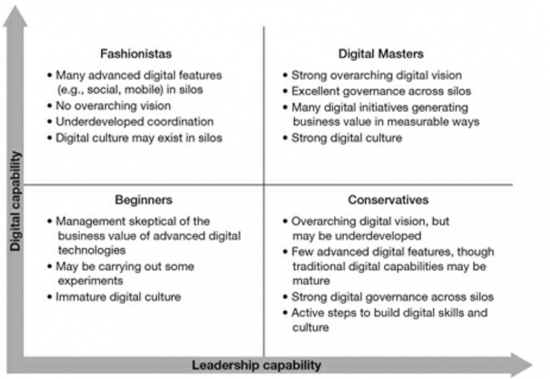
The problem isn’t unique and is an issue across many industries. In the book Leading Digital, authors George Westerman, Didier Bonnet, and Andrew Macafee developed a framework that helps identify where companies are on their journey in aligning both their investment and leadership within digital initiatives.

Source: http://www.thedigitaltransformationpeople.com/channels/the-case-for-digital-transformation/digital-mastery

Based on their research, the authors noted that there is effectively an axis for where companies drive leadership capabilities and where their digital capabilities lie. Four levels define where organizations currently sit in their execution and investment:

  • Beginners: These are organizations in the very early stages of adopting digital and IIoT. They may have engaged in small pilots or dabbled in some areas, but have not made investments to make IIoT a core part of their business or culture.
  • Fashionistas: These organizations have a digital culture in pockets. They may have invested in digital applications and IIoT, but have not aligned leadership in implementations and are struggling to scale their investment and operationalize their digital efforts.
  • Conservatives: These organizations have aligned a vision and a governance model, but lack wide-scale investment in digital initiatives.
  • Digital Masters: These are the groups that have aligned both the business side and the application side of their investments. This structure includes culture, vision, and governance.

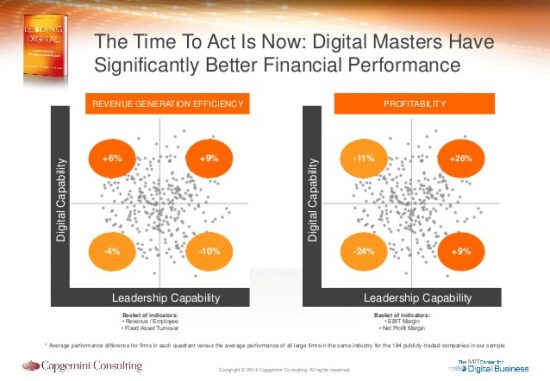
The benefit of moving up and to the right becomes clearer when viewing revenue generation and profitability across this framework. On average, companies that become more digitally capable are more efficient at revenue generation and profitability. The sample of publicly traded companies by Westerman, Bonet, and Macafee breaks down as follows:


Source: https://www.slideshare.net/rbouter/didier-bonnet-oracle-open-world-presentation-on-leading-digital-capgemini-consulting-digital-transformation

Digital masters on average see a 9% increase in revenue efficiency and a 26% increase in profitability when compared to their peers. When reviewing the numbers in the chart above, it’s easy to see why organizations are driven to become digital masters. For manufacturers, however, the current state is that many are stuck in that beginner’s quadrant, with some good IIoT initiatives but inertia in moving along on the digital transformation journey.

IIoT: Breaking Through

Manufacturing is a more conservative business when it comes to taking on projects, compared to other industries. Initiatives must have clear ROI, minimal impact on current operations, and be able to scale across an organization. “Science projects” are not well-received on the factory floor.

The other reality is that resources are constrained, as companies have to focus on staying competitive in increasingly fast-changing markets. Becoming a digital master is very possible, but the reality is that it often takes help from someone who understands both digital capability and leadership capability.

These resources usually aren’t available—or don’t exist—within industrial organizations. For manufacturers, this means finding a partner that understands how to coordinate business models to address security, reduce downtime, increase overall equipment effectiveness (OEE), and bring new products to market faster. This understanding is where Cisco Services can help—and has a proven track record of assisting manufacturers achieve digital mastery. The key is building that digital foundation, which should include:

  • Assessment of current environment
  • Planning a solution using validated architectures
  • Solution design
  • Solution deployment
  • Care and support

Unlocking value from your digital investment is the key to driving increased revenue and profitability. Combining leadership and capability will position companies for a long-term strategy that optimizes into the future. I invite you to check out the following information to learn how our Services team can help move you toward becoming a digital master.


Authors

Eric Ehlers

No Longer at Cisco