Avatar

As technology marches forward, we’re using and creating more high-tech products than we imagined! Who would have thought of a cab hailing service running on our phones a decade ago? Or, the sheer ingenuity of renting out a vacation home via a web app when you’re not using it?

But for each of these applications to exist, platforms are key to foster such an ecosystem. Platforms are the springboard for fostering digital innovation. The “new” Cisco, is working to make platforms that are open and directly encourage this kind of innovation. One great example of this shift is the Aironet Development Platform (ADP), an open canvas on which developers can paint their innovation as they desire.

So, what is the Aironet Development Platform? It’s a framework that enables the creation of a comprehensive ecosystem of expansion modules for Cisco Aironet Access Points. This allows enterprises to develop custom application modules while making use of the industry’s most comprehensive and innovative access point portfolio.

Why is the Aironet platform so important for the future? In a word, growth. The Internet of Things is exploding right now, it’s expected that over 25 billion devices will be networked by 2020. Mobile-to-mobile traffic is expected to grow 14-fold in the next four years. As the world accelerates and new users and devices emerge at this break-neck pace, the ability to cater those devices and technology to the world becomes more important to success.

Not only are IoT and mobility growing separately, they are also converging more. This is creating the need for a flexible wireless solution and platform that not only can allow for countless new and future use cases, but also provides future-proof deployment so that investments in the network of the future are protected. The entire ecosystem is connected. Developing within a connected platform is the basis for the whole. Success hinges on enabling modular, open platform ecosystems enabling partners to solve business-critical problems.

This ecosystem is also massively beneficial for developers and the industry. This platform allows developers to prototype a proof-of-concept and experience live application development, all while receiving support from the Cisco DevNet community. DevNet provides helpful tools such as sample code and apps, virtual sandbox to prototype new concepts and a vast knowledge base to help partners kick start their projects.

So, what does this look like in practice?

In this recent blog, the Aironet Development Platform was highlighted as transforming access points from simply being access devices to a versatile development platform. One of the exciting use cases that was used as an example was the ability to leverage ADP software in a retail environment to dynamically change product prices on store aisles through the use of a centralized server. This allowed for real-time changes to be made to even individual products without the laborious and costly process of having workers spend their time roving isles and individually changing price tags.

This is just one example of the flexibility and usability that is possible with an open development platform. Another example includes indoor location and way finding services or for video analytics at the edge since the platform provides enough horse power to run computing at the edge.  These are just two use cases, but there are infinite uses across several verticals.

Foundations are important. Whether you’re building a house that you would like to last for decades, or building a network that will change the world, building a strong foundation is critical. In technology, we must not just build strong foundations, but flexible ones. The Aironet Development Platform is just that, a flexible, open foundation that allows developers to freely innovate and invent in a way that will drive the growth of IoT, mobility, and much more.


Authors

Anand Oswal

No Longer with Cisco

Avatar

There’s been a lot of talk about the new service offerings Cisco recently announced and Robb and I are here to help you separate the signal from the noise. Robb gets the high level overview with Bryan Palma, SVP of Advanced Services, as well as Joe Pinto, SVP of Technical Services. And I deep dive into some of the analytics, use cases, and other things we’re doing with the new services with Ulf Vinneras and Laura McCarty.

This is really a breakdown of the new offerings from both the Advanced Services team at Cisco and the Technical Services team. Both teams really try to help our customers fill in the gap, so to speak. So what’s the difference?

Advanced Services – Business Critical Services:

For one thing AS is all about advising customers. Helping customers figure out the right way to move forward with their networks, data centers, enterprises and campuses. The second big thing is actually helping customers provision the actual tech and products. IT folks are no longer only having to worry about the network switches and routers. There are IoT devices, Machine Learning and Analytics, Security, Wireless, etc. Business Critical Services allows customers to use AS across all these platforms, helping to reduce the silo problem and ultimately help everyone move up the maturity curve in the data center and/or enterprise/campus. There are four key areas Business Critical Services focuses on: Analytics, Automation, Compliance Remediation, and Security.

According to Brian Palma, “customers who use Business Critical Services have 21% less cost, 74% less downtime, and 42% quicker time to remediation.” Make sure to watch the episode to see Ulf’s deep dive on what Cisco can do with analytics to help our customers predict and remediate problems.

Technical Services – High Value Services

You may know Technical Services better as TAC which provides technical support globally to our customers for every technology offered by Cisco. So essentially we’ve always had Smart Net and Basic Software Support. With the newer High Value Services offering we’re building upon this foundation. For example, the Basic Software Support get you TAC support, kind of a reactionary support when things go wrong as well as software updates. But with High Value Servies, specifically Enhanced and Premium, our customers get things like case prioritization, Direct Access to Experts, and Workflow Integration.

Joe Pinto pointed out that customers using Technical Services have 43% faster resolution and 70% fewer outages. Good numbers all around!

Check out the end of the episode for some use cases in the lab around High Value Services.

As always thanks for watching!

Avatar

With the growing threat landscape, it is imperative for product designers to build integrated security. This means that the security must be total and go across the board from procurement to deployment. This total security allows customers to establish trust. Often the introduction of this security paradigm overlooks and compromises simplicity, which can result in significant loss of valuable operational time thus resulting in poor customer satisfaction and even worse success metrics.

To address this two-fold security and simplicity challenge to establish trust, Cisco commissioned Miercom, an independent testing lab, to comprehensively evaluate and test Cisco Digital Network Architecture and Huawei’s Agile Solution. The detailed report of Miercom’s analysis is already published for download.

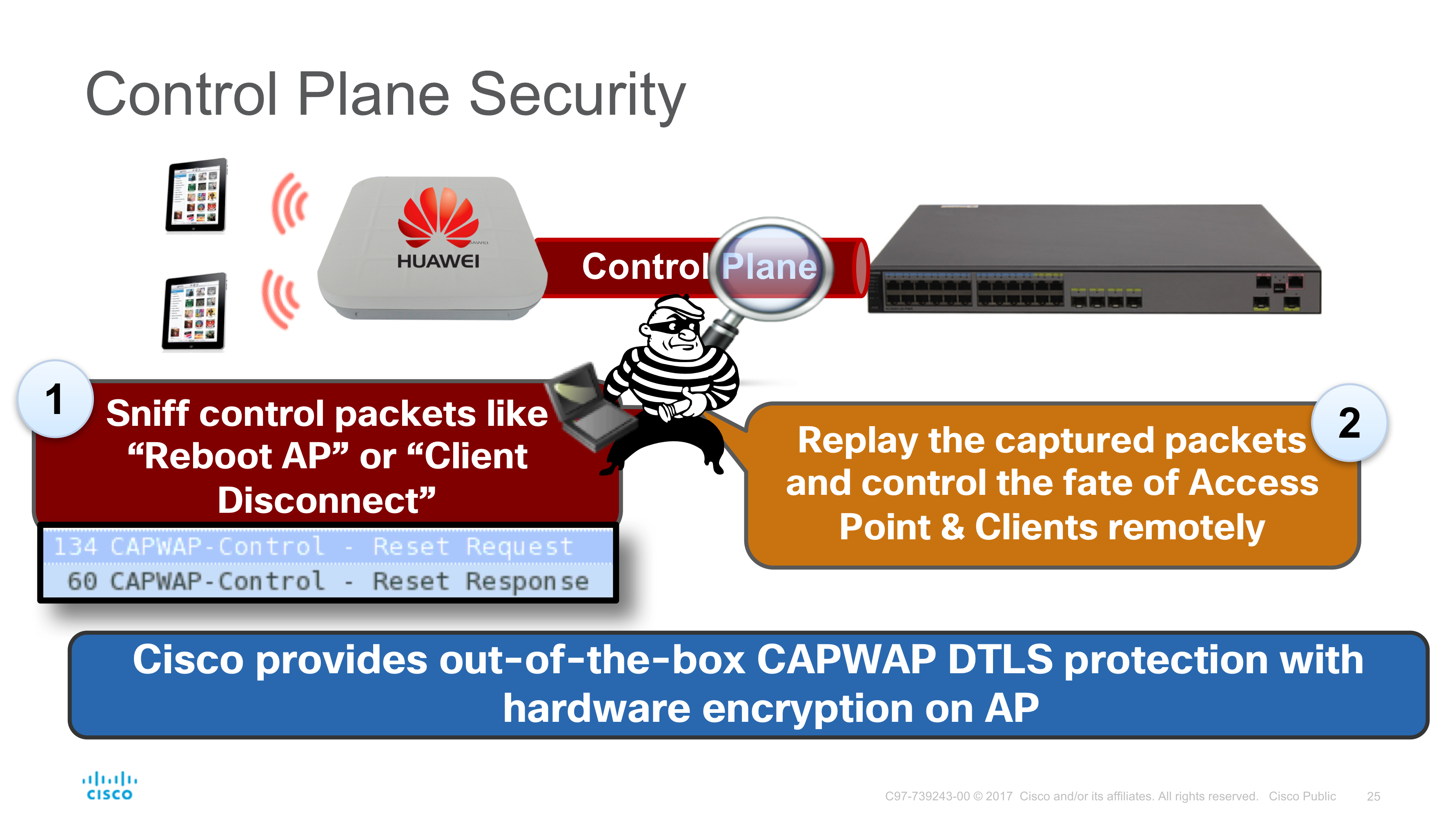
We will dive deep into the test case to evaluate “Control Plane Security”, a communication protocol between the Access Points and the Wireless LAN Controller (WLC) that allows for secure exchange of configurations and wireless client information.

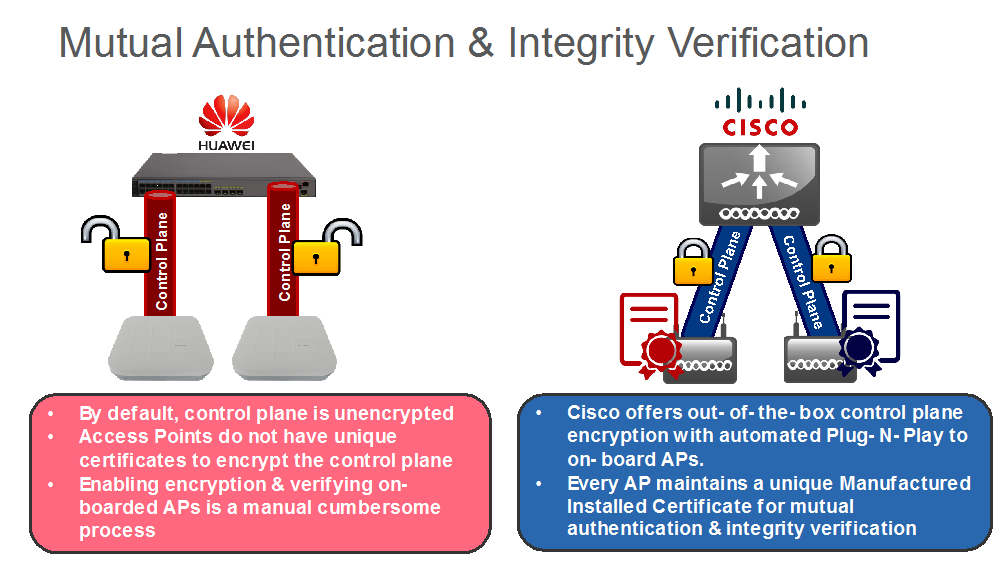
Miercom observed that Huawei does not encrypt the Control Plane tunnel by default and the data communication is readable in clear-text. On the other hand, Cisco secures the communication channel with a plug-and-play offering that saves significant deployment time while ensuring trust.

Because Huawei keeps the encryption disabled by default, on further test Miercom evaluated that the protocol is susceptible to Man-in-the-Middle attacks. It was observed that a remote attacker can:

  1. Simply replay the sniffed packets to command Huawei’s Access Point while pretending that it is coming from a legitimate Wireless LAN Controller.
  2. Hijack the legitimate wireless client session and connect the network with an un-authorized device.

If the customer deploying Huawei’s Agile Solution reads the “Warning Sign – Datagram Transport Layer Security or DTLS for Control Plane is OFF by default” and understands the implications then there is no choice but to activate it. Miercom explained about what it takes to activate DTLS encryption to measure the operational burden on customers:

  1. Manually create whitelist of all the Access Points MAC address on their controller.
  2. Configure a common “Private Secured Key” (PSK) that will be used for Control Plane DTLS encryption.

Miercom observed that the overhead of implementing PSK across the infrastructure still does not guarantee security because it is susceptible to brute-force dictionary attacks.  In sharp contrast, Cisco’s DNA offers out-of-the-box mutual authentication and integrity verification. Every Cisco Access Point carries a unique Manufactured Installed Certificate (MIC) that is used for mutual authentication with the WLC and the entire process to verify the integrity of the products and does not demand any user intervention. The work is already done for the customer.

It is also important to note that one of the key reasons Huawei shies away from activating DTLS by default is their lack of performing encryption and decryption in hardware, which directly affects their wireless performance. Click here to find out Miercom’s result on performance.

Finally, Miercom evaluated Cisco’s suite of Trustworthy Systems features that offers customers  insight into device integrity, run-time defenses to ensure only genuine Cisco software and hardware can operate together. Huawei’s Agile Solution fails to offer any visibility and innovation that can allow customers to build a chain of trust that ensure their investments are safe and protected.

Remember trust has be established from supply chain to production deployment with built-in simplicity.

Click here to download the full report.

Read other security resources that are evaluated by Miercom:

Authors

Karan Sheth

Technical Marketing Engineer

Cisco’s Enterprise Networking Group

Avatar

Introduction Tieto, a leading Nordic software and services company is growing rapidly and plans to continue fueling growth through new services and capabilities. Tieto’s growth strategy is built on a shift from providing mere services to delivering an outstanding experience to its customers. This requires the ability to deliver services quickly and make it possible to build anything on the application level that a customer wants, without being hindered by the underlying physical infrastructure. Tieto is investing in SDN technologies to meet these goals.

Tieto’s Solution

The Tieto team explored several potential SDN solutions and conducted head-to-head comparisons. They chose Cisco Application Centric Infrastructure (ACI), because it met all of Tieto’s technical requirements, implementation goals, and projected business benefits.

“We have had a long experience with Cisco products and services,” said Jyrki Halonen, Lead Service Architect at Tieto. “The Cisco team helped us fine-tune our SDN plan to deploy the solution as quickly as possible.” The Cisco ACI™ solution, with its industry-leading software-defined networking (SDN) capabilities, provides a holistic architecture with centralized automation and policy-driven application profiles.ACI delivers software flexibility with the scalability of hardware performance.

Solution Deployment Details

Tieto deployed Cisco ACI in six data centers in three countries. With Cisco Services, they deployed the Cisco ACI infrastructure in just six months. Using the Cisco ACI unified policy model, the team enforces policy through endpoint groups (EPG), a collection of network endpoints that includes a wide range of entities, including bare-metal servers, virtual machines, and containers. Tieto is looking forward to begin using additional Cisco ACI capabilities to provide the best possible connectivity solutions for its future service delivery infrastructure.

Solution Components and Partner offerings

  • Cisco Application Centric Infrastructure (ACI)
  • Cisco Application Policy Infrastructure Controller (APIC)
  • Cisco Nexus 9000 Series Switches enabled for ACI
  • Cisco Network Services Orchestrator (NSO)
  • Cisco UCS Director
  • Cisco Adaptive Security Appliance (ASA)
  • Cisco ACI Ecosystem, Partner – ServiceNow

Business Outcomes

Tieto’s Roadmap

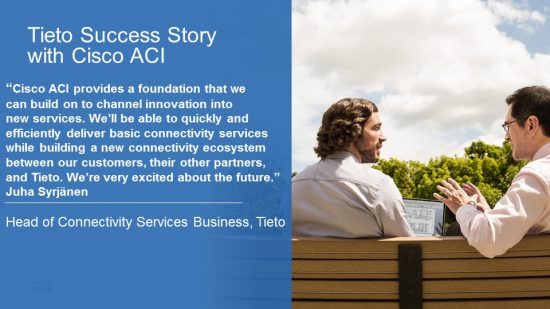
“Cisco ACI provides a foundation that we can build on to channel innovation into new services,” said Syrjänen. “We’ll be able to quickly and efficiently deliver basic connectivity services while building a new connectivity ecosystem between our customers, their other partners, and Tieto. We’re very excited about the future.”

Related Information

www.cisco.com/go/aci

Customer Success Stories

ACI Ecosystem webpage

Case study Link

Authors

Ravi Balakrishnan

Senior Product Marketing Manager

Datacenter Solutions

Avatar

These vulnerabilities were discovered by Claudio Bozzato of Cisco Talos.

Executive Summary

The Foscam C1 Indoor HD Camera is a network-based camera that is marketed for use in a variety of applications, including use as a home security monitoring device. Talos recently identified several vulnerabilities present in these devices, and worked with Foscam to develop fixes for them, which we published the details for in a blog post here. In continuing our security assessment of these devices, Talos has discovered additional vulnerabilities. In accordance with our responsible disclosure policy, Talos has worked with Foscam to ensure that these issues are resolved and that a firmware update is made available for affected customers. These vulnerabilities could be leveraged by an attacker to achieve remote code execution on affected devices, as well as upload rogue firmware images to the devices, which could result in an attacker being able to completely take control of the devices.

Read More >>

Authors

Talos Group

Talos Security Intelligence & Research Group

Avatar

Business mobile devices can be a lifeline for increasing employee productivity – but how do your business customers realize value when the costs of managing enterprise mobility are so high?

This was the focus of a new study, released today by Cisco, in which Forrester was commissioned to survey over 300 decision makers who manage mobile devices and services within their company.

The survey reveals the core issues that lead to high mobility costs for your business customers and how innovative service providers are leveraging automation to help them optimize their mobility management TCO.

To find out more, you can:

Beyond the bill – what’s really increasing mobility TCO?

In managing a mobile workforce, subscription costs such as monthly telecom bills and overages are a central expense. But those costs make up only 33% of the typical overall mobility budget, according to Forrester’s survey findings.

In the report, “Optimize Mobility Management TCO Through Automation,” Forrester noted the majority of mobility expense goes into maintenance tasks like mobile services management, employee support, and managing device inventory, upgrades, and security.

The primary challenges driving up mobility TCO costs include:

  • Manual processes – With too few self-serve, online tools and no way to automate processes, both you and your business customers need to invest more staff and more time to handle thousands of mobile device and service changes every month.
  • Domestic and roaming overages – Without real-time visibility to monitor usage during the billing cycle, your customers may frequently be hit with unexpected charges. Nearly 90% of companies see overages on their bills every year, resulting in billing disputes, credit backs and lower NPS scores for you.
  • Unused devices – Lack of visibility into usage also means your business customers may be paying for deployed mobile devices that aren’t getting used. Forrester found nearly 20% of devices go unused on average.
  • Costs of third-party tools – While telecom expense management (TEM) or managed mobility services (MMS) vendors alleviate part of a company’s internal support burden, they add to the already high mobility TCO. High TEM/MMS costs are the second biggest challenge in reducing mobility TCO, per Forrester.

Automating away the costs of mobility management

Whether your enterprise customers have employees that run up heavy mobile data usage, travel into new regions or countries, or leave the company, automating mobility management can help them dramatically lower their mobility TCO. Service providers are already leveraging to automation to win more customers and reduce this customer care costs.

So how exactly are leading service providers enabling automation in their business customer experience? Find out in our webinar on Nov. 14, “Optimize Mobility TCO with Automation” (or view on demand after). Hear from Michele Pelino, Principal Analyst at Forrester on what’s impacting mobility costs and how automation can help.  You’ll also see how you can enhance your business customer experience with Cisco Jasper’s automated mobility management platform – Control Center for Mobile Enterprise.


Authors

Pallavi Vanacharla

Global Head of Product Marketing

Enterprise Mobility, Cisco IoT

Avatar

Business mobile devices can be a lifeline for increasing your employee productivity – but how do you realize value when the costs of managing enterprise mobility are so high?

This was the focus of a new study, released today by Cisco, in which Forrester was commissioned to survey over 300 decision makers who manage mobile devices and services within their company.

The survey reveals the core issues that lead to the increasing cost of mobility management in today’s mobile first environment and how automation can optimize mobility management TCO.

To find out more, you can:

Beyond the bill – what’s really increasing mobility TCO?

In managing a mobile workforce, subscription costs such as monthly telecom bills and overages are a central expense. But those costs make up only 33% of the typical overall mobility budget, according to Forrester’s survey findings.

In the report, “Optimize Mobility Management TCO Through Automation,” Forrester noted the majority of mobility expense goes into maintenance tasks like mobile services management, employee support, and managing device inventory, upgrades, and security.

The primary challenges driving up mobility TCO costs include:

  • Manual processes – With too few self-serve, online tools and no way to automate processes, it takes more staff and more time to handle thousands of mobile device and service changes every month.
  • Domestic and roaming overages – Without real-time visibility to monitor usage during the billing cycle, you may frequently be hit with unexpected charges. (Nearly 90% of companies see overages on their bills every year, per Forrester.)
  • Unused devices – Lack of visibility into usage also means you may be paying for deployed mobile devices that aren’t getting used. (Forrester found nearly 20% of devices go unused on average.)
  • Costs of third-party tools – While telecom expense management (TEM) or managed mobility services (MMS) vendors alleviate part of your internal support burden, they can add to the already high mobility TCO. (High TEM/MMS costs are the second biggest challenge in reducing mobility TCO, per Forrester.)

Automating away the costs of mobility management

Whether your employees have spikes in mobile data usage, travel into new regions or countries, or leave the company, automating your mobility management can help you dramatically lower TCO. Automation transforms how you manage mobility, accelerating processes and reducing the cost of monthly telecom services, device management, and reporting.

To learn more, join us on our webinar on Nov. 14, “Optimize Mobility TCO with Automation” (or view on demand after). Hear from Michele Pelino, Principal Analyst at Forrester on what’s impacting your mobility costs and how automation can solve your challenges. You’ll also see how to automate your mobility management with Cisco Jasper’s innovative platform, Control Center for Mobile Enterprise.


Authors

Pallavi Vanacharla

Global Head of Product Marketing

Enterprise Mobility, Cisco IoT

Avatar

You wake up this morning, and you feel miserable and tired. Getting out of bed is the worst, but you stumble down the hall with a heavy head, chills, and a serious case of congestion just to get a glass of water. All signs point to the flu.

What a way to start the day!

Now compare your body to any business. When things are good, all the functions are working to their capacity, and everything is great. A simple pathogen in the form of ransomware could bring all that productivity to a screeching halt. Endpoints are offline for weeks as they are reimaged. Workers on payroll are paralyzed as they wait for systems to come back online.  Business is lost and money is spent just to get back to square one. Many organizations burn through a quarter just to recover from such an outbreak. And it all starts with an endpoint infection.

How vulnerable you are to an infection?

An estimated 70% of breaches start on endpoint devices. So, why do endpoints continue tobe the primary point of entry for attacks? For many organizations, antivirus is the only form of endpoint protection deployed. Advanced threats can easily evade this type of protection. In fact, 65% of organizations say attacks evade the existing prevention tools deployed.[1]

Attackers use email or hijacked websites as ways to bypass the preventative measures to gain access. Despite all the training and warnings, it is inevitable that a user is going to open a malicious attachment or click on a link they shouldn’t. Attackers bypass endpoint defenses 48% of the time simply because of user error.

Attacks that evade preventative measures can go undetected in the network for several months. Since more than half of organizations are unable to pinpoint the cause of the breach, consider this:

  • Do you have visibility into every endpoint on your network?
  • If there was a breach, could you identify the origin of the attack?

Not all hope is lost. A strong first and last line of the defense goes a long way to maintain the immune system of your organization.

Building immunity

We want to prevent infection in the first place, but if an infection were to occur, we will need a way to get deep visibility into file activity and any malicious DNS requests originating from the endpoint. Cisco AMP for Endpoints and Cisco Umbrella provide the first and last line of defense on your endpoints from such malicious attacks.

Prevent infection

Cisco Umbrella is the first line of defense to protect your endpoints from downloading malware. It acts as a persistent medical mask to prevent harmful pathogens from entering. Umbrella blocks malicious requests from a variety of attack vectors whether it is a phishing attack with a malicious link in email or an infected webpage with malware trying to download in the background.

If a file were to be downloaded on the endpoint, AMP for Endpoints is there to prevent that malicious file from infecting the machine. AMP for Endpoints blocks malware using global data analytics, exploit prevention, cloud look ups, machine learning, fuzzy fingerprinting, rootkit scanning, and a built-in antivirus engine. The flu is quarantined before it can spread to any other part of your business. It is your immune system turned up to 11.

Accelerated treatment

No one solution will ever block 100% of malware infections. Our last line of defense is to identify and remediate the infection quickly and easily before it spreads among the organization. Umbrella Investigate provides up-to-the-minute threat data and historical context about domains, IPs, and file hashes for faster investigations.

AMP for Endpoints provides device and file trajectory to see compromised devices and how the malware file behaved over time. File analysis gives you detailed information on file behavior, which you can turn in actionable results to quarantine files and block future attacks on all endpoints.

Doctor’s orders

Preventative medicine is your first line of defense from any potential attack. Use Cisco Umbrella and Cisco AMP for Endpoints to prevent malicious files from infecting your endpoint. Yet any malware that evades front line defenses could be disastrous. That’s why Umbrella and AMP for Endpoints also provides the best response to an infected endpoint by providing the context and visibility necessary to act.

Learn more on how to immunize your endpoints here.

[1] A Year of Mega Breaches, Ponemon Institute, 2015

Authors

Thomas Licisyn

Product Marketing Manager

Security Marketing Group

Avatar

This post was guest-written by Juliana Rotich, a consultant at Novato Africa, technologist, strategic advisor, entrepreneur, and keynote speaker. She is the co-founder of BRCK Inc, a hardware and services technology company based in Nairobi, Kenya, and Ushahidi, a non-profit tech company, which specializes in developing free and open source software for changing how information flows in the world.


There is an oft-quoted line that says, “Talent is evenly distributed, opportunity is not.” This is something that became clear to me on a recent visit to the most remote technology hub in Lodwar, the home of Learning Lions and Startup Lions.

Lodwar is the capital of Turkana County in Kenya and is fast becoming an important location for young people from nomadic, pastoralist communities to get an education, and ultimately, a job.

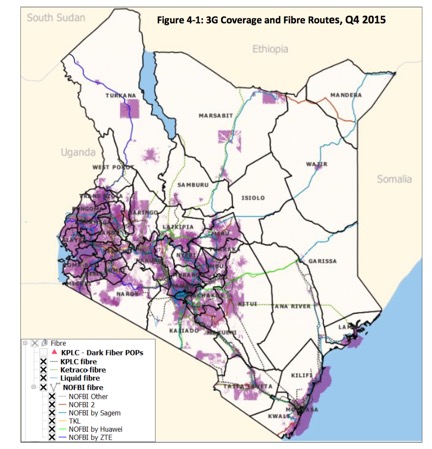
However, Lodwar has 3G coverage and a line from the National Fiber Optic cable, which is not fully connected yet. Thus, connectivity is basic at best and not as robust as it could or should be.

3G-coverage map courtesy of Communications Authority of Kenya

I had the honor of speaking at the opening of a new building for self-directed learning, where I got to hear about the journeys of Learning Lions students who learned how to create websites and multimedia work, 3D modeling, and animation and design — just a few courses offered at Learning Lions.

What happens when connectivity is provided?

Even with basic connectivity, Learning Lions showed me that connectivity creates opportunity. Knowledge becomes more accessible, so students can complement the instruction they receive with online knowledge and additional training. Students can also connect with online communities in their field to learn more.

Trailblazing global problem solvers

Last year, I had the honor of speaking at the graduation ceremony for the first cohort of Learning Lions, where I met a group of youth ready to advance their skills. Among them were Isaiah Mutekele and Enomat, who went on to become Startup Lions entrepreneurs and were finalists in the first ever Aeromobility startup competition in East Africa.

This story of young people getting trained, honing their skills, and becoming entrepreneurs encourages me. What has become clear in my experiences with Learning Lions is that there is talent in Turkana, just as there is in Nairobi or New York. Indeed, talent is evenly distributed, but opportunity is not.

That’s why I’m proud to partner with Cisco to help extend opportunity to as many hubs, locations of learning, entrepreneurs and global problem solvers as possible.  The Cisco Global Problem Solver Challenge is just one of many such opportunities to show how the ideas, technologies, and solutions of young innovators can help benefit the economy, society or environment.

With Learning Lions, we see what connectivity, knowledge and opportunity can bring forth, and my hope is that we can not only support, but elevate the work of young people in Kenya and globally.


If you’re a student or recent graduate with a technology solution that could make an impact on the world, apply for the Cisco Global Problem Solver Challenge here. With $300,000 in prizes to accelerate your product or solution, now’s your chance to truly digitize and do more good.

Submit your solution by December 1, 2017.

Authors

Austin Belisle

No Longer with Cisco