Wow! OFC is going to be another really great event this year. If you’re like me, you already have a busy schedule planned, there are just so many great speakers, sessions, and workshops available to choose from – including some excellent sessions and topics featuring Cisco’s own Bill Gartner, Ron Johnson, Walid Wakim and Carl Moberg.
Make Sure You Stop by and See Us at Booth #1501
Although it may be hard to find the time to break away and visit the exhibit hall, I really encourage you to do so. We’ll be demoing some cool technologies including our QSFP-DD pluggable transceiver form factor for 400G applications, and our Optical Multi-Tenant technology, which can be used to embed and manage Optical VPNs, instantiate and delete optical circuits, and leverages the restoration capabilities of GMPLS to provide OVPN-specific restoration of optical connections. And we’ll also be showcasing some of our industry-leading optical network solutions that can help you to simplify the network and make it more agile; make more money faster, and cut both cost and complexity when deploying new services.
Our theme for this year’s event is “There’s Never Been a Better Time to Transform Your Network,” and we’ll show you exactly how you can do that using our open network architecture in conjunction with our Transport Network Modernization, Central Office Transformation, and Data Center Interconnect (DCI) solutions.
Live Demonstrations
We have a great lineup of demos this year, be sure to stop by and see some of these in action:
• Automating Optical Interconnects for Web-Scale
• QSFP-DD Pluggable Transceiver Form Factor for 400G Applications
• Telemetry Driven Automation
• Service Lifecycle Management: From Planning to Assurance
• Optical Multi -Tenant Solution
Meet with Cisco Executives and Subject Matter Experts
OFC is a great time to meet with Cisco executives and subject matter experts. Our team will be available to meet with you to discuss your current challenges and opportunities. To request a meeting, contact your Cisco account manager.
Vulnerability Discovered by Cory Duplantis of Cisco Talos
Overview
Talos is disclosing TALOS-2016-0227 / CVE-2016-8714 which is a buffer overflow vulnerability in the LoadEncoding functionality of the R programming language version 3.3.0. The R programming language is commonly used in statistical computing and is supported by the R Foundation for Statistical Computing. R is praised for having a large variety of statistical and graphical features. The vulnerability is specifically related to the creation of a PDF document.
UPDATE: It was recently disclosed that in addition to Content-Type being vulnerable, both Content-Disposition and Content-Length can be manipulated to trigger this particular vulnerability. No new CVE was listed, however details of the vulnerability and remediation are available in this security advisory.
Talos has observed a new Apache vulnerability that is being actively exploited in the wild. The vulnerability (CVE-2017-5638) is a remote code execution bug that affects the Jakarta Multipart parser in Apache Struts, referenced in this security advisory. Talos began investigating for exploitation attempts and found a high number of exploitation events. The majority of the exploitation attempts seem to be leveraging a publicly released PoC that is being used to run various commands. Talos has observed simple commands (i.e. whoami) as well as more sophisticated commands including pulling down a malicious ELF executable and execution.
With exploitation actively underway Talos recommends immediate upgrading if possible or following the work around referenced in the above security advisory.
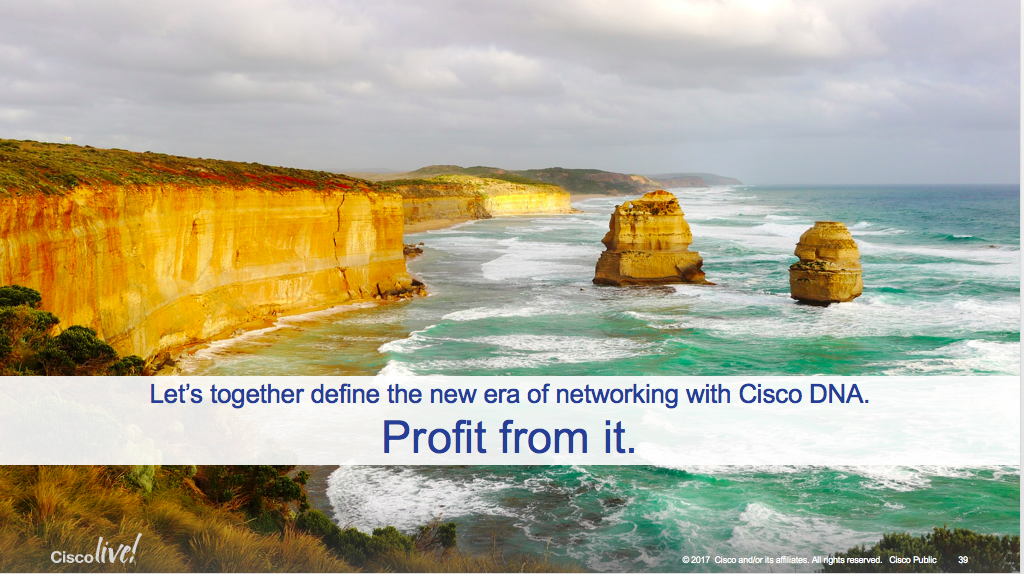
Digitization opens up an amazing opportunity to create new capabilities, richer experiences and an unprecedented economic opportunity. And yet, research shows that digital disruption will also displace four out of the 10 top companies by 2020. Those that succeed will have one key asset in common: a digital ready network. To be prepared, organizations must fundamentally change how they build, manage and secure their networks. This is the new era of networking.
The network of the future is simple intelligent, automated and secure. Cisco is at the forefront of this transformation with our Digital Networking Architecture or DNA as we refer to it. DNA is a blueprint for organizations to build digital-ready networks. IDC recently surveyed 2,054 global organizations across 10 countries to determine the digital readiness of their networks. Their research revealed that companies that have invested in modern network capabilities like DNA are experiencing two to three times the rate of growth in revenue, customer retention and profit.
But that’s not all! DNA has also spawned off over 250 innovations in areas like fog computing, streaming telemetry, connected buildings while contributing to industry bodies like the IETF. This has a profound impact on how we’re taking the industry along on our path to create the network of the future. Likewise, we’re building industry-leading partnerships with companies like Apple to enable richer customer experiences.
There are several far-reaching technology implications of digitization. This includes – proliferation of cloud-delivered apps and services, the exponential growth in connected devices coupled with the ever-increasing security landscape and how network analytics can be tapped to drive business outcomes. With DNA, organizations can usher in a new era of networking, where the network becomes a platform for insights, automation and security, simplifying IT and providing businesses with greater agility and efficiencies. This is the essence of Cisco’s software-driven approach to networking.
Enterprises must build the networks of tomorrow, today. The future is now. Join us on this journey and profit from it.
Last week we shared a video and guest post from Cecilie Sindum, co-founder of Denmark’s Orthodox Design. She writes about how her small, family-run homeware design startup is using Cisco Spark to grow its business. Stories like these play a large part in how we design our products. And we get them from going to places where creative thinking has no limits.
To that end, this weekend we’re heading to Austin for SXSW Interactive: the mecca for design-thinking people. If you’re there too, we’d like you join us at Cisco Spark Haus at Parkside on Sixth Street from March 11 to 13. There you’ll find a heavy focus on how we bring approachable, thoughtful, and intentional design to everything we do.
We’ve designed Cisco Spark Haus in a way that literally brings our products to life. And not just everyday life, but life as it is in Austin during one of the world’s most eclectic tech shows. It’s a showcase that we’re excited to bring to customers, startups, end users, and special guests.
We’ll be collecting input from people at our event — as well as online — to shape some of the next applications we’re building into our products.
One particular guest that I am most excited about is our good friend Jason Calacanis. Serial entrepreneur turned angel investor, he was founder at Engadget and most recently Inside.com and LAUNCH. Jason also leads the popular video podcast, This Week in Startups.
I’ll be joining Jason at Spark Haus to film a live episode on Monday, March 13. In it, founders attending SXSW will have the chance to pitch Jason for five minutes and receive feedback on their business plan design. What an opportunity!
Stay tuned to our social accounts to learn more about how to participate in Cisco Spark Haus if you’re in town, or how to tune in live if you’re not. @ciscospark and fb.me/ciscospark
Last year, Cisco launched Distribution Sales Visibility (DSV) and began deploying it, country by country, across our distribution channel. Distis in Canada and the US are all now using DSV.
A Step toward EoDB
The whole point of DSV is to make Cisco easier to work with for our distributors and for the resellers they support. In most cases, it reduces the crediting of bookings to the Cisco sales team to hours vs. days, and removes the $100k order minimum. It also helps distributors leverage existing inventory and deliver the value-added services that give partners a competitive edge. It replaces Channel Bookings Neutrality (CBN) – a welcome change for many of us – and puts distribution ordering on equal footing with direct orders.
Yes, CBN is going away.
We started with POS. Under that system, Cisco account managers received sales credit for distribution orders several days after the order was booked. Sometimes it took weeks. Compare this to direct orders, which receive same day credit, and you can see how distribution became a less productive and less attractive option. POS also made sales forecasting difficult, negatively impacting visibility, bookings attainment, and customer satisfaction.
We implemented CBN in FY10 to solve these problems, but we were still left with certain limitations that slowed down product delivery and management of inventory and returns. Distribution was still working at a disadvantage and it made us a less competitive fulfillment path.
Benefits of DSV – Distributor, Partner, Cisco Sales
DSV helps make distribution as attractive a route to market as direct, and sometimes more so because it allows our partners to leverage distributor value-add and decreases time to market.
The benefits are across the board for everyone in the sales cycle.
For partners, the process of ordering through distribution does not change, but there is now a single process for assigning sales credit to the Cisco field – and it’s fast, equalizing direct and 2T routes to market. Partners and their customers will also get improved lead times, since Distributors are able to leverage their inventory for any order.
For our distributors, this is another step in our quest to improve your ease of doing business with Cisco. We eliminate the complex and resource intensive CBN process for virtually all orders, and we enable you to deliver any order from inventory, increasing turns and improving cash flow.
Nicko Roussos, a director of the Cisco Solutions Group at Tech Data, has been using DSV and has this to say: “DSV is a program that solidifies Cisco’s commitment to distributors and the partner community at large. CBN enabled all stakeholders to work together collaboratively, substantially reducing the channel conflict that may have existed previously. DSV furthers this agenda, but does so with immense operational efficiency. All parties involved can now refocus the afforded capacity to add incremental value into their customers.”
Implementation Schedule – Americas
We are well into our rollout plan in the Americas, with Canada, the United States, and Miami export into Latin America up and running. We plan to expand into Latin America in our FY18.
Co-written with Patrick Warichet, Technical Marketing Engineer
I’ve been asking that question to many Service Providers and I’ve always got unclear answers. Either they don’t have the answer handy or they don’t really want to share this insight fearing to be compared with their peers … Without disclosing any secret here, answers range between a few hours and a few days or even weeks.
Do we have any industry benchmark? Yes! Best-in-class Hyperscale Web Providers can achieve this stunning result – 15 minutes from truck to live traffic deployment!
Of course, time matters but it should not be the unique criteria for assessing performance in that space.
What about the resources you need for that operation? On-boarding new devices has always been a tedious task as it relies upon manual processes and tight synchronization between teams across different departments.
Do you believe this mode of operation is still suited to the pace of change you’re dealing with?
I bet the answer is no! So, what can we do about it? Simply automate the entire process.
Once you remove your IOS XR device from its box and get it racked and cabled, the first step is to boot it.
In the past, you would have sent someone over with a USB key on which an ISO image is stored. This person would have inserted the disk in the system, and booted the ISO using some BIOS commands.
The good news is you can avoid this manual step. Are you in any ways familiar with iPXE?
In case you’re not, go and check some information about iPXE, the leading open source network boot firmware. iPXE brings some key enhancements to PXE such as:
Boot from a web server via HTTP
Control of the boot process with scripts
Support for iPXE boot is included in the system firmware (UEFI) of our NCS1K, NCS5k and NCS5500 series routers.
iPXE can act as an NOS installer for IOS XR. It gives you a lot of flexibility in choosing the image the system will boot based on the system Platform Identifier (PID), the serial number, or even the management mac-address. We recommend you use iPXE in case your system does not have a valid image on the Flash filesystem or if you want to re-image your system.
At this stage, your device has booted with a valid image and you’re ready to move on to the next step, the configuration of your device. Here again, no need to send someone for doing the basic configuration.
With automatic provisioning, you can greatly simplify configuration and customization task and operate at scale. This process is activated at the end of the previous step and offers you two options.
The first option lets you merely apply a configuration of your choice to your device. Very standard procedure.
The second option lets you refine and customize the provisioning phase the way you want using scripts and tools available inside Linux. Your scripts can update or install IOS-XR and third party packages, manipulate the configuration, etc. …
As an example, your script could install and launch a Chef or Puppet agent, these agents, in their turn, could install specific configurations or packages on your device.
What I’ve just described above is actually what the industry at large names Zero Touch Provisioning (ZTP).
So what’s in it for you?
A clear path towards the automation of on-boarding new devices in your network infrastructure.
It’s available now so don’t wait for saving on time and resources!
If you feel ready to make Zero Touch Provisioning to the test, check out these tutorials:
Ransomware continues to be a plague on the internet and still sets itself as the fastest growing malware family we have seen in the last number of years. In this post we describe the technical details about a newly observed campaign of the notorious Crypt0l0cker (aka TorrentLocker or Teerac) ransomware. Crypt0l0cker has gone through a long evolution, the adversaries are updating and improving the malware on a regular basis. Several indicators inside the samples we have analysed point to a new major version of the malware. We have already seen large campaigns targeting Europe and other parts of the world in 2014 and 2015. It seems to be that the actors behind these campaigns are back now and launching again massive spam attacks. This post will also give you insights about the level of sophistication this malware has reached.
Simplification, automation and virtualization are words that have been used by marketers, like myself for years. I think we can all agree, at some point, for these words to become reality, the “software innovation rubber” must meet the road. Technology decisions must be made and deployments have to happen which utilize software innovations from vendors and OpenSource communities, in harmony, and only then, will provider networks transform to support the next wave of services.
Cloud-Scale Networking, Central Office Transformation, The Internet of Everything, Infinite Video, millions of applications driven through mobile devices and the ever changing enterprise landscape need to be supported. The puzzle pieces are many and the way we were building networks will not necessary work to support future needs. Does this mean our current networks are bad, or without value? Absolutely not! After kicking the “technology tires” for years, it is clear network transformation is not easy and we can’t transform on our own. We will transform together.
This is why if you are a network transformation junkie, there is no better place to be than at MPLS+SDN+NFV World Congress on March 21-24, 2017 at the Marriott Paris Rive Gauche Hotel and Conference Center. Ask any previous attendee, and they will tell you the value of attending this event.
Why is this event so powerful? It’s simple. This is the event where the “software innovation rubber” meets the road!
Industry experts from operators and vendors are under one roof for an entire week. They present real live use cases and technology demos. They are honest about what works and what does not and this is based on real deployments in live networks. Sometimes, conversations get interesting because the best of the best attend and there is no room for fluff or “belief system” based ideas without actionable outcomes to solve network transformation challenges.
Don’t take my word for it, look at the below quote given last year at the conference by Stephane Litkowski from Orange Group. This was originally published in a blog by my colleague, Frederic Trate. See the entire blog here.
Stephane did in-depth testing of micro-loop avoidance code provided by Cisco and shared great insights at MPLS World Congress 2016.
This is what Stephane has to say about it at Cisco’s Segment Routing software innovation:
“Customer expectations in term of quality of experience are growing with the criticality of their applications. As MPLS transport is the foundation of our services, we must make it the most efficient and robust, also because bad things can happen in a network and network must dynamically adapt without disrupting customer applications. In this area, micro-loops have always been a pain for networks by breaking fast-reroute or creating micro-congestions. Orange was interested in micro-loop prevention for many years by investigating, evaluating, implementing multiple solutions. But all those past solutions were only partial or too complex to be deployed in a live network. Now, thanks to the Segment Routing building blocks, we have the technology to easily build loop-free paths in the network in a simple way. We consider Segment Routing as an enabler to prevent micro-loops in IP/MPLS networks. We already evaluated Segment Routing micro-loop avoidance in our labs, showing impressive results: we will deploy it for sure!”
Powerful stuff! The only question left on the table is… Why haven’t you purchased your ticket to Paris yet? This is an event you don’t want to miss!
Cisco Sponsored Activities at Conference:
Cisco’s Pre-Conference Customer Network Transformation Workshop March 20, 2017 from 1:30PM – 5:30 CET, on Level – 1 in Salon GHIJ. Cisco Customers can register for the workshop here.
The agenda will cover software innovations in the following areas:
EVPN
Segment Routing
Presentation by Bell Canada on Central Office Transformation
Model-Driven Telemetry
Automation with Network Services Orchestrator
SD-WAN
Cisco Customer Reception Monday, March 18, 2017 from 5:45 – 8:00 P.M. CET at the R’Yves Restaurant at the Marriot, Level 2
Visit the Cisco Booth #312 to see Cisco IOS XR Software Innovations for Network Transformation.
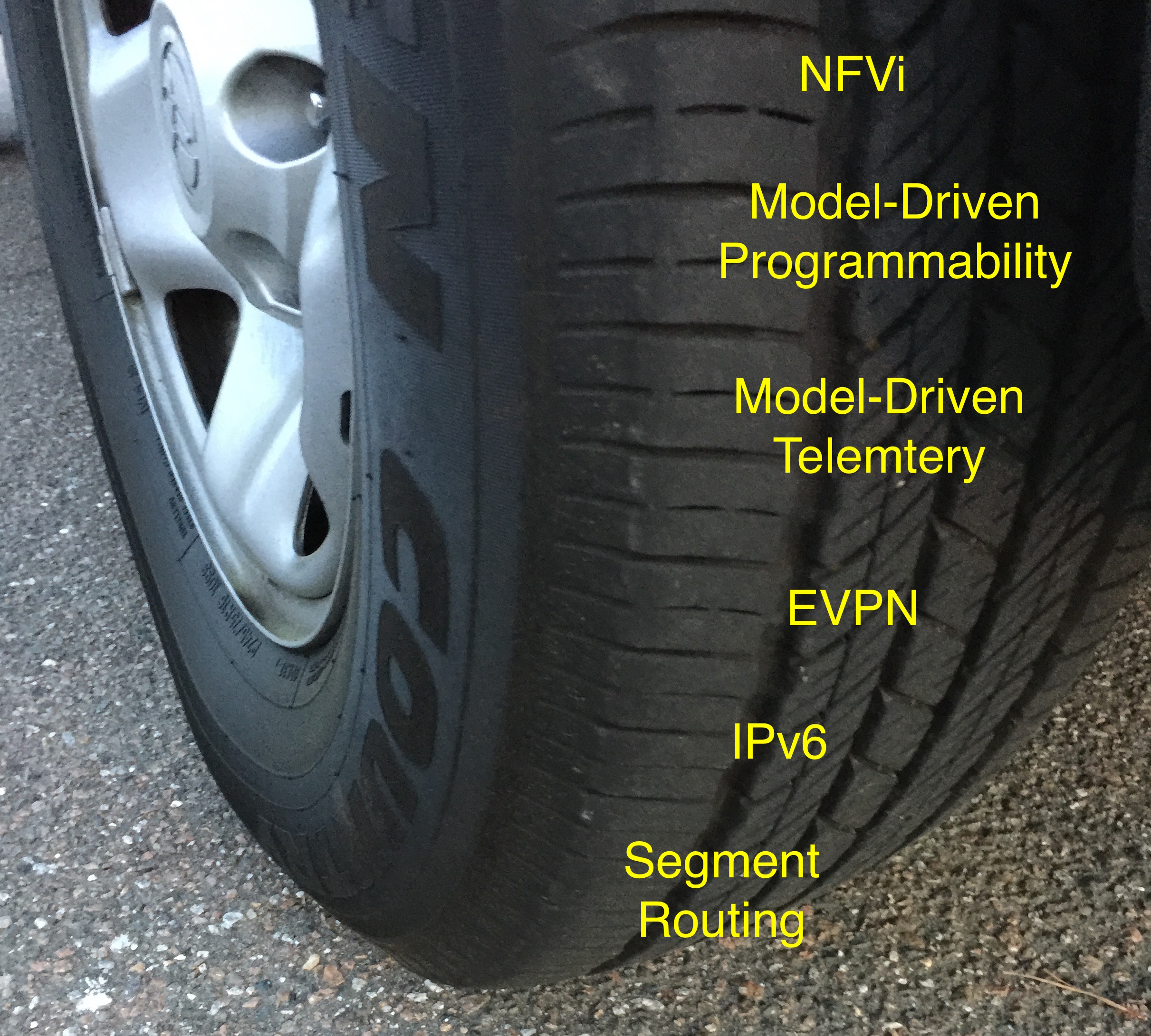
This includes demonstrations of Segment Routing, IPv6 Segment Routing, Model-Driven Telemetry, NFV Infrastructure (NFVi), Cisco Network Services Orchestration (Tail-F) and SD-WAN.
Schedule a private meeting through your account team with one of the many Cisco subject matter experts on site. If your account team is not available, you can stop by Cisco Booth #312 on-site at the show to schedule a private meeting.
For those of you who have not registered for the event please feel free to use Cisco’s 35% off VIP discount code: CIS35vipenton2017
Cisco’s Speaks Include:
David Ward, Engineering CTO and Chief Architect – Keynote
Carl Moberg, Technology Director – Orchestration – MPLS SDN Track