Upgrading your hardware is a great way to strengthen your network without spending a lot of money. Mexico’s Universidad Panamericana recently found itself in a tough situation when the college’s IT staff determined that their patchwork network couldn’t cope with the demands of its users.
Universidad Panamericana is one of Mexico’s top private universities and is spread out over four separate campuses. There are over 40,000 students, staff and faculty trying to connect to the university Wi-Fi, so this is a network that needed dependability first and foremost. With a 50 percent rise in device use trend on its main Mixcoac campus in Mexico City, this was a situation that was only going to get larger. The IT staff needed a fast and reliable fix for its network, but also one that wouldn’t break the bank.
Thanks to a Wi-Fi network upgrade, Cisco offered the best value for the money.
“Cisco was at least 50 percent cheaper once running costs were factored in,” said Luis Enrique Gómez Sutti, IT Infrastructure Manager at the Universidad Panamericana Mexico City campus. “Plus there was no learning curve.”
Seventy percent of the existing access points needed a software upgrade, which meant that only 30 percent of the hardware had to be replaced. The Mixcoac, Guadalajara and Aguascalientes campuses were all brought up-to-date with new Cisco access points, switches and controllers. The new products that made up the infrastructure include: Cisco Aironet 3700, 3600 and 2700 Access Points, Cisco 8500 and 5500 Series Wireless Controllers and a variety of Cisco Catalyst and Integrated Service routers.
With this new infrastructure suppling high-speed Wi-Fi, the entire college community is using the network more than ever before.
“The average device numbers per user have gone up from 0.5 to three in the last 10 years,” said Ernesto Jonnatan Arroyo Pilatowsky, IT Director at the Aguascalientes campus. “With Cisco we’ve overcome this device growth while increasing Wi-Fi coverage from 80 to 100 percent.”
And it’s not just fast internet that the Universidad Panamericana is thankful for, the built-in Cisco security is great too. Cisco Prime allows a simplified IT management that proactively supervises network usage and allocation. Any problems are quickly targeted and fixed.
Digitization has opened up a myriad of new applications, efficiencies and innovations. Along with all this progress, however, comes a continued and urgent need for more advanced and effective security at the very foundational level–the network node and network systems.
From phishing and malware attacks to advanced persistent threats to SQL injections and everything in between, malicious security threats to the network are all around us. Attackers could significantly amplify the impact of an attack by targeting a specific network node that provides connectivity to multiple users, rather than targeting each user independently. Imagine a scenario where an adversary successfully runs modified software on the network node. A hacker could potentially tweak the software to get copies of every packet that transits the network node, or plant malicious software in all the end-points that are connected to the network. The increased complexity of a universally-connected network by definition allows for more threat vectors that must be protected from both simple and sophisticated attacks. In effect, the network as a whole is vulnerable, but fundamentally more so at the level of the network infrastructure.
A great example of the risks that are associated with the ubiquitously-connected network of the future was a bug for the website heartbleed.com. Heartbleed.com’s security vulnerability, one of the worst in the last decade, was due to an improper input validation in an OpenSSL crypto library that resulted in information assets being hijacked widely across numerous openings. Likewise, another security incident called “Dirty COW” emphasized the real threat and how important it is to take preventive and proactive action.
Cisco is embedding security across its networking portfolio through an integrated architectural approach towards creating a secure, resilient network foundation for digitization. With security embedded across multiple Cisco platforms, Trustworthy Systems is built for today’s threats. The holistic approach provides comprehensive verification of hardware and software integrity by securing the device, securing network communications and securing applications. Securing the device translates to protecting production, delivery, boot and runtime of devices which ensures that no one can tamper with the software that will be hosted on the device during the entire lifecycle of the product. Securing protocols and defaults ensure secure communication across the network thereby protecting the device from being attacked by an individual with malicious intent. Lastly, ensuring the security of our open containers, VMs and sandboxes aids in securing applications. This helps reduce vulnerabilities and risk, increases visibility into platform integrity and allows for faster identification and remediation of threats.
Embedded security translates into process-based security and security technologies that Cisco has created. The former includes all aspects across the secure development lifecycle including product security requirements, third-party security, secure design, secure coding, secure analysis, and vulnerability testing. Trust anchor technologies like signed images, secure runtime defenses and trust anchors enable the building of secure product lines.
This mesh of security allows us to guard against a whole spectrum of attacks including reconnaissance attacks, counterfeit avoidance, DoS attacks, advanced persistent threats, repudiation attacks, brute force attacks, side channel attacks and more.
Fostering excellent security and staying one step ahead of attacks is a challenging, high-stakes game. However, managing our innovation trajectory without compromising on security is what keeps us going. Our march towards the new era of networking is only complete when we ensure that it is easy to use, seamless, automated and fully secure.
As always, would love to continue the conversation @aoswal1234.
Technological progress is resulting in computing systems that are smaller, cheaper and consuming less power. These micro-computing systems are able to be integrated into everyday objects; when coupled with ubiquitous wireless connectivity these devices form the “Internet of Things”. The IoT has the potential to improve our lives, but only if we correctly manage the security risks which are inherent to these devices.
Save the Children believes every child deserves a future. In the UK and around the world, Save the Children gives children a healthy start in life, the opportunity to learn, and protection from harm. Our mantra is to “do whatever it takes” for children – every day and in times of crisis – to transform their lives and the future we share. Last year we helped over 17.5 million children through our work.
Providing the right information to decision makers, donors, fund raisers, and foundations is a critical enabler for our mission. But a myriad of internal and external data sources, plus the need to quickly respond to world events, make delivering insights a significant data integration challenge. And with 91% of the funds spent on charitable activities, leaving just 9% for fundraising and all other costs, technology investments must be prudent and effective.
Formerly, our IT landscape was afflicted with many of the same issues other organizations face:
Redundant data with different answers
Difficulty extracting value due to no single view or real-time data
Lack of agility to respond to business needs in timely manner
No shared metadata specification
Insufficient data governance and ownership
We needed a better way – so we designed a new data, analytics, and insight architecture to help meet our mission and overcome technical challenges.
We launched three key initiatives
The first initiative we launched was a new approach to data modeling called the Common Business Model. The Common Business Model allows the business to centralise their data to create a single source of truth, which is used for applications and reporting. Additionally, it helps the business enforce a standard data model, governance, ownership, and architecture.
The second was chartering an internal group to build and maintain these models. We brought together representatives from every department, including data owners, and formed the Common Business Data Panel to agree on (and determine ownership of) the rules, definitions, and processes for data that goes into the Common Business Model. The panel also helps contribute to a business data directory, approves any changes to the Common Business Model, and regulates what can be seen in the model and by whom.
The third was to coalesce around best-in-class data and analytics products, including those shown below.
Data virtualization was a new addition. Cisco Information Server was selected to instantiate and operationalize the Common Business Model.
We saw fast results
We achieved the following milestones in a very short time:
Delivered a consistent, single data view to Adobe Campaign Manager regardless of original source
Began plans to replace a legacy data warehouse with a virtualized feed to save costs while providing more consistent reporting
Reduced interim staging environments, and their associated storage costs and ETL processing workloads
Finally, we leveraged Cisco Information Server’s agile and iterative coding capabilities to prove a successful, agile delivery process across business and IT. This level of agility couldn’t be done using a traditional waterfall delivery model, and is now the standard model for our software development.
“The way of collaborative working has been transformational. Previously, the business would provide detailed requirements (sometimes utilizing BA resource), and then IT would development and test. This process has been streamlined as we all now work as one team and can accommodate change as the work progresses. For example, data discovery can identify changes in requirements and we can now make (and see very quickly) the results.”
We are positioned to build on our success
With data virtualization skills, infrastructure, and agile delivery processes in place, we are well positioned to build on our success. Partly funded by savings from our first initiatives, a number of projects have been identified and commenced including:
Refine and expand the Common Business Model
Further integrate with Adobe digital platform
Deliver projects continuously as required by the business pipeline/roadmap
Advance the new data, analytics and insight architecture
I knew our rescued Dalmatian mix Proteus was something special. What I didn’t realize was the special moments we would be creating as we used our Cisco volunteering hours together after he became a therapy dog.
Proteus is the Son of Poseidon, as you may know, from Greek Methodology, and the name definitely fits him. Part hound, Proteus can be a little goofy, but is also regal at the same time. He likes to play dumb, but don’t let that fool you – he is actually quite smart.
We found Proteus at a Dalmatian rescue. He was airlifted from Cincinnati during heavy floods to the Virginia area, and eventually found his way to a local Dalmatian rescue we had previously adopted from. When I called to ask about a male to keep our female company, they said, “Boy, do we have a dog for you!” We connected instantly, and could not believe how well balanced and sweet his demeanor was!
It’s been five years since we adopted him and now I can’t imagine our family without him.
I always thought that Proteus would be a great therapy dog. He is quiet, secure with himself, happy, and well balanced. Nothing bothers him. He doesn’t bark and he only howls when he wants some attention or when he is happy. So, I set off to have him cleared to visit nursing homes, shelters, and hospitals, and was told that he was “a natural; and made for this job”.
Eventually, we began visiting our local hospital, Mease Dunedin, under their Caring Paws program. Proteus even has his own name badge for when we visit; and I was happy that I could work out a schedule with the hospital that is flexible. Proteus and I visit the hospital for two hours every Thursday morning, as long as I am not traveling. We’ve been visiting the hospital since last summer; and we both really love it!
I couldn’t do this without the flexibility and encouragement that Cisco provides to give back – and knowing that they support such incredible causes and allow us to choose how we volunteer our time truly means the world to me. But, I think the most rewarding part of our volunteering is seeing a patient’s eyes light up when they see Proteus walk into their room – they tell me that we’ve made their day! It makes me so proud to work for a company that enables us to be able to contribute in such a way to our local communities.
During one visit, there was an older woman in her late 80’s, crying in her room while she was on the phone. I didn’t want to disturb her, so I didn’t ask to go in initially, but one of the nurses told me to try. As soon as she saw Proteus, her tears stopped. She reached out to pet him, and we sat there for about 15 minutes visiting with her. She felt comfortable enough to tell me about her situation, and having Proteus there helped her to calm down. By the time we left she was actually smiling. That was a really good day.
Both my parents spent a lot of time in the hospital before they passed away recently. I know if they had a Proteus to visit with them that it would have made them so happy. I do this to also honor their memory because they loved dogs so much which makes this even more meaningful for me.
My motivation is to help people smile a little bit in a place where they are most likely to be in physical and emotional despair. It reminds me how precious our health really is, and how we can all help each other to smile a little bit more.
An unexpected bonus too — The Staff at the hospital loves seeing Proteus! When we go by the Nurses’ station, they crouch down and open their arms for him. We spend about half our time with the Staff – when people work such stressful jobs, seeing a dog can release that stress and give them just a moment of true happiness. I had no idea we could make a difference with their day too, but I am so glad that we do!
If you’re interested in having your dog become a certified therapy dog, I would recommend you work with them early to be a good Canine citizen. If your dog is calm, well behaved, and has a minimal level of obedience training, he/she will do just fine. The investment in time and love comes back to you many times over. Proteus and I have bonded in a unique way during our times at the hospital and somehow he knows when it is Thursday morning. He can’t wait to get in our Van!
My only other suggestion would be to just do it! Google “pet therapy” in your area and make the time to get out there with your Canine kid to have them certified. It’s an easy process and you definitely will not regret it. Then both of you can use your Cisco volunteering hours together!
Interested in joining a company that encourages you to give back? We’re hiring – join us!
Discussions of enterprise storage networking often focus too much on the speeds-and-feeds of a given technology or system and very little on the use case. Is Fibre Channel faster than IP storage? Is IP storage easier to manage than FC? What about uptime and other high availability matters? And so on.
But if you look at the need for these technologies from the end-user perspective, the discussions become much more interesting. The new use cases for IP-storage, such as Big Data Analytics, Video Surveillance, Hyper-convergence, and Tele-Medicine applications, to name a few, have set the stage for renewed interest in converged storage networking.
With the introduction of the Cisco Cloud Scale (ASICs), Cisco is capable of delivering the next-gen architecture for any IP Storage network. These platforms provide the switching foundation to host the most demanding customer applications. Cisco Cloud Scale introduced a revolutionary technology called Smart Buffer in conjunction with QoS. Customers can now take advantage of these capabilities and build their IP/Ethernet-based storage networking based on their requirements with the Cisco Cloud Scale switching platforms.
Cisco advanced capabilities include:
Smart Buffers for intelligent congestion control mechanism for efficient IP Storage
Flexible performance options from 100 megabytes to 100 gigabytes in port speed
Lossless fabric-wide architecture to support any storage traffic
Seamless connectivity for distributed apps via container-based micro-services
Why Smart Buffering for scaling IP storage?
Let’s take a deeper dive into just one of these capabilities: smart buffering. When operating correctly buffering is essential to both maximize network capacity and minimize application and storage traffic latency ensuring the optimal application and storage response times.
I’m thrilled to announce Tech Field Day is returning to Cisco Live this year and on June 27, Cisco will be presenting a full DNA focused day.
If you’re skipping Cisco Live, or just don’t feel like leaving your hotel suite at that particular time, Tech Field Day is live-streamed (for anyone to watch) and a great learning opportunity that also promises to be highly entertaining. Mark your calendar for June 27 to watch live here or on Tech Field Day.
Last year I was excited to blog about the Apple and Cisco partnership. It was amazing to see the opportunities being created for developers with iOS 10. A lot has happened since then, and the opportunities for developers just keep getting better!
Now we are happy to announce DevNet Fast lane validation for iOS developers. Let me tell you more about this…
As a result of the partnership, enterprises are now able to provide higher quality Wi-Fi connections, and give priority to business critical apps within their network environment. This gives businesses a technical advantage of great importance, as mobile apps have become the primary vehicle for reinventing entire workflows that transform businesses.
When deploying new services, enterprises want to make sure that the applications critical to the productivity of their employees or customers get priority treatment.
I have a daily example that’s close to home. My two year old daughter hates getting the “poor connection” message when talking to grandma and grandpa. (That’s her “business critical.”) You can easily imagine how poor Wi-Fi connection or poor performance on the enterprise network can get in the way of business in industries like healthcare, manufacturing, financial services, or retail. For example, when a shopping mall or amusement park wants to offer an AR/VR experience for their customers, the business owner can prioritize that mobile app in their business network by using the iOS 10 SDK to tag your app and its data as business critical for QoS.
We all know that not all apps have the same importance to a business, and that latency sensitive services like voice and video greatly benefit from a little VIP treatment on a network. Often however, the hard part is creating a full enterprise environment with the right infrastructure to automatically ensure that the right apps are operating most efficiently, and the iOS device is being prioritized on the network. This priority gives preference to apps that are necessary to get important work done. Think of it as giving high priority apps a ‘Fast lane’ on the network.
To assess apps in a real enterprise environment, a number of healthcare applications were tested in-house with actual business critical software running on iOS devices on a Fast lane capable network. Ensuring that all patient information flows over the air to the caregivers and providers can be critical in a hospital environment and also dependant on the network infrastructure. The results showed significant improvement in audio and video quality as well as optimized roaming between access points, which are all business critical critical in a healthcare setup.
Observing such results sets an important prerequisite for iOS app developers who design and build these business apps. So in DevNet we have expanded our work with third party iOS app developers to support them in validating that their mobile apps are accurately tagged for QoS, so they can be optimized for Wi-Fi, and prioritized for Cisco Wi-Fi networks. We call it the “Fast Lane Validation Program”.
Cisco DevNet now offers a service especially for iOS app developers to verify their iOS app functionality on a Cisco infrastructure without having to spend thousands of dollars on a test bed. DevNet provides a Cisco enterprise and cloud-managed Cisco Meraki infrastructure test beds for testing QoS tagging of their apps. With the latest announcements from Apple earlier today, DevNet is working to expand the validation processes to include iOS 11 and macOS as part of the test bed. Interested developers can now learn hands-on on how Fast lane improves app performance and communicate directly with the Cisco DevNet team via our website.
Another opportunity that exists for iOS app developers is the recent availability of the Cisco Spark SDK for iOS. This developer kit makes it easy to embed Cisco Spark capabilities into apps for iPhone and iPad. What that means is, we give you amazing audio and video capabilities, and you add them into your existing app workflow and or user interface. No need for users to switch apps or disrupt their flow. A person ordering an item through an app can reach customer service directly from their ordering screen during a purchase without ever leaving their app.
And if the application has been using the correct QoS tags to be optimized for business, your video calls inside your apps will get priority on your Cisco Wi-Fi network.
The capabilities of the SDK enable unlimited customization and applicability for your industry, especially financial services, healthcare, sales and marketing, task management, retail, and even remote tech support or mobile service-worker use cases.
Find more, including Getting Started guides for each of the widgets and SDKs, on the Cisco Spark SDKs and Widgets page. It’s fast and easy with a few lines of code. Get hands on experience with Cisco Spark integration with DevNet.
I would like to invite all app developers working on enterprise apps to reach out to us at Cisco DevNet. We can help you get your iOS apps validated and marketed to the enterprise audience. Reaching us is easy…go to https://developer.cisco.com/site/apple and click the Contact Us link at the bottom of the page.
Just last month, DevNet sponsored its first-ever developers conference – DevNet Create. For the event, Apple and Cisco partnered to create iOS mini-hacks around QoS tagging and Spark integration. It was a fantastic way for the developers to get hands-on experience with the technologies in a venue with Cisco experts right there to support them. The response from developers was so positive we’ve committed to bring the mini hacks to the DevNet Zone at Cisco Live Las Vegas later this month. I hope to see you there!
Watch for more enhancements to be introduced over the next few months that further enrich experiences for our users and developers working with Apple products used in the enterprise domain. Rowan highlights several upcoming enhancements for our customers within this partnership in his blog, make sure to check it out here.
Let DevNet help you make your apps Fast lane enabled.
Look forward to working with you!
Susie
Susie Wee @susiewee VP and CTO of DevNet
Cisco Systems
It’s hard to believe it’s been a year since we unveiled initial customer solutions from the Apple and Cisco partnership. We started off by seamlessly integrating enterprise calling, prioritizing business critical applications, and optimizing the Wi-Fi experience for iPhone and iPad on Cisco networks. We’ve seen healthy adoption across multiple verticals, including healthcare and retail.
Today, I’m pleased to give you a glimpse into what’s next from Apple and Cisco.
We’re broadening support for optimized Apple devices on Cisco networks. We all want the apps that we rely on for work to simply work, no matter which Apple device they’re using. We are pleased to announce that we’ve extended the “Fast lane” for business critical apps to macOS. This will enable you to be productive and efficient while working on the device of your choice – iPad, iPhone or Mac, even when the network is congested.
We are delivering effortless meetings with Cisco Spark and Cisco WebEx on iOS and Safari. Building upon our commitment to deliver seamless experiences, we are enhancing how Cisco Spark and Cisco WebEx will take full advantage of iOS 11 in three significant ways.
Cisco Spark and Cisco WebEx meetings are now a simple tap away from your iOS calendar or meeting notification.
When joining a Cisco meeting from an iOS device, users will be able to seamlessly share their screen real time with other meeting participants.
Guests and infrequent users of Cisco Spark or Cisco WebEx will be able to quickly join on Safari with full audio, video, and presentation viewing capabilities.
We are also working with Apple and the developer community to help them take advantage of the innovation we’re delivering. Check out Susie Wee’s blog on how Cisco DevNet is helping iOS developers validate their enterprise apps for Fast lane and integrate Cisco Spark video and voice into their apps.
Reach out to your account team if you want to be the first to try these new features. Tune in to Cisco’s annual customer event – Cisco Live! and check www.cisco.com/go/apple as Cisco makes more announcements around our innovative solutions.
What do you think? What else do you want to see? Let me know @rowantrollope.






 Embedded security translates into process-based security and security technologies that Cisco has created. The former includes all aspects across the secure development lifecycle including product security requirements, third-party security, secure design, secure coding, secure analysis, and vulnerability testing. Trust anchor technologies like signed images, secure runtime defenses and trust anchors enable the building of secure product lines.





 My motivation is to help people smile a little bit in a place where they are most likely to be in physical and emotional despair. It reminds me how precious our health really is, and how we can all help each other to smile a little bit more.


 Last year I was excited to blog about the Apple and Cisco partnership. It was amazing to see the opportunities being created for developers with iOS 10. A lot has happened since then, and the opportunities for developers just keep getting better!
 Another opportunity that exists for iOS app developers is the recent availability of the Cisco Spark SDK for iOS. This developer kit makes it easy to
 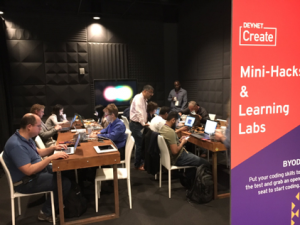 Just last month, DevNet sponsored its first-ever developers conference – DevNet Create. For the event, Apple and Cisco partnered to create iOS mini-hacks around QoS tagging and Spark integration. It was a fantastic way for the developers to get hands-on experience with the technologies in a venue with Cisco experts right there to support them. The response from developers was so positive we’ve committed to bring the mini hacks to the DevNet Zone at Cisco Live Las Vegas later this month. I hope to see you there!