Avatar

#CiscoChampion Radio is a podcast series by technologists for technologists. In this episode we’re talking to Peter Jones (father of the 3850 platform UADP Doppler chip and now UADP 2.0) about The Network Intuitive.

Get the Podcast

  • Listen to this episode
  • Download this episode (right-click on the episode’s download button)
  • View this episode in iTunes

Cisco Guests

Cisco Champion Hosts

Podcast Discussion Topics

  • The beginnings of 3850 (launch Jan 2013) and the journey from 3850 to 3650 and 3650 mini.
  • Why the focus has been on building a platform a la Lego and how customer feedback fed into the evolution of the line.
  • Differences between the UADP 1.0 to 1.1 to UADP 2.0 chips.
  • The importance of visibility to capture issues and analytics and the impact on product development of the chip.
  • New launches: 9300 (stackable access box); 9400 (4500 next gen); and 9500.
  • Defining Programmability: hardware that can evolve.
  • Why the investment on simplifying is important.
  • Design constraints during the development of UADP. 2.0.
  • Design goals for the development of UADP. 2.0.
  • Why they invested in flexibility.

Listen in and provide us feedback, we would love to hear from you!

Resources:


Authors

Andi Fisher

No Longer with Cisco

Avatar

We’ve come a long way as an industry in last 10 years.  As I travel to #KubeCon in Austin, I’m reflecting back on what has changed.

10 years ago, I ran an independent research group called the IT Process Institute, and was lead researcher on a study designed to identify change, config, release best practices.  I had the privilege of working with @realgenekim and personally interviewing IT ops teams from a dozen companies recognized for their exemplary results. From the interviews, we created hypothesis about what practices enabled highest levels of performance. And then collected data from 250 companies in order to test whether those practices correlated with higher performance across a broad industry sample.

Back Then – People were Breaking Things

Change was the biggest cause of system failures.  Applications were hard wired to their environments. Systems were reaching a point of complexity where a single person didn’t have knowledge to understand the impact of a simple change. And people were responsible for making changes. Changes made by people up and down the stack often had unintended consequences. As a result, we used change advisory boards, forward schedule of change, release engineers, and a CMDB to help document dependencies. Change management was a major ITIL process implemented to help gain control. Controls made sure people followed processes, and helped reduce the chaos related to managing brittle, finicky, prickly systems.

The general approach to successful code release, was to test changes in a pre-production environment that was “sufficiently similar” to production, in order to verify changes worked before rollout.

Changes to deployed systems – in response to change request or service impacting incident – often left production systems in an unknown state.  That resulted in additional service quality and security/compliance risk. As a result, the collective “we” IT professionals shot ourselves in the foot over, and over again.

Pinnacle of the Slow and Careful Era

As example of exemplary practice at one organization where the whole IT org’s bonus was tied to down time (think IT group that ran a US stock exchange)

  • Rollouts – including environment and application changes, were documented in a runbook. They practiced and timed the rollouts in a pre-production environment. They knew what should happen, and how long it should take.
  • Rollbacks – were documented in a runbook, and practiced, and timed.
  • Scheduled changes – during nightly maintenance windows. If the rollout wasn’t successful by a pre-set time, they would trigger rollback. A task that didn’t match the runbook also triggered rollback.
  • Devs were banned from Production –  and they had a “break glass” process where developers could fix production in an emergency. But someone from Ops literally looked over their shoulder and wrote down everything they did.

A key question of that time, was how much money to spend on building and maintaining a redundant, underutilized, “sufficiently similar” pre-production environment in order to pre-test changes to ensure success?

Digital Eats “Slow and Careful” for Lunch

The “Slow and careful” era had an inherent conflict built in.  Everyone knew that slowing down improved results. A careful and cautious approach improved uptime and security and compliance related to complex systems. However, that approach turned out to be wholly inadequate as Marc Andreessen realized that Software is eating the world and The lean startup with minimally viable products, and new digital business models (Uber, AirBnB) — all relied on getting new products and features into users hand faster, not slower.

Looking back at my interview notes, 10 years ago, I asked everyone “What metrics do you use to measure success?” Everyone measured uptime and change success rate. Nobody measured frequency of change, or time between change request and completed change.

Along Comes Kubernetes

At same time I was conducting this research, Google was building Borg the first unified container management system. Their second iteration was called Omega.  Both remain proprietary.  But their third version of this system is called Kubernetes.  And they launched this as an open source project to share their new and powerful way of doing things, and help drive usage of their infrastructure as a service Google Cloud Platform.

Kubernetes is a container orchestration system. But more importantly, Kubernetes codifies a new way of doing things that wasn’t yet aspirational in the “Slow and careful” era. Kubernetes changes how you build, deploy and manage applications – that is “built for purpose” to meet the needs of the digital era.

Velocity is the New Metric of Choice

In the digital era, feature velocity replaces uptime and change success rate as the defining operational metric.

Slow and careful IT – with a focus on uptime, doesn’t support digital business models that need new features to attract users. Fast and careless Dev – that produces unusable or unavailable applications, drives users away.

Velocity – as a measure, combines the two.  It measures the number of features you can ship while maintaining quality of service. Kubernetes and ecosystem tools – give you what you need to move quickly while maintaining quality.

@kelseyhightower, Brendan Burns, and Joe Beda explain in “Kubernetes up and running” that there are three core concepts baked into Kubernetes that enable velocity. And based on my look back, represent an 180 degree shift and transformation from the best practice of the slow and careful era.

  • Immutability – Once an artifact is created, it is not changed by users.  Antipattern: change something in a container or application deployed via container.  It is better to create a new container and redeploy, than for a human to make a change to a deployed system.  This supports a green/blue release process. There is no runbook rollback. There is no “break glass” process for people making changes to deployed systems.
  •  Declarative configuration – Kubernetes objects define desired state of the system.  Kubernetes makes sure the actual state matches the desired state. There is no runbook with a documented series of steps to take.  It does not need to be executed to be understood. Its impact is declared.
  • Self-healing – Kubernetes includes a controller-manager that continuously takes actions to make sure current state matches desired state. People don’t repair (e.g. make changes) via mitigation steps performed in response to an alert or change request. Kubernetes consistently and repeatedly takes actions to ensure current state matches desired state.

Runbooks are replaced by Immutability and declarative configuration. Self-healing replaces “break glass” production repair processes.

I believe Kubernetes is more than a container orchestrator. Velocity enabled by Kubernetes represents a new IT operating model for how applications are built and managed.

I’m excited to see what’s up at KubeCon this year.

Stop by Booth P18 to see how Cisco participates in the Kubernetes community, and offers powerful network and management solutions to help you deploy production grade Kubernetes in your organization.

Footnote

Kubernetes stands on the shoulders of giants, so to speak. Some key stepping stones and enables that make Kubernetes possible and popular now, include:

  • DevOps – culture shift and automation tools that implement the idea that you can speed up AND increase service quality.
  • Virtualization –  VMs abstract applications from infrastructure.
  • Infrastructure as code – configuration tools that help maintain desired state
  • Cloud computing – infrastructure services for rent called via API
  • Software Defined Datacenter – compute, storage and network via API in an on premises infrastructure.
  • Containers – immutable images that bundle an application and all of its dependencies.


Authors

Kurt Milne

Marketing Manager, US

CloudCenter Marketing

Avatar

See and stop threats using your existing network.

If you live in the United States, there’s a 44% chance your most valuable personal data were recently compromised[1]. The silver lining, if there is one, is that this breach compelled many to start actively monitoring their credit report for signs of suspicious activity. It often takes a mega breach – such as that of a major credit reporting agency – to incite action. This is despite the fact that identity theft was already a $15 billion problem and the likelihood of being victimized was significant even before the new breach. One of the reasons identity theft can be so damaging is that most people don’t have the appropriate precautions in place, and by the time they realize they’ve been owned, it’s too late.

A similar dynamic exists with organizations. The likelihood of a network compromise has never been higher. It’s not a matter of “if” you’ll be breached, but rather “when”.  And in the event of a breach, companies often have open networks, making it easier for threats to move laterally throughout the network. Or there’s simply no mechanism to see malicious activity after it breaks through the perimeter. This all means free reign for threats to reach and exploit your critical data, unimpeded. This is a key reason why the industry average time-to-detection and containment are 191 and 70 days, respectively. And these time-to-detection lag times make expensive breaches even costlier at an average of $3.62 million in 2017.[2]

Since the invention of the network, security has been a prime concern. Ironically, the recent trend is to manage networking and security separately, and call it network security. This approach has led to fragmented defense postures, which are challenging to implement and too easy for hackers to circumvent. The two shouldn’t be mutually exclusive.

Cisco has long believed enhancing the network itself is the most effective and practical way to safeguard your data. And despite the fact that both networking and security have dramatically evolved, it’s now more important than ever to streamline your network defenses with built-in security solutions. We’re pleased to announce the official launch our Network Visibility and Enforcement solution, which features Cisco Stealthwatch, the Identity Services Engine (ISE) and TrustSec. Only Cisco is positioned to offer the most effective way to achieve the following key outcomes that will minimize the impact of a breach:

  • Prepare as though you will be breached
  • Detect threats sooner
  • Achieve rapid threat containment

Prepare as though you will be breached

When the day comes (and likely, it already has) that a threat presents itself in your network, you want to make sure that any damage is limited to the specific part of the network where the breach occurred, and nowhere else. This is why a segmented network is so critical. But not all approaches to segmentation are created equal. More on that in a minute. Cisco Identity Services Engine (ISE) in conjunction with Cisco TrustSec provides role-based segmentation for simplified access control that scales with your business. And Cisco Stealthwatch provides the assurance necessary for effective segmentation monitoring.

Detect Threats Sooner

Do you know if you’ve been breached? How do you know? Whether it’s an insider threat or malware, there’s indicators of compromise that are manifested in your network traffic. You just need the visibility and detection capabilities to discover these bad actors. Cisco Stealthwatch lights up the dark corners of your network by gathering network telemetry, using multi-layer machine-learning to analyze and detect malicious activity. Integration with ISE makes it possible for Stealthwatch to ingest user and device details for more actionable reporting. This includes our new Cisco Encrypted Traffic Analytics solution that leverages Stealthwatch to provide visibility and security analytics to encrypted traffic. So even when the inevitable a breach occurs, you’ll know it – faster.

Rapid Threat Containment

When Stealthwatch raises a security event, you have the power to respond…. at the click of a button. Within the Stealthwatch management console, ISE is alerted to immediately quarantine any compromised devices and the impact of the attack is contained. This is where software-defined segmentation plays such a critical role. TrustSec the agility to automatically remove a given device from the network is very challenging to execute at scale with access control lists (ACLs). Central policy management is maintained in ISE, which leverages TrustSec software-defined segmentation technology to dynamically enforce across the network without all the manual configuration.

Customers are already enjoying the benefits of Network Visibility and Enforcement. Read more about how Sentara Healthcare has dramatically improved their security posture.

Digital transformation is demanding change at an unprecedented pace and putting extraordinary pressure on the network. This network complexity is increasing the attack surface, impeding visibility and making organizations more vulnerable to attacks. Network Visibility and Enforcement is a strategy to proactively safeguard your data from the inevitable breach. The inability to anticipate every breach and minimize its impact is too costly to ignore. You should start developing these capabilities today!

Learn how you can see and stop threats using the power of your network. Find out more about Cisco Network Visibility and Enforcement at cisco.com/go/nve.

[1] AP News

[2] Ponemon Institute

Authors

Dan Stotts

Former Product Marketing Manager, Cisco

Security Product Marketing Organization

Avatar

I recently returned from Cisco’s Optical Packet Networking Conference (PONC) in Rome, Italy, where we had the opportunity to host and interact with more than 230 attendees from 57 companies across the globe.

It was an invigorating experience as we covered topics from Service Provider trends and network modernization to disaggregation and analyst market updates. I want to thank everyone who attended, as well as our organizers and sponsors, making this one of best PONC events ever.

I invite you to view our short video for a glimpse into what made this PONC so compelling.

Watch this blog and follow me on Twitter as we continue to discuss how Cisco is helping our customers transform their optical networks.

Authors

Bill Gartner

Senior Vice President/GM

Optical Systems & Optics

Avatar

Jim Grubb talks to Jeff McLoughlin, Principal TME, Cisco Enterprise Switching & Wireless, about the value adds of SDA (efficiency, automation, scalability, security) and what they mean for network operations now and in the future.

Guest Star

In the pilot episode of The Grubb Cast I introduced myself and offered my thoughts on the effects of automated provisioning and visibility tools on networks and network operators. In this episode, I was pleased to be able to sit down with Jeff McLoughlin, a Principal TME in the Enterprise Switching and Wireless group to take a closer look at the new tools.

Unified Access

Jeff and I first spoke about Cisco Unified Access® – and why the creation of the Switching & Wireless group represented an organizational change for Cisco, but also a fundamental shift in the way we think of networks and security.

Wired & Wireless access is unified at Cisco because the policy should be based on the user, the device they used to access the network, (PC, Tablet, Phone), and the location where they are connecting as they move through the network. A mobile user community means that the IP address as a means of identifying a user is limited, and we have to integrate user-level authentication.  It also makes it much easier for the network administrator as the current spreadsheet/Visio/text-file methods of keeping track of the ACL’s and QOS cues is no longer necessary.  DNA Center provides flexible, scalable, efficient tools that will help us keep pace with the changing needs of an itinerant work force. Unified Access is quickly becoming a business need rather than a convenience.


Cisco Software Defined Access (SDA)

Cisco Software Defined Access unifies wired and wireless policies as part of the network intuitive. It uses software to manage the network in a fundamentally different way – more efficiency, more automation, more scalability & more secure & standardized policy application. SDA is a campus fabric, a physical network topology with an overlaid virtual network to provide secure policy in a software defined environment.

Cisco Identity Services Engine (ISE), a component of SDA, is the gold standard for authentication and is required for first release of SD-Access. It allows you build more complex policies using drag and drop and just a few mouse clicks to establish segmentation and micro-segmentation.  In contrast, in the past we had to have an engineer log into every device and manually provision from box to box throughout the network.

Micro-segmentation

Micro-segmentation delivers very strong security, if you can manage to get it implemented.  It’s very time consuming and error prone and just plain hard to do manually. The problem is that the more granular the micro-segmentation, the more overhead it creates. The complexity creates a tremendous work load.  SDA allows you to establish a policy using modern point and click tools.  The configuration is carried out through automation between the DNA controller and the devices in the fabric.

The Four-Stage Workflow

The meat of the podcast discussion was SD-Access implementation. You can implement via CLI, old school, or use the management layer of Cisco DNA Center. This provisioning, management, and troubleshooting solution does discovery, automatic provisioning, and management of both overlay and underlay in a greenfield environment. In a brownfield environment, it discovers and maps the network, then allows you to add devices to the fabric.


Implementation is a four-stage workflow – design, policy, provision, and assurance.

  • Design – In this phase we define the hierarchy of sites, starting global and working down. We import floor plans, wireless AP placement, define global and local settings for fabric. This phase establishes consistency to make troubleshooting easier and increase scalability.
  • Policy – Here we define the policy for the virtual networks and also set up containers for groups or users. When we define groups, by default traffic is permitted. Inside the group, networks can talk by default, but we can set up policies that prohibit them to talk – even if they’re on the same subnet, same VLAN, or in the same location.
  • Provision – After the devices are discovered into the tool, we identify which devices are in the fabric and what their roles are. Then we use the GUI to set them up and push the config, either now or at a scheduled time.
  • Assurance – The assurance phase is where we set up monitoring and troubleshooting for wired and wireless networks. DNA Center gives all the usual monitoring information, like a health score and notifications, but also provides visibility into flows and user traffic. Rather than needing an IP address to determine where a user is and what they’re doing, you can type in a username and get their IP address, MAC address, and perform path traces – lots of client level information. Assurance provides end to end visibility, including showing which devices have issues, and then presents possible troubleshooting steps.

Cisco is drawing on years of experience & knowledge to develop self-diagnosing, self-healing solutions for the #NetworkIntuitive. I look forward to addressing more of them in podcasts in the coming weeks with other experts, and doing more dCloud demonstrations with Jiwan to show the solutions.

dCloud Resources

Other Resources


We’d love to hear what you think. Ask a question or leave a comment below.
And stay connected with Cisco DevNet on social!

Twitter @CiscoDevNet | Facebook | LinkedIn

Visit the new Developer Video Channel

Authors

Jim Grubb

Chief Technology Evangelist

Cisco Customer Experience Center

Avatar

Cisco is committed to enhancing UCS Director, our private cloud platform for Infrastructure as a Service (IaaS) and a key component of our converged infrastructure solutions. The product roadmap is designed to complement Cisco’s long-term infrastructure management strategy that includes Cisco Intersight, the UCS management portfolio, and HyperFlex Connect.

Guest Blogger: Anand Louis, Sr. Product Manager for UCS Director

UCS Director – Heterogeneous Management

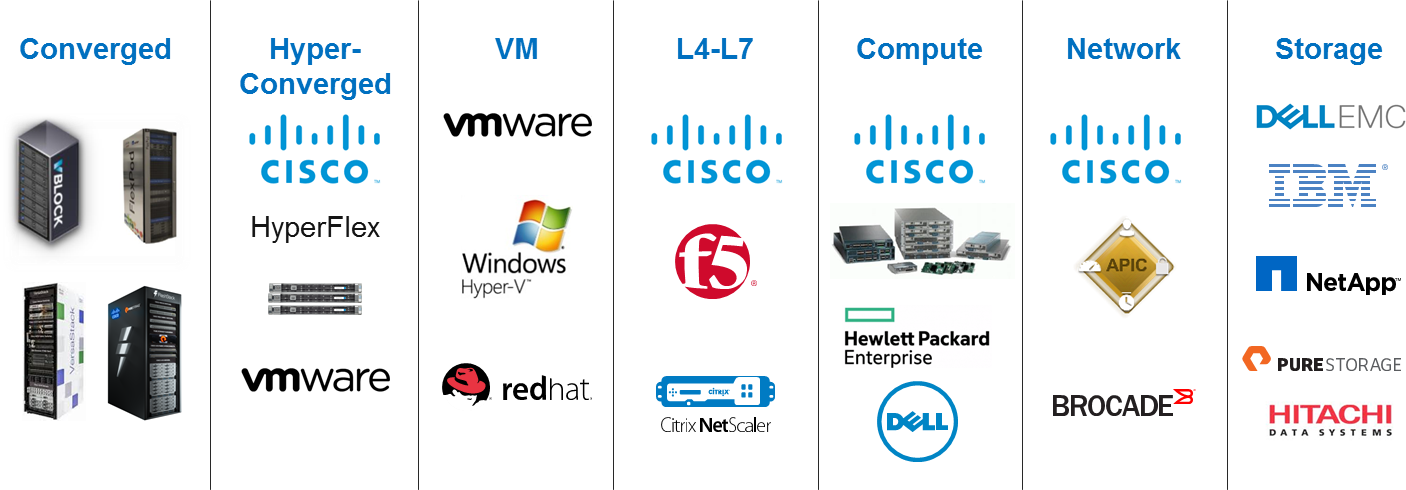
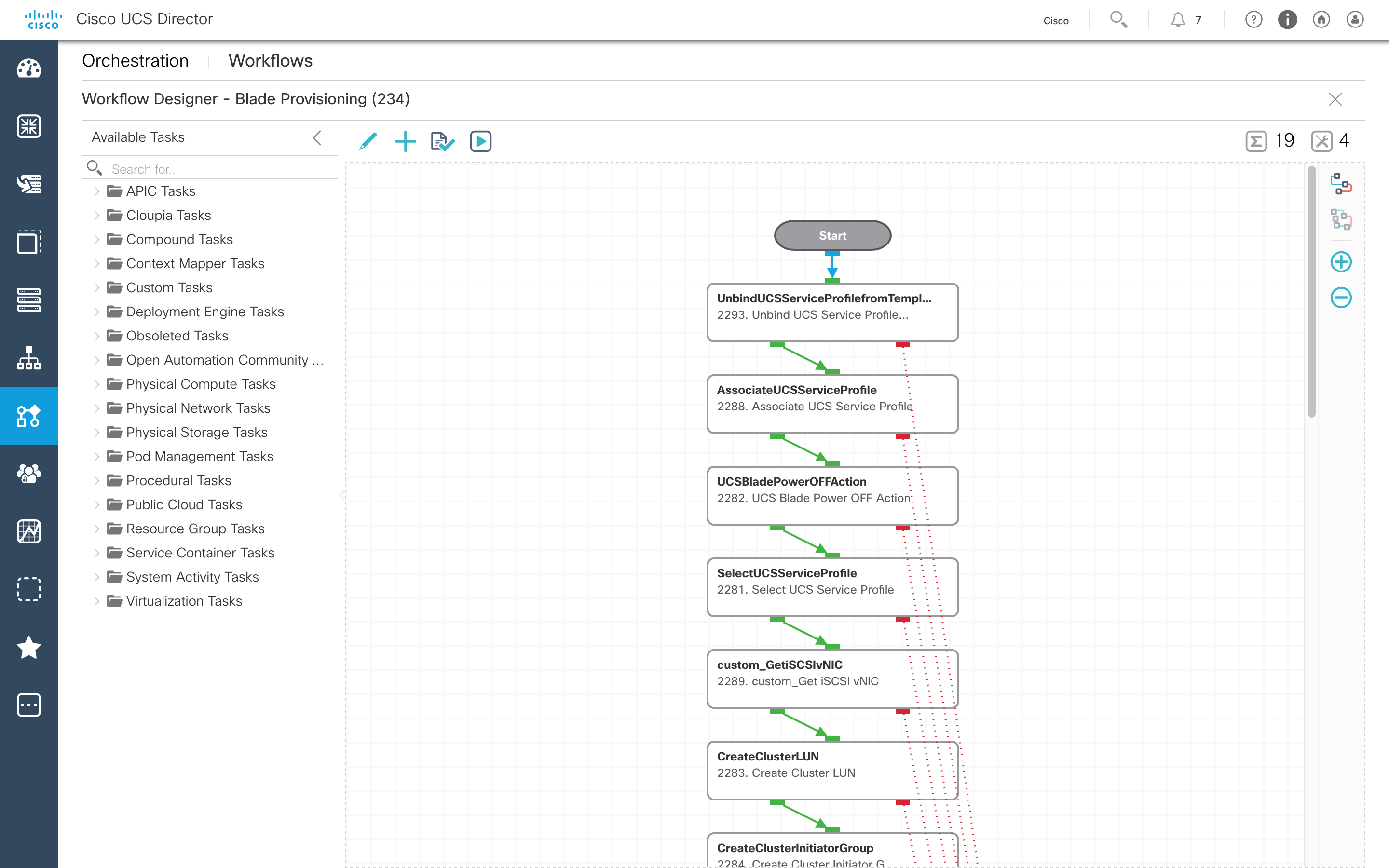
UCS Director is an open platform that provides infrastructure management, automation and orchestration across Cisco and a variety of third party systems and software. By starting the product name with the word “UCS”, it can be misleading. UCS Director is a heterogeneous IaaS management platform. It features multi-vendor task libraries with over 2,500 out of the box workflow tasks for end-to-end converged stack automation. UCS Director supports bare metal and virtualized environments.

Systems and Hypervisors Supported by UCS Director

This robust platform is foundational to the converged infrastructure solutions Cisco has developed with our storage partners. The converged infrastructure solutions include: VCE VxBlock, NetApp FlexPodIBM VersaStack, and Pure SmartStack

UCS Director is also a significant component of the Infrastructure Automation offer in the Cisco ONE Enterprise Cloud Suite. It is integrated with the UCS Central, and IMC Supervisor products to streamline provisioning and ongoing operational management.

Our Latest Improvements

Earlier this year, we released version 6.5 of UCS Director. This release completely transformed the user interface from Flex to HTML5, and it includes many other features to improve ease of use. The workflow framework was improved to run a workflow on multiple schedules and resource access can be synchronized across workflows to guarantee mutual exclusion through Semaphore lock. You can also find improved operations for workflow schedule management.

We’ve also added some significant new features for developers. There’s a new integration with Git that allows you to integrate UCS Director with public (for example GitHub) and private (enterprise) repositories for the purpose of pulling custom tasks (i.e. Java scripting code) from a centralized repository. We’ve also added a native Java editor for custom tasks to minimize errors at runtime due to syntax issues.

RoadMap to the Future

Cisco plans to introduce new versions of UCS Director next year. Here’s a few critical areas of focus we will include (but not restricted to) in the releases:

  • Accelerate feature delivery with UCS Director southbound connector modularity
  • Platform support and integration enhancements for ACI, HyperFlex, and UCS
  • Simplifying deployment and user experience for environments at scale

UCS Director is Alive and Evolving

When something new comes along, it tends to get most of the attention in the market. In September we introduced Cisco Intersight, our new cloud-based systems management platform. It delivers Management as a Service (MaaS). Intersight is an important strategic product with some great capabilities, but it is just getting started. As you can see in the planned enhancements/features above, we will add a UCS Director connector to Intersight. This new connector will allow Intersight to collect telemetry information.

Over time most of the functionality we offer in UCS Director will eventually migrate into Intersight. This will enable us to combine IaaS with MaaS and analytics, so users can more effectively support multi-cloud, data center, and edge computing environments. However, it should be noted that the transition process will take a couple of years to implement.

Making the Transition Easier

Cisco is still investing in UCS Director. It remains a critical component of our converged infrastructure and Enterprise Cloud Suite solutions. We will offer a complimentary product strategy with UCS Director and Intersight that allows customers to preserve the investments they’ve made in infrastructure, operational processes, workflows, and licensing. (This investment protection applies to UCS Director and the rest of the UCS management portfolio.) Our goal is it to make it easy for our customers to transition from UCS Director to Cisco Intersight when and how it makes sense for their organization.

For additional information go to the UCS Director web page.


Authors

Ken Spear

Sr. Marketing Manager, Automation

UCS Solution Marketing

Avatar

Over the past few weeks, Bell Canada has successfully rolled out Segment Routing in its next-generation core network, marking a milestone as the first Canadian carrier to actively use this innovative technology for network automation and software-defined networking (SDN) capabilities.

Internet traffic per month per user in Canada will be up to 142.6 GB in 2020, from 63.3 GB in 2016 – with 74% of Internet traffic being video. To meet this astounding growth in demand for bandwidth and more devices connected to the network, Bell Canada made the decision to go full speed on Cisco segment routing technology.

Bell Canada’s next-generation core network uses segment routing technology to simplify network operations, increase network robustness, optimize network utilization and offer innovative network services.

As part of its ‘Network 3.0’ transformation plan, Bell recently upgraded the‎ first four IP core routers to support seamless connection between network data centers and its Smart Core network. Using segment routing, client workloads across multiple data centers will be able to activate new connectivity services and tap into more bandwidth capacity using software-driven provisioning.

We’re excited to be working with Bell Canada on this initiative as we are seeing wide industry support for its innovative capabilities.

“Segment routing is a significant step forward on our mission to transform the way our network interacts with our people, processes and technology at Bell,” said Stephen Howe, Executive Vice President and Chief Technology Officer, Bell Canada. “As our Network 3.0 transformation progresses, and with segment routing now in place, we now have the foundation to enable greater network reliability, as well as enhanced speed and agility from Bell in responding to clients’ needs. Using new IP routing protocols, we can improve the reliability and performance of our Smart Core network, including our network data centers, helping us to better manage overall network operations and offer our customers a superior service experience.”

I’m really pleased to see Bell Canada so well advanced in its network transformation journey. This clearly exemplifies the foundational role Segment Routing plays in making network infrastructures SDN-ready while giving Bell Canada a competitive edge to deliver innovative services much faster and more efficiently.

Authors

Yvette Kanouff

Senior Vice President/General Manager

Service Provider Business

Avatar

The Cisco Product Security Incident Response Team (PSIRT) is committed to protecting customers by sharing security-related information in a timely manner and in different formats. Although some of the information that we receive may not relate to a specific vulnerability or issue in a Cisco product, the information may be valuable to our customers. For this reason, PSIRT is introducing a new Security Impact Rating (SIR) for Cisco Security Advisories: Informational.

The Informational rating gives PSIRT the flexibility to provide important security information that may not fit into the traditional Critical, High, Medium, and Low range of SIR values for our security advisories. In advisories that have an Informational SIR, we’ll cover topics such as:

  • Information discussed in a public forum
  • Configuration suggestions
  • General, proactive security outreach

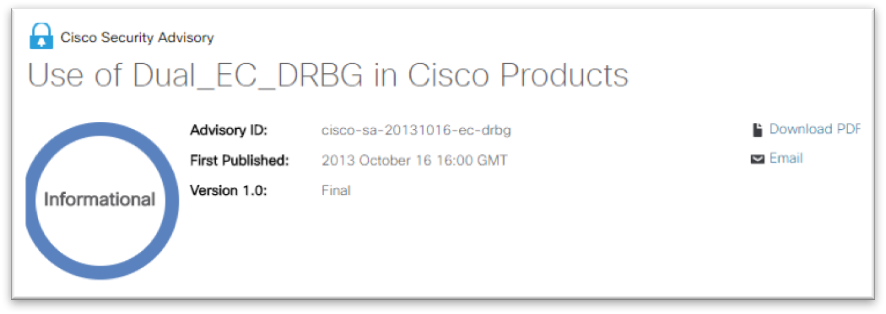
The format of these advisories will be the same as any other type of Cisco Security Advisory. The following figure shows an example of a Cisco Security Advisory that has an Informational SIR:

Cisco Security Advisory - Informational

Key differences from other advisories are the color and text in the advisory badge and the possible absence of Cisco bug IDs, a CVE ID, a CWE ID, and CVSS scores. This is due to the nature of the Informational advisory. Unlike advisories with other SIR values, Informational advisories are likely to discuss potential issues, not proven vulnerabilities or vulnerabilities that affect Cisco products. To learn how the new Informational SIR value compares to existing SIR values, see the Assessing Security Risk section of the Cisco Security Vulnerability Policy.

Like other Cisco Security Advisories, PSIRT will publish Informational Security Advisories to the Cisco Security Portal and they will be available from the Cisco Security Advisories and Alerts page. On this page, you can sort advisories and apply various filters, including a SIR-based filter, to find what you are looking for. Also like other Cisco Security Advisories, you can use various methods to be notified when we publish an Informational advisory. For information about the different ways that you can receive security vulnerability information from Cisco, see the Cisco Security Vulnerability Policy.

Note that Informational Security Advisories replace a previous publication type, Cisco Security Responses. In the past, PSIRT used Cisco Security Responses to address issues that required a response to information discussed in a public forum, such as a blog or discussion list. The responses were typically published if a third party made a public statement about a security issue or vulnerability in a Cisco product. PSIRT will now use Informational Security Advisories to respond to these statements. To ensure that you have a consistent experience finding and reviewing this information, PSIRT converted existing Cisco Security Responses to Cisco Security Advisories that have a SIR value of Informational, and we retained the revision history of each publication.

Authors

Zach Spicer

Project Manager

Product Security Incident Response Team (PSIRT)

Avatar

Recently I blogged about how Cisco are working with ScotRail (the train operator) and Network Rail Telecom (the track operator) in Scotland to deliver a trial of the world’s fastest in-train WiFi, an evolution of work done earlier on “Project SWIFT”.  I also described a school of thought that suggests the problem of railway passenger connectivity is best solved with 5G – something that was suggested indeed in the UK Industrial Strategy released earlier this week.  While there is no question that 5G technologies can help, why wait until (arguably) 2025 to solve this problem when Cisco has made a huge step forward today?  Let me, then, give some background on the challenges we’ve overcome to deliver this connectivity step-change today. I will also provide a point-of-view on how strategic this project could be for not only Scotland, but the UK as a whole, including in the race to 5G.


Making It Happen

You may be thinking – “Why hasn’t anyone done this before?”, as I was asked at a recent review meeting.  There are a number of reasons – people and expertise, process, and technology.

People, Relationships & Expertise

My brief description in last week’s blog does a complete injustice to the investment that Cisco – both financially and in people’s time (including significant expertise from my colleagues in Cisco Services) –has made in bringing this to life.

We’ve built excellent relationships across ScotRail and Network Rail – it has to be said that the staff in both organizations, coupled with the collaborative environment we have found in Scotland, are the key reasons why we’ve made such fast progress towards the live trial.

Processes

The challenges of running public data traffic over the safety critical infrastructure of Network Rail were significant.  Notably, Cisco is the first organization to pass the railway safety cases (as required by procedures) and convince Network Rail Scotland and their close partners ScotRail (the train operating company) that our network design could maintain safe railway operation at the same time as running a public data service over trackside infrastructure.  As the UK budget announcements filtered through last week, it wasn’t surprising to see MNOs remark on the challenges that they have struggled to overcome in regard to rail connectivity.  Cisco has made the investments in understanding and complying to customer process, and has applied the best expertise, including Cisco Services networking experts to overcome these – and consequently it’s Cisco that is able to deliver the world’s fastest railway WiFi in my own backyard.

Technology

Careful network design and mast placement ensure that there are no gaps in coverage, with seamless 200ms transfer between masts (each connected to trackside fibre, currently used only for rail signalling), delivering a seamless WiFi experience at 150mph.  Finally, Cisco has applied the latest WiFi technology in this design.  This makes it possible to deliver an average of 300 Mbps to the train – which is a substantial step function increase over current technology, thereby transforming customer experience.


The (Rail) Track to 5G

You could be forgiven for thinking that I’m against 5G.  Not at all. Cisco’s railway initiatives in the UK could, in fact, play a major role in the accelerated adoption of 5G in the UK (and I’m sure, elsewhere).  Deloitte, the consulting firm, has highlighted that insufficient fibre exists in the US to exploit 5G – and classes it as a “national imperative” to invest is further fibre deployment.   Further, according to the Cisco Visual Networking Index Forecast, mobile offload exceeded cellular traffic for the first time in 2015. Fifty-one percent of total mobile data traffic was offloaded onto the fixed network in 2015.  We will, therefore, see increasing demand for more fibre capacity as 5G transforms the number of devices connected to the internet.

Cisco’s success in collaborating with Network Rail and ScotRail to leverage their trackside fibre opens up a huge range of possibilities for these organizations – in terms of their own productivity and safety – as well as passenger experience and productivity.  Trackside CCTV for example would deliver both safety, security and operational cost savings.

Further, and more strategically, there are huge potential benefits for the country as a whole.  Currently dedicated to railway signalling and other railway-specific tasks, Network Rail Telecom’s network has enormous capacity.  As well as a business case that can be justified by operational improvements (e.g. trackside CCTV for safety and inspection, for example), their trackside network has greater potential – and could deliver significant value for Scotland and the UK as a whole in the race to 5G.

I’ve blogged before on the broadband and mobile coverage challenges we have in Scotland (for example, at major tourist attractions in rural areas, and also on major trunk roads).  The rural and mountainous nature of Scotland means that delivering broadband has faced real technical challenges – it’s been a significant civil engineering project. The railway network in Scotland is extensive – and extends into rural areas as well as the more heavily populated urban area.  Imagine the benefit to the country as a whole, and some of the internet-challenged rural areas, if we could leverage the fibre to deliver internet connectivity via the railway fibre network.

Therefore Cisco’s pioneering work with Network Rail Telecom and ScotRail to date, coupled with upcoming network techniques such as network slicing, our work has removed real barriers and could have a transformational impact on internet delivery across the country – as well as providing a new revenue stream for the railways.  And with the fibre capacity challenges outlined above threatening the rapid roll-out of 5G, the railway network across Scotland and the broader UK could be a real asset in the race to 5G.


The Next Steps

Returning to the upcoming ScotRail WiFi trial, it’s important to remember that what we are running will be a live trial.  It’s real and will serve thousands of passengers on the Glasgow to Edinburgh rail line daily for the duration of the trial. It’s most definitely not a test in a controlled environment (we’ve already completed that phase of testing) – we’re testing live on the busiest rail route in Scotland.  Cisco is confident of proving the technology and solution.  The challenge then transfers to the transport authorities and government – are they ready to “grasp the thistle” and deliver a huge step change in connectivity across Scotland’s geographically diverse rail corridors?   Or will the decision be taken to “wait for 5G”? – that is, wait for 5G to be delivered across a geographically challenged country where, as the UK government’s “Connected Future” report highlights, even 2G is not yet pervasive on our roads and railways.


Authors

Stephen Speirs

No Longer at Cisco