Ask anyone who’s witnessed a match; rugby is one of the toughest sports in the world. But, as the National Rugby League (NRL) of Australia recently found out: running a
rugby league without a robust wireless network infrastructure can be even tougher.
Recently the NRL, which is the top rugby league in Australia and New Zealand, moved its league offices to Sydney. With its new headquarters, the league felt this was the right time to update their network infrastructure to fit its evolving needs. The NRL wanted create a new outbound call center to drive club membership and the ability to support a rapidly growing mobile workforce.
With a third of their 600 employees being mobile, the NRL felt it was important that their new solution allowed people to work from any location and have the same user experience as if they were in the NRL offices. In addition, they wanted only one vendor to provide the unified data center and communication solution. Continue reading “Cisco Tackles Australian Rugby League Networking Problems”
In the last five years I have moved from Siberia to San Francisco, to Berkeley, to San Jose, to Phoenix, and now to Minneapolis. Unlike most people, moving so many times almost feels like a privilege to me. My husband and I have been able to explore the “sparkle” of Silicon Valley. We enjoyed Phoenix during the not-so-hot months. And now we are in Minneapolis where every day of summer seems like the 4th of July. (I might not be bragging in January when its -30 degrees. But hey, I’m trying to tell myself that it’s healthy for the soul to endure a Winter Wonderland in the U.S. Midwest.)
There are many reasons why we’ve had to relocate so often. Whether I moved to be closer to the beach, the snow, or family — or due to a tragedy — I’m glad that my personal life did not impact my professional life. Aside from constant packing, unpacking, and doing the legwork of finding housing – I don’t know what I would do if I also had to start and restart the process of finding a job.
I have worked for Cisco a little more than two years now. Throughout my transitions, my responsibilities have changed only slightly. Surprisingly, my productivity and efficiency have increased thanks to my new, liberated perspective of work.
My job moves with me anywhere I go. As long as I have an internet connection, I can work from my home office, my backyard, a restaurant, a coffee shop, or even on my family’s boat. My laptop and smartphone are the only devices I need to be fully functional. And Cisco tools such as Jabber, WebEx, and now Spark (a team collaboration solution) allow me to collaborate with my colleagues across continents.
If I need to join an important meeting with executives or managers, I have a DX70 desktop endpoint for better audio and video quality. If I have a meeting with local colleagues, we can use room systems like MX800 or IX5000 in a Cisco office. It has been fun to explore the differences between the Cisco offices in Phoenix, San Jose, and Bloomington, Minnesota. (Hmm, I think next year I should visit the Cisco office in New Zealand.) Continue reading “My Job Moves with me Anywhere I Go”
Guest blog by Dan Crawford, Marketing Manager, Cisco
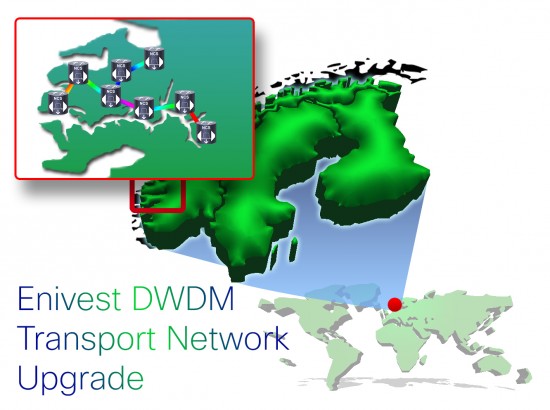
In the western Scandinavian fjords of Norway, Enivest an internet service provider has deployed a new optical transport network using a Cisco optical network solution (NCS 2000). While this, in itself, may not be big news to most people, the real story is about how Enivest managed this deployment. For people who are not familiar with the expertise and time needed for installing and then lighting up an optical network, it typically takes two days per node/site with some give or take depending on the level of the technician’s expertise.
So, if we consider the eight (8) sites and nodes that Enivest lit up along a 260km span of Sognefjord in Norway (see map below) we would estimate the deployment to have taken upwards of 16 days. What is impressive abut this deployment is that it took less than a week for Enivest to install and turn on over 260 km of fiber running through 8 sites/nodes for its customers. This kind of agility is important for service providers who are continually looking to cut operating costs and realize new revenue streams.
In the past few months we have seen major outages from United Airlines, the NYSE, and the Wall Street Journal. With almost 5,000 flights grounded, and NYSE halting trading the cost of failure is high. When bad things happen IT personal everywhere look at increasing fault tolerance by adding redundancy mechanisms or protocols to increase robustness. Unfortunately the complexity that comes with these additional layers often comes with compromise.
The last thing your boss wants to hear is, “The network is down!”. Obviously it’s your job to prevent that from happening, but at what cost? Many of us enjoy twisting those nerd knobs, but that tends to only harbor an environment with unique problems. I too fear the current trend of adding layer after layer of network duct tape to add robustness, or worse, to try and fix shortcomings in applications. NAT, PBR, GRE, VXLAN, OTV, LISP, SDN… where does it end!?
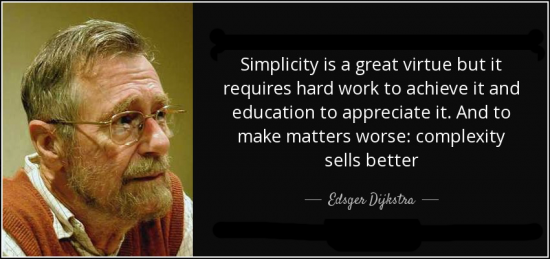
The greater the complexity of failover, the greater the risk of failure. We often forget the lessons of our mentors, but keeping the network as simple as possible has always been best practice. As Dijkstra said, “Simplicity is a great virtue but it requires hard work to achieve it and education to appreciate it. And to make matters worse: complexity sells better”. This is a fundamental design principle that is often overlooked by enthusiastic network engineers or, even worse, sales or marketing engineers who are trained to sell ideas that only work in PowerPoint. When planning out your latest and greatest network design each and every knob that you tweak puts you farther and farther into uncharted territory. While it may work, for now, you’ll be the only one running anything close to those features in unison. And when, not if, you have to call TAC, they have to understand the fundamental design of the network BEFORE they can troubleshoot it. Validated designs do exist for a reason.
While both of these outages were simple in nature, the complexity of the growing network was key in causing the failure. A lack of continuous design, periodical review, and most important failover testing inherently nurture failure.
We all know that data is exploding and in more places than ever before. Without the right strategy in place, it can be a real monster. When tamed, data holds the key to great insights about an organization’s business that could help grow sales, improve the customer experience and save a lot of money.
Unfortunately, in real life we don’t have an ‘Analytics Man’ superhero that can turn data into insight magically with the snap of a finger. However; with the right IT strategy in place, data can save the day!
In that spirit, here are five ways to help tame your data:
The second mini-talk I gave was twofold in itself: I discussed Cisco’s journey from the Verbs API to the Libfabric API, and discussed how well Libfabric plays inside the Open MPI implementation.
The ancient Roman poet Virgil might feel at home in the Digital Age (once the initial future shock wears off!). He famously said, “Fortune favors the bold.” These words have never been more prescient.
In a recent article, we likened the current climate of ever-present disruption, innovation, and change to a Digital Vortex, in which ideas and technologies constantly break apart and recombine — often into highly disruptive and sometimes unexpected new business models (Apple, Amazon, Tesla, and Fortune magazine’s list of unicorns have benefited from this phenomena).
In the Digital Vortex, bold innovation and gutsy, disruptive new business models are a necessity. That is, if you want your company to be a disruptor rather than disrupted.
By their very nature, startups exemplify this bold approach. They are smaller, more agile, able to experiment, innovate and execute faster, and recover from minor missteps more quickly. Above all, they are digital. Continue reading “In the Digital Age, Fortune Favors the Bold”
Many manufacturers operate at high volumes, and unplanned production downtime is costly. One leading auto manufacturer estimates unplanned downtime in a factory can cost them as much as $20,000 per minute. Often these line down situations are the result of production machine failures that could be avoided if data from the machine was available to anticipate the failure so a planned repair could take place in a standard maintenance window. I’ve traveled the world recently and visited with the world’s leading manufacturers across many sectors. What I have seen is that almost all of them are focused on reducing unplanned downtime with predictive maintenance.
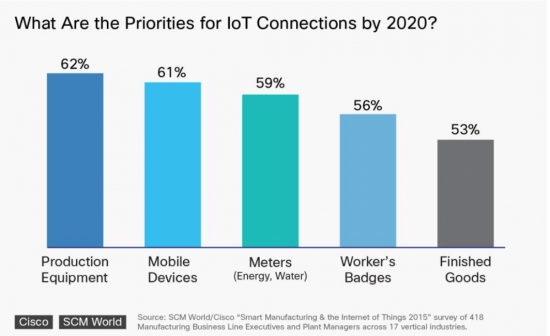
This issue is also driving plant floor machine builders and their manufacturing customer to prioritize their digitization and IoT efforts to connect machines to enable real time access to new types of structured and unstructured data from production processes. This is a recurring theme reiterated in a recent survey by SCM World and Cisco. We asked plant managers and business line executives what “things” they were connecting now and in the years ahead. Production equipment was listed as a top priority, with 62 percent planning to connect these resources by 2020.
Machine Builder OEMs (Original Equipment Manufacturers) are facing new business imperatives, as well, to grow services business and customer intimacy. As their manufacturing customers demand the highest possible availability, quality and uptime, OEMs are striving to become more agile and proactive. They’re looking for solutions to enable zero-touch deployment and provisioning. They’re exploring ways to control support costs with remote connectivity and monitoring. They’re also taking more control of the aftermarket for parts and tools. Connectivity and remote access are essential capabilities to enable new predictive maintenance and machine-as-a-service (MaaS) business models.
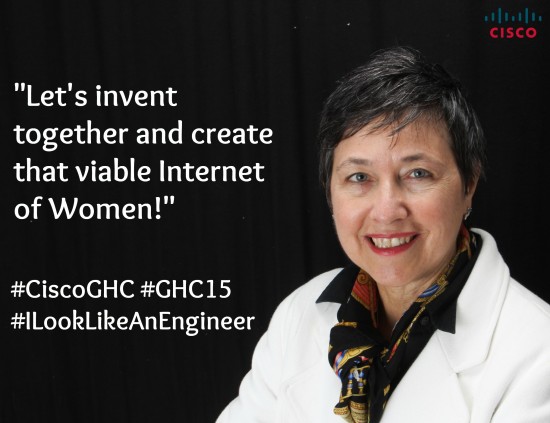
From Cisco Women in Cybersecurity to extraordinary software developers and inspiring executive I invite you to join us at Cisco to invent together.
Intercloud, security, and IoE are all areas that present massive opportunity for re-invention and innovation. The need for enhanced security is real Continue reading “Define Your Future @Cisco”



 hest sports in the world. But, as the National Rugby League (NRL) of Australia recently found out: running a

 My job moves with me anywhere I go. As long as I have an internet connection, I can work from my home office, my backyard, a restaurant, a coffee shop, or even on my family’s boat. My laptop and smartphone are the only devices I need to be fully functional. And Cisco tools such as

 Guest blog by Dan Crawford, Marketing Manager, Cisco
 What is