#CiscoChampion Radio is a podcast series by Cisco Champions as technologists. Today we’re talking about SDWAN and NFV with Cisco Product Marketing Manager Bill Reilly.
Get the Podcast Listen to this episode Download this episode (right-click on the episode’s download button) View this episode in iTunes
Cisco SME Bill Reilly, Product Marketing Manager
Cisco Champion Guest Hosts Bill Carter, @ccie5022, Senior Business Communications Analyst
Brad Haynes, @GK_bradhaynes, Client Solutions Specialist
Highlights Benefits of virtualizing WAN and layering on new services at branch level
Role of Network Functions Virtualization (NFV) at VBranch and in SP Cloud
How MSPs are integrating NFV
NFV use cases and surprise deployments in the field
How to deploy and manage NFV in the Enterprise
Skill sets needed to take advantage of NFV
Surprising NFV app policies in the field
As we gear up for our biggest collaboration event of the year, Collaboration Summit, I thought it would be a great opportunity to kick off a blog series leading up to the announcements we’ll be making there this December about the evolution of our Collaboration Cloud Platform.
At last year’s summit, we announced Project Squared, our foray into what Gartner calls “enterprise mobile messaging,” but also a proof of concept for our entire cloud platform. We created this app, now known as Cisco Spark, to help us collaborate better internally while we built a new collaboration infrastructure from the ground up.
Infrastructure is top-of-mind for enterprises today, especially considering the rise of cloud and mobile and the increasing pressure of business leaders to make a decisive move to cloud. As our CEO Chuck Robbins noted in a recent blog, “The critical timeframe to deliver on the transformation cycle is compressing, and we all must move faster than ever before.”
It’s not possible to simply move our current infrastructures into the cloud. We saw the need for a new kind of cloud architecture reimagined to work with enterprise and partner networks in a radical way.
We built our platform with modern cloud-based technologies focused on key customer and partner concerns, including user experience, security, flexible deployment options, and ecosystem. For the first time, we can deliver the incredible experience users want built on the dynamic and secure infrastructure IT demands.
Please follow this series of blogs from our cloud team as we track the evolution of our cloud from app to platform to ecosystem, allowing each of our cloud leaders to comment on the design and technical principles behind its truly unique architecture.
The future is going to be in the cloud, but not all clouds were created equal. With digital transformation looming large in the minds of business leaders worldwide, it’s important to choose a cloud deployment model that can actually get them there.
At the Cisco Collaboration Summit, we will share all the details of how we have achieved this feat. Please join us for the keynote to hear from myself and Collaboration CTO Jonathan Rosenberg. Register today and watch on December 8 at 9:00 a.m. PST.
Every service provider I talk to these days wants pretty much the same thing: a faster, less expensive way to develop services. Faced with increased competition on all sides, along with increasing demands for more mobile and richer media offerings, speed to market and efficient operations are everything.
For many, networks have become cumbersome, resulting in long services lifecycles. Slow processes—from creation to modification and end of life—hamper business agility and make networks too costly to manage. And as new, more agile competitors without legacy burdens enter the market, the intense pressures on profitability continue to mount.
You have several options for developing new services in an inflexible infrastructure environment: Get out your crystal ball. Go with your gut. Or wait and see where the market goes, then catch up.
That’s right, these aren’t options at all. None are sustainable in today’s market conditions.
You have to innovate. Get the right partner and tap into the wide innovation engine that is the world. Make your network your innovation platform. It is the platform on which to build a more successful business.
Why flexibility is essential
To compete, you need to evolve to a network with built-in flexibility. A flexible network helps you adjust to market demands quickly, enables you to automate network functions, and supports innovation—for you and others. Doing this via open software becomes essential.
This is much more than an IT strategy. It’s a business strategy that’s absolutely essential to compete and profit. It’s also the foundation for a broader culture of innovation, where people inside and outside your organization can act on ideas and develop solutions quickly.
If I had a nickel for every time I’ve been asked the question ‘what is a smart city really?’ then I’d definitely have enough change to buy a round of drinks. When you hear about smarter, more connected communities, the definition has become varied and often self-serving. However, as someone who dedicates a significant amount of my personal and professional life to sustainable and equitable urban development, I believe in the true importance of the smart city concept. It’s imperative that each city and country define what it means to become smarter, each idea will be different, depending on unique goals and citizen needs.
The apparent common thread is and will continue to be the use of technology. Today, businesses are pivoting toward digital transformation on a massive scale. A trend that governments should take hold of as it’s pressed to find new ways to operate and modernize its services. Whether it is through collaboration initiatives, embracing cloud computing, or driving more informed decisions through data analytics, there are unprecedented opportunities ahead for the evolution of digital government. In the face of uncharted territory and guaranteed disruption in its wake, building deep and lasting best practice sharing alliances will be an essential platform. Through vast sharing and partnership, we can bring together the most brilliant minds of the public, private, non-profit, academic, and philanthropic sectors to identify innovations that can be scaled, replicated and transferred to make a lasting global impact.
https://www.youtube.com/watch?v=mnyrUhPwd70
Join the world’s most thoughtful industry leaders
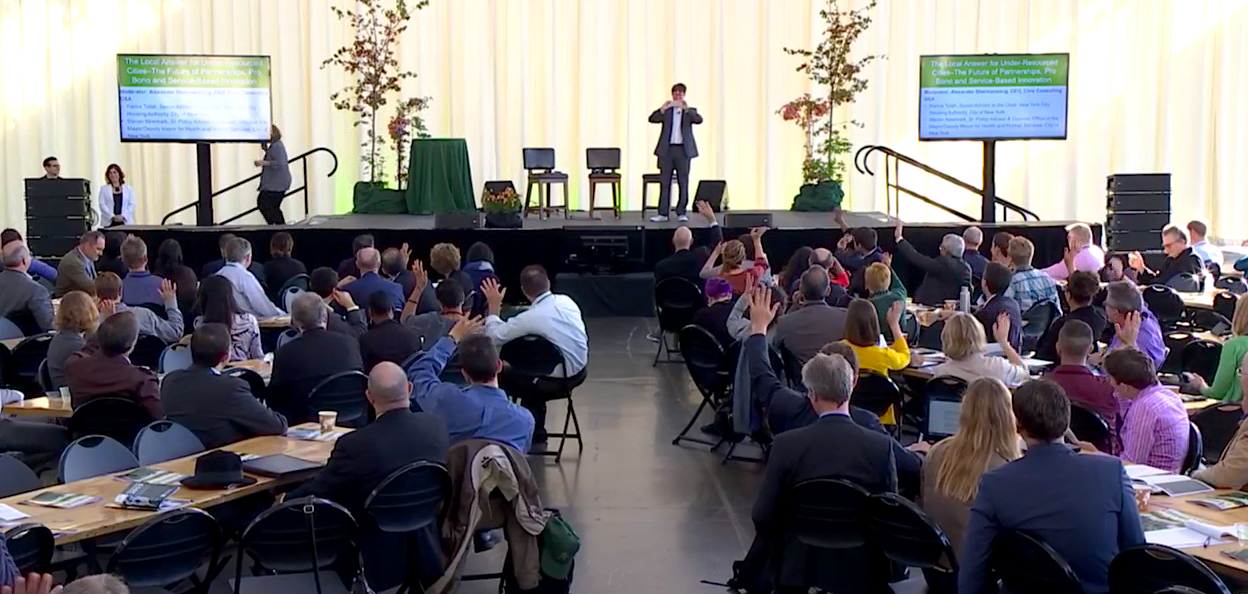
This week our citizen has the unique opportunity to join the ranks of global innovators and leaders at the bleeding edge of urban sustainability and digital technology. Meeting of the Minds kicked off yesterday, and more than 400 executives from 25 countries hailing from public and private sector, philanthropy, and academia join our citizen in Richmond, California. The 3-day summit will focus on delivering smarter public services and building better city systems, enabled by forward-looking public policies, intelligent infrastructure, and digital technologies.
Our citizen has heard and will witness a wide range of topics. First on our digital citizen’s agenda is the discussion around urban transportation. There’s no doubt that global communities are rapidly seeing their growing need to develop and implement public transit options and solve the interface between people and mobility systems. Dubai’s initiatives are enticing more people toward using public transportation by offering all services 24/7 via handheld devices and by easing the traveler experience with uniform ticketing and easy payment options, no-stop tollgates, and smart parking meters. Although a one-size-fits-all fix is not the answer, looking at the modes that are successfully serving city dwellers can help your own path become clearer.
Up next, our citizen looks forward to a session on comprehensive and accessible healthcare, and its criticality in economic vitality of communities and nations. Despite increasing expenditures in health, our citizen knows that the US is falling in key indicators of health, underwhelming and under delivering in a variety of health outcomes. Pioneers in the health and wellness industry are focusing on how to improve health, particularly for those in underdeveloped and underserved parts of the world. Sichuan, China is a leading example of breaking new ground through innovative models of cross-industry collaboration. Through integration with upstream determinants of health such as education, economic development, and community organizing, Sichuan has significantly improved access to medical care.
We’re now on to discussing environmental sustainability, a core pillar of the smart city concept. In our increasingly digital world, the quality of air and water, the movement of people and objects, the changes in weather, traffic congestion, CO2 levels, the production and consumption of energy, can be measured, tracked, and interconnected in real time. It is through this connection that we’re seeing smarter and more deliberate solutions for environmental and resource sustainability. This does not mean reinventing the wheel, but innovatively combining what is available with the advantages that technology affords to create high quality living environments. For example, Water for People works closely with local governments and private organizations to create and deliver an open-source smart device application that helps to provide clean water and basic sanitation services to people in disadvantaged communities around the world.
And finally, on to the much-anticipated topic of education and preparing the next generation workforce. Prior to the session, our citizen begins pondering how we can properly prepare a workforce for an ever changing and ever more competitive environment. Academic institutions like San Jose State University are bridging the gap between traditional and innovative methods, using digital technologies to promote anytime, anywhere learning. The very best schools must position themselves as a vital contributor to digital community initiative. Along with it, there is a celebrated movement toward including broader professional readiness, as well as personalized social and emotional learning.
Vigorous smart cities and digital government conversations are underway all over the world. Of the most important themes that have emerged on the Meeting of the Minds agenda, financing challenges are considered among the more profound roadblocks. This year’s Meeting has a pervasive track focused on financing mechanisms and strategies that are working for early adopters. Best practice sharing and idea swapping show that there are clear steps that can be taken, such as getting assistance in leading projects, improving planning, and achieving a better understanding of the cost and benefits of a smart city. As leaders undertake the steps recommended and learned at this forum, they can move beyond the current barriers and start to capitalize on the benefits of a smart, digital community.
Gatherings such as Meeting of the Minds are enabling cities and countries to respond to increasingly complex challenges. It’s important that leaders and innovative thinkers continue to showcase best practices developed inside these living labs, allowing for the proliferation of ideas to help grow a smarter, more sustainable world.
You can watch the full Meeting program, streaming live: http://cityminded.org/webcast. And make your voice heard at Meeting of the Minds via Twitter: #MOTM2015.
Next Stop
Stay tuned for next Wednesday’s post to discover more information on keeping digital communities safer and more secure. And be sure to check back each week as we explore new themes, challenges and observations.
Additionally, you can click here and register now to get your questions answered on how to become the next digital community.Finally, we invite you to be a part of the conversation by using the hashtag #WednesdayWalkabout and by following @CiscoGovt on Twitter.
Heading into a conference, you never know what to expect. Heading in to my very first Grace Hopper Celebration conference, I really didn’t know what to expect. I’m relatively new to Cisco, and I knew that we were there to show our talent for disruption. What I didn’t count on was seeing up close a side of Cisco that the world may not know about.
The trade show doors swung open on Wednesday evening at 5pm, and the crowd of women in tech – thousands deep – rushed in to scout out the booths, epic swag, and network. There were at least 15 attendees from Cisco there to welcome them with open arms. As someone who was all but raised in Orlando, Florida I can tell you that the equivalent to this experience is Disney World on Christmas Day. As far as the eye could see? A crowd existed. Everywhere you turned? There was someone to reach out to and talk with. Opportunity was everywhere.
In addition to some powerful motivation from key speakers (including a NASA Astronaut!) the highlight for me was meeting former Cisco interns, prospective Cisco interns, current Cisco employees (including these strong women!) and friendly faces from other companies who admired what Cisco was doing.
We were there to inspire these women in tech to reach new heights. One of the conference slogans was “Our time to lead” and you could not only see the excitement, but feel it. In the midst of the action, was where you could find the Cisconians. The booth glowed, literally and figuratively, and everyone was buzzing about just how awesome Cisco represented.
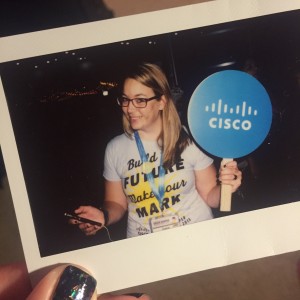
Casie Shimansky at Grace Hopper.
“This is Cisco?!” a former Cisco intern admired, “This is incredible!” She turned to a friend, “I’m so proud of them!” and then turned again to show me her Cisco backpack, “I loved interning with you guys!”
Maybe she hadn’t yet learned what I knew. That Cisco has a new passion for disruption and for showing up differently. A passion for making sure women in tech have a voice in the industry. And the “cool” factor of a new CEO, a new leadership team, and a renewed excitement by employees.
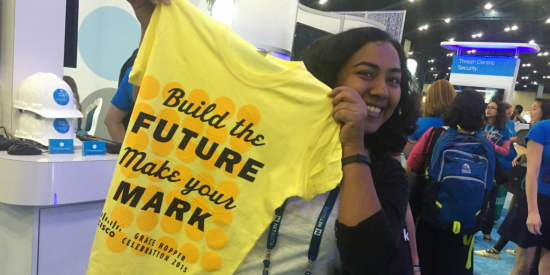
Our booth was an eye-catcher filled with clean whites, brilliant blues, and a warm, bright feel. We featured a glowing statue, which we affectionately call “Penelope” as a representation of our strong tech-savvy women. Executive meet and greets and Innovation Cafes featuring Cisco’s many specialties from IOT and even a WebEx session with employees that couldn’t be there in person also kept the energy sky-high. We were also designing customized screen printed t-shirts onsite with a little help from our friends at the OMG Bus out of Houston, Texas.
At any conference, bringing a “swag bag” is a good idea, because there are giveaways everywhere. But the swag at the Cisco booth was what everyone seemed over the moon about. Those customized screen printed tshirts drew lines sometimes an hour and a half long. But no one seemed to mind. While standing in line (which attendees said was “worth it!”) many continued to network with new people.
We were there to inspire these young women, but you know what? They inspired me. And Cisco inspired me all over again.
I’ve worked for a lot of great companies before Cisco, and yet I’ve never had an experience quite like this one. Everyone I spoke to between Wednesday night, and even waiting for my flight back to Orlando Friday evening (as women from the conference spotted my Cisco t-shirt), had some out-of-this-world praise for us. The company pride I felt for Cisco put me on cloud nine for days, and I think it helped us to make a lot of new friendships for the future.
As businesses strive to become digital, they need to be more flexible, innovative, and agile than ever. Customers are engaging with businesses differently from how they were just five years ago, and the bulk of their interactions are not with people but with systems (think airport and hotel check-in, ordering a product, or getting a taxi).
For all this to work, it’s critical that the systems on the back end know who you are, where you are, and what you need, to connect flawlessly to the front-end device. That airport check-in app on your phone, for example, requires integration with the airline reservation system, the ticketing system, the baggage handling system and gate information in order to provide full value to you as a user.
For organizations looking to take advantage of the wave of digital disruption that’s sweeping industries on a global scale, getting into the heads of their customers is probably the best place to start.
With tech trends like social, mobile, cloud and Big Data converging, organizations who want to remain competitive are in a race to adapt to the new realities of digital disruption. A March, 2015 Forrester Research Inc. report, “Digital Predator or Digital Prey?” has shed new light on what these trends can mean for business vitality, serving as a wake-up call for organizations.
According to the in-depth report, by 2020, every business will become either a digital predator, able to achieve digital mastery and create new value sources for customers or digital prey, industry “dinosaurs” who’ve adapted too late or not all – eventually becoming extinct. And though many industries have gotten ahead of the trend, others are woefully behind, remaining static in an Internet of Everything-connected world that simply flows around them.
Interestingly, research conducted through the Global Center for Digital Business Transformation, an IMD and Cisco initiative, revealed that 45 percent of companies don’t see digital disruption as a subject worthy of board-level attention. And another third of respondents have adopted a “wait-and-see” approach to decide whether or not they will re-examine their end-to-end customer approach in regards to digital.
Companies are going through a change in the way they conduct their businesses and digital transformation is paving the way. IT services and applications are distributed and beyond the traditional boundaries of the data center. Cloud adoption is a big part of the transformation. Enterprises are looking at multiple cloud technologies from established and emerging players to handle the transformation.
More and more companies are adopting Fast IT as a standard to meet these challenges. Dev and test teams are looking to shorten the development life cycle, and innovative cloud developers are looking for platforms that are programmatic and automatable. Companies are looking at flexible, open options to meet these needs in-house. OpenStack, is emerging as the leading open source cloud computing software platform and customers are actively considering it for their businesses.
OpenStack has come a long way in the last few years; the broad OpenStack community is delivering new features and capabilities rapidly. It has gained interest across various customer segments. However it continues to be a challenge for businesses to adopt OpenStack due to the skillset needed to design, optimize and deploy an OpenStack based cloud in their data centers. Another challenge is the support needed to maintain, troubleshoot and evolve with the industry.
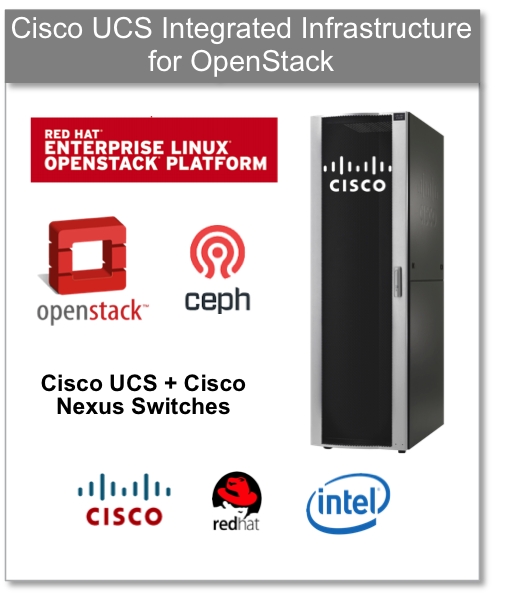
Cisco Validated Designs and Implementation Guides offer proven processes and tested configurations that reduce the complexity of deploying OpenStack. Cisco works closely with ecosystem partners like Red Hat and Intel to develop validated solutions for standing up OpenStack based private clouds.
Next week, we will release a new CVD jointly developed with Red Hat and Intel. The new validated solution combines the power of Cisco UCS Integrated Infrastructure with the most recent OpenStack distribution from Red Hat, so our customers can more easily and quickly deploy OpenStack private clouds.
Cisco UCS Integrated Infrastructure is a reliable, scalable industry-leading platform that matches the needs of an agile business. Cisco’s innovative solutions for stateless computing, programmability and automation are enabled within the context of OpenStack through easily available, open source plugins.
Red Hat Enterprise Linux OpenStack Platform is a stable and tested distribution of OpenStack. OSP director is an integrated and centralized tool for deployment and management of OpenStack and Ceph.
Intel has made key contributions towards making OpenStack enterprise-ready such as support for live migration capability and scalability.
All the capabilities and features of Cisco UCS and contributions by Intel are delivered and deployed through Red Hat Enterprise Linux OpenStack Platform 7 (OSP 7), for a seamless and stable experience. With this solution customers can manage compute, network, storage, hypervisors and virtual machines from the OpenStack environment. Our fundamental focus is to deliver an enterprise ready OpenStack platform solution with validated configuration, to increase speed of deployment and reduce risk.
For easy adoption of OpenStack, Cisco will be the single point-of-contact for installation and on-going support for the entire solution including the infrastructure and OpenStack . Cisco will work with Red Hat to provide coordinated support for faster resolution.
Simplifying OpenStack deployment is critical for the success of our customers and to ensure IT adoption of the technology; we are committed to delivering that to our customers with our eco-system partners.
Please join us at the OpenStack Summit in Tokyo between Oct 27-29th to learn about the solutions we are building to address customer needs, our participation and contributions to OpenStack, or for any discussions on OpenStack.
Our Cisco Validated Design for deploying Red Hat Enterprise Linux OpenStack Platform on Cisco UCS Integrated Infrastructure will be available for download in the Cisco Design Zone.
#CiscoChampion Radio is a podcast series by Cisco Champions as technologists. Today we’re talking with Cisco Champions about their favorite gadgets and networking tools that help them at work.*
Get the Podcast Listen to this episode Download this episode (right-click on the episode’s download button) View this episode in iTunes


 #CiscoChampion Radio is a podcast series by Cisco Champions as technologists. Today we’re talking about SDWAN and NFV with Cisco Product Marketing Manager Bill Reilly.



 Why flexibility is essential



 As businesses strive to become digital, they need to be more flexible, innovative, and agile than ever. Customers are engaging with businesses differently from how they were just five years ago, and the bulk of their interactions are not with people but with systems (think airport and hotel check-in, ordering a product, or getting a taxi).