In 2013, Roland Holloway learned he was cancer-free. For 9 years, Roland, a Cisco employee, had battled neck cancer, but a surprising recovery inspired him to give back to his community. With the help of Cisco’s Employee Purchase Donation Program (EPDP), Roland is empowering a local nonprofit with new technologies and helping others in need.
Roland, who will celebrate his 20th anniversary at Cisco later this year, is taking advantage of his newfound health to create change in his own neighborhood. “I’ve had a lot of good fortune come my way,” he said. “I enjoy giving back; I can’t change world politics, but I can definitely help my local community.”
After recovering from neck cancer, Roland enjoys spending time with his family and grandchildren
He started by visiting his childhood friend, Johnny Taylor, who founded a veterans’ outreach nonprofit called Promised Land Foundation. Doctors diagnosed Taylor with polio as a child, forcing him to use an electric scooter for transportation and making his goal of serving other veterans difficult. Roland saw his friend struggling, and helped Taylor purchase a wheelchair-accessible van in 2013. “I wanted to help him fulfill his aspirations to help veterans,” Roland said. “I saw him struggling to get around, and he’s using the van to make veterans’ lives easier.”
However, Roland didn’t stop giving back. In 2014, he learned about Cisco’s EPDP through a colleague who had used the program to donate equipment to his daughter’s school. Roland realized that as a Cisco employee, he could purchase equipment at a 75% discount for donation to qualified nonprofits and schools in the United States.
I speak with customers every day and often hear they are confused by conflicting vendor claims, marketing hype and embellishments. This is especially true when discussing SDN, where both the technology and the market have evolved significantly over the past few years.
I’ve invited Frank D’Agostino, one of Cisco’s top technical experts on SDN, to join me in separating fact from fiction. Frank and I are on a mission to debunk trendy technology myths, and this is the first in a three-part video series that we’ll bring to you over the next week.
In this first episode, Frank and I discuss the differences between Cisco’s ACI and VMware’s NSX. Frank is in a unique position to discuss both technologies, since he’s the only expert that has been deeply involved in the development of both NSX and ACI.
We think that ACI and Nexus is the most complete solution on the market. It does everything customers want from SDN, while offering more capabilities than NSX, and being two to three times less costly in typical customer configurations.
Cisco also collaborates very closely with our customers on technology, and we work with a wide variety of industry leaders, including competitors, to offer the best level of technology integration and interoperability. The reality is that the choice between ACI or NSX is not “either or:” if customers want both, NSX can run on ACI just like any other application, and in fact NSX will run better over an ACI infrastructure than over any other infrastructure on the market.
Take a look at our first video below, and then compare for yourself which solution makes the most sense from the perspective of cost, performance, scalability, and features.
We look forward to reading your comments and feedback.
Thirty years ago a UN commission published the Maitland Report, proposing that by the early 21st century, every individual on the planet should “be within easy reach of a telephone” given the economic benefits. That was interpreted as being within a one day walk of a phone. Anyone suggesting back then that over 90% of the global population would be covered by mobile cellular signals, and over half of the world’s population would have a phone in their pocket, would have been labeled a crazy optimist. Yet, today it’s all about high-speed broadband connections, which total over 3.4 billion as of 2014 – nearly half of the world’s population.
This year’s Global Information Technology Report, and chapter 1.2 in particular, details this history of ICTs as a powerful driver of economic growth, and discusses the remaining barriers to more inclusive prosperity. While ICTs have a multiplying effect on income and growth, unconnected countries and people are being left behind. To address a widening income gap, particularly within countries, more needs to be done to increase broadband adoption, particularly through policies that focus on universal access, affordability, digital skills and the gender gap.
Evidence from the last two decades demonstrates that ICTs, particularly broadband Internet, are an income multipliers. At the country level, macroeconomic data links fixed telephony, mobile telephony, Internet use, and broadband use to gross domestic product (GDP) growth in a causal relationship across developed and developing countries. , And increasing the intensity of data use also drives per capita income growth. This growing body of evidence highlights the fact that we are long past the days of the “Solow paradox,” when, in 1987, Nobel Prize–winning economist Robert Solow noted, “you can see the computer age everywhere but in the productivity statistics.”
At the microeconomic level, emerging analysis highlights the impact that ICTs can have on driving income growth at the bottom of the economic pyramid. Mobile phones in particular, have spread across the developing world and this ‘mobile miracle’ is contributing to income growth as handsets act not only as a communications device for sharing public and private information, but also as educational tools delivering learning content, and as a financial transfer and savings device.
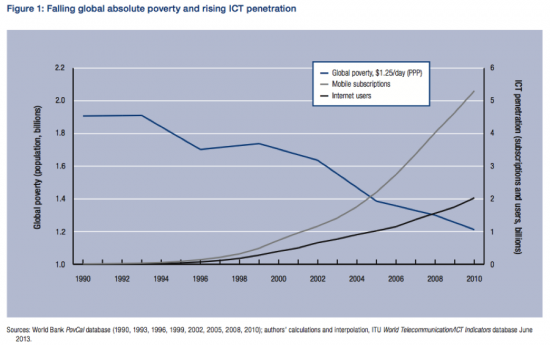
A direct result of ICT adoption is the steady decline in absolute poverty across developing regions. The global extreme poverty rate (those individuals surviving on less than US$1.25 per day) dropped from 1.9 billion people in 1981 to 1.3 billion in 2010 according to the World Bank: extreme poverty rates in developing countries dropped from more than 50 percent to 21 percent. This decline in extreme poverty has been driven by long-run economic growth in China and India, recent growth across Africa, and the impact of social programs in Latin America.
The picture is more mixed, however, when looking at ICTs’ impact on income inequality. At the global level, the latest available data from the World Bank show income inequality (the distribution of income across all people in the world) to be on the decline. The most recent analysis finds that global income inequality has fallen steadily from a Gini coefficient of 72.2 in 1988 to 70.5 in 2008 with the decrease attributed to the large overall income gains of the global median (around the 50th percentile) of the population.
However, the decrease in global income inequality masks the income inequality increases observed within individual countries. With-in country income inequality appears to be rising in many countries (developed and developing) and one analysis by the International Monetary Fund suggests that technological progress, measured as the share of ICT capital stock, has a statistically significant impact on inequality. The available evidence presents a paradox where ICTs are driving economic growth and decreasing global inequality while at the same time contributing to rising within-country income inequality.
While this paradox appears, the full benefit of ICTs has yet to accrue to lower income groups. For example, network effects and externalities that multiply the impacts of ICTs require minimum adoption thresholds before those impacts begin to materialize. One analysis finds a positive impact of a 2.8% increase on GDP resulting from a 10% increase in telecommunications infrastructure, but only once a minimum threshold density is reached. In this case, the threshold was at 24% of the population. In other words, countries will only experience the full growth impacts of ICTs once penetration passes that point. Similarly, a 2009 analysis determined that increasing returns to broadband investment occurs when a critical mass of penetration—above 20% (20 subscriptions per 100 people)—is reached. Greater access and adoption of ICTs in lower-income groups will further accelerate income gains at the base of the economic pyramid.
To counter the disparity in the utilization of ICTs between lower- and higher-income groups, immediate actions should focus on closing the disparity in ICT adoption/penetration. To ensure that benefits of ICT accrue to lower income populations, more needs to be done to increase broadband availability and adoption, particularly through policies that achieve universal access, increase affordability, increases digital skills and close the gender gap. These include:
1) Focusing public resources and incentives for building broadband Internet access out to rural and underserved communities
2) Connecting schools and libraries to broadband Internet service and ensure widespread connectivity within schools
3) Removing excessive taxation on devices and access, and consider targeted subsidies for certain populations
4) Developing robust ICT training curricula and programs
5) Focusing on closing the gender gap in ICTs
The data in this year’s Global Information Technology Report leave no question that the adoption and use of ICTs has a positive effect on income and growth on lower-income countries and populations. However, the challenge to accelerate ICT adoption, particularly among lower-income groups, remains. Combining the positive economic growth impact of ICTs with targeted interventions focusing on alleviating poverty, will improve the well-being of citizens everywhere, especially those in absolute poverty at the bottom of the pyramid.
On Wednesday, April 15, at 10am US EDT, please join me and colleagues from the World Economic Forum to discuss the findings of the 2015 Global Information Technology Report.
Have you ever imaged what your company would look like if you only employed the best and the brightest employees? Midsize business leaders, just like enterprise companies, need to recruit and retain the most capable employees. They recognize that because today’s talent is on the move, the best employees may not be local.
There is a new understanding for midsize organizations: To remain competitive, they need new ways to support engaging face-to-face virtual interactions. Midmarket organizations also recognize that as employees juggle their time to have fulfilling careers, simplifying their ability to maintain a work-life balance is also important. Let’s face it: Connecting people on a very personal level is good for business.
So how will this help my business be more successful? Collaboration technology can amplify the value of each participant’s talents and contributions. It is this thinking that has led many midsize organizations with which I’ve spoken to use collaboration technologies to engage more personally with their customers, stakeholders, partners, and others (suppliers, consultants, or specialists) regardless of their location.
Greetings from Berlin and the Policy Control Conference, where we won the “Most Innovative Virtualised PCRF Solution” award. This is a great honor, as it reflects demands for virtualized Policy to address the evolution of policy from traditional PCRF, and Cisco’s leadership in this space.
Cisco’s own Dez O’Connor from our Business Development organization spoke about how Policy is evolving to address the growing demands on the network from video. His panel was titled “2018 prediction 79% of internet traffic will be video.” Because consumers are using mobile networks to watch videos, networks today are Continue reading “Cisco Wins “Most Innovative Virtualised PCRF Solution” Award”
Today, Microsoft has released their monthly set of security bulletins designed to address security vulnerabilities within their products. This month’s release sees a total of 11 bulletins being released which address 26 CVEs. The first 4 bulletins are rated Critical and address vulnerabilities within Internet Explorer, Office, IIS, and Graphics Component. The remaining 7 bulletins are rated Important and cover vulnerabilities within SharePoint, Task Scheduler, Windows, XML Core Services, Active Directory, .NET, and Hyper-V. Continue reading “Microsoft Patch Tuesday for April 2015: 11 Bulletins Released”
I don’t know about you, but the thought of using a “server” as a “backup storage” resource may sound a bit odd at first. After this post, you may change your tune. Let’s dig into this a bit.
I’m sure you’ve heard of the Cisco UCS Unified Computing line of servers and their associated Fabric Interconnect technologies. Additionally, you may know that there are M-Series, B-Series and C-Series form factors for the various configuration options that are in high demand for the modern data center. Which reminds me, you should check out this PDF poster of all of the current UCS components; it is my go-to resource to see how the different UCS offerings can be arranged and interconnected.
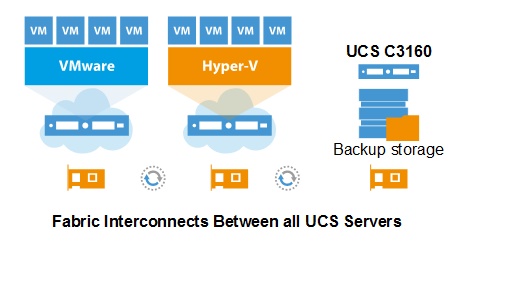
So let’s zoom in on the Cisco UCS C3160. It has a few key specifications that caught the interest of a number of keen architects in my extended professional networks which led to this notion of putting the C3160 in place as high performance and high capacity backup storage system. The most interesting specification is that the C3160 can hold up to 60 small form factor drives. Two additional small form factor SSD drives are in place for the boot volume. What this means is that these 60 drives can be used as a backup storage repository. RAID levels are available on this configuration as well, in particular the Cisco 12G SAS Modular RAID controller supports RAID levels 0, 1, 5 and 6. I’d recommend RAID level 6 for this large of a storage resource in terms of drive capacity (up to 4 TB) and the sheer number of drives coupled with rebuild times and have some spares in place. That being said, there is easily over 200 TB available for backup storage in one C3160 server. Let’s take the following figure:
The C3160 provides large amounts of backup storage with excellent connectivity
Coming back from a world wind Mobile World Congress with a record breaking number of customer meetings, Cisco received some great news from ACG Research, Cisco continues to be the #1 provider of the Mobile IP Infrastructure Market Share with over 39%.
I recently participated in a Cisco advisory board meeting attended by some of our leading manufacturing customers. There was a lot of discussion about the tough challenges the industry is facing. Flexibility, agility, and managing costs were hot topics. Traditional manufacturing environments with manual processes, independent systems, and siloed data create a lack of visibility into real-time operations and result in delayed responses to quality issues and inventory waste. Many manufacturing organizations are starting to take their first steps towards becoming digital. Let’s take a look at what that means and why making the transformation to a digital factory is the next wave of evolution. Continue reading “The Digital Factory: Real Solutions and Real Outcomes”















 topics. Traditional manufacturing environments with manual processes, independent systems, and siloed data create a lack of visibility into real-time operations and result in delayed responses to quality issues and inventory waste. Many manufacturing organizations are starting to take their first steps towards becoming digital. Let’s take a look at what that means and why making the transformation to a digital factory is the next wave of evolution.