Avatar
It's not about dressing up...
It’s not about dressing up…

We get this question all the time.  As much as camera technology has advanced over time, there are still some important things to understand about how light is processed through a lens and what your choice of attire can do to mess it up.

Our eyes are still better at adjusting to many things than a camera is. The color and the patterns we see will look different through the lens. When it comes to TV, you really want to dress for the camera to look your best.  Some people worry too much – but it is good to have a little knowledge as to WHY we are asking you not to do certain things.  I have divided these tips that I generally share into a couple of simple categories to make this as easy as it really is.

1. Color

Bold colors can do a lot to project certain traits of your personality but how they are paired with other items can make a big difference.  If you are wearing a bright red tie over a very neutral shirt, the color could easily bleed.  This can also make your face look flush as the camera attempts to balance everything in the scene.  The challenge is in high contrast images.

This is why we often say NOT to wear all black or all white shirts.

The camera looks for the predominant value in the scene so it can balance everything else.  A lot of black can cause an over exposure of other, brighter colors.  All white forces the camera to seek a middle value as base for the other colors and consequently under expose them.   Any of these can then costs a loss of detail and often make it hard to get skin tones looking good.

This is why you will often see cool blues, natural tones and pastels.  It is always helpful to stay away from primary sold colors, bright red, blue or green, choosing off or light version of the colors is always better. Earth Tones are a great choice as well.

Any tie, jacket, shirt combination should be subdued.  Blues are probably the most camera friendly and this is why you often see us men abusing them as our ‘go to’ color when doing a video.

2. Patterns

Pinstripes, checks, herringbones and textured fabrics will wreak havoc for the camera. These patterns will interfere with the camera sensor and you will see a strange ‘swimming’ effect which can be distracting and dizzying.   After 300 or so videos, I get tired of wearing the same darn thing however and using a patterned shirt underneath a neutral jacket seems to work OK (“most of the time” added by Producer Steve who must be ‘accepting’ my jacket over busy shirt strategy more often than I realized)

https://youtu.be/jXEgnRWRJfg

Solids are your safest bet.

3. Reflections

As you would probably guess. There are (or should be) a lot of lights used within video.  A good video production will pay attention to the lighting of the background and the lighting of the talent (that’s you).  Basic lighting of a person includes at least three lights:

– Key light (main light directed toward the front of you),

– Fill light (control the amount of shadow thrown from the key light), and a

– Hair light (sounds gross…but not for your hotel room, this light is often behind you aimed at your head…it is great for getting separation from the background).

Shine On.

All of these foreground lights are directed at you so it makes sense to think about how reflective you are.   This is not usually an issue for guys as we don’t tend to wear much jewelry.  However, if you wear glasses and are doing a lot of video, a pair of glasses that has a NON-REFLECTIVE coating can be very helpful. This will cut down on the lights reflecting back at the camera, thus allowing  the audience to see your eyes.  And then there is makeup.  I don’t like wearing makeup any more than most guys but we are only wearing it to remove the shine.  Unless you have seen it, you just would not believe how shiny our faces can get under these lights.  It does not look good. A little anti-shine can go a long way in looking healthy.

4. Noise

Jewelry can always be a nice touch for anyone of course but beyond making sure it does not reflect in strange ways…be sure its not causing too much noise. I have worked with some people that show up dressed like a wind chime…and they sound like it too. Less a problem for men of course but we tend to mess this one up in two ways:  big class rings and watches.

Watches and rings tend to bang on stuff, especially lab tables, keyboards and any hardware demos based on my experience.  I sometimes punctuate a point by lightly banging my hand on the table and anything metal can make a sharp, distracting sound.  This is also one of the reasons it can pay to have a dedicated sound engineer monitoring your recording.  Part of their job is to identify extraneous sounds that are picked up in the recording and help the director determine if things should be redone to get a ‘cleaner take.’

My overall advice: Bring some options. 

Besides being prepared and listening to direction, one thing a Director/Producer will love is a person who comes with alternate shirts or outfits. You can never be too sure how your choice that day will look when put in front of certain backgrounds or when next to other presenters.  Don’t waste time trying to coordinate outfits in advance. Bring some options.

Be as original as usual.

My last tidbit here would be to still remain original. For those of us who work in a corporate atmosphere, we tend to give up on originality.  Most of us dress pretty much the same.  My shows are almost always casual. But if you wear a certain hat. Maybe you are a ‘vest’ guy…or just always wear khakis.  Then do it. Be yourself. I can’t stand video where the content is not ‘real’ and certainly if the people are not themselves.  I am a boring dresser.  If my wife does not pick it out…then chances are I have done a bad job matching it up.  I like to wear jeans and leave my shirt untucked. This is why you will see that in most of my stuff.   But don’t match me unless its you. I am good either way as long as you stay true to yourself.

Hope that helps a bit!

Robb

VISIT TECHWISETV.COM for “Technology you can Use from Geeks you can Trust”

LET’S CONNECT!

PS.  I always hated turning my phone in airplanes as I never found any information about how that could possibly affect plane safety.  I know there is some effect, but if it were really an issue, they would have confiscated our phones a long time ago.  Turning your phone off while in studio however is very important – I will explain why in my next post!  Blog.techwisetv.com

Authors

Robb Boyd

Producer, Writer, Host

Avatar

In the last episode of our myth-busting series, Cisco SDN expert Frank D’Agostino and I are debunking the myth of the bargain priced white-box switch. White boxes aren’t a new subject in the market, but customers are just now starting to evaluate them for return on investment. So, where to start? When considering a white-box deployment, it is crucial to do all of the math. You must consider both the capital costs and the ongoing operational costs of this type of solution.

Two independent reports show that the up-front cost savings of a white-box switch are marginal as compared to those of traditional vendors. Deutsche Bank published “Whitebox Switches are Not Exactly a Bargain” in 2013, while Forrester Research recently released a study titled, “The Myth of White-Box Network Switches,” (February 20, 2015).

While the cost of a white-box and traditional switch are fairly similar from a capital expenditure point of view, Cisco analysis shows that white-box switches are more expensive when you include operational expenditures, such as the integration of third party software, tools and support costs. In fact, these real-life deployment factors can result in a total cost of ownership for Cisco that is approximately 20-30 percent less expensive than the full deployment of white-box switches.

Bottom line: White-box switches have hidden costs that make them more expensive than traditional switches when fully deployed. When you add up the cost of hardware, third-party software, integration and support, they are clearly no bargain. Check out our video conversation for more on this topic.

https://www.youtube.com/watch?v=0RpOKBZ4Jf0


Authors

Rob Lloyd

President, Development and Sales

Avatar

This week I’m attending CERAWeek, the premier international gathering of energy industry leaders, experts, government officials, policymakers, and innovators. While this is the 34th annual CERAWeek conference, the mood is definitely not “business as usual.” The disruption and uncertainty created by plunging oil prices and shifting market dynamics has created the urgency throughout the industry to rethink strategies and adopt connected technologies to spur operational efficiencies.

But disruption can also create opportunity. Forward-thinking oil and gas (O&G) firms see today’s turbulent market as an opportunity to gain competitive advantage by harnessing new technologies. For example, in the Eagle Ford region in North America, improved drilling technologies are now enabling oil rigs to produce 18 times more efficiently than in 2008, and 65 percent more efficiently than in 2013.

A new study by Cisco highlights the opportunity to achieve even greater efficiencies through transformed business models and digital technologies powered by the Internet of Everything (IoE)—the networked connection of people process, data, and things.

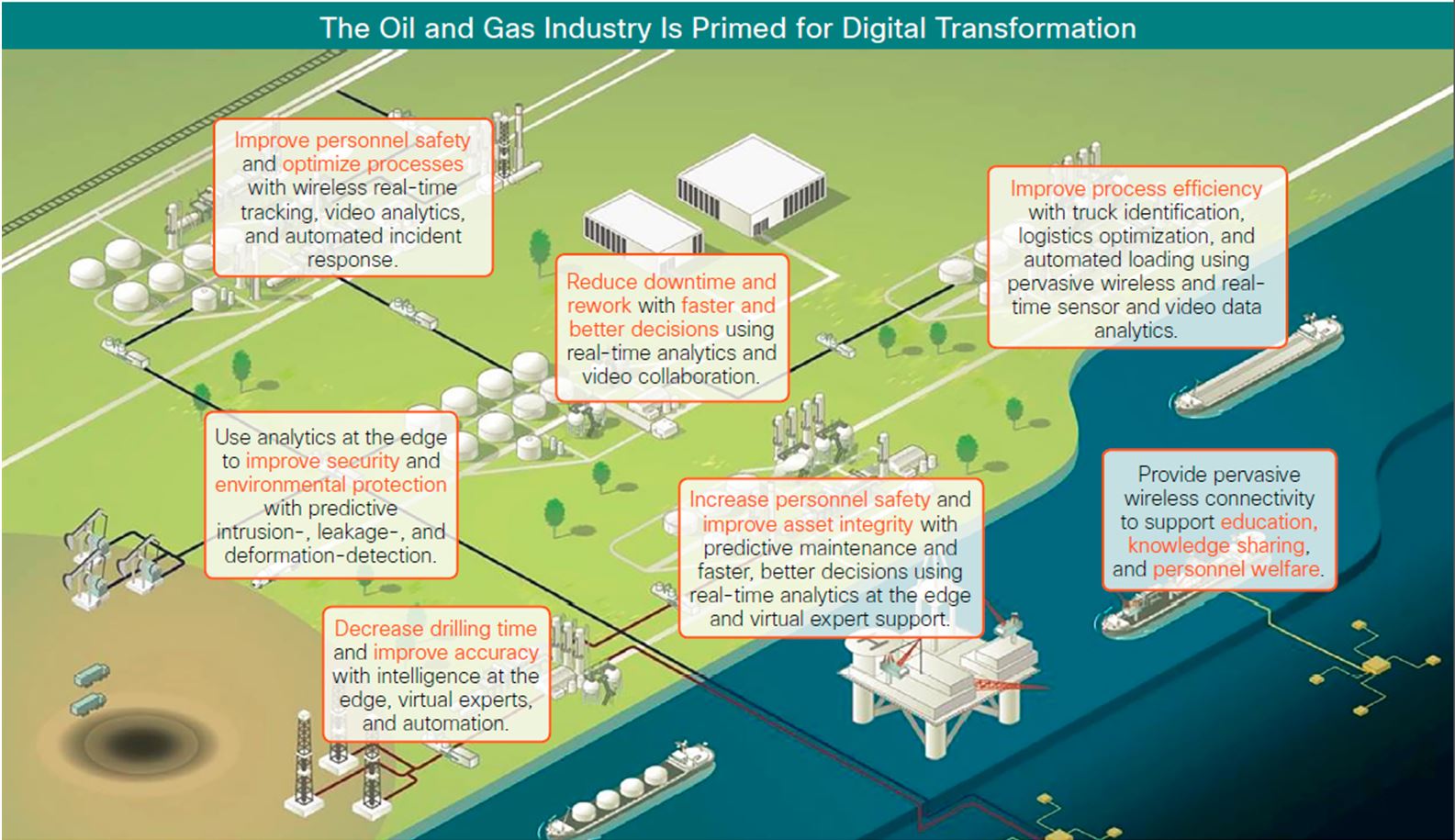
With IoE, oil and gas firms have the opportunity to make IT services a commodity in the business, creating the potential for dramatic cost reduction and improved operational efficiency. The illustration below shows several ways O&G operations can benefit from connected technologies. To achieve these benefits, however, they will need to bring together both the IT and the operational technology (OT) sides of the business. Our survey indicates that oil and gas firms have a long way to go in breaking down the barriers between IT and OT. In fact, only 41 percent of respondents “completely” or “somewhat” agreed that their firms’ IT and OT strategies are aligned.

OandG_Digital_Tranform_01
Source: Cisco, 2015

Here are some examples of how IT-OT convergence can impact the areas of data, collaboration, and cybersecurity: Continue reading “IoE-Powered Business Transformation Boosts Agility and Efficiency for Oil and Gas Companies”

Authors

Nicolaas Smit

Director

Energy Industry Global Industries Center of Expertise

Avatar

Guest Wi-Fi has become a must-have, not a nice-to-have requirement for our customers.  Today, let’s talk about building customer engagement through guest Wi-Fi and how CMX Connect creates a new guest Wi-Fi experience. We also have a special offer to share if you’re interested in trying out CMX (Connected Mobile Experiences) Connect.

Offering Guest Wi-Fi is a No-Brainer

Have you ever found yourself constantly checking emails on your phone, whether you are in the supermarket, a sport stadium or your doctor’s office? We live in a connected world so when people lose their Internet connectivity, they feel as uncomfortable as if they are walking in the dark. According to a Cisco report [1], one in every three college students and young professionals believes the Internet is as important as air, water, food, and shelter. At college games, fans often leave at half time if they cannot connect to the Internet to post photos or tweet comments [2]. Offering guest Wi-Fi has become a must, not an option, for most of our customers across all verticals such as retail, healthcare, sports and entertainments, and education.

Guest Wi-Fi is an opportunity to engage and delight your visitors

So you’ve decided to offer guest Wi-Fi at your venue, but how do you make the most of it from a business standpoint? According to a Hotels.com 2013 survey, the first thing hotel guests try is the quality of guest Wi-Fi, before the quality breakfast or even the comfortable bed [3]. So guest Wi-Fi is a perfect opportunity for you to engage your visitors and increase customer satisfaction and loyalty. With a seamless one-click mobile-first onboarding experience, visitors can check-in on your business Facebook page, or provide email information for future promotional campaign. Since you also know the context and location of your visitors, you can offer personalized and relevant information to visitors. For example, first-time parents connect to the hospital’s guest Wi-Fi in the Maternity ward can be served a video on changing a newborn’s diaper .

CMX Connect is built to address these use cases

We have made significant improvements in the CMX 10.1 release and will continue to partner with our customers in this journey. So how does CMX Connect help you improve your business?

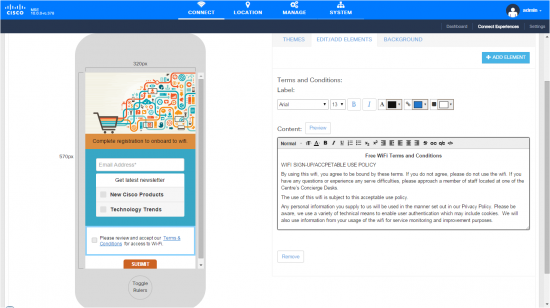
  1. We have a modern and intuitive user interface so IT managers can work with the marketing team to create guest portals, collect visitors’ information, and customize promotional offers by location. You don’t need a user guide or need to write any code to create guest portals. Figure 1 shows an example of the simplicity in building a portal page. Figure 2 provides examples of guest portals built by our tool.

bao image 1

Figure 1. Example of the portal builder tool.

bao image 2

Figure 2. Example of custom guest portals Continue reading “Creating a new guest Wi-Fi experience with CMX Connect”

Authors

Bao Nguyen

Product Manager

Mobility Services and Cisco Connected Mobile Experience (CMX) Group

Avatar

The Cisco TelePresence Hardening Guide has been updated, adding the DX70, DX80, and DX650 models. The Cisco DX Series run the Google Android operating system, which has special considerations for security.

The updates cover security areas related to:

  • Access to the Google Play store and 3rd party apps
  • Remote access to the device
  • Simple versus Enhanced mode
  • Syncing the system to external accounts
  • Serial and console access
  • Bluetooth considerations

The hardening guide can be found at the following URL:
http://www.cisco.com/web/about/security/intelligence/TP_Harden_Guide_wp.html

Give it a read and learn how to harden your TelePresence DX system.

Authors

Scott Bradley

Security Intelligence Engineer

Security Intelligence Operations

Avatar

Product recalls can be a headache for customers and consumers, but a financial nightmare for manufacturers.

Just look at the auto industry. An air-bag recall will cost one manufacture up to $235 million. While a gas pedal problem will hit another manufacture with upwards of $2 billion. Yes, billion.

But recalls aren’t isolated to the auto industry. Food. Toys. Tech. Virtually no industry goes untouched.

And it’s not just the size of a recall that matters. It’s the damage to your brand’s reputation. Plus, recalling a product is more complex than ever.

Here’s why. Continue reading “The Internet of Everything Will Help Solve Problems That Lead To Recalls”

Authors

John Kern

Senior Vice President, Supply Chain Operations

Avatar

Creative. Problem Solver. Team Player.

These could easily be a part of a job description in LinkedIn, but for me these words describe the group of 5th and 6th graders I had the privilege to meet last week.

Through a Cisco volunteer program called Programa Escuela, elementary school students have the opportunity to learn firsthand about the latest technology from Cisco employees: from connecting things through the Internet of Everything to how cities are becoming “Smart.” This is especially relevant to the classrooms we visited in Barcelona as their community is continually referenced in the Smart City space.

https://www.youtube.com/watch?v=TCbvxb5t5_8

The goal of the program is to teach children about technology, inspire them to keep up their studies, especially around STEM-related areas (science, technology, engineering and math), and to engage them in a hands-on project where they can apply their knowledge. They also receive coaching and mentoring around project work and communication skills.

Continue reading “Seeing the Connected World Through the Eyes of Children”

Authors

Julie Chrysler

Program Manager

Cisco Networking Academy

Avatar

An excellent post from Mike Riegel talks about how things have changed between the Tech industry and the Oil and Gas Industry over the past 20 years. The conversations he once had with his father-in-law who was at Mobil Oil have changed dramatically since the nineties. Oil companies are now  ‘Digitizing’:

  • The Digital Age has come to the Oil industry, and despite the current downturn, the most visionary companies  will have the opportunity to transform their business models for future growth.
  • The recently released report: “A New Reality for Oil & Gas – Complex Market Dynamics Create Urgent Need for Digital Transformation” makes it clear that the move to a Digital Business and the adoption of Internet of Everything is the way forward for the industry and for the global economy.
  • IT and OT (Operational Technologies, sometimes called Automation Control Systems/ACS or Industrial Control Systems/ICS) need to become more aligned out of their silos.
  • Biggest issue the industry faces is the ‘data-deluge’ – there’s a need to do deal with sensor and other data both in real-time at the source (usually the edge of the network) and that stored away in huge historians. Analysis of historical and real-time data is an imperative.
  • The US is well positioned to be the ‘swing-producer’ in the market as a result of their agile adoption of IoE, and the successful companies will take advantage of the market dynamics to invest, whilst others will cut costs, investments and retrench, falling behind. This week at CERAWeek we’ll hear from Marcel Cappetti about that (Wednesday at 11:20 AM).

Check out the full post from the IoE Blog channel here:

20 Years Hence – What Do Oil, Dating, Digital, and Analytics Have In Common?

Mike will no doubt get feed back from his father-in-law this weekend and hopefully we’ll get a report back!

As always, let us know what you think!

Authors

Peter Granger

Senior Sales Transformation Manager

Avatar

This is a big week for the global energy industry, as thousands of energy leaders, experts, technologists, and policymakers gather in Houston, Texas, for the 34th annual CERAWeek conference, the premier international event for the industry. As a corporate sponsor of the event, it’s also a big week for Cisco.

Just last week, Cisco released a new report focused on the need for digital transformation in the oil and gas industry. Based on a survey of oil and gas executives, analysts, and consultants in 14 countries, the paper validates CERAWeek’s “oil day” theme, “Turning Point for the Oil Industry.” For forward-thinking oil and gas companies, the price volatility and turbulence in the market could represent a turning point toward true digital transformation. Continue reading “A Turning Point for Oil and Gas: Managing Through Turbulence to Digital Transformation”

Authors

Tony Shakib

No Longer with Cisco