In 1930, Henry Luce started Fortune magazine. In 1990, Cisco went public through an IPO. In 1995, John Chambers became CEO of Cisco. In 1998, Fortune started its “Best Companies to Work For” List. As a young company, Cisco was pleased to be on that first list in 1998. We’re extra proud to have been on this prestigious list every year since its inception. For the 16th year in a row, Cisco is on Fortune’s “Best Companies to Work For” list. We came in at #42…so, we have some room for improvement, but, WOW: 16 YEARS IN A ROW!!
“This is the most recognized and visible employee survey in the United States, both inside and outside Cisco, and placing on the list is beyond an honor,” says Kath Weslock, SVP and Chief HR Officer. “As we work on re-invigorating our culture and engaging with our employees, this award couldn’t be more important to us and speaks volumes about the true spirit of our employees.”
As the Cisco NRF 2013 Team packs our bags and heads home from New York City, we wanted to say what a great success NRF 2013 was for Cisco and our customers and partners. The Cisco booth was packed both days of the show, Monday 1/14 and Tuesday 1/15. Our four Big Ideas Sessions were very well attended – with two at standing-room only capacity!
We will be posting highlights and videos about Cisco at NRF 2013 in the coming days. To kick things off, here are two videos about Cisco’s Big Ideas Sessions: New Wi-Fi Solutions and Digital Malls.
Big Ideas Session #1: Engage and Entice Your Customers with New Wi-Fi Solutions
Bob Friday, CTO, Wireless/Mobility, Cisco and several mobility thought leaders discussed how retailers can use their wireless network to enhance the in-store shopping experience. Watch this video to hear innovative ideas on how to engage and entice today’s mobile, tech-savvy shoppers to improve brand loyalty and sales.
Ask the Data Center Security Expert with Cisco’s Rajneesh Chopra
Rajneesh Chopra is the Director of Product Management and Marketing at Cisco for the enterprise firewall line of technologies and has more than 10 years of product management leadership experience in the networking and data center arena. He also has a very futuristic outlook and a great passion for solving big customer problems.
Rajneesh sees the confluence of mobility, power efficiency, and standardization as the key drivers for change in the next-generation data center and with implications for the way security will need to be addressed. These changes are particularly significant as they are being driven by end-users versus heavy marketing pushes, which can often artificially induce change. Rajneesh delves into each of these factors and the role they play in the next generation data center.
Now that 2013 is officially here – it must be time for the next wave of innovations for the Cisco VXI Smart Solution. The first of these enhancements is Jabber for virtual environments, which we are announcing today.
In 2012 we saw the 1000th customer deploy VXI to meet their desktop virtualization and VDI needs. You can read Phil Sherburne’s blog for a look back on 2012. Granted, these VXI deployments are not all 30,000 seat environments – they cover a complete spectrum of implementation scale, from small pilots to large production environments with tens of thousands of seats.
We recognized an interesting trend in 2012. Many IT departments were expanding on their initial deployments by simply adding UCS blades to scale the installed pilot VXI infrastructure – one of the great benefits of having a VDI architecture that scales seamlessly from zero to 5000 virtual desktops in just 30 minutes.
It’s rare for an IT department to roll out an enterprise-wide desktop virtualization deployment from day one. There are technology and operational lessons that are often best learned though a pilot production deployment numbering hundreds, rather than thousands of seats. With Cisco VXI we are assisting IT organizations with the initial pilots through attractive bundles that are targeted at pilot deployments, pre-production pilot service offers and the like.
However, once the pilot is successfully deployed, IT needs to consider how best to expand the deployment on three dimensions:
Efficiently scaling the number of virtual desktops
Supporting additional work profiles and use cases and
Operationalizing the provisioning and administration of large deployments.
The VXI roadmap is well aligned with helping customers expand and scale their desktop virtualization deployments across all three dimensions.
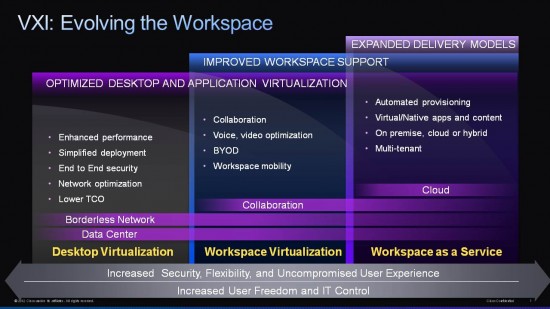
Phase 1 of the roadmap has been focused on providing the most scalable, efficient and simplified infrastructure for desktop and application virtualization. Together with partners, including Citrix and VMware, we continue to expand on the capabilities of VXI in this area with greater virtual desktop densities, storage optimization, network and security enhancements – and the like.
In phase 2 of the roadmap we have been focused on expanding the use case support by enabling greater levels of mobility, broader device support and just as importantly greater support of integrated collaboration and voice/video services in a virtual desktop and application environment.
In the 3rd phase we will focus on helping enterprises and service providers enhance the operational efficiencies of large deployments through private, public and hybrid cloud workspace models.
Today’s “Jabber for virtual environments” announcement is squarely focused on enabling support for a broader set of use cases, by evolving our virtual workspace architecture. This important enhancement is part of a strategy for better enabling collaboration services on any device running a virtual desktop. This capability is enabled by software, called the Virtualization Experience Media Engine (VXME) that will initially run on Cisco’s thin clients followed by Windows thin clients and Windows PCs.
To learn more watch the webcast or take part in the conversation here
Also if you are going to be at Cisco Live in London at the end of the month – don’t miss out on seeing the VXI technologies in action at the World of Solutions Data Center and Unified Workspace booths.
And finally, be on the look out for additional VXI developments as we progress through the rest of 2013.
Network Management is dull. No excuses. Monitoring and interacting with the devices that move data from one location to another is a thankless undertaking that most of us building networks leave to an afterthought. Part of that is the complexity associated with managing networks. There are at least a dozen common methods for interacting with devices in the network including SNMP, CLI, AAA, Syslog, Netflow, and fancy XML/HTTP interfaces. So much variety breeds complexity so we tend to set our goals pretty low for interactivity with the network.
Cisco partners have told us multiple times that the Virtualization Experience Infrastructure (VXI) continues to be the Gold standard for Virtual Desktop Infrastructure (VDI). We appreciate your input. At the same time, we know there’s more we can do to help you.
So we’re happy to share with you that a new release of VXI comes out today. What does this mean for you?
Let’s have a look first at what’s new, how this meets your customers’ demands, and then how that applies to your business.
First, key to the announcement is an opportunity for partners to now offer Cisco’s collaborative services, enabled by Cisco Jabber. This means customers can select the work style most suited to their needs: mobile, fixed, and now virtual. Cisco Jabber for virtual environments is enabled by Cisco Virtualization Experience Media Engine (VXME), a new software component that delivers high-definition video and voice communications to be integrated as part of a virtual desktop session.
These are exciting times. Today Cisco announced the latest release of the Cisco Virtualization Experience Infrastructure (VXI) Smart Solution and I am very pleased to share this news with you. Cisco has unveiled a new software strategy to support Cisco Jabber for virtual environments as an integral part of Cisco VXI. Cisco has taken this path to innovation based on how our customers use the Cisco VXI Smart Solution today for desktop visualization and from trends in the market. We continue to see strong growth in desktop virtualization and in new collaborative experiences not to mention the ongoing demand for BYOD and mobility.
Cisco VXI was the first desktop virtualization architecture to eliminate the bottlenecks and overloads that often occur with rich media collaboration. Today we are evolving that architecture further by including Cisco Jabber for virtual environments which — thanks to Cisco Virtualization Experience Media Engine (VXME) — leverages the computing and processing power of the local environment to minimize the impact of rich media on network performance and data center resources.
Cisco VXME enables virtual desktop users to take advantage of Cisco Jabber’s suite of collaboration features like voice calling, high-definition video calling, presence and instant messaging. Meanwhile, virtual desktops, applications and collaboration services are centrally hosted on the Cisco Unified Data Center and delivered to a broad array of devices resulting in a seamless user experience. It’s just like using a traditional local desktop.
With today’s announcement, Cisco VXI becomes the first desktop virtualization solution to integrate network-based Quality of Service. The Cisco VXME software makes the network aware of voice and video traffic and automatically prioritizes it, reducing jitter and delays. The result? IT managers are now able to easily deliver a high quality collaboration experience to their virtual desktop user communities.
Not only do these innovations create a stellar user experience, they also meet security needs. Virtual desktops become a mirror of traditional workspaces, and as such provide the same level of secure access to documents, corporate applications, and a full suite of collaboration tools via Cisco Jabber.
Additionally, users are now able to personalize their virtual workspace experience with our new desktop accessories from Jabra and Logitech.You really have to check them out.
We continue to work closely with our partners who are fully enabled to implement an end to end VXI Smart Solution. Find out what this new release means to them.
Right now, Cisco VXME is designed to work with the Cisco Virtualization Experience Client (VXC) 6215 and will be globally available in March of this year. Support for 3rd party thin clients and Windows PCs will follow during the first half of 2013. Cisco Jabber for virtual environments is compatible with Cisco VXI solutions running Citrix XenDesktop, Citrx XenApp, or VMware View 5.1. Read Citrix and VMware perspectives on these innovations.
To learn more about Cisco’s desktop virtualization strategy and see a demonstration of Cisco Jabber for virtual environments and the new UC accessories, I invite you to join me for the Cisco Collaboration Announcement Webcast with live Q&A on Jan 17 from 9-9:30 a.m. Pacific Time (replay available after 11 a.m. Pacific Time).
The Global Certification Team is proud to announce that the Cisco Catalyst 4500-X has earned USGv6 and Ready Logo certifications! The 4500-X was certified on IOS XE version 15.1(1)SG. The details of the individual certifications can be found below:
The fixed-aggregation Cisco Catalyst 4500-X Series Switches deliver best-in-class scalability, simplified network virtualization, and integrated network services for space-constrained environments in campus networks. More information on the Cisco Catalyst 4500X can be found on Cisco.com.
Get up to the minute updates on Cisco product certifications from the official GCT twitter, @CiscoCertTeam!
Meanwhile, we asked our Twitter followers and Facebook fans some of the same questions. We learned that when it comes to having the data on your phone deleted or skipping showering for a week, nearly 70% of you would choose to conserve water.
We also learned that over half of our fans and followers would rather lose their wallet than their smartphone and close to 90% would sooner cut the cord on their cable TV subscription to keep their smartphones.
These anecdotal findings are consistent with what we found from our global survey. The 2012 CCWTR confirmed that this smartphone behavior is ingrained in 18-30 year olds. And while the drive to stay connected is global, the CCWTR uncovered a few regional differences as well. For example, the CCWTR found that nearly 2 out of 3 Canadian consumers say they use their smartphones for non-phone functions more than phone functions. In India, China and Korea, millennials said they were more likely to meet online with friends than in person. Latin American countries Mexico, Brazil, and Argentina were found to be the most Twitter-savvy countries by the Report and millenials in European countries were least likely to feel anxious about losing contact through smartphones.
https://www.youtube.com/watch?v=P6rOsrmxgXo
How does your country stack up? Click here to view our interactive world map with CCWTR findings. Keep following the conversation at #DataInMotion.