Charles Clarke, former UK Secretary of State for Education and founder of the EWF, brought his huge experience of and commitment to turning political vision in to practical action, challenging the delegates to create the conditions that can transform education systems – forging consensus, building leadership, driving change. Education leaders everywhere have a huge responsibility for ensuring that they build opportunities for all, not just a few. Because that is both right and necessary to compete in the modern world.
In a time when the manufacturing industry is in dire need of new employees as more and more baby boomers move to retire, I find it interesting that more than 50 percent of 2011 college graduates are either jobless or underemployed (AP Report). To me the numbers don’t add up. Sure, at first glance, it’s easy to blame the poor economy for the unemployment rate, but try considering reasons beyond that. What are the real reasons many college graduates are unemployed? I don’t necessarily think it’s because there aren’t jobs, because in the manufacturing industry, there are plenty. Some have estimated there are hundreds of thousands of jobs that are going unfilled in manufacturing in the US alone; jobs that are good-paying and that can be the foundation and means for someone to attain their “American Dream”.
As I reflect on this information, a couple of things come to mind. Kids growing up today are expected to go to college and graduate. This is great, but over the past few years, we have seen more and more students going to college without a well thought out career in mind. They all have aspirations to be “successful” and have a “dream job” once they graduate, but many students are never really able to untangle what that dream job looks like. This can lead to four or more years of education along with college debt without a clear career path. Continue reading “Reshaping the Manufacturing Industry Perception to Attract the Next Generation”
Integrating Social Media Channels into Existing CRM Systems and Processes
The year is 2024, and you just walked into a department store to return a pair of jeans. As you enter the store, the near field communication (NFC) chip in your smartphone tells the store who you are because you have enabled the privacy settings to do so. The store knows you’re an active fan on Facebook. You’re even classified as one of their ambassadors. You’ve been identified as a frustrated customer after posting a comment on the company’s Wall about your brand new jeans being defective. One of the sales representatives receives an alert message that you’ve arrived, and she’s waiting for you in the jean section, holding a new pair of the same jeans, in your size, ready to make an exchange. The NFC chip in your phone has already confirmed your identity, reducing the need to show a receipt, credit card, or drivers license. You’re out the door with a new pair of jeans faster than you’re able to post a raving review on their Facebook wall, reclassifying you as an advocate in their CRM system.
“They replaced my busted jeans without even asking a question!”
OK, the year is not 2024, Cisco doesn’t sell jeans, and I’ve only been able to use NFC once in the year I’ve had it on my smartphone. But haven’t you wished that the company you just called already knew the past phone, email, even Facebook conversations you’ve had with them so that you didn’t need to explain yourself to them again and again? Isn’t your time valuable, shouldn’t all of their systems talk to each other to create a better, not worse experience for you? Continue reading “Connecting the Customer Experience Through Social #CiscoListens”
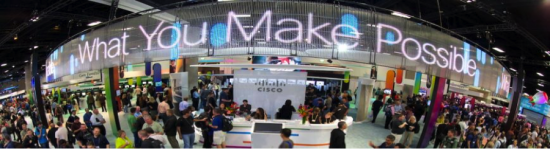
Cisco Live Europe returns to London this year more precisely at the ICC Excel Conference Centre.
By focusing on “What You Make Possible”, attendees are invited to hear customer testimonials and see Cisco’s innovation solutions that showcase what is possible when partnering with Cisco.
As usual the event is divided between a series of educational programs, starting on Monday January 28 with a full day of technical seminars , followed on the 29, 30, 31 and even Feb 1st by a large range of opportunities
Keynotes sessions with CTO Padmasree Warrior (1/29) and Data Center SVP/GM David Yen (1/30 )
Break out sessions
Panels
Labs
Meet the Engineers
Cisco Certifications
I will not detail all the activities. I encourage you to check the website. If you’re in London you want to attend directly – If not you may want to check www.ciscolive356.com to discover a large choice of sessions that you can attend on line .
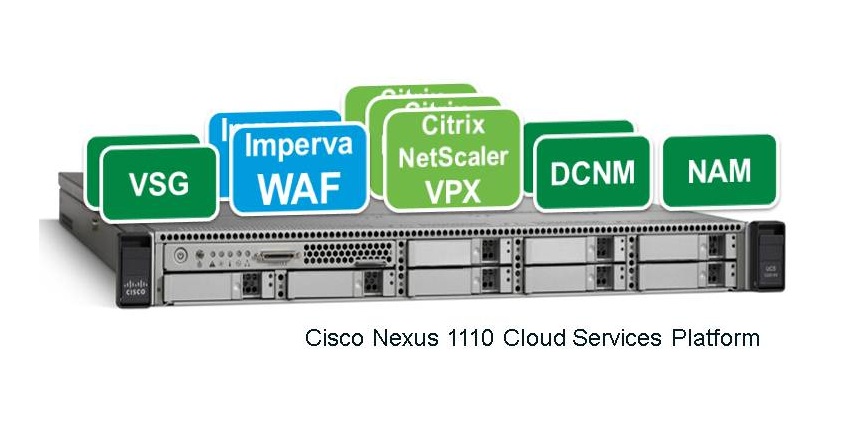
The Nexus 1110 is the latest generation of appliances that started with the Nexus 1010. The Nexus 1110 helps customers that are virtualizing more of their application and security services and want to run them on a dedicated platform. For example, virtual firewalls, like our Virtual Security Gateway (VSG), complement physical firewall appliances to support virtual application deployments and VM mobility requirements. The Nexus 1110 appliance serves that need, running a range of virtual services on a platform that the networking and security teams can more directly control than the other application servers.
With Citrix NetScaler VPX integrated into the Nexus 1110 Cloud Services Platform, enterprise IT admins can scale-out deployments by enabling additional virtual NetScaler instances (VM’s) directly from the Nexus 1110. NetScaler VPX also provides feature and management consistency across physical and virtual ADC’s, as well as consistency across physical and virtual workloads that are being managed. The NetScaler portfolio includes two other physical appliances, MPX and SDX. The virtual VPX can also load balance across both physical and virtual servers, as well as multiple web servers, application servers and database servers.
If you haven’t heard about Unified Management, it refers to our portfolio of data center and cloud management software products. Cisco’s data center and cloud management software helps our customers to deliver IT services faster, more efficiently, and with lower total cost of ownership.
This year we’ve made it even easier for you to learn about these software solutions, with several demo stands on the expo floor and more than 17 breakout and theatre presentations.
We invite you to join us at Cisco Live London and learn more…
Cloud computing has evolved from the hype cycle of the last few years, to being an integral part of the Enterprise IT strategy as well as a fundamental service provider offering. The types of cloud constructs have evolved as well – public, private, hybrid and community clouds are all the basic variants, with more sophisticated application-specific cloud offerings continuing to evolve.
While the journey to the private cloud has been continuing and relatively maturing, at least in the more developed countries, and public cloud services offerings are becoming relatively ubiquitous, adoption and deployment of hybrid cloud offerings have had a relatively modest uptake.
The reason for this is not because the allure of hybrid clouds is unappealing, or that it has few use-cases. It is quite the opposite. There are several use-cases all of which are applicable to real-world IT deployments today:
Workload migration: Seamless migration of workloads from the data center or private cloud to the public cloud for better capacity utilization.
Dev/QA operations: Testing of new applications can induce requirement for additional temporary capacity and having an extensible hybrid cloud is quite appealing, instead of investing in on-premise infrastructure.
Cloud-bursting: To handle the needs of bursty applications, temporary capacity allocation in public cloud environments can be extremely cost-effective, providing the convenience of “infrastructure-on-demand”
Disaster recovery: Providing data resiliency in case of failure of on-premise resources
If the use-cases are real and the benefits are so apparent, why have Enterprise not gone all out to deploy more robust hybrid clouds? Why have only few Enterprise and selective applications followed this model?
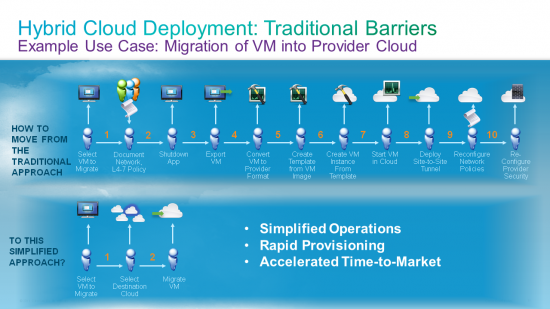
I can think of a few. To make it real, let’s consider the use-case of migrating a virtual machine (VM) from the private cloud to a provider cloud, as an example to illustrate some of the challenges:
Remember to join the Education Fast Forwad (EFF6) debate which will take place at the Education Word Forum with remote participants via Cisco Telepresence. It takes place on Monday, January 28, 2013. Entitled From Learner Voice to Emerging Leaders, the debate will be filmed in front of a studio audience for the very first time and broadcast by Cisco TV. The live stream is accessible on Promethean Planet from 11 a.m. to 12 noon (GMT) on the day. See the Promethean Planet page about the event for further unformation and also to tune into the Live Broadcast on the day.
If you are interested in current education developments and in particular the influence that learners can have – this is not an event to miss.