In just two short days, we’ll be hosting the lovely Tech Field Day delegates once again at Cisco for Wireless Field Day 4!Tcisco
From 9:30-12:30, we will be hosting Wireless Field Day with our engineers from Cisco’s Wireless Networking Group (WNG). It’s going to be a great session, covering Converged Access with the new IOS-based Wireless LAN Controller 5760, delve into the details of our exciting Cisco Mobility Services Engine-driven mobility solution Connected Mobile Experiences, and with a special feature from our friends at Meraki.
9:30-10:30* Jeevan Patil presents Converged Access with Wireless LAN Controller 5760
10:30-11:30Jagdish Girimaji presents Connected Mobile Experiences
11:30-12:30 Sean Rhea presents Meraki Backend Infrastructure
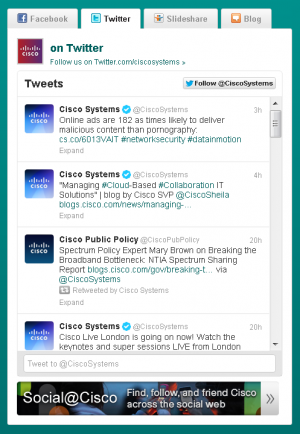
Cisco’s Social Channel Feeds allow encourage visitors to continue their social journeys from YouTube.
YouTube video plays several key roles in the Customer Journey. The video platform offers customers a way to engage through comments and sharing content with one another and plays a supporting (sometimes starring) role in other social media campaigns by serving up videos for Twitter, Facebook and blogs.
While it is more obvious that these other Social Media Platforms steer the customer journey towards YouTube videos, it is also interesting to note where and how the customer journey continues on from online video. Video can and does assist in the continuation of the customer journey towards these other social media platforms. The trick is optimizing YouTube to tap the full potential online video has in supporting and continuing the customer journey:
IP Address Management and the Cloud is a topic that requires solution architecture for every cloud deployment. While Cisco IA for Cloud has a basic in-built IPAM system out of the box, often times we find customers need one of the worlds highest scale IPAM solutions. Cisco’s Prime Network Registrar is one such product in this category.
The follow blog is from our guest Blogger, Jim Kao of the Cloud & Systems Management Technology Group Product Management team.
Cisco Intelligent Automation for Cloud (IAC) is a cloud management platform for Enterprise IT or Service Providers to build cloud services, such as IaaS. You can learn more about it here. The IAC solution supports a customer’s cloud journey by providing a solution that is extensible, scalable and easy to use in order to help them reduce the operation costs, optimize their resource utilization and efficiency.
One of the areas that are critical to customer’s infrastructure growth is IP Address Management (IPAM.) This is especially critical to large enterprise or service providers who need a scalable and extensible IPAM solution. Cisco Prime IPAM is the solution that provides strong IPAM management capability as described in Jamie Lerner’s blog. With these two best of breed products both coming from Cisco and both aiming to give customers scalable management solutions, it makes perfect sense to build integration between the two products. I would like to take this opportunity to introduce an integration recently made available by our engineering team to integrate CIAC and Cisco Prime IPAM. This integration will be made available to customers as part of the latest release of IAC, 3.1.1.
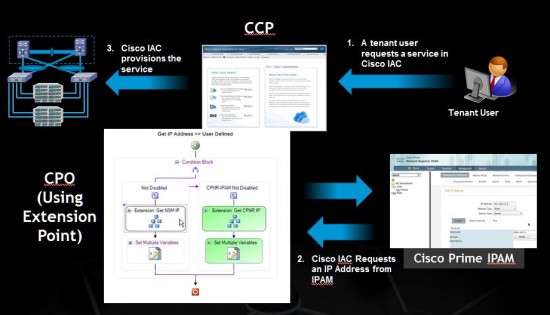
To explain what we have done, the following figure shows the high level end-to-end use case:
In this use case, it starts with a user ordering a virtual machine from a cloud built with Cisco IAC. This order is handled through the Cisco Cloud Portal (CCP) and Cisco Process Orchestrator (CPO). In the case where a customer has Cisco Prime IPAM, IAC will obtain an IP Address from the Cisco Prime IPAM. Before IAC invokes the API to acquire an IP address, the Prime IPAM shows the first available IP address is 192.168.10.9, as shown in the following figure:
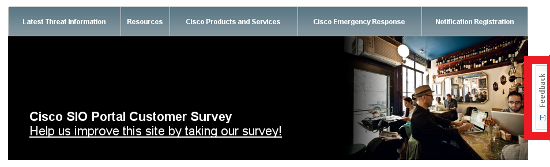
During the 2012 fall season, we launched a survey that seeks to understand how you use and value the security resources on the Cisco Security Intelligence Operations Portal at http://cisco.com/security. At the same time we also made available our enhanced feedback mechanism—shown below highlighted in red—to allow you to more easily share your thoughts and frustrations with our content.
The response has been fantastic; thank you.
Through the new survey and feedback systems, we are broadening our understanding of the content-types you find useful, those you don’t, as well as content you’re not familiar with. We have received very specific questions and feedback and done our best to respond directly when we could (did you include an email address?) and have responded publicly via @CiscoSecurity a few times when no contact information was shared. For example, when an anonymous feedback-submitter suggested we provide RSS feeds for Cisco Security Advisories, we responded via Twitter with:
@CiscoSecurity: A friendly reminder, RSS feeds for all Cisco SIO content types, including Security Advisories, are available at http://cs.co/9007VQr7
In Monday’s blog, Maciej Kranz, Cisco VP/GM for the Connected Industries Group introduced the Cisco Industrial Smart Solution which converges factory automation, control systems and enterprise business systems onto a common, standards-based IP network.
Yesterday, Maciej and many others wrapped up the second of four days at the ARC World Industry Forum, discussing processes and technologies that enable breakthrough performances in industry and infrastructure.
Some Cisco team members shared their perspectives on the Cisco Industrial Smart Solution, how it effects industrial performance, and how it’s being received here at the ARC Forum.
Paul Didier, Solutions Architect, Cisco Connected Industries Group “IT & OT convergence is helping industrial companies meet the primary business goal of Overall Equipment Effectiveness (OEE). A converged network will allow for faster fixes, better monitoring, and easier access to remote partners, employees and expert resources. Standardizing on Ethernet enables rapid network deployment and a less expensive total cost of network ownership.
The keynote topic here at the forum was about achieving breakthrough performance. The Internet of Things (IoT) was recognized as a top trend that’s having positive effects on manufacturing and automation and even on society. The Cisco Industrial Smart Solution enables the IoT so our industrial customers can benefit from those effects.” Continue reading “Initial impressions of the Cisco Industrial Smart Solution at ARC Forum”
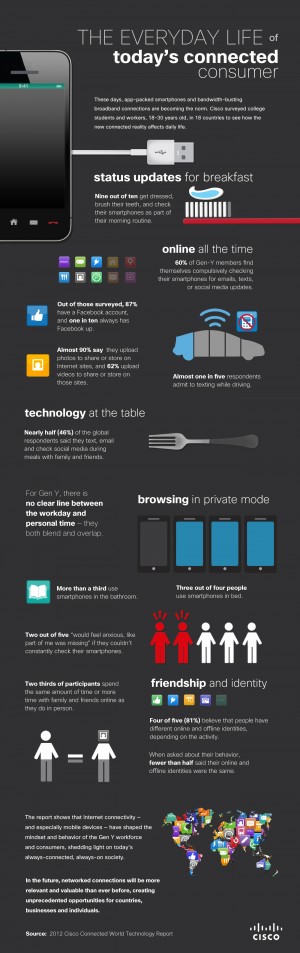
Back in the days, I was one of those students who wanted the most up to date scientific calculators and the latest design of the Trapper Keeper notebook. These days, it’s the wifi access the students want, to stay connected anytime, anywhere on their smartphones or tablets.
According to the Cisco Connected World Technology Report more than 40% of Gen Y (18-30 year olds) “would feel anxious, like part of them were missing” if they couldn’t check their smartphones. I was chatting with my colleague Rochelle Brocks-Smith from the Healthcare team the other day and she was joking that soon, her kids will develop carpal tunnel syndrome with all the texting they do! Continue reading “Wifi password please?”
In our fiscal year 2012, which ended in July, Cisco completed and met our latest greenhouse gas (GHG) reduction goal. To recap our past goals:
September 2006: Clinton Global Initiative (CGI) commitment to reduce GHG emissions from all Cisco business air travel worldwide by 10% absolute (FY06 baseline).
This goal was met in 2009.
June 2008: EPA Climate Leaders commitment to reduce all Scope 1, 2, and business-air-travel Scope 3 GHG emissions worldwide by 25% absolute by CY12 (CY07 baseline).
Both the Scope 1 / 2, and Scope 3 parts of this goal were met in 2012.
We believe formal goals should address the most material environmental issues—which for Cisco are GHG and energy. Over the years, we accumulated several insights—some learned on our own and others suggested by stakeholders—that informed the creation of our new goals. Below, I introduce our new goals and the thinking behind each one.
“Everywhere we go in the world, the things that we come across aren’t intelligent. Like this wall that I’m looking at, it’s just separating the room from the other side. In actuality, that wall should be intelligent.”
He goes on to say, “The next 10 years [will be] nuts.” I couldn’t agree more.
Cisco defines IoE as bringing together people, process, data, and things to make networked connections more relevant and valuable than ever before—turning information into actions that create new capabilities, richer experiences, and unprecedented economic opportunity for businesses, individuals, and countries.
What better way to spend Valentine’s day than to watch a webcast on OpenFlow and SDN, perhaps with your significant other? The last couple of years have seen considerable buzz around aspects of software-defined networking. A significant portion of the early seed discussion was around OpenFlow. As part of the Cisco Open Network Environment webcast series, this time on February 14th, 2013 at 9 AM PST, we take look at an :Introduction to OpenFlow”: What is it? How does it work? What are some of the potential use-cases?
Joining me in this discussion with be David Ward, Cisco CTO of Engineering and Chief Architect. At the time of recording David also wears the hat of the being the Chair of the Technical Advisory Group at Open Network Foundation (ONF). So he brings perspectives both as someone who’s driving the evolution of the protocol, as well as somebody guiding its implementation across several products within the Cisco portfolio.
Also joining the webcast to lend end-user perspectives will be Matt Davy, who is formerly of Indiana University, having been the executive director of the INCenter facility there. Matt’s recently moved onto a new role, but he built a lighthouse test bed around OpenFlow and SDN the last few years during this employment at the university. Matt will talk about campus slicing and his experiences around OpenFlow. Providing service provider perspectives from NTT communications will be Yuichi Ikejiri, Director of the Network Technology Services division.
As mentioned before, this is part of an educational series. If you’ve not watched the first in the series, entitled “An Introduction to OpenStack” – please feel free to register and watch it here. The panel of Lew Tucker and Raj Patel below provide interesting perspectives on OpenStack.









 Paul Didier, Solutions Architect, Cisco Connected Industries Group