With the industry’s drive toward personal and wearable devices, soon people will be walking around with smart glasses, watches, phones, and even shoes. Not to mention they’ll be driving networked cars.
In the future, the task of securing your personal network will become increasingly difficult, which creates a new frontier to the threat landscape, one that is certainly personal. How are people expected to secure all these devices in their everyday personal network? How will we be protected while walking around a crowded shopping mall, admiring koalas at the zoo, or boogieing down in a busy nightclub? Who will combat this emerging threat?
Multiple readers have told me that it is difficult for them to understand and/or visualize the effects of latency on their HPC applications, particularly in modern NUMA (non-uniform memory access) and NUNA (non-uniform network access) environments.
Let’s breaks down the different levels of latency in a typical modern server and network computing environments.
Today Supervisor 720, the most widely deployed Catalyst 6500 Supervisor Engine, turns 10-years old.
Supervisor 720 was launched on March 31, 2003. It enabled me to be the first modular switch to support true 10G Ethernet . Supervisor 720 has brought extensive feature set such as MPLS, VPNs, and VSS over the last 10 years. If has also spread throughout the world over the last 10 years as the graphic (created using Tableau) shows. Continue reading “Catalyst 6500 Speaks: Happy Birthday Sup720, Here’s To The Big 10”
For those who are on the learning curve on various aspects of network programmability, open networking and SDN (like we are), I’d like to invite you to the third in a series of educational webicasts on these topics. Brought under the umbrella of the Cisco Open Network Environment, this particular webcast focuses on “An introduction to onePK”, and will be broadcast on April 9th, 2013 at 9 AM PST. You can registerhere.
The Cisco Open Network Environment is all about bringing the network closer to applications. One way of doing that is by exposing network devices to applications through a rich set of APIs, that can help tap into the intelligence inherent in the hardware and ASICs as well as in the network operating systems. This is what onePK is all about – it’s a single platform kit that will span all of Cisco’s network infrastructure portfolio across Enterprise and Service Provider, exposing them to applications in a homogenous way, allowing app developers to tap into the power of the open network.
Cisco announced its Open Network Environment or Cisco ONE strategy on June 2012 and has been in execution mode since then. onePK happens to be a key proofpoint of this cross-architectural strategy.
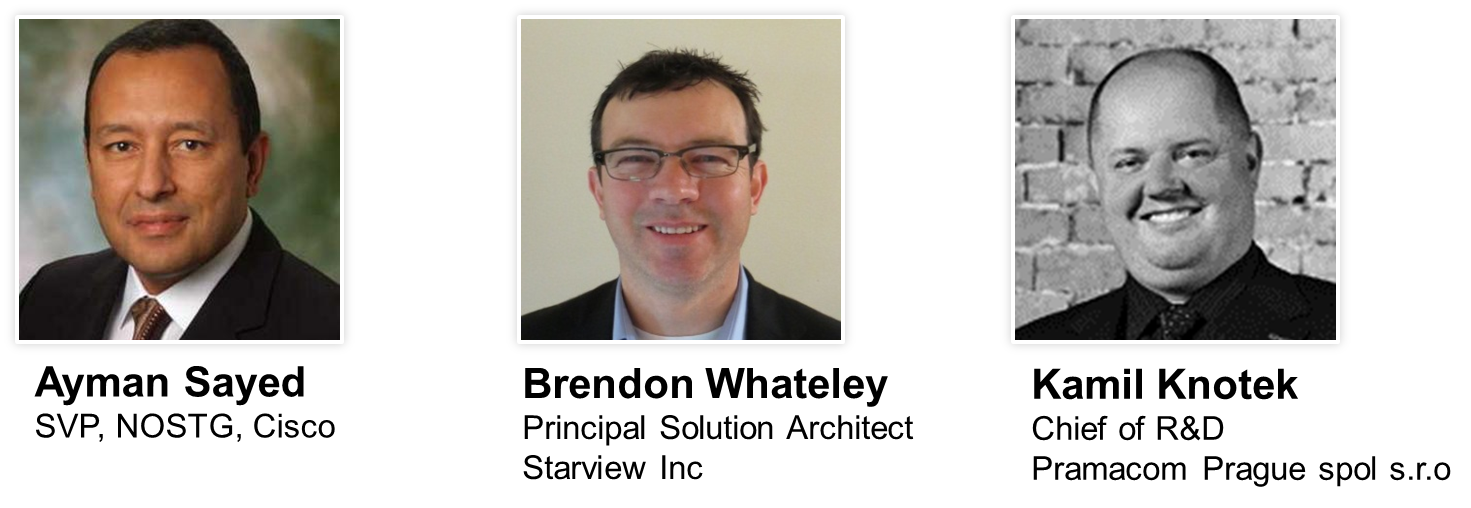
Join me on this webcast, as I host Ayman Sayed, SVP of Cisco’s Network Operating Systems Group as the lead Cisco expert on this topic. We will also be joined by two of the development partners that are working on onePK trials including Brendon Whateley, Principal Solution Architect at Starview Inc., and Kamil Knotek, Chielf of R&D at Pramacomm Prague spol s.r.o, as well as some new demos.
If you missed the last webcast on “An Introduction to OpenFlow” with David Ward, CTO, Cisco Engineering and Chief Architect, we had a turnout from 84 countries and over 120+ questions answered by our question managers in a one-hour period. You can watch a reply of the webcast here.
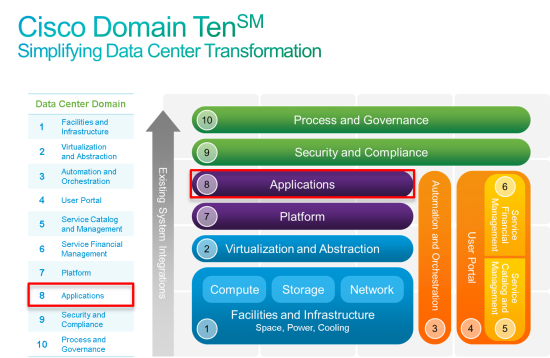
“Applications?” I hear you say. “Why are Cisco talking about application? They’re a networking company!?” If this is what you are thinking, I’m glad you are reading this blog. As we’ve broadened to be an IT company, we in Cisco Services have been quietly building our application migration capability for the past 2 years. And with cloud, as the leading designers of cloud IaaS infrastructure, we in Cisco Services are in a unique position to help you migrate applications to the cloud, where the skillsets required are not only application migration, but a deep understanding of how to enable your applications to genuinely exploit the capabilities of your cloud infrastructure.
Which takes me to the subject for this blog, Domain 8 in the Cisco Domain TenSM framework – Applications, following on from my Domain 7: Platform discussion the other week. In our view in Cisco Services, (business) applications are the primary reason for the existence of the data center. Applications drive so many of the decision in the other facets of the data center. And when it comes to cloud (which is my theme for this Cisco Domain Ten series), there are additional considerations related to migrating applications to the cloud. Let’s discuss some of these in this blog.
Topics such as Software Defined Networking and programmable networks are of great interest to many network operators these days. With that in mind we’re pleased to kick off a new series of Webcasts to help our customer learn more about Cisco’s Open Network Environment strategy.
Please join us on April 9, 2013 at 9:00 am Pacific Time / 12:00 pm Eastern Time for an educational webcast featuring Ayman Sayed, Cisco Senior Vice President of the Network Operating Systems Technology Group. As part of the Cisco Open Network Environment (ONE) educational series, this session will focus on the Cisco One Platform Kit (onePK). Speakers will talk through how this easy-to-use toolkit provides users access to the valuable data and services inside the network for development, automation and rapid service creation with Cisco’s onePK SDK.
During the hour, Cisco technology experts will join with industry leaders to discuss their experience with Cisco’s onePK. Industry experts include:
Kamil Knotek, Chief of Research and Development, Pramacom Prague spol. s r.o.
Brendon Whateley, Principal Solutions Architect, Starview Inc.
Are you excited about March Madness? Turn on a TV and it will be hard to avoid the games, the news, the commentaries, and the jokes about it. If you eavesdrop in any restaurant, bar, or office conversation, I can assure you that you will hear something about it. Even U.S. President Barack Obama filled out a March Madness bracket. Productivity in many offices drops significantly as employees search and watch videos to see how their bracket picks are progressing. At Cisco, we have an open policy and employees can watch and search the scores of their favorite teams. Watch this video posted by CNN where Kip Compton, Cisco’s Video Collaboration Group CTO, talks about March Madness.
During the last couple of years, the industry saw a spike in web malware during the March Madness season. SQL injection attacks, iframe injections, JavaScript, and Java malware were some of the most prevalent. A few months ago, I provided details about some of today’s cyber-criminal tools— exploit kits—and some of the weapons of choice like Blackhole, RedKit, Styx, CrimeBoss, and Cool.
A few things to keep in mind:
Legitimate business sites may have vulnerabilities that allow a hostile site to deliver malware.
In most drive-by downloads, the victim is willing to dismissively click pop-ups and warnings as they navigate to the desired content. In this case, users may just click on pop-ups or ads to watch videos about their favorite team.
A common perception is that there is a difference between being secure and being compliant. A Verizon analysis on cybercrime reported that cyber-attacks on Retailers are increasing and becoming streamlined and automated. According to the 2012 Verizon PCI compliance report, “97% of breaches were avoidable through simple or intermediate controls”. How does a Retailer protect itself? One method is through PCI Compliance. Does that sound contradictory to that common perception?
Join Cisco on April 16th, 2013 10:00am PT for a webcast on PCI compliance and security with guests from Ponemon Institute, Verizon Business and PCI Security Standards Council.
https://www.youtube.com/watch?v=RxlwWeZQ3ZM
As part of the planning of the webcast, we sat down with Bart McGlothin and Christian Janoff from Cisco’s security team to discuss PCI compliance and security for retail and get some answers. Here’s what we learned:
A few months back we announced how Hrvatski Telekom, Croatia’s largest telecommunications company, is using a Cisco’s end-to-end solution for its advanced TeraStream cloud-enabled Internet Protocol (IP) architecture. Operated by Deutsche Telekom subsidiary Hrvatski Telekom (T-HT), it’s initially providing broadband services to residential users in the Zagreb area of Croatia.






 Or in IPv6 speak, you’re an “A”, for Awesome



 Are you excited about
  During the last couple of years, the industry saw a spike in web