Usually at shows like Interop Las Vegas 2013, attendees wander around the show floor looking at all the new products that are coming out from vendors. Now it is always exciting to see the latest and greatest technology coming out, but very often there is so much information to consume it is difficult to envision how these new products will solve problems that IT organizations are facing today.
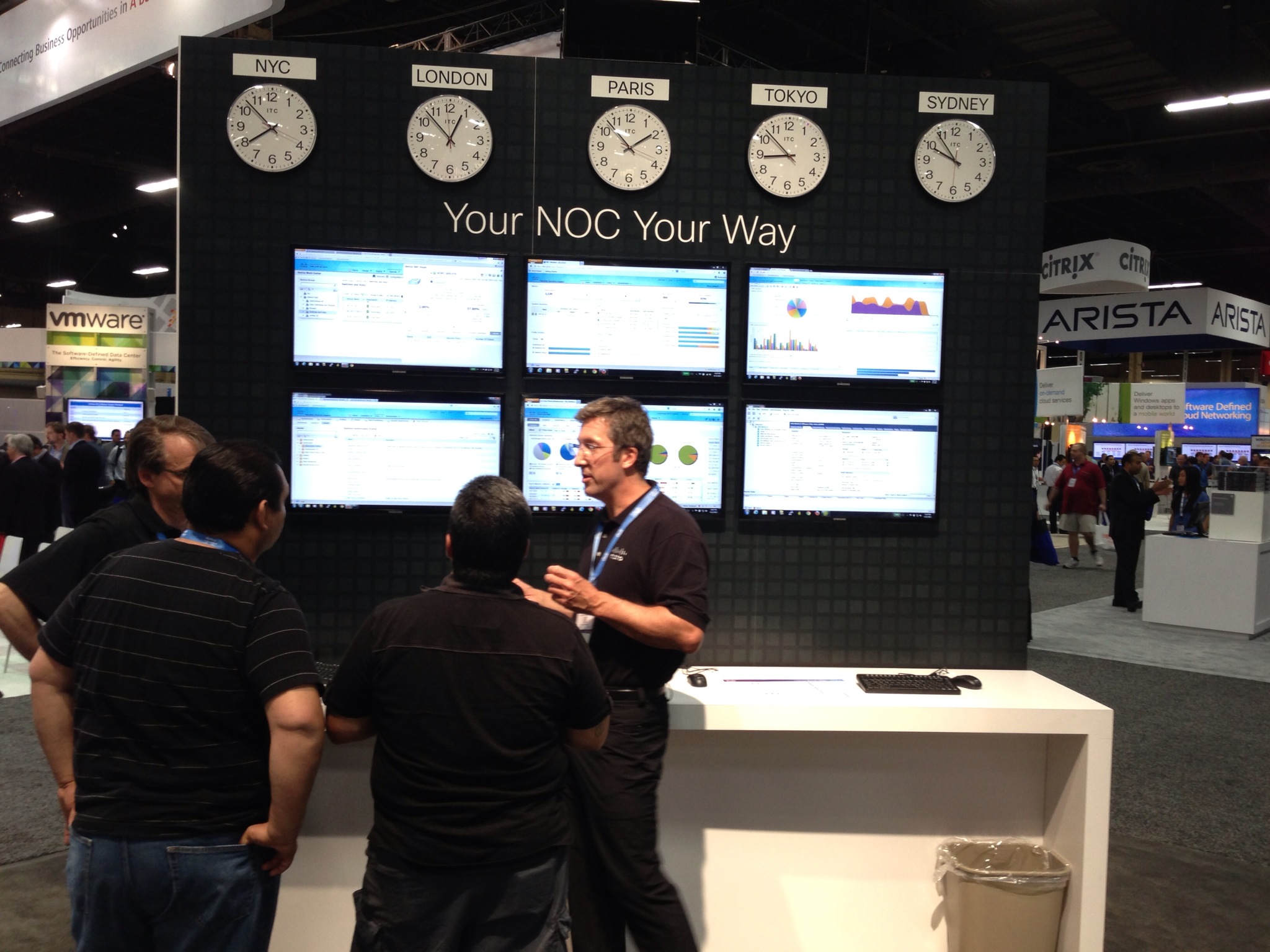
Cisco is taking a different approach at Interop this year. In the Cisco booth there are a number of demo stations including the traditional new product demos, ask the experts stations, trivia games and many more, but in addition there are two unique demos the “Your NOC Your Way” Demo and the Unified Access Experience Demo that take a solution perspective to addressing top IT concerns.
InfoVista recently announced its support for Cisco’s Application Visibility & Control (AVC) as part of its Application Visibility Services solution for communications service providers (CSPs). I took some time out this week to speak with Christopher Cullan, product marketing manager for business services at InfoVista, to discuss the solution and specifically the significance of Cisco’s ISR-AX and AVC to his business.
Bob: Christopher, tell me what’s behind InfoVista’s investment in the Cisco AVC technology as part of your solution?
Christopher: Sure, by the way, you can call me Chris. Cisco AVC and the ISR-AX capability provides an attractive and simple architecture that takes advantage of the Customer Premise Equipment (CPE), and allows CSPs to offer customers a better service experience by enhancing the visibility of the service from an application perspective.
Bob: The application visibility?
Christopher: Yes, exactly—it’s a solution to the problem of the enterprises’ business-IT gap. Enterprise IT is constantly tasked to deliver greater agility to their business stakeholders, and it’s challenging for them to communicate with the business from an infrastructure perspective, including WAN services. The application is better understood and more tangible to the business because they experience it more directly (e.g. the business understands salesforce is slow today, versus the network latency is high). Having insight into not only what applications are traversing the WAN, between which users and systems and how much, but also the application performance itself, empowers enterprise IT to make better decisions and provide a greater experience to their stakeholders. In essence, it helps enterprises better align their IT to the needs of the business. Continue reading “InfoVista Highlights the Significance of Cisco AVC to Application Visibility for Operators”
My colleague Norm Jacknis (former CIO of Westchester County, New York) passed along a list of CIO concerns for 2013 that was prepared by Alan Shark of Public Technology Institute, a nonprofit that provides technology guidance to local government. The list for cities and counties included:
I’d want to expand on a few of these items to include another emerging issue for CIOs and other government leaders: getting cities to embrace cloud and networking tools – while moving their urban economies forward.
Well, there’s good news to report on that overarching concern. There are several opportunities to learn more about how cities can embrace technology for economic growth:
The last couple of weeks have been among my most hectic. CA World 2013 was a blast and the return flight from Las Vegas was an adventure in itself with an inebriated co-passenger. Over the weekend I attended a colorful Indian wedding deep in heart of the Austin hill country. Anyone who has been a part of the groom’s party knows how tiring it can be. To top it, last week I was at OSCON (Open Source Conference) 2013, a conference hosted by Cisco at which we had speakers from IBM, Canonical, Red Hat and Rackspace Hosting among others.
The keynote session at CA World 2013 with Richard Branson, Founder of Virgin Group, was absolutely fascinating. Richard spoke about how he started Virgin Airlines. We also got to see the advertisement for space travel with another of his ventures – Virgin Galactic. A musical performance by the Goo Goo Dolls on the 23rd of April ended with a spectacular fireworks display.
The Cisco UCS session at CA World 2013 by Mark Balch and Lax Sakalkale was well received. In the session Mark highlighted how the increasing demands on data centers and adoption of cloud computing require IT departments to be agile and use flexible infrastructure. He then went on to show why more than 20,000 customers have adopted converged infrastructure based on Cisco UCS technology to meet these requirements. He gave examples of operational efficiency with Cisco UCS in deploying solutions such as VDI, Cloud and Big Data applications. He also cited case studies in which customers had seen significant economical benefits. Lax then showed some of the advantages of managing the UCS infrastructure with solutions from CA Technologies.
We also had a houseful of attendees in the theater session, which discussed real world operations management results from UCS deployments. This session aggregated the results from customer case studies. It also went on to explain the underlying basis for the economical gains that customers are experiencing. Most importantly we had engaging conversations with customers who were designing and deploying continuity and disaster recovery solutions for business critical applications on Cisco UCS. We heard from at least two customers who had UCS blade servers running the critical software for their business.
McAllen Independent School District (ISD) is a great example of a school district utilizing Cisco BYOD Solutions for K12 Education. With nearly 3300 employees and over 25,000 students in 33 campuses, McAllen ISD was challenged with a slow server and an overtaxed network. The bandwidth limitations and made it extremely difficult for the school to embrace the BYOD trend, let alone creating an enriched learning environment leveraging mobile devices.
With a pervasive, scalable and reliable wireless network, the school can now provide affordable mobile devices for a 1:1 learning experience to their students.
See how, after selecting and deploying Cisco’s BYOD Solutions for K12, McAllen ISD achieved anytime access and a greatly improved, learner-centric environment. Students can now utilize mobile devices anywhere on campus with wired-network speeds and performance. Educators have enrolled into the Teacher Cadre Advocates Initiative program to discuss several innovative new methods of educating their students going forward. Learning continues well beyond the classroom and can be accessed anywhere, anytime on campus with Cisco BYOD Solutions for K12 Education.
Technology will continue to transform education as an experience for both students and educators alike. Learn more about Cisco BYOD Solutions for K12 Education.
With more users and devices being added to your network every day, unified access and central policy control have become critical needs. Your organization isn’t alone.
By Chris Ortbals, Senior Vice President, Product Management , Cbeyond Inc.
At the company’s inception in 1999, Cbeyond saw the potential in using IP technology to deliver enterprise-class productivity enhancing communications services to small and medium-sized businesses (SMBs). Today, as a cloud and communications services provider, Cbeyond continues to live up to its brand promise as the technology ally to small and mid-sized businesses,
As Cbeyond witnessed the business value large enterprises were achieving from cloud computing, we sought to devise a new strategy and products that would offer our SMB customers the same benefits in a secure, reliable and affordable way. Our competitors typically offer SMBs a commodity-grade or exclusively self-service type of cloud offering. However, we wanted to go further and provide a cloud service that would not only support end-to-end enterprise-grade production applications but also deliver a much superior experience for SMBs.
Our initial expansion into the cloud came with the 2010 acquisitions of MaximumASP, a hosting provider, and Aretta, a network-hosted VoIP provider. We integrated and enhanced the technologies we acquired into TotalCloud, our flexible and highly customizable cloud services platform.
We’ve had a successful relationship with Cisco since 1999, when we launched the first Cisco-powered 100% IP network delivering services to SMBs. So naturally we considered partnering with Cisco as we made the move into the cloud services market.
In the search for the right partner, we did our due diligence and evaluated three vendors. However, we found that only Cisco could help us deploy, provision, test and implement a cloud platform that not only met our requirements but that could also be launched within our aggressive timeframe.
Our TotalCloud Data Center, a service platform for public and private cloud solutions, is powered by Cisco technology, with Cisco Unified Computing System™, Cisco UCS Blade servers, and Cisco Nexus switches. This solution provides us with a repeatable, scalable architecture that can be used in our current and future data centers.
We collaborated with Cisco Services, for Data Center Optimization and Network Optimization Services since network performance is critical to running production applications in the cloud.
Other vendors would have pieced a cloud offering together from multiple sources so going with Cisco as a single vendor offered a clear advantage over using multiple vendors to accomplish the same task. Also, many cloud platforms are built like an island with limited integration into other products used by a service provider, however the Cisco offering is the complete opposite. Cisco has architected its technology in partnership with us so that their technology not only supports how we want our business to operate but how we deliver services and value to our entire customer base.
And partnering with Cisco paid off. With the help of Cisco Services, Cbeyond’s time-to-market for our cloud offering was reduced by two months, and we were able to secure new revenue opportunities earlier than expected.
This introductory post explains how one of Cisco’s security research groups established a network data collection capability for large amounts of network traffic. This capability was necessary to support research into selected aspects of the Domain Name Service (DNS), but it can be adapted for other purposes.
DNS exploitation is frequently the means by which malicious actors seek to disrupt the normal operation of networks. This can include DNS Cache Poisoning, DNS Amplification Attacks and many others. A quick search at cisco.com/security yields a lot of content published, indicating both the criticality and exposures associated with DNS.
Data generated by people and data generated by machines is actually quite different and as we move from the Internet of Things
to the Internet of Everything, this has some pretty interesting implications.
Data generated by things or machines is actually quite structured: A sensor is programmed or created to produce only a specific type of d
ata. Count the cars that cross the intersection, for example. And it’s predictable, sending a signal at specified intervals which makes the data pegged to a specific moment in time, as is the data’s relevance. It’s also generally low bandwidth, as you would imagine: A single signal from a sensor, providing specific data on a short time horizon.
Data generated by people, on the other hand, is highly unpredictable – I don’t know who I’m going to call or email and whether there’s a photo op when I step outside. Data from humans is unstructured, from spreadsheets to blooper videos, and has historical relevance. Tax returns, photos of your kids, the novel in draft in your desk drawer. It’s moderate to high bandwidth, depending on what you’re doing and it’s always on, always available. Continue reading “Birth of a New Class of Data in the Internet of Everything”















![Cisco_data-in-motion[1][2]](https://blogs.cisco.com/gcs/ciscoblogs/1/Cisco_data-in-motion12.jpg)