After more than 15 years of working in the telecommunications and IT industries, I’ve seen firsthand how people use technology to make a difference and change lives. While there are innovative uses of technology across all industries, nothing continues to impress me more than how collaboration technologies are reinventing education.
As we’ve seen time and time again technologies like video and mobile devices are enhancing 21st century learning. But no matter what technology schools and educators are using, the delivery of services matters. Thanks to the cloud, schools can deploy advanced collaboration technologies with increased financial and operational flexibility.
With Cisco Hosted Collaboration Solution (HCS), organizations can implement unified communication applications while saving money by switching from a capital expenditure model to an operational expenditure model. The flexibility of the cloud enables customers to accelerate rollouts, improve business agility, lower maintenance and utility costs all while continuously delivering services.
Take for example Perspectives Charter Schools, which serves more than 2,300 students across several Chicago communities. When Perspectives Charter Schools made the shift from an on-premise unified communications system to a cloud collaboration solution they lowered monthly costs, simplified system maintenance and improved administrative efficiency. With Cisco HCS, Perspectives’ monthly bill is now 25 percent less than their previous monthly costs for phone lines, maintenance, software support contracts and repairs. But while the total cost of ownership for communications has dropped, the quality of services hasn’t. The schools have added new collaboration capabilities such as voicemail-to-email and single number reach help make staff members more accessible.
And they’re not the only ones…
Alamance-Burlington School System in North Carolina made the same shift from on-premise to the cloud for voice services and experienced much of the same benefits. With Cisco HCS they’ve lowered the overall cost of their voice system by eliminated the need for one connection for each school and freeing up the IT team. Not only are they saving money, they are also increasing collaboration. The switch to the cloud gave students and faculty access to more advanced collaboration capabilities such as video and instant messaging.
Alamance-Burlington School System and Perspectives Charter Schools’ use of Cisco HCS are classic examples of doing more with less. Powered by the cloud they can both deliver the advantages of Cisco’s collaboration solutions with the financial, operational and strategic benefits associated with the cloud.
Is your school ready to start benefiting from the cloud?
Live music is a very social experience. And, social media enables concerts to be experienced outside of the four walls of the concert hall.
I went to see the Rolling Stones in San Jose earlier this week. “How was the concert?” people asked me. My Response: “The most rocking concert put on by 70-year old rockers in the history of rock.” This is a true statement, but it also belittles the staying power of the greatest rock and roll band of all time. (You can disagree or agree with me on the “greatest band” point in the comments section).
Rolling Stones: 1962 – present
Sir Michael Philip “Mick” Jagger – born 1943
Keith Richards – born 1943
Ronald David “Ronnie” Wood – born 1947
Charles Robert “Charlie” Watts – born 1941
(a combined 200 years of rocking)
As I work in technology, I noticed a lot of technology during the concert. There was a sea of people with smart phones taking photos or video of the concert (link to photo below) as well as people posting to Facebook and Twitter or texting during the concert. Yes, I was guilty of some of this as well.
It made me to think about the shared experience of live music. I had a blast at the concert, but if it were just me and the Rolling Stones it wouldn’t have been as much fun – actually, that’s not true, that would be awesome, but stay with me here…we just want to share our experience with friends. If they are right beside us, great. If they are half a state, a country or world away then that’s fine too – social media allows us to do this.
Welcome to the Cisco Sizzle! Each month, we’re rounding up the best of the best from across our social media channels for your reading pleasure. From the most read blog posts to the top engaging content on Facebook or LinkedIn, catch up on things you might have missed, or on the articles you just want to see again, all in one place.
Let’s take a look back at the top content from April…
Are you prepared for the IoE Economy?
In this blog post, Cisco’s Chief Futurist Dave Evans and Joseph Bradley of Cisco’s Internet Business Solutions Group share two use cases for IoE – connected marketing and connected healthcare – with both a near-term and futuristic lens.
https://youtu.be/M578lU2TGeI
John Chambers Receives Honorary Doctorate
Cisco Chairman and CEO John Chambers received an honorary doctorate from San Jose State University at the honors convocation ceremony in April. His main message to the grads? Never stop learning.
Tomorrow Starts Here
What if the next big thing, isn’t big at all? It’s lots of things, all waking up. Explore how IoE will change the way we work, live, play and learn.
Innovation May Spark Economic Renewal
If we’ve learned anything from the last two decades, it’s that every time we think the Internet has exhausted its transformative potential, something highly disruptive comes along. Cisco CTO Padmasree Warrior talks IoE innovation and the $14.4 trillion value at stake that will spur research, new investments and new jobs.
A Typical Day
Explore how the Internet of Everything is sparking innovation and instigating meaningful actions to happen faster.
https://youtu.be/J8mORYxnBXQ
Is Your Site Safe From Attack?
Ars Technica editor Dan Godin compiled a list of Apache website compromises that have been impacting thousands of legitimate sites by allowing entrance to remote attackers. Until his research, no one had realized the magnitude of the situation and how widespread the attacks were. Check out the full insights, including potential solutions, in this blog post.
Three Networking Truths
There’s a clear consensus that one size does not fit all when it comes to deploying Software Defined Networking (SDN) solutions to different organizations. Time to dispel common networking misconceptions with three truths about the future of networking as Cisco sees it.
I had the opportunity to chat with David Yen a few days ago on a number of topics–one of the things he touched on was how he sees the data center evolving. Now seeing as David is the Senior Vice President and General Manager of our Data Center Group, there are more than just idle musings. Here is a snippet of our conversation:
Omar Sultan: David, you talk about the evolution to an application-defined fabric–from a practical perspective, what does that mean to our customers?
David Yen: We are seeing a shift from a static, IT-controlled environment to a highly dynamic, user-driven environment. The net effect is to bring IT and the business closer together so that is good, but there are some practicalities that need to be addressed in the process. Amon the things we are focused on is making IT easier to consume for app owners and making this dynamic new environment easier to manage for IT.
OS: So, what are we doing to help customers make this transition?
DY: Well, we have been giving them the tools to prepare for this on-demand world for over five years now–our entire Unified DC portfolio—Unified Fabric, Unified Computing and Unified Management –is built around making data center resources flexible and more responsive to quickly changing user demands.
Unified Fabric allows customers to quickly and easily provision network and storage access wherever and whenever they need it. Similarly, UCS Service Profiles allow a UCS server to quickly and automatically adapt to the specific needs of a new workload. We have an entire portfolio of complimentary VM-networking technologies that then ensure there is consistency between the physical and virtual environments. Finally, Unified Management orchestrates, automates, and puts the infrastructure at your fingertips. Today, you can completely configure infrastructure for your apps with a few mouse-clicks. And with Cisco ONE, we are now adding the programmatic interfaces so apps and other systems will be able to directly configure their infrastructure for themselves.
While we have been doing this for a while now, it seems some companies are just catching-up. Recently, we saw a competitor claim leadership in the data center, but if you closely examine their claims, they announced things we have been shipping for a while: cloud-optimized architecture: check, on-demand resources: check, orchestration and management tools: check, L2 Multi-Path: check. Its actually more interesting to note what’s missing—things like network and compute integration, hybrid cloud capabilities, service chaining and multi-hypervisor support. Speeds and feeds are always important, but if that’s all you can talk about, then you are not going to be relevant to today’s conversation.
OS: Where are we going next with the data center fabric?
DY: Looking ahead, there are a couple of areas we will look to address. First of all, while we know that customers are aggressively moving to VM and cloud-based workloads, there is going to be a significant transition period and most enterprise data centers will remain a mix of physical, virtual and cloud workloads and we want to give customers a more comprehensive approach to dealing with this. At the end of the day, the data center should be able to deal with all types of workloads as equal citizens. We don’t have that today in the industry–we have to resort to gateways and other mechanisms to span across physical, virtual and cloud domains–while that’s OK in the interim, its problematic in the long-term.
The other area we will address is increasing operational simplicity. In this dynamic environment, it is neither feasible nor desirable for network operations to be involved in every config change. Ultimately we need to be able to do things at machine speed. You have seen some initial steps in that direction with the Nexus 1000V and its hypervisor integration or new technologies like Power-On Auto Provisioning. Our work with Cisco Open Network Environment has given us the tools and mechanisms to open networks up to facilitate these machine-to-machine or application-to-machine conversations through APIs like onePK and REST and through support of SDN controllers and agents like OpenFlow.
OS: David, why should customers remain confident about Cisco’s vision?
DY: Betting on Cisco is not an act of faith–time and again, we have lead market transitions and delivered the technologies customers need to take advantage of those transitions. We are still, by far, the preferred networking choice, even in the most demanding environments like Massively Scalable DCs, where we are in production for 9 or 10 of the largest providers. We have more than 40,000 NX-OS customers and over 11 million 10GbE ports out there. This gives us unmatched insight into what customers are actually doing and where they are going with their networks. Similarly, we will be delivering VM network solutions across all four major hypervisors, which gives us unmatched breadth of experience in that space. Central to this longevity is avoiding technical blinders. UCS was a great example of our willingness to start off with customer needs in mind. Everything was on the table and that led us to breakthroughs like a brand new operations model based on service profiles. This willingness to risk and lead has translated into to remarkable growth in a very demanding market against a number of capable and entrenched competitors.
As I look at the competition, I see two hurdles they must clear. The first is simply one of simple experience. Its one thing to have a theoretical understanding of a technology and its quite another thing to have actually built and supported it. We have being shipping our Nexus 1000V virtual switch for four years now–we are into third generation functionality like hybrid cloud transport, cloud-based routing services, service chaining and multi-hypervisor support. Compare this to companies that are just getting around to shipping their first virtual switch and will still be working through first generation features and problems.
The second hurdle is a matter of getting caught up in a technical agenda instead of focusing on the customer’s agenda. Software in networking is all the rage right now, for some very good reasons, but you see companies that want to shift all the network functionality into the software because that suits the narrative they want to tell. Now you and I both know, there are some things that absolutely are better handled in software, but, by the same token, there are things are better handled in hardware. We have control over both and that gives us the freedom to put functions where they are best handled. We think that will always give us an advantage over companies that are locked into a particular narrative and must make compromises to support that story.
To hear more from David, and trust me, he has some interesting and entertaining things to say, check out his Solution Keynote on Monday, June 24 at CiscoLive in Orlando.
Two years ago Swisscom AG switched to cloud-based service deployment for their customers, but unfortunately, the switch ran into a hitch …
As more customers move from landlines to mobile devices, the mobile market continues to increase in size and complexity and become more competitive. To create new revenue streams, many telcos are finding it necessary to offer a broader range of services.
Swisscom attempted to answer this challenge by introducing Dynamic Computing Services, a comprehensive cloud offering designed exclusively for Swiss businesses looking for a secure, scalable, cost-effective approach to IT. However, difficulties quickly emerged.
The inefficient automation of billing processes produced unnecessary operating costs; customers had very little transparency into the management of their cloud data; and a lack of configuration flexibility impeded getting new product features to market quickly.
Okay, so there was more than just one hitch.
Looking for a solution, Swisscom asked three top cloud vendors to play ball in a proof-of-concept demonstration. Cisco hit a home run. Proving that Swisscom’s use cases were not too challenging for them, Cisco delivered a truly dynamic, customizable solution that successfully addressed the telecom’s issues.
Having implemented Cisco Intelligent Automation for Cloud (Cisco IAC), with customization from Cisco Services, Swisscom now offers a standardized catalog of 26 different cloud-based services and plans to expand those services’ features. They are particularly interested in deploying Cisco IAC’s multi-cloud accelerator to speed the transition from single to multi-cloud service delivery.
For Swisscom, Cisco has proved itself to be not just a software provider, but also a trusted cloud solutions consultant that eases the hassles with hitches.
Over the last few weeks, we’ve started to unpack some of the focus-group discussions we’ve recently had with hundreds of IT professionals. The goal of these focus groups was to help as Cisco continues to ensure we’re meeting our customers’ needs. We’ve discussed some of the top priorities for network managers including, keeping users happy, reducing the dreaded help desk calls, and improving ROI while reducing overall operational costs.
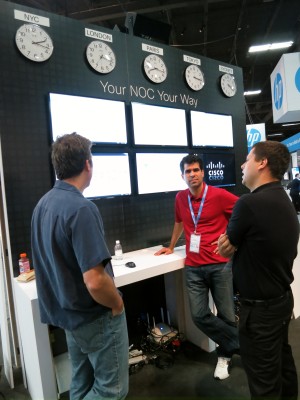
These and other top concerns for IT professionals were paired up with Cisco and partner technologies to show real solutions. These solutions have been on display at Interop at the Cisco booth in our NOC area and will likewise be at the Borderless Networks booth at CiscoLive Orlando. Jimmy Ray Purser and Rob Boyd caught up with the architect of this NOC, Marlowe Fenne to get an introduction to the Unified Access solution.
Cisco published earlier this week the 2013 Cisco Global IT Impact Survey, exploring the relationship between IT and the business goals of the companies they support. Among other things, 42 percent of those interviewed responded that they know about the Internet of Things, “as well as I know Einstein’s Theory of Relativity.” In other words, beyond a passing knowledge of e=mc2, the relevance of the Internet of Things to IT is about as illuminated as a black hole.
Does that really matter at this point? you might ask. Isn’t the Internet of Things about Nike FuelBands and talking toasters? In fact, a lot of what we call “industrial automation” or “safety and security” is the leading edge of the Internet of Things. It’s already here today, called into the service of greater efficiency, productivity, and safety. This is “operational technology” instead of “information technology”: in other words, technology that directly monitors or controls physical objects and processes, such as assembly lines on a factory floor.
This has enormous implications for IT:
1. Security threats go from the merely cyber to the cyber-physical. Gartner summed it up nicely in the WSJ last week. And let’s not even talk about Shodan.
2. Beyond BYOD. The consumerization of personal electronic devices transformed the enterprise networking landscape. IT adapted to the new security threats posed, figured out how to associate multiple devices to a single user, etc. Now imagine “bring your own programmable logic controller.”
3. Redefining networking scalability and data management. And we thought video was a huge driver of traffic on the network. SAP and Harris Interactive recently estimated that 4 billion terabytes of data will be generated this year alone. (For some idea of the scale, take a single IoT use case — smart meters. Jack Danahy estimated 400MB of data per year. Not much, you say? Multiply that by, say, 1 million households, and you get 400 terabytes already. For a single use case. In one city.)
IT has much to offer, and should. As proprietary connectivity networks converge onto TCP/IP, IT can bring its expertise in securing IP-based networks. With experience in deploying cloud services, IT can bring in network management best practices. And with expertise in software-defined networking, IT can help re-architect networks to support immense scale, real-time requirements, analytics at the edge, and more.
From the outside-in, the Internet of Things may seem like a fast-moving train that’s zooming by too fast to board. But if you’re in IT, get on board: you’ll experience relativity and relevance.
As we prepared for this show working with the Cisco MDS (which I think stands for Multi-Layer Director Storage Switches), I thought it was fun that Nitin Garg, our top of show guest, was also our guest from a segment shot back in London. Nitin was foreshadowing upcoming announcments that he subsequrently revealed in today’s show.
Nitin Garg with Jimmy Ray Purser at Cisco Live London
https://www.youtube.com/watch?v=JTqIQjPORmA
Beyond the people you see on screen, this show was largely made possible by the hard work of Gabe Dixon. Gabe has worked with us on multiple topics over the years.
Frankly, I don’t think he ages.