Security teams are not struggling because they lack tools.
In most enterprises, the opposite is true. They have tools everywhere: firewalls, VPNs, identity systems, access controls, observability data, network telemetry, and cloud enforcement points. But together, they often create a new challenge: too many consoles, too much data, and too little shared context.
The real opportunity is not adding another tool. It is reimagining how security work gets done: with shared context, governed action, and AI agents that help teams move at business speed.
From fragmented tools to unified operations
Security issues rarely stay inside one product boundary.
A user blocked from an application might involve VPN posture, zero trust policy, branch connectivity, identity context, firewall rules, or application performance. An urgent policy change might require understanding years of firewall rules, business intent, and compliance requirements. A security gap might remain open because the signals needed to fix it are spread across disconnected systems.
That fragmentation has a real business cost.
Policy changes take longer than they should. Skilled administrators spend too much time decoding legacy rules or chasing knowledge that lives in someone’s head. And when something breaks, teams lose time trying to answer a basic question: is this a security issue, a network issue, an access issue, or all of the above?
Bringing security into Cisco Cloud Control
That is the challenge Security in Cisco Cloud Control with AI Canvas is built to address.
Security in Cloud Control brings Security Cloud Control into Cisco Cloud Control’s unified operations platform. The goal is simple and powerful: give teams one governed environment to manage security enforcement points, correlate alerts across Cisco domains, and act with shared context.

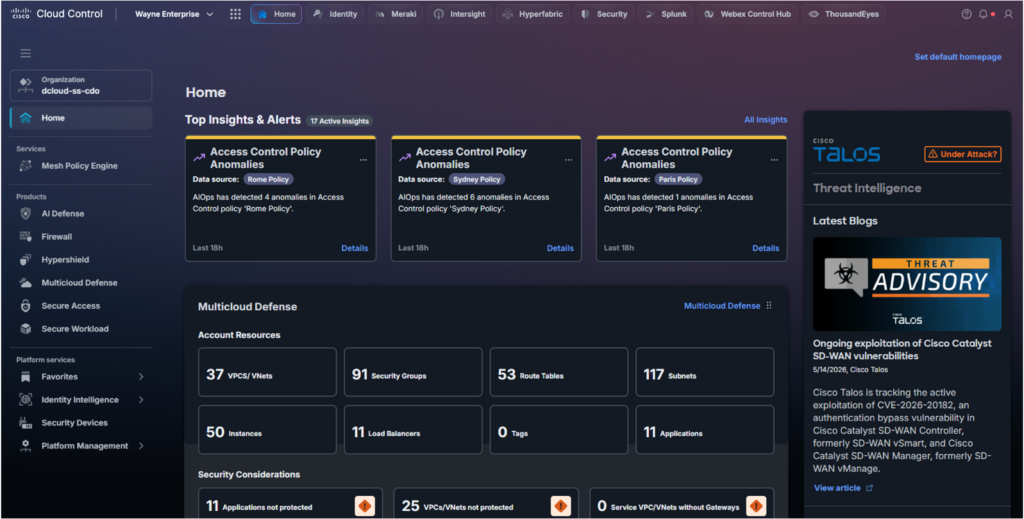
But the bigger shift is not just where the work happens.
It is how the work happens.
With Cisco Cloud Control, security becomes part of a broader operational model across domains. Inventory, topology, policy, identity, network, observability, collaboration, and data center context can come together in one shared experience. Security decisions are only as good as the context behind them.
Here’s what sets this model apart:
- Unified context: Teams can connect security signals with network, identity, application, and infrastructure data.
- Governed action: Operators can move from insight to action with validation and review built in.
- Human-agent collaboration: AI agents can gather evidence, recommend next steps, and accelerate execution while humans stay in control.
Making complexity workable with AI Canvas
AI Canvas is where that complexity becomes workable.
Inside AI Canvas, operators and AI agents investigate together in a shared workspace. They can correlate signals, build a timeline, trace dependencies, and move from question to resolution without losing context across handoffs. A Unified AI Assistant gives teams a natural language way to ask questions and get guidance. When an issue needs deeper investigation or execution, teams can escalate into AI Canvas with the right people, agents, and data in the same workspace.
This matters because many of the hardest security problems are not purely technical.
They are operational.
Take firewall policy. A business team may need urgent access changed for an application, but the rules are poorly documented, the original admin has moved on, and nobody wants to make a risky change under pressure. In the old model, that means manual analysis, multiple reviews, and expert time spent reconstructing intent.
In the new model, an admin can describe the desired policy in plain language. The system can translate that intent into candidate rules, map the change back to the business requirement, explain the reasoning, and validate the update before deployment. That does not remove the human from the decision. It gives the human better context, faster.
Agentic operations for real security work
The same pattern applies to zero trust.
A team may not know that some users are reaching sensitive applications through VPN in a way that violates access best practices. Finding that manually could require continuous analysis across large volumes of event data. An AI agent can monitor for that pattern, surface the risk, explain why it matters, recommend configuration changes, and let an admin approve or refine the action.
That is the practical value of agentic operations.
Not AI for the sake of AI. Not automation without oversight. But AI that helps skilled teams move faster, preserve institutional knowledge, reduce risk, and spend less time stitching together fragmented evidence.
Agentic operations rest on three core principles:
- Human in the loop: Teams stay in control, bringing judgment and accountability to every important decision.
- Cross-domain context: Agents connect signals across networking, identity, policy, observability, and enforcement points so teams see the full picture.
- Purpose-built intelligence: Security workflows need agents that understand the domain, environment, and impact of every recommendation.
This is how AI becomes more than an assistant. It becomes a collaborator.
A new era for security operations
Security in Cisco Cloud Control with AI Canvas is about bringing security work into the same operating model the rest of IT needs: unified context, governed action, and collaboration between people and AI agents.
The end state is not a world where every task is automated blindly.
It is a world where security teams can define once, enforce where needed, investigate with full context, and act with confidence.
Security teams have never needed more tools. They need a better way to work.
And with Security in Cisco Cloud Control with AI Canvas, that new operating model is here.
We’d love to hear what you think! Ask a question and stay connected with Cisco Security on social media.
Cisco Security Social Media