
“If I could change one thing about my organization’s segmentation approach, it would definitely be to further automate and integrate our segmentation tools and processes. By leveraging automation and integration, we could enhance the effectiveness and scalability of our segmentation strategy. This change would have significant impact on effectiveness and efficiency.”
UK, IT, telecoms, and technology, 2025 Cisco Segmentation Report
Segmentation is a complex and evolving technology that bridges multiple layers of the IT stack. Any change in network architecture or application access has the potential to kick off a series of chain reactions that may disrupt or break workflows. As a result, many organizations – from around the world across market segments – are in the process of modernizing their segmentation policies to better align with the changing way people work today.
It’s important for vendors like Cisco to better understand customers’ experiences with segmentation implementations so as to better meet their specific needs and expectations. Cisco commissioned a global survey to better understand the drivers, challenges, approaches and benefits of segmentation. The research involved surveying 1,000 respondents with knowledge of their organization’s network security and segmentation practices across the Americas, EMEA and Asia Pacific.
The responses in the 2025 Cisco Segmentation Report make clear that in an era where 84% of organizations suffered a breach in the past year, segmentation has become the foundation of resilience. This concept – along with other insights – is helping Cisco to better understand and address organizations’ security needs and meet our ultimate goal to help enable security in the modern world.
Here are the main takeaways from the report.
1. Priority vs. Reality: Segmentation is a high priority for many, but few have fully executed
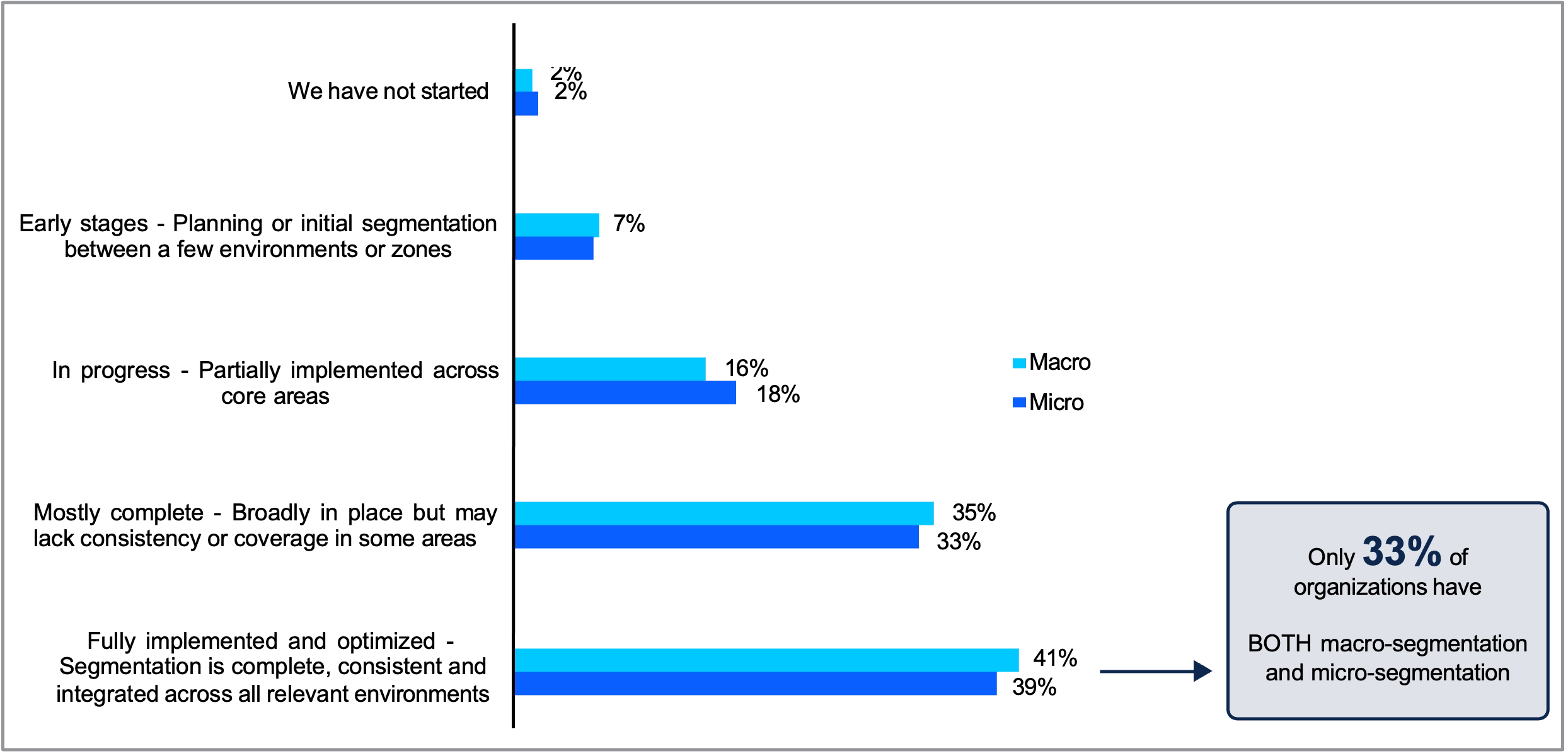
According to the responses in the report, a majority of organizations say that segmentation is a top priority (79%), but only one third have fully implemented both macro- and micro-segmentation (33%). This contradiction tells us that organizations know what they need to do, but complexity and outdated approaches are holding them back. This is backed up by the fact that nearly nine in 10 said that their segmentation processes need improvement (87%).
The main challenge holding organizations back is the increased complexity due to hybrid IT, cloud, containers and legacy systems. Coupled with network decentralization, this complexity prevents security teams from gaining visibility into distributed workloads. Limited understanding of how these disparate users, devices, applications and services are connecting and interacting with each other makes it difficult to create, apply and enforce segmentation policies.
Segmentation is a priority for most organizations…

…but implementation lags behind.
2. Critical asset protection and meeting regulatory compliance are common driving factors for implementing segmentation
Today’s organizations are under pressure to protect what matters most without impacting productivity and are using segmentation primarily to protect high-value / critical assets (57%) in the most non-disruptive manner possible. Meeting mandatory requirements and strengthening resilience against breaches are also priorities, according to the report. In other words, segmentation is no longer about risk reduction. It’s about safeguarding business continuity and customer trust.
Asset protection is a driving factor for implementing segmentation.

3. Complete segmentation could deliver measurable gains for organizations looking to provide secure access to applications and users
The respondents in the survey who have implemented both macro- and micro- segmentation in their organizations agree that their strategies have strengthened network security, reduced the impact of breaches and improved operational alignment. Done right, segmentation isn’t just a control. Segmentation accelerates business recovery, aligns teams across operations and creates a foundation for automation.
Specifically, organizations that have implemented both macro- and micro-segmentation report that they have reduced recovery time from 29 days to 20 days across the entire attack cycle (discovery, containment and recovery). Furthermore, 87% of these organizations say their teams are fully aligned, versus only 52% of organizations that have not fully implemented both macro- and micro- segmentation. Organizations with full implementation are more likely to strongly agree that automation is the key to scaling and maturing segmentation projects (63% vs 50% without full implementation).
Segmentation speeds recovery time.

Moving forward with segmentation
Segmentation has emerged as a foundational security strategy, allowing organizations to ensure business resilience, align teams across operations and create a foundation for IT automation. However, few organizations have implemented successful macro- and micro-segmentation strategies and report being hamstrung by growing complexity, limited visibility into workloads and a lack of understanding of legitimate communication flows between systems. The 2025 Cisco Segmentation Report is helping Cisco align our segmentation product strategies to these customer challenges in hopes of ultimately enabling security in the modern world.
Explore the full 2025 Cisco Segmentation Report to see how your peers are rethinking segmentation in an increasingly complex world.
We’d love to hear what you think! Ask a question and stay connected with Cisco Security on social media.
Cisco Security Social Media