
 This blog post is being guest written by Shreya Arora on Cisco’s India Cash Grant team, where she supports the rollout and governance of CSR programs across India. Drawing on seven years of experience in program development and fundraising, Shreya brings a holistic view of the nonprofit world and a strong desire to translate local needs into real-world solutions.
Shreya’s commitment to inclusive, community-driven change is fueled by the inspiration she finds in collaborating with Cisco’s network of partners.
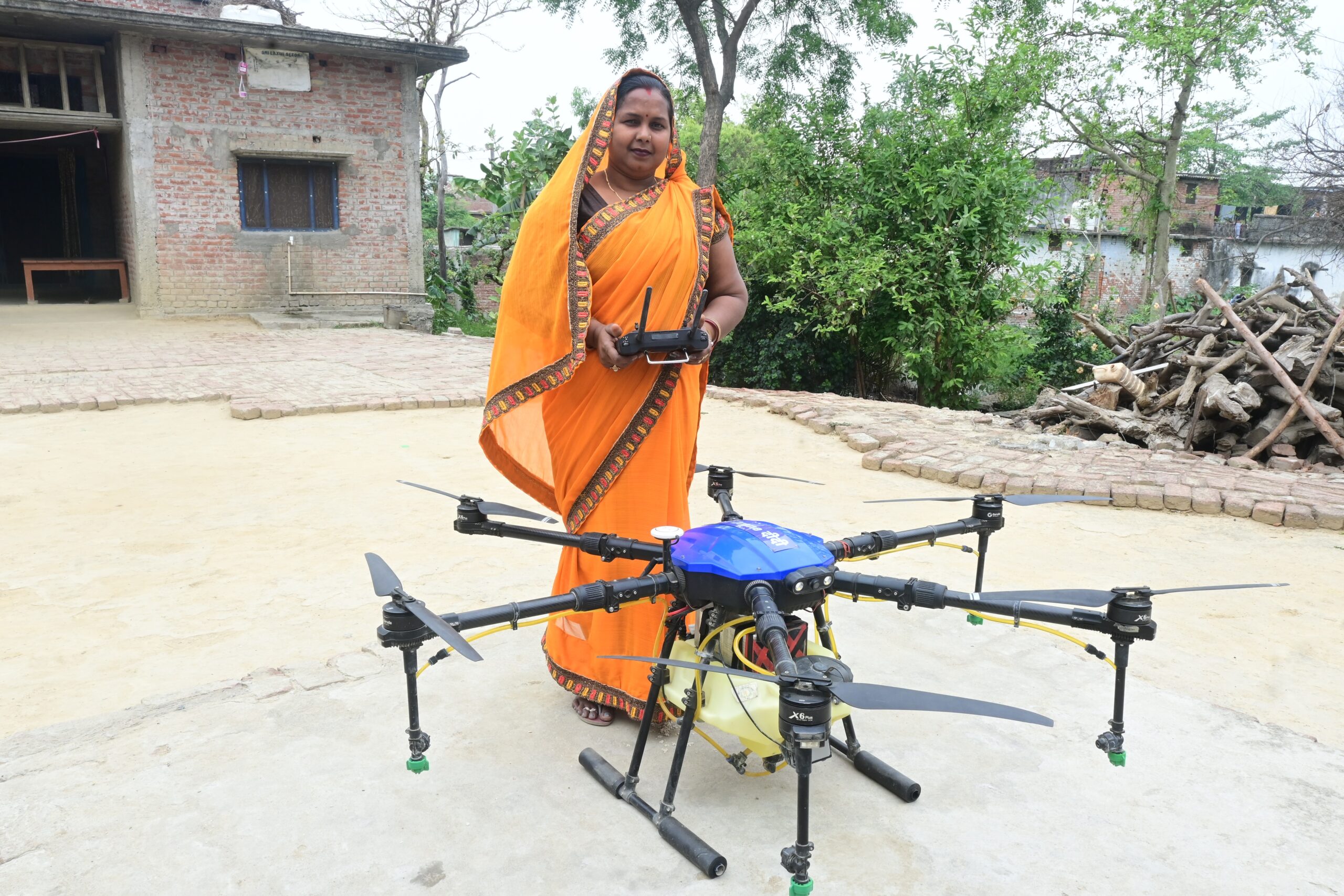
In Deoria, a village in Purvanchal, the eastern region of India’s Uttar Pradesh state, Seema Gupta is known as “Drone Didi” — the drone sister. Farmers call on her when their crops need spraying, and she pilots an agricultural drone over their fields, applying fertilizers, pesticides, and herbicides that improve how they farm.
She learned to build her business — market her services, reach more clients, develop the strategy for making it last — through the Tech Shakti Sri program, implemented with Cisco support by our partner Jagriti.
Seema’s story is a window into something larger happening in Purvanchal, a region with significant untapped potential where improving access to infrastructure and formal income opportunities can unlock new pathways for economic mobility. By pairing rural women with the right digital tools and a structured path to entrepreneurship, the Tech Shakti Shri program is creating more opportunities in communities that have rarely been at the center of conversations about tech and growth.
Expanding digital pathways to rural entrepreneurship
Guided by Cisco’s Purpose to Power an Inclusive Future for All, we partnered with Jagriti because of its deep grassroots reach, commitment to nurturing entrepreneurs, and belief that talent is everywhere, even when opportunity is not. Through initiatives like Tech Shakti Shri, we combine technology with community-led support to help more aspiring entrepreneurs turn bold ideas into sustainable livelihoods, strengthen local economies, and create lasting change.
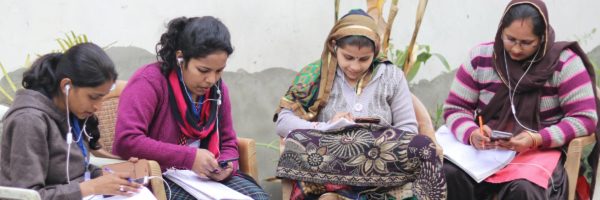
Jagriti designed Tech Shakti Sri in three stages, each one narrowing the focus and deepening the investment. Beginning with awareness camps across Deoria, Kushinagar, and Gorakhpur, the goal at this stage was exposure: helping women see digital tools as a viable path to economic mobility. From the 1,110 women mobilized in this first phase, 618 went on to complete structured training in digital and entrepreneurial skills, covering basic computer and internet literacy, using smartphones for business and digital payments, social media for marketing, and financial literacy.
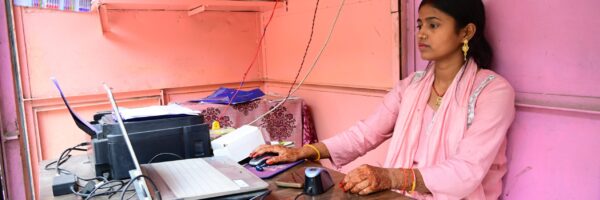
From that group, Jagriti selected 42 women for an intensive incubation phase based on entrepreneurial potential and motivation. These women received one-on-one mentorship from Jagriti enterprise coaches; digital equipment like laptops, printers, and lamination machines; and connections to suppliers, government e-service networks, and local institutions. They visited enterprises and innovation hubs. Business development was hands-on, with participants learning about client acquisition, financial management, and service diversification.
The funnel got narrower, but the investment per person deepened considerably. That structure was intentional. Casting a wide net at the mobilization stage meant reaching women who wouldn’t have found their way to a skills program on their own. Concentrating resources at the incubation stage meant those with the drive to build something had the tools to do it.
The ripple effects of digital enterprises
Among the 42 women who went through incubation, the outcomes are concrete. Take Kashish Verma from Gorakhpur, who came to the program with no background in design. With mentorship and access to digital tools, she now works with four clients on graphic design and video editing, earning close to ₹40,000 per month. “Everything changed for me after I connected with Jagriti,” she says. “Our mentor gave us a clear roadmap to turn clients into long-term partners. The path here was challenging, but with the right guidance and connections, the journey became smoother.” She’s now learning AI tools to strengthen her work further.
Manisha Sharma, from Deoria, built a T-shirt printing business despite real resistance. “Many people said, ‘this work isn’t meant for women,'” she recalls. “There were moments where I felt like giving up, but I kept going.” Her business now supports her family and employs others — a ripple effect that the program’s funnel model, in many ways, was designed to produce.
That ripple extends further than individual livelihoods. The businesses emerging from Tech Shakti Sri are digital at their core, spanning fields such as drone services, graphic design, digital photography, virtual reality, IT education, and technology-enabled service centers. Women who completed the program have hired local assistants, mentored peers, and set up enterprises — libraries, gaming zones, digital service centers — that serve as gathering points for digital access in their communities.
The real impact is not just in the businesses women build, but in the ripple effects they create — changing perceptions within families, inspiring the next generation of entrepreneurs, and strengthening communities.—Ashutosh Kumar, CEO of Jagriti
By helping community members access information, financial services, government schemes, educational resources, and digital tools, these women are serving as the last-mile link between technology and underserved communities. In doing so, they are not only building businesses of their own but also expanding digital access, inclusion, and opportunity for countless others, bringing the vision of Digital India to life at the grassroots.
“In Purvanchal, we say jo dikhta hai, wahi bikta hai — what is visible, sells. For generations, women here have possessed extraordinary capability, but too often it remained unseen,” says Ashutosh Kumar, CEO of Jagriti. “Tech Shakti Sri was designed to change that by creating pathways from awareness to opportunity and from potential to enterprise.”
Advancing our vision of a digitally inclusive future
Back in Deoria, Seema Gupta still gets calls from farmers when they need support with their crops. She flies the drone, reads the data, and when the equipment needs fixing, she fixes it. “Today, I am earning well,” she says. “I am making a name for myself.” Kashish, Manisha, and dozens of others across the three districts are doing the same, each in their own way.
“Our commitment is to ensure that access to technology and opportunity reach those who need it the most, so that their determination can translate into lasting progress for themselves, their families, and their communities,” says Harish Krishnan, Managing Director & Chief Policy Officer, Cisco India, South and South East Asia. “We are proud of what these women have achieved, and they inspire us to keep building pathways that enable more people to realize their potential.”
The Tech Shakti Shri model — wide mobilization, structured training, deep incubation — has shown what’s possible in Purvanchal. The work now is to bring that same approach to more people and more communities across India, bringing us one step closer to our vision of a truly digitally inclusive future for all.

Power an Inclusive Future for All
Driven by our Purpose, we combine our technology, people, and broader networks to address society’s greatest challenges.
Learn more about our Purpose