



For decades, Wi-Fi has been the invisible backbone of enterprise connectivity. From the early days of 802.11b delivering a modest 11 Mbps to today’s Wi-Fi 7 networks pushing multigigabit speeds, each generation has promised and delivered transformative capabilities for businesses worldwide.
But as enterprises grapple with the unprecedented density of connected devices, bandwidth-hungry applications, and the rising expectations of hybrid workforces, a new question emerges: what comes next?
Enter Wi-Fi 8—the next frontier in wireless networking that promises to fundamentally reshape how enterprises think about connectivity. And while we’re 3–5 years away from mainstream deployment, we are sharing where Wi-Fi is heading. Understanding this roadmap is essential to strategically future-proofing infrastructure and proactively leading your organization’s wireless evolution.
The relentless march of wireless innovation: From convenience to critical infrastructure
Wi-Fi has evolved from a convenient alternative to wired Ethernet into a critical foundation for high-performance enterprise connectivity. The timeline below highlights the major milestones in this journey—from Wi-Fi 4’s introduction of practical wireless networking to Wi-Fi 7’s ultra-high throughput and multi-link capabilities.
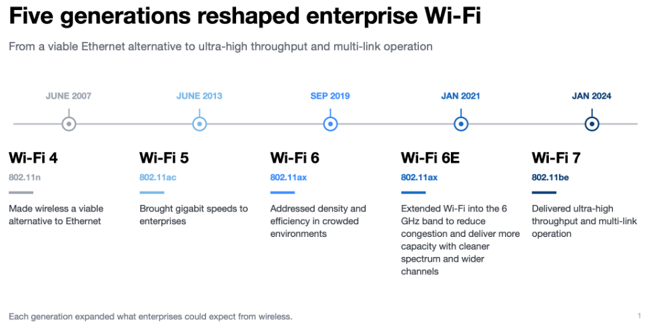
Figure 1. The evolution of enterprise Wi-Fi
Each generation solved the problems of its era. Wi-Fi 6 was born from the chaos of stadium deployments and open office floors. Wi-Fi 7 emerged to support bandwidth-intensive applications like 4K video conferencing and augmented reality (AR) and virtual reality (VR) experiences.
But Wi-Fi 8 will be different. Expectations for Wi-Fi reliability and consistency are rising. Speed is no longer the focus; it’s about being smarter.
The enterprise challenge: Faster isn’t always better
Despite having access to the fastest Wi-Fi technology ever created, network performance complaints persist. The issue is driven by inconsistent reliability and resource allocation in increasingly complex environments.
Consider the modern enterprise campus:
- Hundreds of devices competing for airtime in the same location
- Mission-critical applications sharing bandwidth with background updates
- Conference rooms where a single video call can dominate the spectrum
- Internet of Things (IoT) sensors, digital signage, and collaboration tools all vying for connectivity
- Expectation of seamless roaming as employees move throughout facilities
The networks are often fast, but they’re not always able to effectively prioritize what matters most.
Wi-Fi 8: Redefining enterprise wireless
Wi-Fi 8 (802.11bn) represents a philosophical shift in wireless networking design. While previous generations focused on raw performance metrics, Wi-Fi 8 is engineered around the needs of today: reliability, efficiency, and intelligence.
At Cisco, we are playing a significant role in shaping this next generation of Wi-Fi, drawing on deep customer insights and technical expertise to help translate enterprise requirements into industry standards. Our contributions to the IEEE 802.11bn amendment include advancing Seamless Mobility Domain (SMD), Dynamic Bandwidth Expansion (DBE), Multi-Access-Point Coordination (MAPC), shaping Dynamic Subband Operation (DSO) and Non-Primary Channel Access (NPCA). We are championing the certification of these innovations through the Wi-Fi Alliance and helping strengthen the future of wireless security through post-quantum cryptography (PQC) work within 802.11bt.
The following capabilities illustrate how these innovations can improve reliability, efficiency, and intelligence for enterprise networks.
Seamless mobility domain (SMD): True wireless freedom
Perhaps one of the most transformative features for enterprise environments is SMD. Today, as users move around a wireless network, be it from the office to the conference room or to the cafeteria, there are micro-interruptions as devices transition between access points. For voice calls, video conferences, or real-time applications, these disruptions are noticeable and frustrating.
SMD in Wi-Fi 8 creates a unified wireless experience across multiple access points, enabling truly imperceptible roaming. For enterprises, this means:
- End-to-end call quality as employees move through the floor
- Uninterrupted video conferences during the move
- Reliable wireless experiences for mobile carts in healthcare environments
- Consistent connectivity for warehouse scanning devices and logistics operations
SMD enables wireless-first workflows that previously required wired connections for reliability.
Dynamic bandwidth expansion (DBE): Flexibility when you need it
Traditional Wi-Fi operates on fixed channel widths—whether you’re transferring a massive file or sending a simple email. Wi-Fi 8 introduces DBE, allowing the network to intelligently scale channel width based on real-time needs.
Picture employees working at their desks exchanging large, bandwidth-intensive presentation files, then they move to a conference room and get on an ultra-high-resolution video call. Wi-Fi 8 can dynamically allocate bandwidth to users efficiently, expanding channel width when the need is there and scaling back when it’s not needed. This flexibility means better spectrum utilization and more consistent user experiences across the enterprise.
Coordinated access points: The end of spectrum chaos
Imagine a conference center where multiple meeting rooms share overlapping channels. Today, access points essentially “shout” to be heard, creating interference and reducing efficiency. Wi-Fi 8 introduces coordinated approaches that allow access points to work together collaboratively, decreasing latency, increasing capacity, and reducing contention to improve overall network performance.
For enterprises, this means better performance in high-density environments without requiring costly infrastructure overhauls.
Dynamic sub-band operation (DSO): Precision spectrum management
Building on the concept of flexibility, Wi-Fi 8 introduces DSO, allowing networks to carve up channels with surgical precision. Rather than treating wide channels as monolithic blocks, the network can identify and utilize portions of the spectrum that can avoid low-capability IoT devices from degrading everyone else’s experience.
For enterprises operating in congested radio frequency (RF) environments, such as dense urban office buildings or multi-tenant facilities, this means dramatically improved spectrum efficiency. Your network can support more IoT devices while allowing higher-priority traffic to move around slower, low-bandwidth traffic instead of being held up by it.
Non-primary channel access (NPCA): Breaking traditional barriers
Historically, Wi-Fi networks have been constrained by the requirement to transmit on the primary channel, even when adjacent secondary channels sit idle. NPCA in Wi-Fi 8 eliminates this bottleneck, allowing devices to transmit on the secondary channels within the operating bandwidth, even when the primary channel is occupied.
The enterprise benefit is immediate: better channel utilization, reduced latency, and improved throughput—especially in environments where certain parts of the spectrum are randomly busy while others remain underutilized.
Dynamic unavailability operation (DUO): Addressing in-device coexistence
Modern devices juggle Wi-Fi, Bluetooth, cellular, and other radios in the same enclosure. Because these radios can interfere with each other or share spectrum, In-Device Coexistence (IDC) can temporarily make Wi-Fi unavailable.
Wi-Fi 8 addresses this with DUO, which lets a device tell the access point when and for how long it cannot receive Wi-Fi transmissions. The access point can then reschedule traffic instead of transmitting during that unavailability window.
The result is better airtime efficiency, fewer lost packets, lower latency, and more consistent performance for devices that rely on multiple wireless radios.
What this all means for enterprise deployments
True mobility-first architecture
With SMD and intelligent spectrum management, enterprises can realize the promise of truly wireless campuses. No more “dead zones” during transitions, no more compromises between mobility and performance.
Maximized spectrum efficiency
The combination of dynamic bandwidth expansion, dynamic sub-band operation, and non-primary channel access means enterprises can extract maximum value from available spectrum—particularly important as the airwaves become increasingly congested.
Simplified network management
With more intelligence built into the protocol itself, network administrators can spend less time firefighting performance issues and more time on strategic initiatives. Wi-Fi 8’s coordinated approaches and dynamic spectrum features reduce the complexity of RF optimization in dense deployments.
Enhanced user experience
At the end of the day, Wi-Fi 8 means end users experience fewer connectivity issues, more consistent performance, and seamless mobility—translating directly to productivity gains. SMD alone will eliminate one of the most persistent complaints about wireless networks: disrupted connections during mobility.
Real-world enterprise scenarios
Healthcare: Mobility without compromise
Imagine clinicians with wireless carts moving from patient room to patient room, accessing electronic health records without interruption. SMD ensures that critical medical data remains accessible throughout the facility, while dynamic spectrum management ensures that patient monitoring systems and clinical applications always have the resources they need.
Corporate campuses: The wireless-first office
Picture an employee joining a video call in their office, then seamlessly walking to a conference room mid-meeting without dropping frames or audio. As they move through high-density common areas, the network dynamically adjusts spectrum usage to maintain quality. This is the wireless-first office that Wi-Fi 8 enables.
Warehouses and logistics: Reliable real-time operations
In distribution centers where every second counts, workers with handheld scanners and their robotic helpers move continuously throughout vast facilities. SMD ensures uninterrupted connectivity for inventory management systems, while dynamic spectrum features maintain performance even as the RF environment changes throughout the day.
Conclusion: Evolution meets revolution
Wi-Fi 8 addresses the real-world challenges that enterprises face every day by prioritizing reliability, coordination, intelligence, and performance. It closes the gap between a network that’s fast and one that’s smart—between connectivity that works most of the time and connectivity you can truly depend on.
It’s crucial to understand where we are in the wireless evolution timeline. Wi-Fi 7 has just gained significant momentum and is actively deployed across enterprises worldwide. It delivers transformative capabilities today—multigigabit speeds, 320 MHz channels, Multi-Link Operation (MLO), and dramatic improvements in latency and throughput. These are proven, production-ready features that are solving real enterprise challenges right now.
Wi-Fi 7 remains the right choice for enterprise deployments today and for the foreseeable future. Organizations investing in their wireless infrastructure should confidently move forward with Wi-Fi 7, which will serve them exceptionally well for many years. The technology is mature, vendor ecosystems are robust, and the performance gains are substantial and immediate.
Wi-Fi 8, by contrast, is still under active development. The IEEE 802.11bn amendment to the 802.11 standard is being finalized, with ratification expected around 2028. In line with ratification, certified Wi-Fi 8 products may arrive a few months before the final standard is formally approved, but it will still take time for the broader ecosystem to mature, including chipset availability, product development and testing, enterprise readiness, and interoperability validation.
Realistically, enterprise-ready Wi-Fi 8 products are 3-5 years away from mainstream deployment. Early products may appear shortly after interoperability certification, but mature, production-grade solutions with full feature sets will take time to develop.
The future of enterprise connectivity isn’t just about moving more data faster. It’s about moving the right data, at the right time, with absolute reliability—and doing so seamlessly, without frozen calls or dropped packets, as users move throughout your facilities. Wi-Fi 7 delivers much of this promise today. Wi-Fi 8, also know as Ultra-High Reliability (UHR), will enhance it further in the years ahead.
That’s the evolution of wireless networking — steady, progressive, and always advancing. Wi-Fi 7 is your solution for today. Wi-Fi 8 is an exciting chapter still being written for tomorrow.
—
Stay tuned for more updates on Wi-Fi 8 developments and what they mean for your enterprise network strategy.
2026 Gartner® Magic Quadrant™ for Enterprise Wired and Wireless LAN Infrastructure
Get report

Get More from Cisco Networking
Customer stories, technical demos and more await!
Check out our Networking video channel
Multidomain Architecture
Learn how to integrate your networking domains and get more out of an enterprise-wide, intent-based network.
Discover multidomain integration