



A fundamental shift is underway in IT operations. At Cisco Live 2026 in Las Vegas, Cisco President and Chief Product Officer Jeetu Patel highlighted this change firsthand. As infrastructure scales from the core data center to the edge, the primary challenge IT teams face is no longer a shortage of tools, but rather the need for a platform that provides unified operational context. Managing distributed environments through separate consoles, different permission models, and disconnected alert systems has become a drag on operational efficiency. This problem is especially challenging during slowdowns or outages that span data center infrastructure. Teams lose critical time navigating disconnected systems, leading to potentially significant business impacts like lost revenue, supply chain delays, disgruntled customers, and compliance violations.
Introducing Cisco Cloud Control
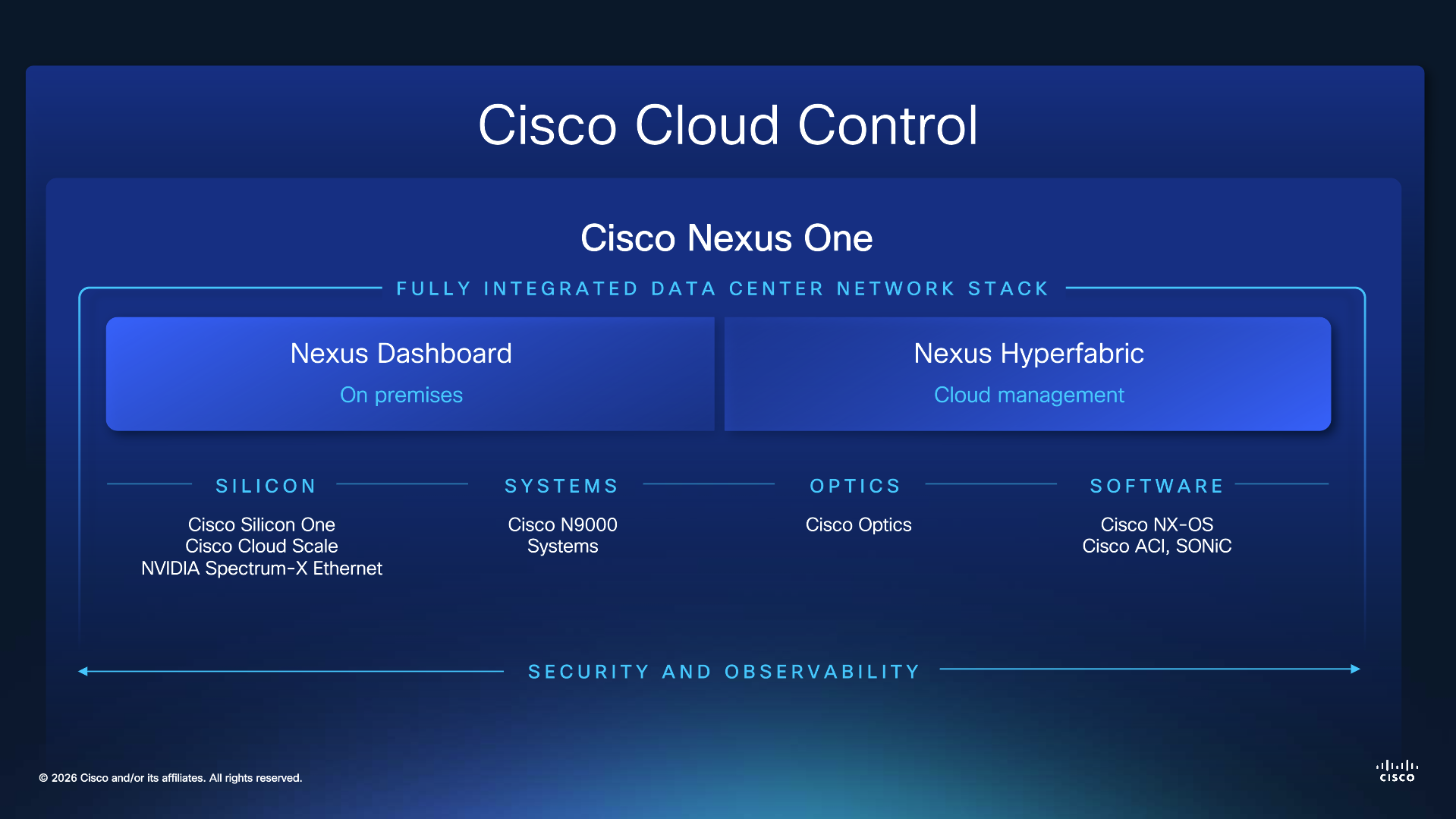
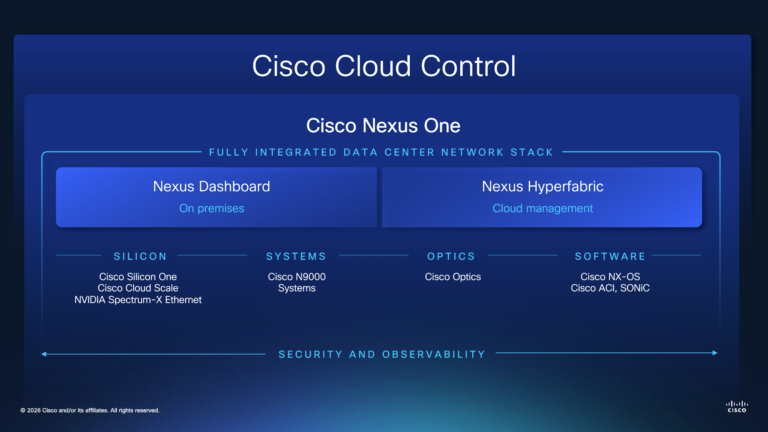
To bridge existing management console silos and provide a cohesive management experience, Jeetu introduced Cisco Cloud Control at Cisco Live. This unified platform manages your entire Cisco estate, including Nexus One and Cisco Intersight, bringing each platform’s powerful capabilities into one place to unlock the context needed for the complexity of cross-domain, agentic operations. Launched with controlled availability for U.S. commercial customers and general availability later this year, Cisco Cloud Control represents a critical operational innovation: instead of managing multiple individual tools, you can now manage data center domains through a unified platform that enhances efficiency and delivers a comprehensive data center view for IT teams.
Why unified operations is a game changer in modern data centers
Modern data centers rely on a multiplicity of platforms and tools, each optimized for specific domains such as networking, compute, security, and observability. However, having so many separate tools creates a problem: when something goes wrong, IT teams have to manually piece together information from all those different sources to figure out what changed, what’s impacted, and what actions to take. A unified operations platform eliminates that problem.
The importance of unification is even more crucial today because of AI-driven workloads, where infrastructure is highly complex and autonomous operations can scale up or down rapidly. AI infrastructure—high-density GPU clusters and specialized AI networking fabrics—must be managed through a single, unified view to prevent blind spots and avoid fragmented insights. When networking, security, and compute data are in separate silos, troubleshooting a performance drop in an AI pipeline becomes a needle-in-a-haystack search. Every minute spent moving between tools is a minute where expensive AI resources sit idle or underutilized.
How Cisco Cloud Control unifies operations
Cisco Cloud Control is a comprehensive data center platform that unifies key operational capabilities. The workspace integrates data and workflows from multiple Cisco products, such as Cisco Intersight, Nexus One, Meraki, ThousandEyes, and Security Cloud Control.
With a single login, operators can gain access to their entire Cisco portfolio, creating a consistent and efficient entry point for operations. This unified platform delivers a normalized inventory and real-time topology that visually maps assets and their relationships. By correlating alerts from multiple domains into a consolidated view, teams can identify root causes faster. By preserving the depth and autonomy of individual domain tools while eliminating the need for manual data reconciliation, Cisco Cloud Control empowers teams to move quickly from signal to action, powered by AgenticOps and collaborative workspaces.
Scaling operations with AgenticOps
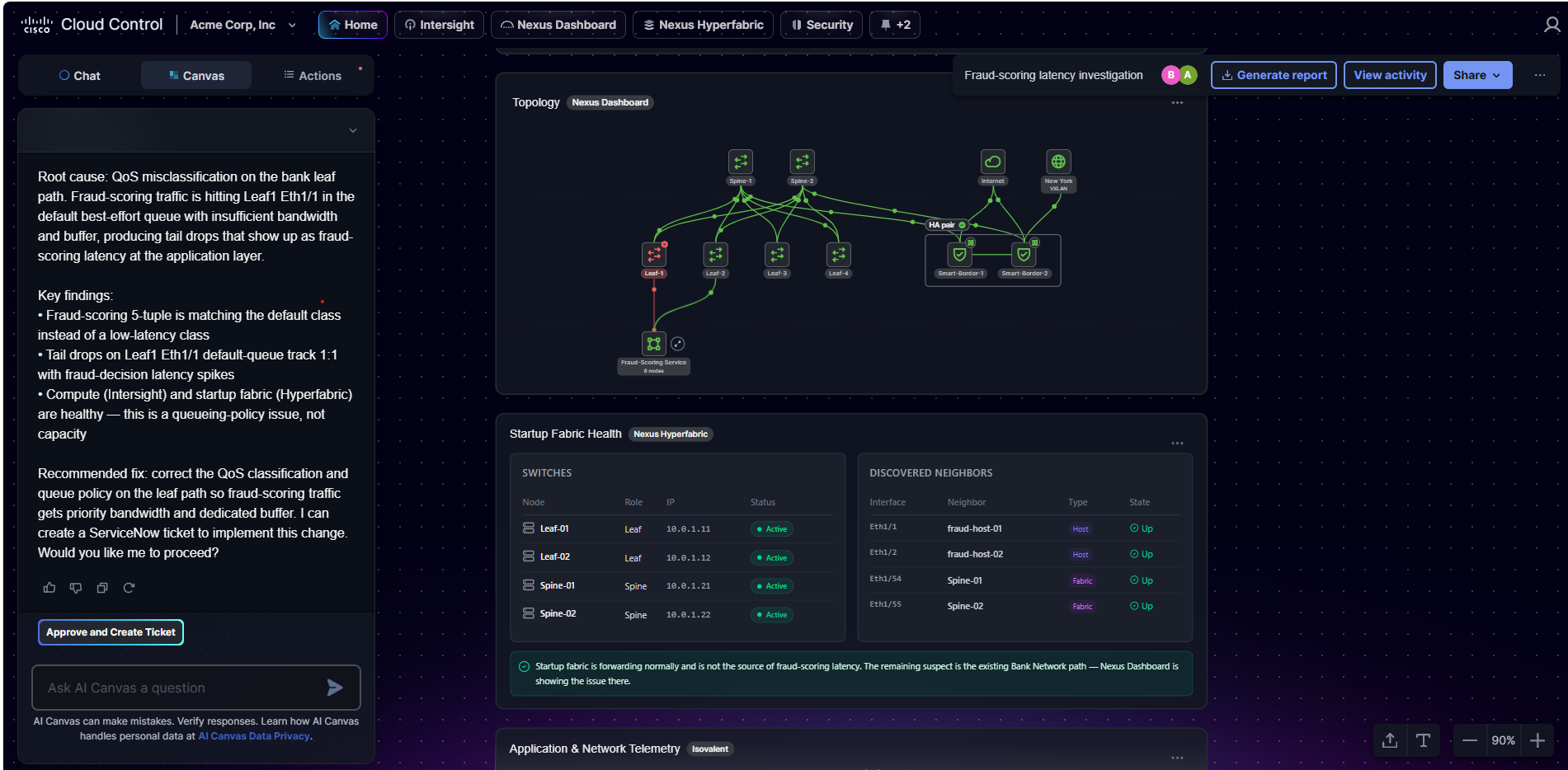
This unified foundation also powers Cisco AI Canvas, the industry’s first multi-user workspace for cross-domain AgenticOps. While Cisco Cloud Control provides the shared context, AI Canvas uses AI agents to investigate, reason, plan, and execute across the entire infrastructure stack, providing operators with clear plans and guided actions. This integrated functionality allows teams to move from reactive troubleshooting to proactive, agent-assisted resolution, while keeping the human operator firmly in control of every decision.
When an application performance issue arises, the workflow shifts from manual investigation to intelligent orchestration, including:
- Alerting: Alert surfaces with correlated cross-product issues
- Investigation: Agent moves alert into AI Canvas for investigation
- Correlation: Domain-specific agents correlate telemetry to solve problems
- Remediation: AI Canvas proposes remediation for human approval
Accelerating resolution in a collaborative workspace
Cisco Cloud Control fundamentally transforms troubleshooting from a series of reactive, isolated tasks to a collaborative, consistent experience. By simply sharing a link, you can instantly bring cross-domain experts into a unified investigation board for real-time collaboration. Because context is maintained throughout the investigation, the need for bridge calls, manual data copy and paste, and the loss of information during shift changes are all eliminated, significantly reducing mean time to resolution (MTTR).
Elevating efficiency for data center operations
Cisco Cloud Control extends the value of your existing operating environment by delivering a unified platform that drives improved efficiency and business continuity across both networking and compute domains.
Key benefits:
- Accelerated root cause analysis through unified cross-domain insights
- Proactive issue detection and resolution to maintain AI workload performance
- Streamlined collaboration with a shared, persistent investigation workspace
- Reduced operational complexity by correlating alerts and providing guided remediation
- Enhanced visibility, correlating network, compute, and security domains
- Consistent, real-time topology and inventory updates across sites and fabrics
Operational continuity, enhanced intelligence
Cisco Cloud Control is designed to act as a force multiplier for your existing environment. The familiar operational models for Nexus One and Intersight remain unchanged. You don’t need to relearn your existing workflows. All current inventory, health monitoring, and policy management capabilities are still accessible. Furthermore, the depth and autonomy of your domain-specific tools are maintained, ensuring that your team can continue to rely on the operational tools you trust.
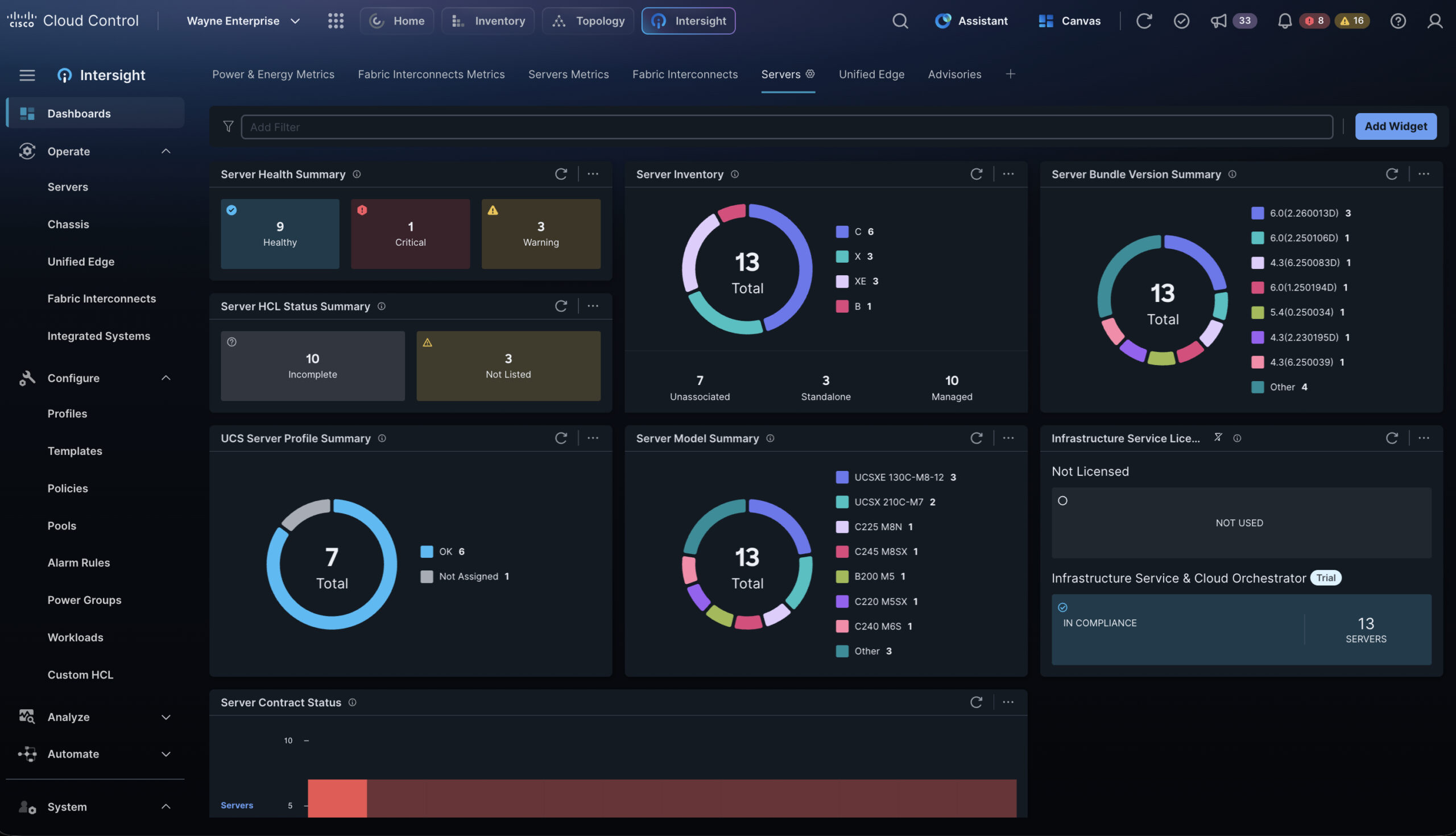
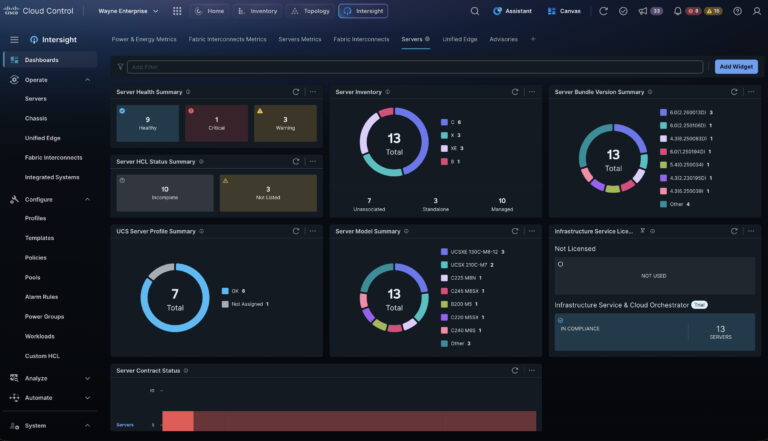
Cisco Cloud Control introduces a shared, persistent investigation workspace that enables real-time collaboration across teams. Alerts can now be correlated across products, providing guided remediation steps that simplify complex troubleshooting. Deep reasoning gives data center operators a structured investigation experience—competing hypotheses, supporting evidence, impact assessment, and a recommended resolution—for the cross-domain problems that simple playbooks cannot solve. Additionally, you gain integrated observability data, which offers the comprehensive, cross-domain context needed to understand how network events impact compute and security. Beyond this, an open connectivity layer links data exchange among external tools (such as ServiceNow) to pull in ticket context, allowing AI Canvas to expedite the troubleshooting of complex compute and network issues.
By showing observability data directly within the unified dashboard, Cisco Cloud Control also empowers operators to correlate infrastructure health with cross-domain telemetry, ensuring your infrastructure remains resilient and fully optimized for mission-critical workloads. This integration eliminates the “swivel chair” effect, the inefficiency and frustration that occurs when employees must manually switch between multiple, disconnected software systems to complete a single task. Instead, operators gain greater operational control and a clearer path from signal to action across Cisco compute, networking, security, and AI-powered operations.
How to access Cisco Cloud Control
Customers in the U.S. can now request access on cloud.cisco.com. To help you get started quickly, no additional licensing costs are required. Access requires two or more connected Cisco products and U.S.-hosted deployment. Regional availability outside the U.S. is planned for later in the year.
Stop wasting time navigating disconnected consoles and start managing your Cisco Nexus infrastructure through a single, unified lens. Cisco Cloud Control streamlines cross-domain troubleshooting by integrating your Nexus One estate, ensuring your infrastructure stays optimized for complex AI workloads and whatever comes next.
Visit the Cisco Cloud Control page to learn more or cloud.cisco.com to request access.
Additional resources:


