


Software for Open Networking in the Cloud (SONiC) has evolved quickly from a hyperscale experiment into a robust, Linux-based platform. By decoupling the network operating system (NOS) from the underlying proprietary hardware, SONiC delivers the disaggregated, vendor-agnostic foundation required for the next generation of networking. It is more than just an open-source project; it is a scalable, AI-optimized framework that provides the flexibility, programmability, and efficiency required to build for the future.
Over time, SONiC use cases have expanded, ranging from data center fabric to data center interconnect (DCI). Cisco has played a leading role in the SONiC innovation journey for years, focusing on platform support, advanced routing, chassis management, telemetry, and security.
Strategic commitment to open networking
Market momentum is strong. According to a study by 650 Group, SONiC data center switching revenue is projected to double between 2025 and 2027 to $8 billion, as organizations look for an open, standardized NOS for their data centers. Customers are motivated by the ability to adopt a common NOS that simplifies provisioning, reduces TCO, and allows for a single, reusable investment in automation.
Cisco is among the leading contributors to the SONiC project. As a SONiC Premier member, we have representation on both the Governing Board and the Technical Steering Committee (TSC), ensuring the open-source stack meets the rigorous needs of high-performance environments (Figure 1). Our “upstream-first” approach means that innovations developed internally are contributed back to the main open-source SONiC community first, ensuring shared benefits, faster innovation, and broad compatibility across the ecosystem. Our customers benefit from the latest updates while leveraging Cisco silicon.
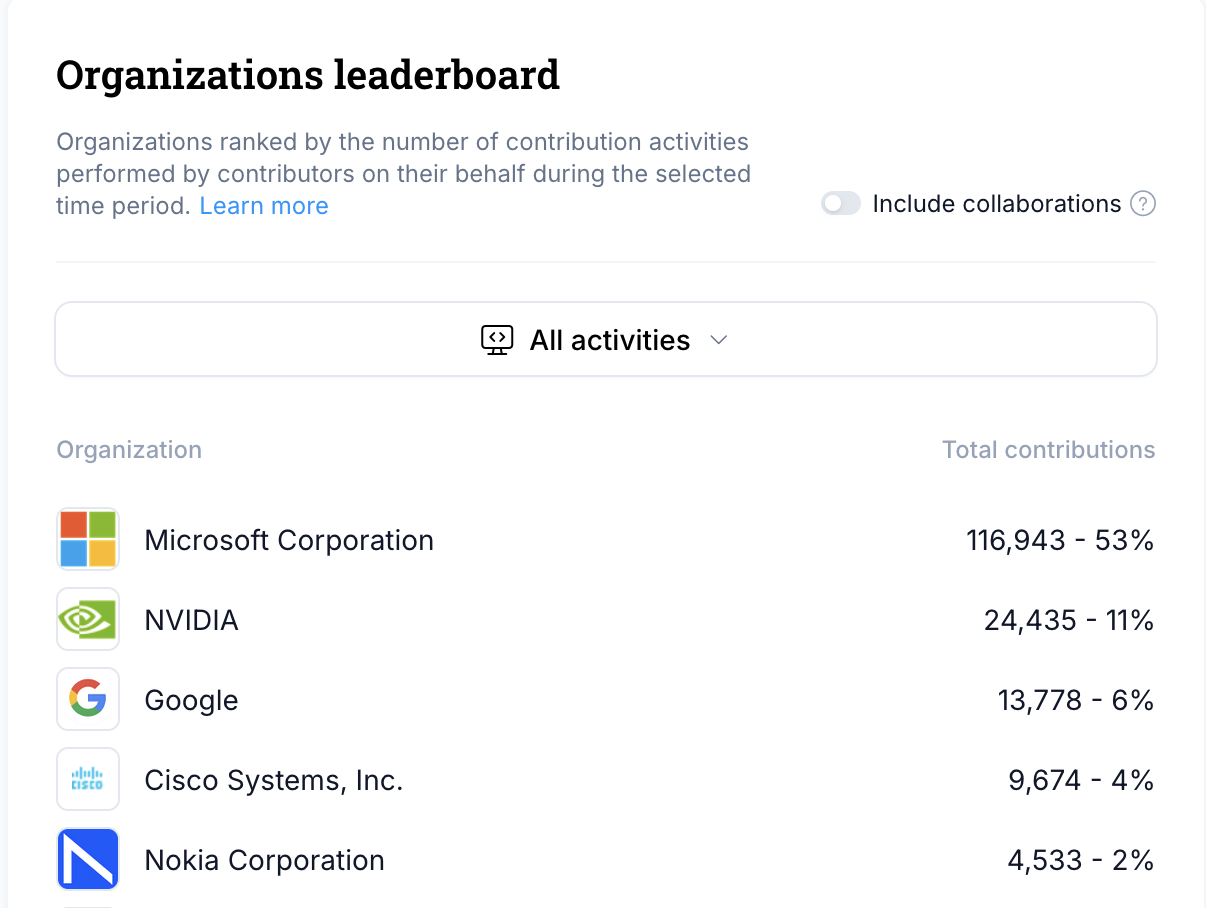
Cisco has taken on two key roles with SONiC: contributing to the mainline (the main open-source project repository) and productizing it for customers. Regular merges with the community version ensure that customers get the latest updates alongside a Cisco-designed programmable ASIC on a standard SONiC environment optimized for Cisco silicon.
Cisco contributes across the entire networking stack, focusing on several main areas:
- Switch Abstraction Interface (SAI): Beyond standard SAI, we are using the Next Generation Data Plane (NGDP) architecture to expose deeper programmability and high-fidelity modeling capabilities. This gives our hyperscale and neocloud customers a way to validate their software stacks and deployment designs ahead of large rollouts, increasing confidence and accelerating time to market.
- Distributed architecture management: Cisco has taken the lead in developing chassis and line card management for distributed forwarding, essential for scaling 400G and 800G deployments beyond fixed-switch limits.
- Wire-speed security: Media Access Control Security (MACsec) enables full-speed Layer 2 encryption for DCI without reducing forwarding performance.
- Modern observability: Improvements to telemetry streaming through Google Remote Procedure Call (gRPC), gRPC Network Management Interface (gNMI), and OpenConfig models enable SONiC to send detailed, real-time data to modern observability and AIOps systems.
- Routing stack evolution: Working with the FRRouting (FRR) project, Cisco has provided full support for Ethernet Virtual Private Network (EVPN) and Virtual Extensible LAN (VXLAN) multihoming and is leading the Segment Routing version 6 (SRv6) support in FRR alongside the wider ecosystem. Together, these efforts strengthen the control plane and expand its flexibility.
The FRR/SONiC synergy: Strengthening the “routing brain”
In the SONiC architecture, FRR serves as the routing brain, and Cisco’s leadership within the FRR community is the primary driver behind the enterprise-grade stability now available in the open-source stack. For customers, this work results in faster network recovery during failures, more predictable maintenance, and the ability to scale fabrics to AI-class route tables without compromising network stability.
By optimizing the Forwarding Plane Manager (FPM) interface, we ensure that advanced protocol updates—such as BGP EVPN prefixes or SRv6 locators—are processed within sub-second convergence budgets, making SONiC behave like an industrial-grade platform capable of carrying business-critical AI workloads.
Maturing EVPN/VXLAN for multi-tenant fabrics
Cisco has enhanced EVPN/VXLAN in the FRR/SONiC ecosystem by enabling active-active multihoming with Ethernet Segment Identifier Link Aggregation Group (ESI-LAG), which allows servers to connect to multiple leaf switches simultaneously for improved high availability and load balancing. These enhancements, integrated into FRR’s BGP, enable SONiC to function as a high-performance VXLAN Tunnel Endpoint (VTEP) for large, multi-tenant fabrics, delivering seamless Layer 2 and Layer 3 connectivity within and between data centers, with scalability and resilience comparable to proprietary solutions.
Leading the SRv6 uSID revolution
Cisco is advancing SRv6 micro-segment identifier (uSID) to simplify the underlay by reducing reliance on per-domain shim layers, such as additional VXLAN-based encapsulations, and consolidating more behavior into the IPv6 header itself. By encoding a compact sequence of instructions in a single address, we turn the network into a stateless program. This is transformative for AI backend fabrics because network architects can now implement proactive path placement. This explicitly steers GPU-to-GPU Remote Direct Memory Access (RDMA) traffic across non-overlapping paths, mitigating the microburst congestion that can stall training jobs.
Additionally, the Integrated Performance Measurements (IPM) embedded in Cisco Silicon One hardware provides detailed latency, loss, and liveness metrics. When combined with SRv6, these metrics transform open networking into a production-grade platform delivering AI-class performance and reliability.
SONiC on Cisco platforms
Cisco’s commitment to SONiC is anchored by a versatile hardware portfolio that spans the high-performance Cisco 8000 Series and will soon include the industry-standard Cisco N9000 Series data center switches.
Powered by Cisco Silicon One and Cloud Scale ASICs, these platforms support speeds up to 800G, with 1.6T coming soon. They are well-suited for both general-purpose data centers and high-performance AI or ML clusters, combining the performance of Cisco ASICs with SONiC’s open, modular architecture to help customers modernize and expand their data centers for the AI era.
Cisco 8000 platforms
Cisco offers two consumption models for SONiC on Cisco 8000 Series platforms, both backed by full Cisco CX support and services.
1. Build your own SONiC distribution
This option is designed for hyperscalers and large operators that want full control over their SONiC environment. Cisco provides the building blocks, and customers assemble the solution their way. Features include:
-
- Source code access for customers that need to co-develop features, integrate custom tools, or maintain their own SONiC fork, with upstream merge tools to remain up to date
- Silicon One SDK, SAI, and platform-specific binaries for customers building and compiling their own SONiC distribution on Cisco hardware, supported by a stable, versioned foundation
2. Prebuilt SONiC images
Intended for customers seeking a validated, ready-to-deploy SONiC solution with a defined upgrade path and no assembly required, this option features:
-
- Fully compiled and tested SONiC images, built and validated by Cisco, for immediate and reliable deployment on Cisco 8000 Series platforms
- Defined upgrade path with versioned releases to reduce operational overhead and accelerate time to production
Across both options, customers retain the flexibility to integrate their own controller or any third-party controller of their choice. This flexibility matters for heterogeneous environments. A hyperscaler building a custom control plane can consume the SDK directly. An enterprise or neocloud networking team can deploy the validated binary and rely on the support infrastructure from Cisco. In both cases, the solution is running on the same physical hardware.
Cisco N9000 platforms
The N9000 Series is expanding to include a foundation for SONiC, built on Cisco Cloud Scale and Silicon One—alongside platforms powered by NVIDIA Spectrum-X Ethernet switch silicon for AI-class fabrics. These platforms give customers a consistent hardware layer for a wide range of leaf-spine and AI/ML topologies.
Our open choice model will extend this flexibility to the N9000, giving customers the future option to run SONiC for AI or non-AI clusters, while maintaining their existing Application Centric Infrastructure (ACI) or NX-OS environments on the same proven hardware, ensuring investment protection and simplifying lifecycle management. Cisco goes beyond “bare” SONiC by hardening the stack and backing it with Cisco Technical Assistance Center (TAC), while integration with Nexus Dashboard provides familiar tools for automated bring-up and health monitoring.
Cisco Nexus Hyperfabric
Cisco Nexus Hyperfabric uses SONiC to bring together Cisco’s trusted hardware and the flexibility of open-source networking. This setup helps organizations create scalable, vendor-neutral networks designed for AI workloads. By combining Cisco’s strong switching with SONiC’s adaptability, teams can simplify operations and prepare their infrastructure for the future.
A cloud controller manages SONiC, handling zero-touch provisioning, telemetry, upgrades, and lifecycle management. It uses an API-first approach and integrates with tools such as Terraform and Ansible. Instead of configuring each device, teams define their network goals and get a scalable, open, and ready-to-use fabric as a service.
Integration with VPP
Cisco’s collaboration with SONiC helps create a high-performance, open-networking environment. Cisco also contributes to the FD.io Vector Packet Processor (VPP) project, which improves software-based packet processing. Adding VPP to SONiC provides a user-space data plane that works alongside traditional pipelines. When used with FRRouting, this setup combines FRR’s control plane with VPP’s fast data plane for high-speed, low-delay performance. Together, they enable robust SONiC management, advanced protocol features, and the performance required for large-scale AI and cloud workloads.
Real-world deployment scale
Today, SONiC runs at large scale on Cisco platforms across hyperscaler AI clusters, cloud providers, and service providers, demonstrating that it is ready for production roles well beyond early trials. Whether the customer is a hyperscaler, a neocloud, or an enterprise modernizing a brownfield environment, SONiC delivers open networking control and transparency with enterprise-grade performance—backed by our upstream contributions, Silicon One ASIC integration, and flexible consumption models. SONiC has truly evolved from an experiment into a proven, strategic foundation.
Explore Cisco AI Networking
Additional resources:


