


Many AI conversations today center on how AI should be deployed, secured, and managed in the real world. At Red Hat Summit 2026, held at the Georgia World Congress Center, the message is clear: the future of AI is hybrid, it is distributed, and it is built on a foundation of deep, collaborative engineering.
To help organizations thrive in this reality, Cisco has developed not only powerful hardware, but also a deep integration between Cisco infrastructure and Red Hat’s open-source ecosystem that’s designed to solve some of the most pressing challenges for modern enterprises from the data center core to the furthest edge.
Read on to learn more about Cisco and Red Hat’s collaboration, as well as additional insights from Red Hat Summit.
A partnership built for the AI era
The collaboration between Cisco and Red Hat has evolved far beyond basic interoperability. Today, it is a comprehensive, deep-stack partnership that spans compute, networking, security, and observability.
We are seeing this maturity across several key areas:
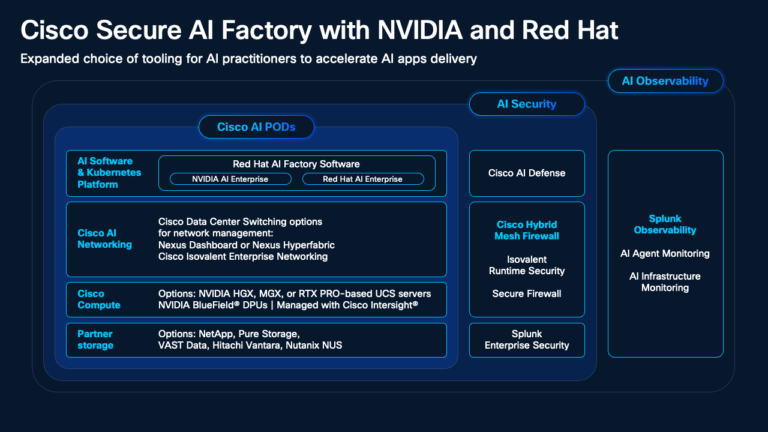
- Compute and AI infrastructure: Through our joint work on Cisco AI PODs and Cisco Secure AI Factory with NVIDIA, we are providing validated architectures that allow organizations to scale AI workloads with confidence.
- Networking and automation: By embedding Ansible into the fabric of our networking solutions, we are enabling teams to treat network configuration as code, simplifying the management of complex, multicloud environments.
- Observability and security: The synergy between Splunk and Red Hat, combined with Isovalent’s eBPF-powered networking and security capabilities within OpenShift, provides a level of visibility and protection that is key for modern, cloud-native applications.
See the future in action: The show floor
At our Red Hat Summit booth, we’re bringing this vision to life through four distinct, high-impact demonstrations:
Secure multi-agents from core to edge (Cisco Secure AI Factory with NVIDIA): We’re showcasing a Cisco Secure AI Factory with NVIDIA for agentic fleets. Using Cisco Unified Edge with high-performance GPUs for real-time edge detection and Cisco AI PODs for core LLM insights, we’ll demonstrate how Cisco AI Defense provides runtime guardrails to prevent prompt injection and data leakage across the entire lifecycle.

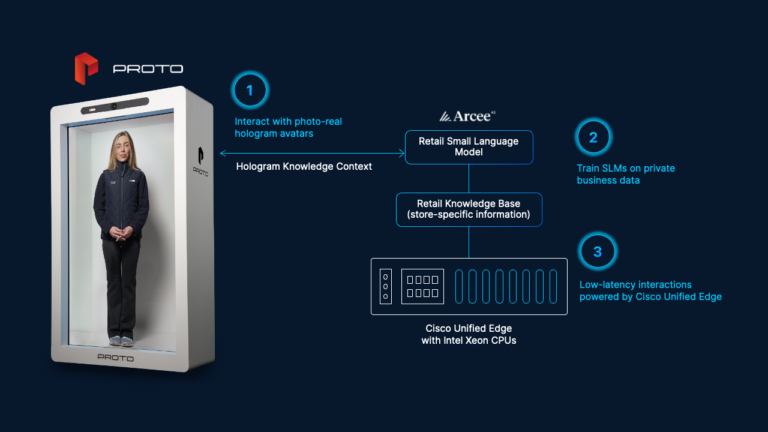
The edge experience (Cisco Unified Edge and AI-powered live hologram assistant): Attendees can interact with a hologram customer service agent powered by an OpenShift container running locally on Cisco Unified Edge. By utilizing a small language model (SLM) from Arcee AI, we’ll show that hyper-personalized, low-latency AI experiences can run reliably at the edge.

Unified control (Cisco Intersight and Splunk Observability Cloud): We’re debuting the new Cisco Intersight OpenShift plugin, providing direct visibility into UCS hardware health. Attendees will also see how the Intersight Ansible collection automates day-2 operations, while Splunk Observability Cloud provides deep insights into AI agent performance.
Network as code (Cisco Nexus Dashboard): Our team will demonstrate how to build and deploy an entire VXLAN EVPN data center fabric modeled as code. By leveraging Cisco Nexus Dashboard’s REST API with Ansible, we’re showcasing a true “No-code/Low-code” approach to infrastructure, complete with GitOps and CI/CD pipeline validation.
Get expert insights: Speaking sessions
Beyond the booth, our experts are taking to the stage to provide a technical deep dive into the architecture powering these innovations:
- Breakout session: Inside secure AI: Eugene Minchenko (Cisco) and Stephen Malkinson (Red Hat) are leading a technical session on how Red Hat AI Enterprise integrates with Cisco Secure AI Factory with NVIDIA and how the Red Hat AI Inference Server works with Cisco Unified Edge. They’ll walk attendees through the Cisco Unified Edge for Red Hat Edge Design Guide, providing a blueprint for deploying and optimizing AI workloads with integrated tools and proven designs.
- Lightning talk: AI made simple and security-focused: Ramya Korada (Cisco) will explore how to accelerate secure, trusted AI adoption without operational complexity. She’ll highlight how Cisco Secure AI Factory with NVIDIA, together with Red Hat, offers a consistent, enterprise-grade foundation for production-ready, scalable innovation, allowing teams to focus on business outcomes rather than infrastructure management.
Why platform thinking matters
The common thread across all these demos and sessions is the shift toward “platform thinking.” Whether it’s the integration of Splunk and Ansible for automated troubleshooting, or the compatibility of Isovalent with OpenShift, our goal is to provide a foundation that is simple to deploy on day 0, easy to operate on day 1, and resilient through day N.
From planning to participation
For years, the industry has been in a “planning” phase with roadmaps, pilots, and theoretical architectures. Red Hat Summit 2026 signals that we have moved firmly into the “participation” phase. Organizations are now deploying AI in ways that are practical, secure, and aligned with their existing operational realities.
Cisco and Red Hat are committed to helping ensure that as you take these next steps, your infrastructure is not a bottleneck, but a catalyst for innovation.
Evolve your data center for AI workloads with Cisco and Red Hat
If you’re ready to explore these solutions further, we’ve developed resources to help you get started:


