



Data center teams deploying AI infrastructure face a critical challenge: building systems that scale efficiently, deliver predictable performance, and maintain operational simplicity without constant reengineering.
The solution requires validated, purpose-built infrastructure designed for seamless integration and proven performance from day one. The Lenovo Hybrid AI 285 with Cisco Networking for data centers delivers a technically pre-validated solution, combining compute density, advanced networking, and automated orchestration to accelerate time to business value for AI deployments.
Pre-validated architecture for high-bandwidth, low-latency AI networking
AI workloads place immense pressure on both compute and data movement. The Lenovo Hybrid AI 285 platform with Cisco integrates:
- Lenovo ThinkSystem SR675 V3 servers, each supporting up to eight NVIDIA GPUs, dual AMD EPYC CPUs, and five PCIe Gen5 network adapters
- Cisco Nexus 9364D-GX2A switches, delivering 400G high-bandwidth, low-latency, lossless fabric with RoCEv2 support

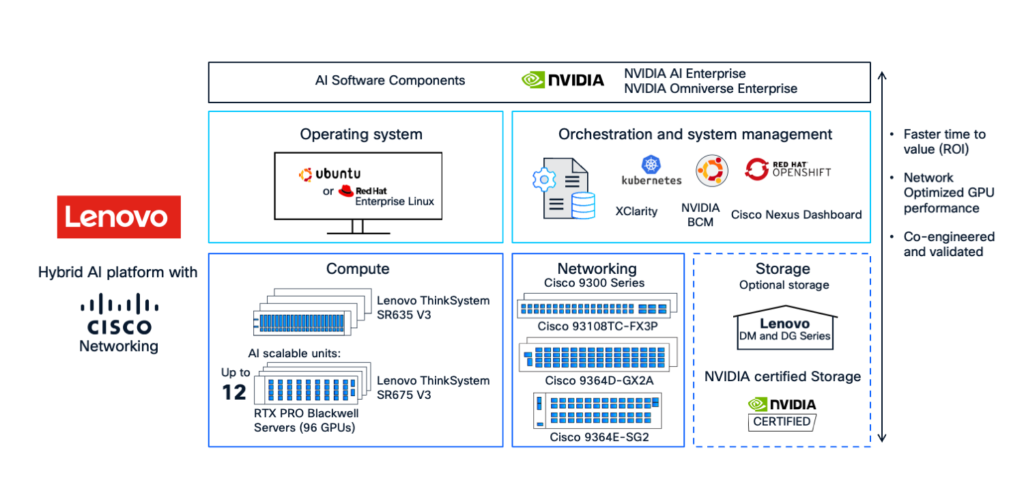
Figure 1. Lenovo Hybrid AI 285 with Cisco Networking for data centers, a technically pre-validated solution, combining compute density, advanced networking, and automated orchestration

This synergy forms a high-bandwidth, low-latency, lossless fabric that is essential for distributed training and inference.
Purpose-built for AI factories
The 2-8-5 server configuration (2 CPUs, 8 GPUs, 5 NICs) is validated for rapid deployment across multiple use cases, from greenfield AI clusters to data center augmentation. The design also allows for the 2-4-3 starter kit configuration (2 CPUs, 4 GPUs, 3 NICs) and scales linearly up to 96 GPUs per deployment unit—without complex reengineering.
Rigorous validation, streamlined deployment
Every component in this architecture undergoes joint validation, including:
- Tuning Non-Uniform Memory Access (NUMA) domains
- Optimizing BIOS / Unified Extensible Firmware Interface (UEFI) optimization
- Automating QoS and Priority Flow Control (PFC) configuration on Cisco switches
End-to-end performance metrics, validated with RDMA/IB benchmarks, consistently deliver 391 Gbps of effective throughput on a 400 Gbps link, demonstrating real-world, line-rate capability.
Business impact of technical validation: Scalability, efficiency, and cost control
Technical validation drives business value by mitigating risks, accelerating ROI, and ensuring consistent network operations. The pre-validated Lenovo-Cisco architecture enables rapid, reliable AI deployment, standardized performance monitoring, and scalable, efficient infrastructure—delivering tangible outcomes in efficiency, scalability, and cost control.
Seamless scaling with measured performance
You can start with a single server or a full-scale AI factory. Scaling is modular and predictable, maintaining performance consistency as you add nodes. This flexibility supports business growth, so that future AI expansions are incremental—not disruptive—investments.
Operational simplicity and lower TCO
Validated design reduces engineering hours, support calls, and the risk of configuration drift. Automated tools replace manual switch programming, boosting reliability and freeing up IT to focus on strategic initiatives. The dense architecture saves on space and power, reducing ongoing costs.
Maximal efficiency and accelerating AI ROI
This validated architecture supports enterprise AI teams, data center architects, and IT operations with scalable, modular infrastructure and simplified management. Designed for organizations moving from proof-of-concept to production AI, it minimizes engineering hours, reduces support calls, and prevents configuration drift. Automated tools enhance reliability, while the dense design saves space, power, and costs, enabling IT to focus on strategic priorities.
Three foundational elements distinguish this validated architecture:
- Enterprise-ready: Joint Lenovo-Cisco validation provides a technical foundation trusted by IT and business stakeholders.
- Optimized stack: Hardware and software tuned for AI means sustained GPU saturation, minimum latency, and fault-tolerant clustering.
- Automated assurance: Cisco Nexus Dashboard centralizes monitoring, and remediation, further simplifying AI network operations.
Build smarter AI factories confidently
The Lenovo Hybrid AI 285 with Cisco Networking for data centers is a blueprint for high-scale AI success. Technical validation translates into rapid, predictable deployments and sustained performance, all with the built-in confidence of industry leaders backing your investment. Empower your business to innovate while the infrastructure just works.
Acknowledgements
Validation led by Meghan Kachhi, Technical Marketing Engineering Technical Leader
Read the Cisco and Lenovo validation guide


