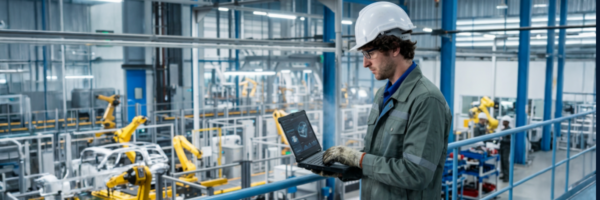
Manufacturers have spent decades building reliable, highly automated factories. But behind many of those sophisticated production lines sits a patchwork of aging servers, industrial PCs, and applications that are increasingly difficult to maintain, manage, and modernize.
For one major U.S. food producer, that challenge prompted a new approach. With manufacturing and distribution facilities spread across the country, the organization selected Cisco Unified Edge to standardize its factory-floor infrastructure, bringing centralized management and a more flexible compute foundation to its operations. The investment also creates a path for future capabilities, including AI-powered applications like advanced real-time analytics and machine vision on production lines.
It’s a challenge facing manufacturers across industries: How do you modernize the infrastructure running today’s factories while preparing for tomorrow’s AI-driven operations?
For nearly two decades, Cisco and Rockwell Automation have worked together to help manufacturers tackle these kinds of challenges. Now, that collaboration is evolving beyond industrial connectivity to address how applications are deployed, managed, and scaled at the edge.
Building on a foundation of IT/OT convergence
A cornerstone of that collaboration has been Converged Plantwide Ethernet (CPwE), a set of tested and validated architectures designed to help manufacturers build secure, reliable industrial networks.
CPwE helped establish a common foundation for connecting information technology (IT) and operational technology (OT). But as manufacturers prepare for AI, the next phase of convergence extends beyond networking.
It’s about rethinking how industrial applications are deployed, how compute resources are managed, and how manufacturers can introduce new capabilities without continually expanding their hardware footprint.
Modernizing industrial compute with containers and virtualization
Traditionally, industrial applications have often been tied to dedicated PCs or servers. Each new function can mean another device to install, maintain, secure, and eventually replace. Multiply that across production lines and facilities, and the complexity adds up quickly.
Containerization and virtualization offer a more flexible approach.
By separating applications from dedicated physical hardware, manufacturers can consolidate workloads onto shared infrastructure. Virtual machines support established software environments, while containers create opportunities to package and deploy newer applications more consistently and uniformly.
Cisco Unified Edge brings these capabilities together on a modular platform designed for distributed environments, supporting virtualized and containerized workloads on the same infrastructure. Its Kubernetes-ready architecture also provides a foundation for orchestrating containerized applications, while Cisco Intersight enables centralized infrastructure management within and across locations.
The result is an opportunity to reduce reliance on scattered, purpose-built servers, simplify operations, and make better use of available compute resources.
Cisco and Rockwell are helping advance this transition through hands-on testing of industrial applications on Cisco Unified Edge. This includes Rockwell applications such as PlantPAx, FactoryTalk Analytics GuardianAI, and FactoryTalk Optix, tested in virtual machine environments. This work helps demonstrate how manufacturers can bring established industrial applications onto a common compute platform, while creating a foundation for more flexible software deployment models over time.
The goal isn’t to replace everything that already works. It’s to make industrial infrastructure easier to manage and more adaptable as requirements change.

Modernizing Edge Infrastructure for the Era of AI
Read e-bookBringing AI closer to production
Modernizing compute also creates opportunities to do more with the data generated on the factory floor.
As we explored earlier this year at Hannover Messe, manufacturing AI demands an infrastructure approach that brings intelligence closer to where production happens. Containerization and flexible edge compute are helping make that vision more practical.
GPU-enabled edge infrastructure brings the processing power needed for demanding AI workloads closer to production.
That opens possibilities for predictive maintenance applications that identify equipment issues before they cause downtime, AI-driven alerts that support faster corrective action, and advanced video analytics that detect quality issues on high-speed production lines.
Rockwell’s FactoryTalk software portfolio brings industrial applications and analytics expertise to these challenges, while Cisco Unified Edge provides a flexible compute foundation for running workloads closer to where data is generated.
Together, these capabilities can help manufacturers introduce AI alongside existing operational applications without creating an entirely separate infrastructure environment for every new use case.
The next chapter: Software-defined manufacturing
The bigger opportunity extends beyond any individual application or infrastructure platform.
Just as Cisco and Rockwell helped manufacturers standardize industrial connectivity through CPwE, we’re now extending that architectural approach into Full-Stack Software-Defined Manufacturing.
This next evolution brings together Cisco software-defined networking and Rockwell software-defined automation, supported by secure connectivity, industrial observability, and flexible compute infrastructure.
The vision is an industrial environment where software capabilities can evolve more independently of underlying hardware, applications can be deployed more consistently, and AI can increasingly support adaptive, autonomous operations.
We’re building toward that future through a shared reference architecture that helps manufacturers navigate the convergence of networking, automation, compute, and AI.
At Rockwell Automation Fair 2026, November 16–19, we’re looking forward to continuing the conversation about how manufacturers can modernize their operations while protecting the investments they’ve already made.
Because the next era of manufacturing isn’t just about connecting the factory. It’s about giving manufacturers the flexibility to make it smarter.
Learn more about how Cisco and Rockwell Automation are helping manufacturers prepare for what’s next in our Full-Stack Software-Defined Manufacturing solution overview.