

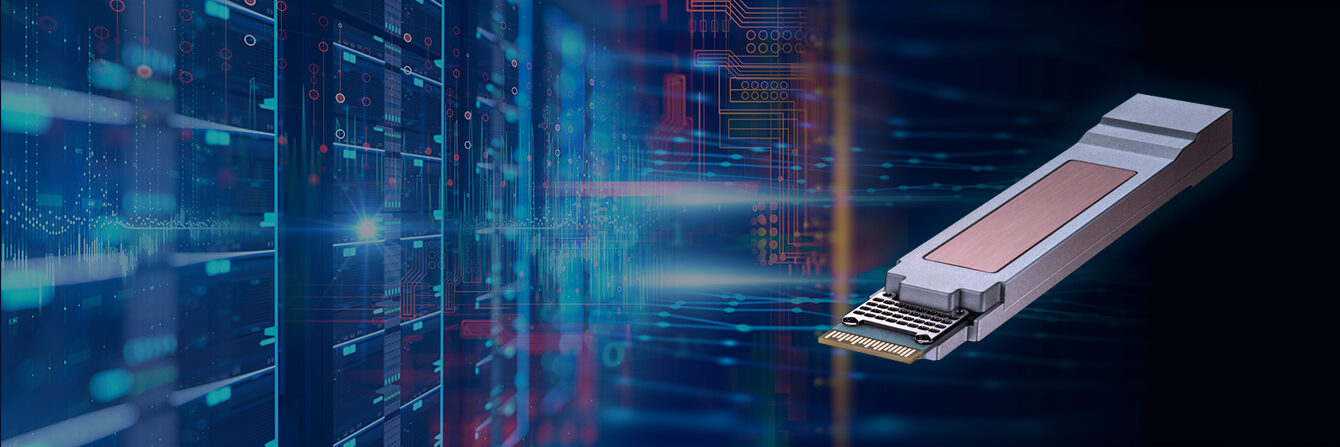
The Ultra-Dense Small Form-Factor Pluggable (USFP) is industry’s first pluggable form factor designed to help customers scale AI networks, providing a path to up to 12.8T of aggregate capacity while preserving proven deployment and serviceability models
As AI evolves from answering prompts to orchestrating complex, multi-step workflows, infrastructure demands are growing rapidly. From training and inference to emerging agentic AI systems, modern AI workloads depend on continuous communication across accelerators, applications, storage, and services, driving unprecedented requirements for bandwidth, responsiveness, and scale.
At Cisco, we believe the future of AI networking will be defined by how effectively silicon, systems, optics, software, and operations work together as a full-stack platform, enabling customers to scale AI with greater performance, efficiency, serviceability, and investment protection by optimizing every layer of the infrastructure together. Customers should not have to redesign their infrastructure or abandon established operational models to take advantage of the next generation of networking innovation.
Today, together with NVIDIA, we are announcing design plans for USFP, the industry’s first 400G-per-lane capable pluggable form factor designed to enable the next generation of AI Ethernet fabrics. USFP will provide a path supporting both 200G and 400G SerDes based systems and ASICs , helping customers scale from today’s 1.6T fabrics, with the ability to achieve 12.8T of overall pluggable capacity while preserving the benefits that have made pluggable optics successful.
Building for AI scale
As AI clusters grow across data centers, clouds, and edge environments, networks must carry significantly more traffic while balancing power, cooling, operational flexibility, and serviceability.
USFP is the next step in that journey. It addresses a critical industry challenge: delivering higher capacity AI fabrics without disrupting the manufacturing, deployment, and operational models that have enabled the scale and success of the pluggable ecosystem.
That perspective has shaped Cisco and NVIDIA’s collaboration for years. Together, we have helped customers build increasingly sophisticated infrastructure spanning networking, security, AI systems, and high-performance AI fabrics. Our work has been guided by a shared goal: helping customers accelerate AI adoption while maintaining flexibility, openness, and choice.
Preserving what works while advancing what’s next
The future of AI networking will not be defined by a single architectural approach. The industry continues to innovate across pluggable, near-packaged, co-packaged, and other emerging optical architectures, each with different advantages and tradeoffs. Customers will choose the technologies that best align with their operational requirements and long-term infrastructure strategies.
Organizations continue to value independently field replaceable modules, mature supply chains, interoperability across suppliers, and familiar serviceability models. These advantages become even more important as AI environments grow in scale and complexity.
USFP will extend those benefits into the next era of AI networking. It will provide a path toward higher capacity AI fabrics and higher density networking switch and compute equipment, while preserving the operational simplicity, openness, and ecosystem flexibility data center operators rely on today.
Accelerating the next generation of AI fabrics
USFP was designed with a simple objective: help AI networks scale efficiently.
With 16 lanes capable of operating at 400 Gb/s per lane, USFP will deliver 6.4T of aggregate capacity, four times the bandwidth density of today’s 1.6T pluggables. The architecture can scale to 32 lanes, providing a path to 12.8T of aggregate capacity. It also creates an opportunity for approximately 1.3x greater power efficiency through the use of 400G SerDes technology, helping operators manage growing power and cooling demands.
Together, these innovations create a foundation for higher-capacity AI Ethernet fabrics and continued innovation across the pluggable networking ecosystem.
Cisco’s platform advantage
To help customers scale AI infrastructure efficiently and sustainably, Cisco takes a full-stack, co-designed platform approach that combines silicon, high-density systems, optics, software, and operational expertise.
USFP reflects that philosophy. Rather than a standalone innovation, it is part of a broader platform vision that advances scale, efficiency, and performance while preserving the deployment, serviceability, and lifecycle models customers depend on.
Building the future of AI connectivity
USFP enables the industry to accelerate AI by building on the ecosystem models that have powered today’s AI networks. By combining a path to higher-capacity fabrics and improved efficiency with familiar operational practices, USFP helps customers scale AI infrastructure while maintaining the flexibility, interoperability, and consistency required at scale.
Cisco has long championed open ecosystems and industry collaboration to accelerate innovation and customer adoption. We see USFP as an extension of that approach, helping create a foundation for broad industry participation, interoperability, and long-term investment protection.
As AI networks continue to grow, Cisco and NVIDIA remain committed to delivering innovations that advance performance while preserving the operational foundations customers trust.
Join us at OCP
This year, Cisco’s OCP presence includes Booth #C59, executive presentations, technical sessions, and collaborations with customers and industry leaders, including Microsoft, AMD, Alibaba Cloud, and Supermicro. Join Cisco at OCP to engage with our experts, explore emerging technologies, and learn how open collaboration is accelerating the future of AI infrastructure. Learn how Cisco is advancing open networking through SONiC and helping organizations build more flexible, scalable infrastructure in our latest blog.

Stay up on Thought Leadership from Cisco
Get the latest blogs from Cisco Executives in your email.
Subscribe to the Executive Platform
Executive Perspectives
Navigate the latest technology trends and get solutions with the help of Cisco executives.
Go to Executive Perspectives X/Twitter
 Facebook
 LinkedIn
 E-mail