
For more than 25 years, I have worked alongside financial institutions as they navigated architectural transitions, regulatory change, and the constant pressure to keep mission-critical payment networks resilient, secure, and compliant.
If there is one constant across global banking and capital markets, it is this: compliance is not a static, once-a-year exercise. It is an operational discipline spanning people, process, and technology.
Today, financial IT leaders face a unique convergence of challenges:
- Accelerating vulnerability velocity: Public vulnerability disclosures continue to rise sharply. Attempting to remediate every advisory with equal urgency is not sustainable. If there was infinite budget, headcount, and change windows, this would not be an issue. In the practicality of finite constraints, prioritization is critical.
- Regulatory mandates with real consequences: With PCI DSS 4.0.1 now in force, and many previously future-dated requirements effective, regulators have newer demands for ongoing compliance. The FFIEC operations manual updated in the past few years, has real OCC level consequences for compliance.
- Operational and portal sprawl: Infrastructure teams spend hundreds of hours reconciling asset inventories, mapping hardware and software lifecycles to advisories, and collecting audit artifacts across multiple tools and portals. What has traditionally been a manual ETL process, to get a consistent inventory.
- The emerging quantum threat: The “Harvest Now, Decrypt Later” model means encrypted financial traffic captured today may become vulnerable once cryptographically relevant quantum computers emerge. With NIST’s post-quantum cryptography standards now finalized, financial institutions need to begin planning for crypto agility today.
To address these pressures without simply adding more manual work, financial institutions need a more unified, intelligent operating model.
Enter Cisco IQ.
What Is Cisco IQ? A Unified Front Door for Infrastructure Lifecycle Intelligence
Cisco IQ is Cisco’s AI-powered digital interface for Support and Professional Services. It is designed to provide a unified front door for infrastructure lifecycle intelligence, consolidating support workflows, telemetry, assessments, and recommendations into a more proactive operational experience.
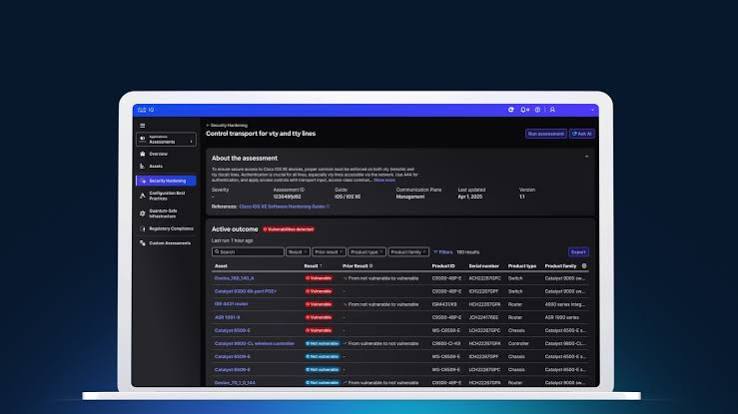
For financial institutions, Cisco IQ is especially relevant because it addresses three persistent operational challenges.
1. Data Sovereignty and Restricted Environments
Financial institutions operate under strict data sovereignty, regulatory, and zero-trust requirements. One of the long-standing friction points with cloud-based management models is telemetry movement outside controlled environments.
Cisco IQ is designed to support flexible deployment and consumption models, helping organizations align infrastructure intelligence with their operational, regulatory, and data-handling requirements.
For tier-1 banks, clearinghouses, payment processors, and other highly regulated entities, this flexibility is critical. It allows teams to pursue AI-assisted infrastructure assessments and lifecycle analytics while maintaining appropriate control over where sensitive operational data resides.
2. Defensible Peer Benchmarking
Infrastructure and security leaders are often asked a simple question: “How do we compare?”
How does patch currency compare with peer institutions? How does mean time to remediate compare with similar environments? Is vulnerability exposure materially higher or lower than comparable organizations?
Cisco IQ’s benchmarking capabilities can help CISOs and infrastructure leaders evaluate operational posture against relevant peer cohorts. That turns budget conversations from subjective debates into more defensible, data-backed business cases.
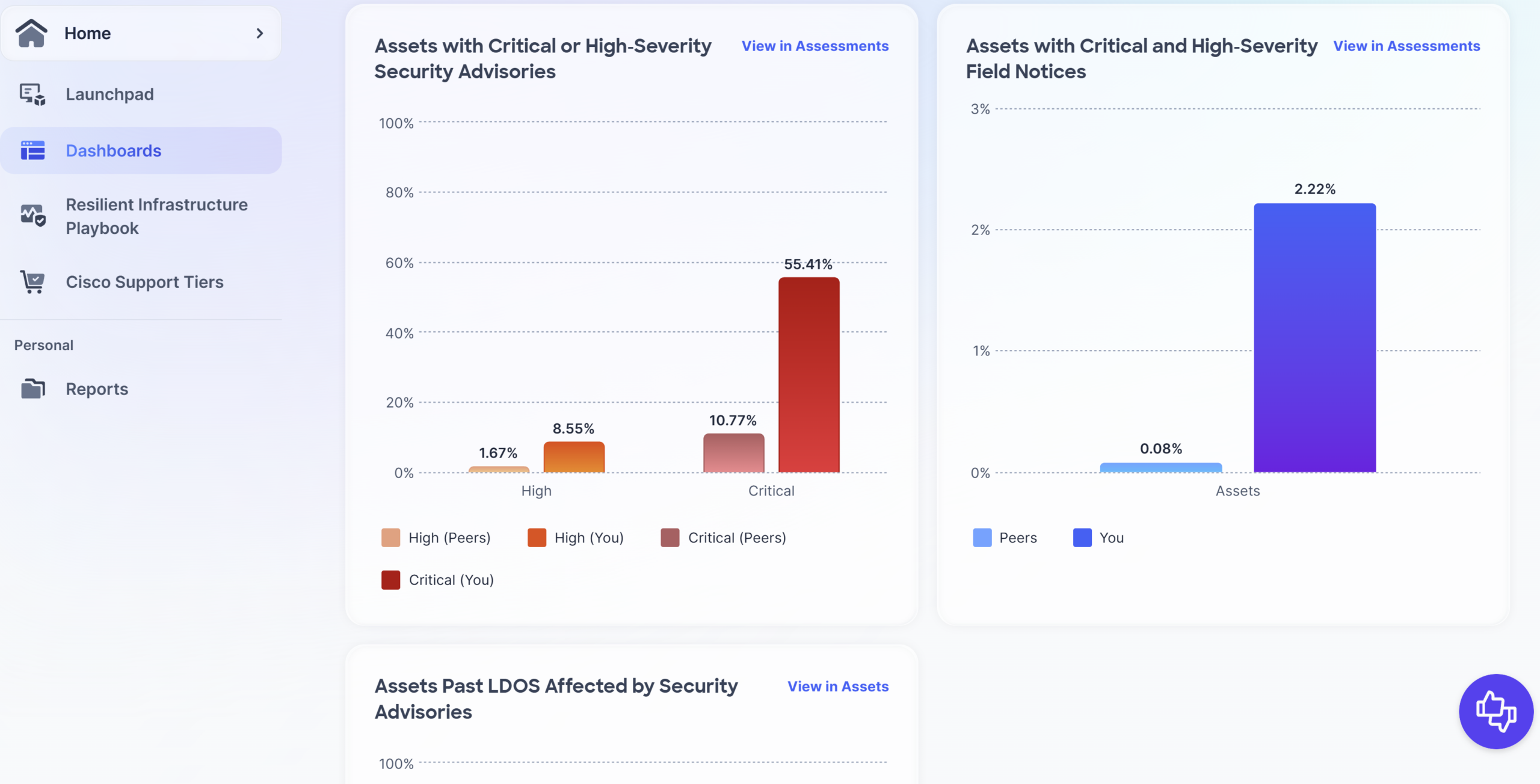
3. Moving from Reactive Support to Predictive Success
Traditional infrastructure operations are often reactive. Teams respond to outages, audit findings, field notices, lifecycle events, and urgent vulnerabilities after the risk has already surfaced.
Cisco IQ helps shift that model toward predictive success by identifying issues such as configuration deviance from best practices, approaching end-of-support milestones, relevant field notices, and high-impact vulnerabilities before they become service disruptions or audit exceptions.
Supporting PCI DSS 4.0.1 with Cisco IQ
PCI DSS 4.0 and 4.0.1 represent a major evolution in payment security. The standard places greater emphasis on continuous security, documented control effectiveness, targeted risk analysis, and flexible implementation through the customized approach.
For financial institutions, the practical challenge is clear: teams must show that security controls are not only designed correctly, but also operating effectively over time.
That requires accurate inventory, configuration visibility, vulnerability prioritization, lifecycle management, administrative access governance, and repeatable evidence.
Cisco IQ can help support these outcomes by giving infrastructure, security, and compliance teams a more unified view of their environment.
Mapping Cisco IQ Capabilities to PCI DSS 4.0.1 Requirements
Requirement 1: Install and Maintain Network Security Controls
This requirement is to ensure connections between trusted and untrusted networks, including the CDE, are controlled, documented, and reviewed. Cisco IQ does this through adaptive infrastructure assessments by analyzing configurations against best practice and security assessments.
Requirement 2: Apply Secure Configurations to All System Components
This requirement is to harden systems, remove insecure defaults, and maintain secure baselines. Cisco IQ does this through configuration hygiene and hardening assessments by identifying risky services, weak management protocols, and outdated cryptographic settings.
Requirement 6: Develop and Maintain Secure Systems and Software
This requirement is to identify, prioritize, and remediate vulnerabilities in a timely manner.. Cisco IQ does this through PSIRT and CVE correlation by mapping vulnerabilities to actual hardware, software, and configuration context, enabling more risk-based patch prioritization.
Two Operational Wins: Requirements 2 and 6
While Cisco IQ can support many areas of PCI DSS 4.0.1, two requirements consistently create the most operational friction for financial institutions: secure configuration, and vulnerability management.
Requirement 2: Reducing Configuration Drift
In large banking environments, configuration drift is inevitable. A late-night emergency change, a temporary troubleshooting exception, or a one-off rule adjustment can remain in place long after the original issue is resolved.
Over time, those small deviations become operational and compliance risk.
Cisco IQ helps infrastructure teams compare active configurations against approved standards and design intent. It can surface risky deviations such as exposed management services, inconsistent logging, deprecated protocols, or misaligned hardening settings before those issues become audit findings.
The value is not just detection. It is repeatability. Teams gain a more consistent way to identify, document, and remediate drift across complex environments.
Requirement 6: Prioritizing the Vulnerabilities That Matter Most
Financial institutions cannot simply reboot core payment infrastructure every time a new advisory is published. Maintenance windows require change approval, failover planning, application coordination, and business-risk review.
The challenge is not knowing whether vulnerabilities exist. The challenge is knowing which vulnerabilities actually matter in a specific production environment.
Cisco IQ helps by correlating advisories and vulnerabilities against asset inventory, software versions, hardware models, and configuration context. Instead of treating every CVE as equal, teams can focus on vulnerabilities that are relevant, exposed, and operationally meaningful.
That gives engineering and risk teams a more defensible way to prioritize remediation, justify maintenance windows, and communicate risk to change advisory boards and executive stakeholders.
Beyond PCI DSS: Preparing for Post-Quantum Cryptography
While PCI DSS 4.0.1 is an immediate priority, financial institutions also need to prepare for a much larger cryptographic transition: post-quantum cryptography.
The Harvest Now, Decrypt Later Risk
Adversaries may already be capturing encrypted financial traffic, payment data flows, interbank communications, and long-retention customer records with the expectation that they can decrypt them later.
This is the essence of Harvest Now, Decrypt Later.
A sufficiently capable cryptographically relevant quantum computer could threaten widely used public-key algorithms such as RSA, elliptic curve cryptography, and Diffie-Hellman. For financial institutions, that matters because some data must remain confidential and trustworthy for many years.
Long-retention financial records, settlement data, digital signatures, audit trails, and customer information may need protection well beyond the useful life of today’s cryptographic assumptions.
Quantum risk is not only a future technology issue. It is a data-protection and planning issue today.
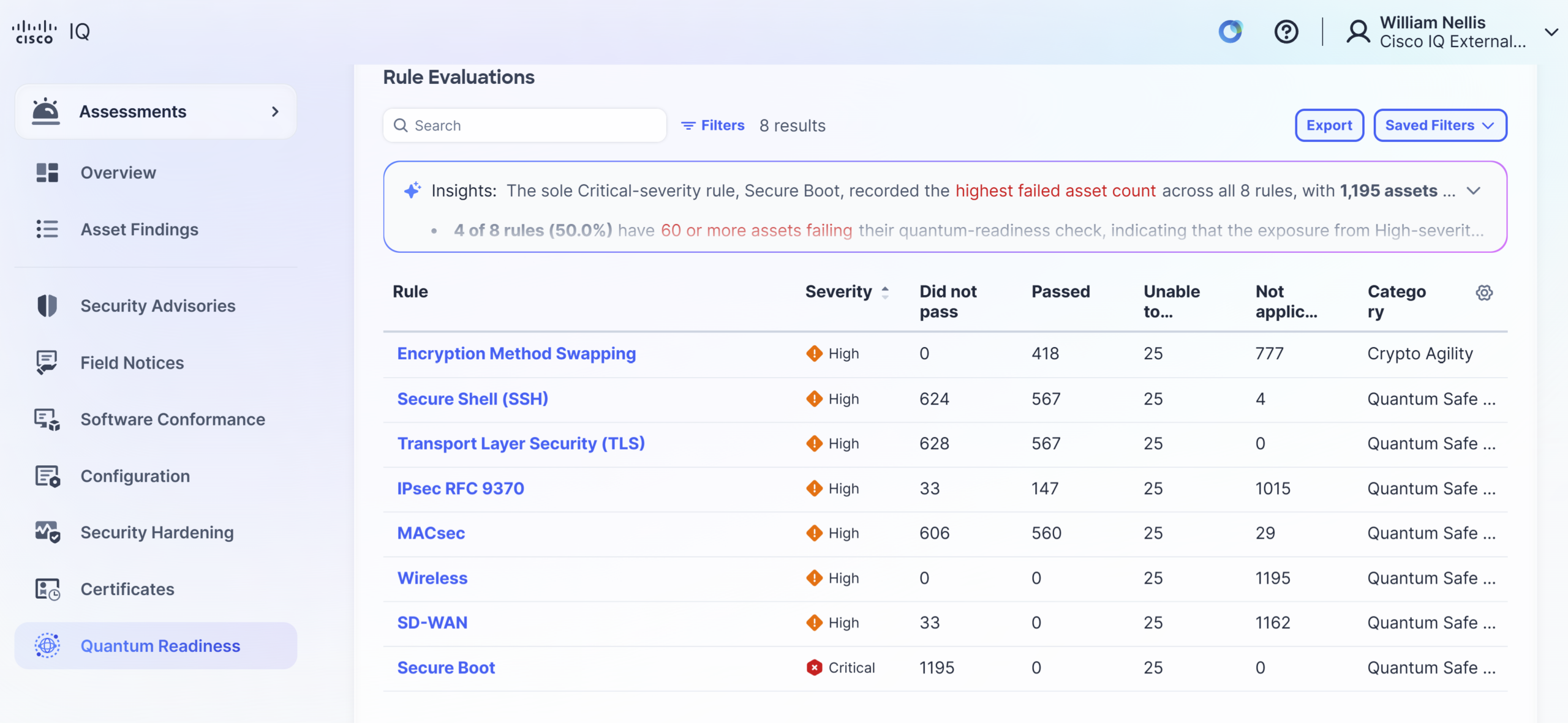
Quantum ready assessments are available today, in Cisco IQ.
The New NIST Post-Quantum Standards
In August 2024, the National Institute of Standards and Technology finalized three post-quantum cryptography standards:
- FIPS 203: Module-Lattice-Based Key-Encapsulation Mechanism, or ML-KEM, based on CRYSTALS-Kyber, for key establishment.
- FIPS 204: Module-Lattice-Based Digital Signature Algorithm, or ML-DSA, based on CRYSTALS-Dilithium, for digital signatures.
- FIPS 205: Stateless Hash-Based Digital Signature Algorithm, or SLH-DSA, based on SPHINCS+, as a stateless hash-based signature option.
NIST’s National Cybersecurity Center of Excellence has also published guidance focused on quantum readiness, including cryptographic discovery and testing for interoperability and performance.
The message for financial institutions is clear: before organizations can migrate to quantum-safe cryptography, they must first understand where cryptography exists, which algorithms are in use, which systems rely on them, and which data flows carry long-term confidentiality risk.
How Cisco IQ Can Support Quantum Readiness
You cannot improve what you cannot see.
The largest practical hurdle in post-quantum migration is cryptographic discovery. Financial institutions need to identify vulnerable cryptography across network devices, VPN infrastructure, certificates, management planes, encrypted tunnels, and high-value data paths.
Cisco IQ’s Quantum Ready capabilities can help organizations build that visibility and begin planning a risk-based migration strategy.
The Path Forward: Balancing Today’s Audits with Tomorrow’s Resilience
Financial technology leaders do not have the luxury of choosing between immediate compliance and long-term cryptographic strategy.
PCI DSS 4.0.1 requires disciplined operational control today. Post-quantum migration requires inventory, planning, and crypto agility for tomorrow.
The path forward depends on three pillars:
- People: Reallocate senior engineers and architects from manual data and audit, so they can focus on high-impact security and resilience work.
- Process: Make posture validation, asset inventory, vulnerability prioritization, and cryptographic discovery continuous operational competencies.
- Technology: Use an intelligent, unified platform such as Cisco IQ to connect lifecycle intelligence, security advisories, infrastructure assessments, compliance evidence, and quantum-readiness planning.
In Summary
The pace of regulatory change is accelerating. So is the complexity of the infrastructure that financial institutions depend on.
Whether the immediate priority is regulatory requirements, AI related vulnerabilities and hardening, audit evidence collection, or preparation for a quantum-safe future, one thing is clear: financial institutions need a unified, intelligent view of their infrastructure.
Cisco IQ helps bring that view together.
By combining lifecycle intelligence, infrastructure assessments, vulnerability correlation, compliance reporting, and quantum-readiness capabilities, Cisco IQ can help financial institutions move from reactive audit preparation to continuous operational resilience.
To learn more about how Cisco IQ can support your compliance, resilience, and quantum-readiness strategy, contact your Cisco account team or Cisco CX specialist.