


Behind the scenes in today’s digital world, data centers power everything from AI-driven applications to the secure storage of vast amounts of sensitive information. As the foundation of modern business operations, data centers play a critical role in keeping services running smoothly, which makes them an increasingly attractive target of cyberattacks.
As the advanced technologies of AI and quantum computing reshape the threat landscape, organizations have little choice except to modernize data center security to protect sensitive data and ensure operational continuity.
Vulnerable, legacy infrastructure complexity
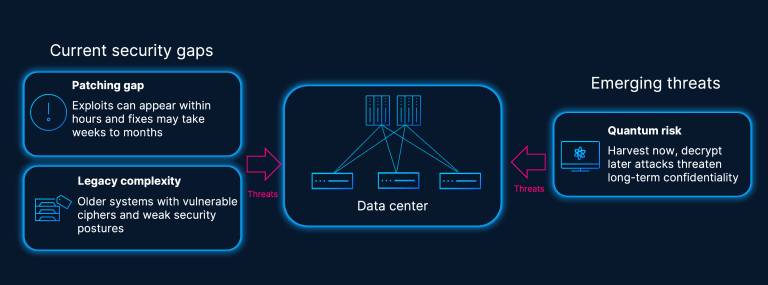
Data center environments are becoming more complex (Figure 1). This increases the number of possible entry points for attackers. Older systems and outdated infrastructure make things even harder because they often lack hardened products, software compatibility, and the latest security features. Legacy systems therefore require frequent manual updates, troubleshooting, and patching to react to security threats—especially with technologies like Claude Mythos, Anthropic’s AI model that can autonomously discover and exploit software vulnerabilities at unprecedented speed. Teams spend more time maintaining and securing infrastructure than focusing on business-critical outcomes.
The patching gap
Unpatched systems and emergency updates can lead to serious problems like service outages, financial losses, and damage to company reputations. The “patching gap” is an example. Attackers can take advantage of the time between when a vulnerability is discovered and when the corresponding patch is fully deployed and systems are secured. This gap may take organizations weeks or even months to fix across all systems.
Real-time threat mitigation challenges
Traditional security patching methods require scheduled downtime and maintenance windows, which can delay the deployment of critical fixes and leave networks exposed to zero-day attacks. These delays create windows of vulnerability that sophisticated attackers can exploit. There is a pressing need for continuous, real-time protection mechanisms that can mitigate threats immediately without causing operational disruption. Such capabilities enable organizations to maintain a strong security posture while ensuring high availability and consistent performance of critical data center services. Real-time threat mitigation reduces operational headaches and supports faster response to emerging threats, contributing to overall network resilience.
AI vulnerabilities
AI introduces new cybersecurity vulnerabilities in data centers by expanding the attack surface through interconnected systems and automated workflows. Malicious actors can exploit AI algorithms, training data, or model outputs to bypass security controls or launch targeted attacks. Compromised AI-powered tools can be misused for privilege escalation or to disguise “living off the land” (LOTL) attacks within normal network activity.
Quantum computing threat to encryption
Quantum computing presents a fundamental threat to current encryption algorithms that protect sensitive data. The risk of “harvest now, decrypt later” (HNDL) attacks means adversaries can capture encrypted data today and decrypt it in the future once quantum capabilities mature, jeopardizing long-term data confidentiality. Critical infrastructure remains vulnerable to these future quantum attacks unless a seamless transition to quantum-resistant cryptography is achieved. This transition involves adopting new cryptographic standards approved by bodies like the National Institute of Standards and Technology (NIST), implementing quantum-safe secure boot processes, and upgrading network hardware to support post-quantum cryptographic workloads. The challenge lies in orchestrating a phased migration that balances security, compliance, and operational continuity while preparing networks for the quantum era.
All these vulnerabilities highlight the urgent need for an integrated security approach that addresses the evolving threat landscape in data centers. By deploying a resilient infrastructure, quantum-safe networking, and real-time threat mitigation, organizations can strengthen their network security, reduce operational risks, and future-proof their data centers against both current and emerging threats like AI and quantum computing.
Achieving a resilient infrastructure for data center continuity
Cisco is aware of the mounting security challenges our customers face in their data centers. Key security features on Cisco N9000 Series data center switches include enhanced visibility, an easy way to remove insecure features, secure-by-default configurations, real-time threat mitigation, and quantum-safe networking.
- Logging and visibility on insecure configurations: Cisco provides enhanced logging, monitoring, and alerting capabilities that notify administrators when insecure configurations or legacy features are in use. Customers receive warnings when configuring insecure options, encouraging their discontinuation and migration to secure alternatives.
- Phased approach to disable and remove insecure features: Insecure legacy features such as plain text credential storage, Telnet, FTP, weak ciphers, and outdated protocols like Transport Layer Security (TLS) 1.0/1.1 are being phased out through a three-phase process that includes warnings, restrictions, and eventual removal. This approach allows organizations to plan and execute secure migrations smoothly.
- Secure-by-default: Cisco Nexus platforms are designed to minimize the attack surface while maintaining maximum uptime. By enforcing “secure-by-default” configurations and removing insecure legacy protocols, Nexus switches provide a hardened foundation. This allows data center operators to manage risks proactively through continuous monitoring and automated fabric management, ensuring that critical services remain available without the need for constant, disruptive emergency maintenance. Cisco is raising the security baseline in data center networks by shipping products in a hardened state where insecure features and protocols are disabled by default.
- Network as a strategic control point for detecting LOTL attacks: Because attackers increasingly use legitimate administrative tools to blend into normal traffic, the network has become the most reliable place to identify malicious activity. Cisco Nexus enhances visibility at the network layer, allowing for the detection of anomalous behavior patterns that characterize LOTL attacks. By monitoring traffic flows and control plane activity, the Nexus fabric provides the oversight needed to identify the unauthorized use of system tools. This network-centric approach allows security teams to intercept malicious activity in real time, providing a robust defense against subtle threats without relying on traditional, disruptive patching cycles.
Quantum-safe networking for the fabric
The foundation of Nexus security begins with a secure hardware and software product lifecycle designed for long-term cryptographic agility (Figure 2). Every Nexus device utilizes hardware-based trust anchors and Secure Boot to verify the integrity of the hardware and software from the moment of power-on. Beyond basic boot security, this ensures that the platform has the computational headroom (unused processing capacity) and architectural flexibility to support the advanced algorithms required by NIST post-quantum cryptographic (PQC) standards. By enforcing signed software images and secure development practices, Cisco ensures the infrastructure is hardened against current tampering and future quantum-based threats, providing a trusted environment for critical workloads.
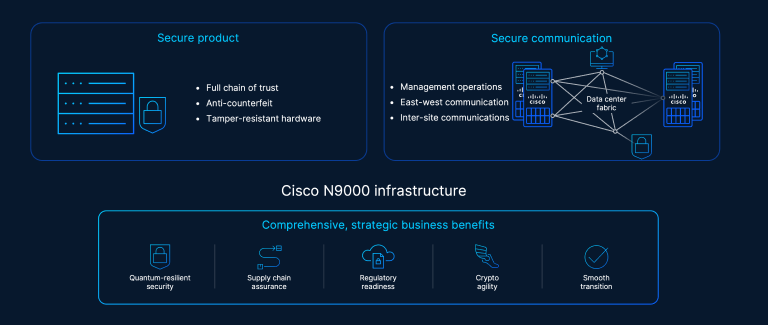
To protect data in transit, Cisco Nexus implements secure communication protocols that are actively evolving to counter the HNDL strategy of hackers awaiting quantum computing capabilities. By integrating quantum-safe solutions aligned with the latest NIST PQC standards, Nexus infrastructure provides a robust, layered defense. This hybrid security model blends classical encryption with quantum-resistant algorithms. By design, this approach maintains full backward compatibility, allowing organizations to adopt advanced quantum-safe protections while ensuring seamless interoperability with their existing network infrastructure and standards. This ensures long-term confidentiality and strict compliance with evolving NIST guidelines, effectively securing data center and WAN communications against both today’s sophisticated attacks and tomorrow’s quantum-computing capabilities.
Real-time threat mitigation without downtime
Cisco Live Protect for Nexus infrastructure replaces disruptive, traditional patching cycles with real-time shields that mitigate vulnerabilities instantly. Live Protect uses extended Berkeley Packet Filter (eBPF) technology, a powerful Linux kernel feature, through the Tetragon agent embedded in NX-OS. This allows deep visibility and enforcement directly within the kernel, monitoring system calls, file operations, process control, and network traffic to detect and prevent privilege escalation, control-plane attacks, and other sophisticated threats.
By orchestrating these proactive defenses through Cisco Nexus One and Cisco Nexus Dashboard on premises, administrators can neutralize threats the moment they arise, ensuring a hardened security posture without sacrificing operational uptime. This approach effectively eliminates the traditional trade-off between security and availability, allowing data centers to maintain a hardened, high-performance posture while ensuring continuous, uninterrupted service delivery.
Together, these capabilities form a comprehensive defense strategy that strengthens network security, reduces operational risks, and future-proofs data centers against both current and emerging threats, including those from AI and quantum computing. This integrated approach enables organizations to maintain secure, resilient, and high-performing networks that are essential for modern digital operations.
Secure your data center now, before threats become disasters
The evolving threat landscape—especially threats posed by AI and quantum computing—demands a proactive response from data center operators. Legacy tools, insecure patching techniques, lack of network visibility, and high complexity introduce serious vulnerabilities that can lead to catastrophic attacks. Cisco’s integrated data center network portfolio for Cisco N9000 Series Switches powered by Nexus One, is a resilient, future-ready foundation that protects your infrastructure from the inside out. Featuring secure-by-default hardware, NIST-aligned quantum-safe cryptography, and real-time defenses like Live Protect, the products help ensure that your organization remains both secure and fully operational.
Every day without a modernized security foundation is a day of imminent risk. Talk to your Cisco representative today and build a foundation that stays ahead of whatever comes next.
Build a secure, AI-ready data center foundation


