


How we’re building the secure harness for the agentic era — converging data, identity, topology, authorization, workflows, and agentic AI across every operational domain.
Why the single pane of glass was never enough
The industry has tried to solve operational fragmentation many times, and most attempts failed for the same structural reason: they unified the interface without converging the data. What looked like a single pane of glass was usually multiple sign-ins across a dozen dashboards — every product still querying its own silo, maintaining its own inventory, enforcing its own permissions, and largely unaware of adjacent domains.
So, when a cross-domain issue hit, teams still ended up on a bridge call. Someone copied device names from one console into another. Someone else checked whether an alert mapped to a known site, a vulnerable asset, a routing change, or a workload migration. The portal looked unified. The operating model was still fragmented underneath.
This is fundamentally a data, identity, authorization, and topology problem. A portal that federates queries at runtime can display information side by side, but it cannot reliably reason across domains, correlate cause and impact, or govern action between products. True cross-domain intelligence requires converged context as an architectural prerequisite.
That premise is what Cisco Cloud Control is built on.
At Cisco Live Americas, we’ll begin rolling it out to customers via Controlled Availability in the U.S.: a converged operations platform that brings every Cisco domain into one environment, with one operating model for every team — and every agent — working across the estate. Essential to the platform will be AI Canvas, a multiplayer agentic workspace, and Cloud Control Studio, a governed environment for building, customizing, and managing AI agents. Also essential will be extensibility for the development and customization of apps, agents and third-party products.
This is the secure harness DJ Sampath describes in his Cisco Live blog — the governed control surface that lets agents and operators act on real infrastructure without breaking it, exposing it, or taking it somewhere it shouldn’t go. This post goes under the hood on how that harness is built.
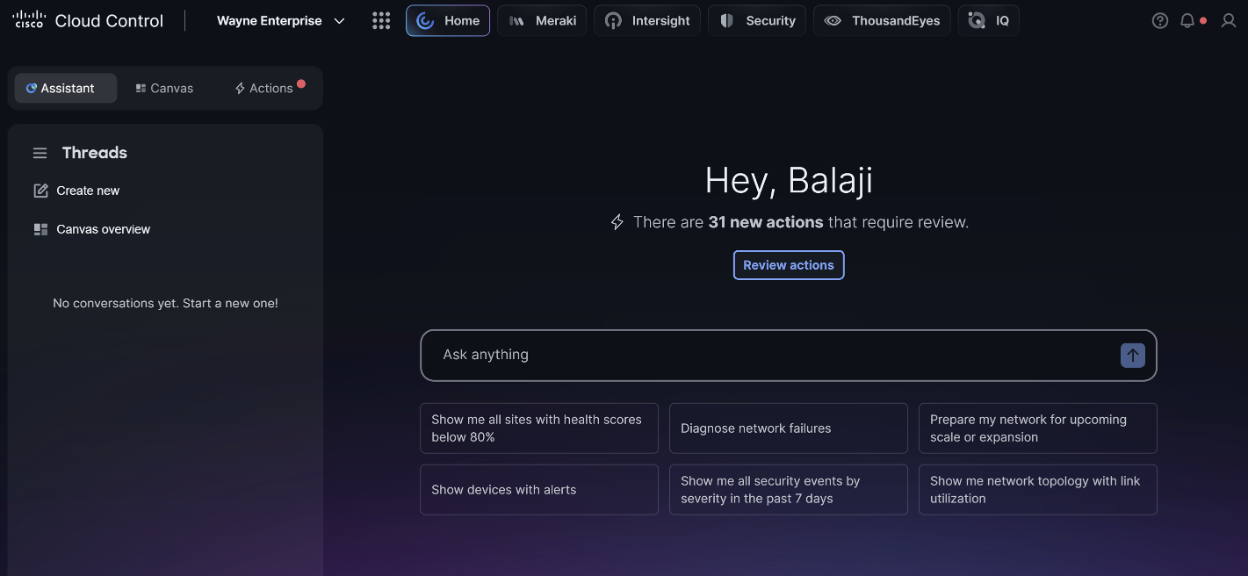 The homepage
The platform, and the workspace inside it
It’s worth being precise about the relationship up front, because it shapes everything else in this post.
Cisco Cloud Control is the platform — the secure harness. It converges identity, assets, topology, authorization, telemetry, and workflow across every Cisco domain, and exposes them as governed services that humans, applications, and agents all reason over.
AI Canvas is the multiplayer workspace that lives natively inside Cisco Cloud Control. It’s where operators and agents investigate, reason, and act together — grounded in the same shared identity, durable context, normalized assets, connected topology, least-privilege authorization, and agent-ready services the platform provides.
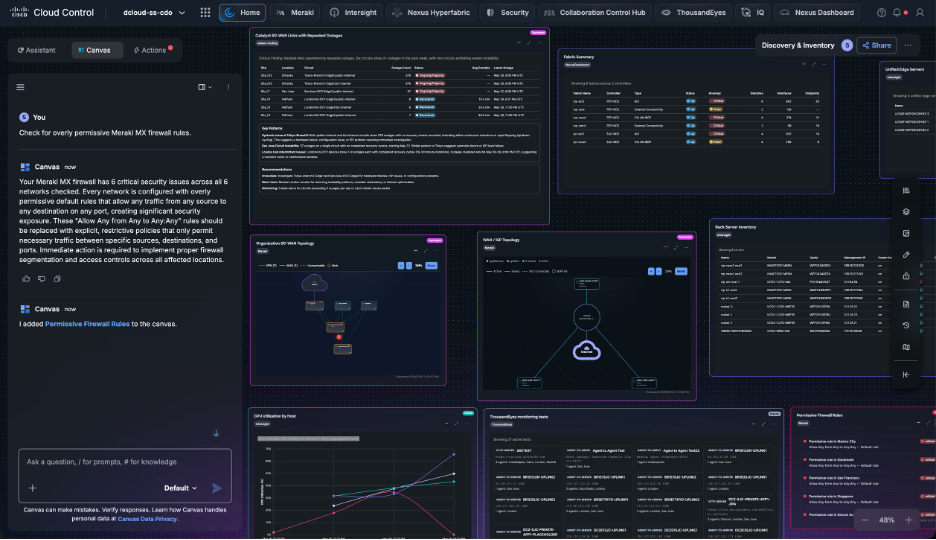 An example AI Canvas workspace
That distinction matters because it’s also the draw. AI Canvas is a multiplayer agentic workspace where operators and AI agents investigate issues together, across domains, in real time. Every UI component it generates, every agent it runs, every action it takes is already governed by Cisco Cloud Control’s substrate. That’s why the experience feels different from a chat box layered over dashboards: the workspace and the harness were built together, and one is only as trustworthy as the other.
Convergence without flattening product depth
The strategic goal is straightforward but technically demanding: make the Cisco portfolio operate as one platform while preserving the depth of every domain and the autonomy of every product team. Customers still need the rich capabilities of Meraki, Catalyst Center, Nexus, ThousandEyes, Security Cloud Control, Webex, and the rest. Product teams still need room to innovate. Convergence will come through reusable platform services.
Cisco Cloud Control uses an open, federated architecture with common services for identity, tenancy, authorization, assets, topology, telemetry, search, navigation, audit, workflow, and agent actions. Domain products and their operators maintain the depth and specialization of their respective areas. The platform provides the cross-domain substrate that makes them interoperable.
If a system of record is where authoritative domain data lives, Cisco Cloud Control is designed to be the platform of record for cross-domain operations — where identity is resolved, context is assembled, decisions are made, and actions are governed across domains.
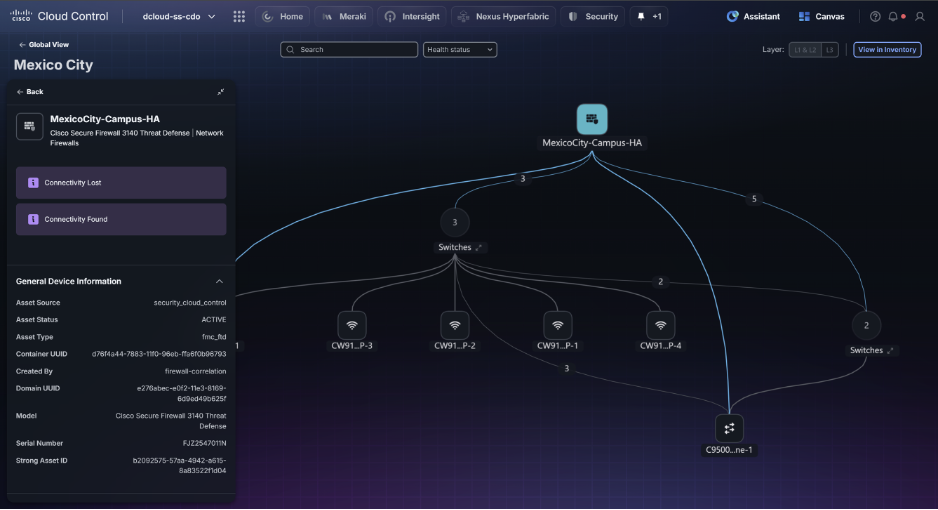 Topology correlation
The architecture, in principle
A few principles shape everything:
- Convergence happens below the UI. Identity, assets, topology, alerts, and authorization must converge before any interface, data layer or AI layer can deliver cross-domain value.
- Federation protects autonomy. Domain controllers will contribute data and intelligence to the centralized platform while maintaining autonomy and depth for persona-based specialization.
- Context must be coherent and consistent. The platform must consistently reference data and assets, what they’re related to and their dependencies—so that context remains the same across pages, changes, escalations, and agent handoffs.
- Authorization is least-privilege by design. A cross-product platform must hold the line on access, never widen it.
- Humans and agents share the same source of truth. The AI Assistant, AI Canvas, Cloud Control Studio, and cross-domain apps all reason over the same governed context.
- Extensibility is a primitive. SDKs, contribution contracts, and agent-friendly APIs let teams build safely at scale.
What convergence actually looks like
Cisco Cloud Control ingests signals from across the portfolio into the Cisco Data Fabric. Data is normalized and converged where correlation, search, and AI reasoning require it, and federated where live product context or domain-specific action requires direct interaction. That hybrid model lets us reason across domains while preserving the fidelity of each one.
Three structural problems had to be solved first.
Identity and tenancy. Every cross-domain workflow depends on knowing who the user is, which tenants they can reach, and what scope they’re operating in. Built on Cisco Unified Identity, tenant linking turns a set of domain-specific relationships into one organizational experience — so users carry preserved context as they move between products and into AI-assisted investigation.
Assets and topology. Inventory had to be truly converged. The Unified Asset Inventory brings assets from connected domains into a searchable, normalized view with live operational, compliance, and reachability signals. Topology uses the relationship of those assets into a coherent end-to-end visualization. This allows operators to see the impact that changes, issues and incidences have on their operating environment.
Navigation. UI federation, micro front ends, and a common Cisco design system let product experiences load in a unified shell while keeping product autonomy. Identity, tenant scope, navigation state, and AI context travel with the user.
The normalized cross-product control plane
The heart of Cisco Cloud Control is a normalized control plane that gives the platform and its applications a shared operating language — assets, topology, authorization, search, alerts, catalog context, navigation, audit, workflows, and AI action context.
This is what lets domain products stay autonomous while becoming interoperable through reusable services. A cross-domain app doesn’t have to reinvent tenancy, authorization, asset lookup, topology enrichment, alert context, or navigation. An agent doesn’t have to guess whether a device name, site, tenant, or alert maps to the same object in another product. The platform assembles and governs that context.
Least-privilege authorization across product boundaries
Cross-domain action is powerful only if it’s safe. Cisco Cloud Control includes a fast inline Role Based Access Control (RBAC) translation layer that is agnostic to each product’s permission model. As context moves across boundaries, the layer preserves, reduces, or constrains access based on the user, tenant, product, resource, and action — so a workflow can correlate broadly while acting only where the user is authorized.
This matters most for agents. Relevance alone never grants action. Agents need scoped tools, bounded skills, runtime policy checks, full auditability, and human-in-the-loop gates for higher-impact work.
AI-ready context for agents, assistants, and apps
Grounded, authorized, cross-product context is what turns AI from another interface into a real operational partner. With it, AI can enrich, disambiguate, summarize, and recommend next-best actions across Cisco’s operational model.
AI Canvas is a good illustration. It assembles product, tenant, asset, topology, alert, and action context that AI Canvas and agents reuse to understand what an operator is asking, which assets are involved, and which actions are permitted. Gateway and protocol-based patterns — including Model Context Protocol and agent-to-agent integration — let agents reach first- and third-party sources in a governed way, fully within platform policy.
From signal to remediation
Picture an operator logging in at 7:14 AM. The home view shows Dallas amber on the Site Health Map. They click in: two switches with elevated errors, an AP cluster with intermittent disconnects, and recommended next steps already surfaced.
Overnight, a scheduled agent ran a compliance scan and flagged the same switches running firmware affected by a critical vulnerability. It prepared a remediation runbook, validated the plan against current topology, checked policy boundaries, and queued an approval. The operator opens the AI Canvas investigation, reviews asset history, topology, and the alert timeline, and approves. The agent executes within policy. The site returns to green.
What makes that workflow possible is the shared substrate behind it. Health, compliance, topology, authorization, remediation, and human approval all operate on the same platform. No bridge call. No copy-paste. No lost context.
Why cross-domain reasoning has to be in the platform
The most valuable insights live between domains. A videoconferencing quality issue across several branches can show healthy local metrics in every tool — collaboration sees degraded calls, networking sees no failures, compute sees a routine workload migration, security sees no blocks. Each domain looks fine on its own, while the customer experience suffers.
With converged telemetry, topology, and event context, the platform can identify the chain: a workload migration shifts traffic patterns, a routing reconvergence affects WAN utilization, and Webex media degrades at branches using that path. That class of insight depends on normalized cross-domain signals already being available — which is why one click should open an AI Canvas investigation with everything preassembled.
Making the platform extensible
A cross-domain platform of this scope can only scale through contribution. Developer experience is part of the architecture itself. SDKs, contribution contracts, publishing patterns, and agent-friendly APIs let Cisco teams, customers, and partners build applications that inherit platform services they’d otherwise have to recreate.
The same principle extends to engineers who prefer automation-first workflows. Headless modes, CLIs, APIs, and AI-assisted development environments — including Codex — meet engineers where they already work. The same coding harness that helps engineers build software can help an admin compose a Cisco Cloud Control app that brings new devices, SaaS apps, or partner systems under Cisco’s governed control surface in hours, not quarters.
The point isn’t to force every user into the same UI. It’s to provide one governed context that can be consumed through whatever surface fits the work: UI, natural language, automation, CLI, or agent. Same identity, same context, same policy, regardless of how the operator chooses to engage.
Where agents live: AI Canvas, Cloud Control Studio, and governed autonomy
Because AI Canvas lives inside Cisco Cloud Control, the full agent lifecycle — authoring, testing, deploying, executing, observing, escalating — runs inside the platform itself.
AI Canvas is the multiplayer workspace where operators and agents collaborate in real time. Dynamic sub-agents focus on discovery, compliance, topology, vision analysis, and other specialized areas. Cards are created when they serve an outcome, and every card links back to the prompt and context that produced it.
Cloud Control Studio is where operational knowledge becomes executable and the Cisco Cloud Marketplace is where customers can connect to third—party ecosystem tools— for Cisco teams, customers, and partners alike. Builders upload SOPs, runbooks, and policies; AI extracts decision logic and thresholds and turns them into bounded, reusable skills like pre-change validation, failover readiness, or compliance checks. The intuition of experienced engineers becomes an agent that runs continuously and escalates when human judgment is required.
Governance runs through the entire lifecycle. Published apps and agents are versioned, immutable, and rollback-ready. Build-time checks evaluate integrations and adversarial content. Runtime protections intercept LLM calls and tool invocations to block unauthorized usage, prompt injection, and sensitive data exposure. Platform RBAC governs what every agent can see and do.
Where this leads
When an entire estate shares one operational context, and agents execute inside governed policy, the system begins to participate in its own resilience. Agents detect drift, correlate incidents, prepare runbooks, validate risk, and execute approved actions. Humans move higher in the loop — toward judgment, strategy, and design — and away from the repetitive, cross-tool assembly work that consumes their attention today.
This is the shift DJ Sampath, SVP of AI Software and Platform Group describes in his Cisco Live blog from dashboards to agentic workflows, from infrastructure as code to infrastructure as a harness, from fixed product features to customer-built infrastructure apps, from static controls to custom runtime shields. The architecture addressed herein is what makes that shift real.
Cisco is uniquely positioned across networking, security, observability, compute, collaboration, and AI infrastructure. When those capabilities operate as one, customers get compound value from the portfolio they already own.
That is what Cisco Cloud Control is built to deliver: the platform of record for cross-domain operations, and the secure, governed harness for the agentic era — with AI Canvas as the workspace where that harness comes to life every day.
Some products or features described may be in various stages of development and offered on a when-and-if available basis.


