

At Hannover Messe this year, innovation isn’t discussed in theory. It’s demonstrated in motion.
Production lines, robotics, and control systems all point to the same shift: AI is moving directly into the operation of the factory itself. Not as dashboards. Not as delayed analysis.
But as systems that make decisions in real time—adjusting processes, preventing defects, and keeping production running.
That shift, from insight to action, is redefining what industrial infrastructure must deliver.
From Industry 4.0 to Autonomous Industrial Operations
For years, Industry 4.0 has been about digitizing the factory: connecting machines, collecting data, and improving visibility across operations. Now, that foundation is enabling something more advanced: software-defined automation and the emergence of autonomous industrial operations.
In this new model:
- Sensors and cameras continuously monitor production
- Data is processed in real time
- AI models detect anomalies, predict issues, and recommend actions
- Systems respond automatically; adjusting processes, triggering maintenance, or stopping defects before they propagate
This is closed-loop AI, where observation, inference, and action happen as part of a continuous system. And it’s happening directly on the factory floor.
This is a fundamental shift in how manufacturing systems operate. As Blake Moret, Chairman and CEO of Rockwell Automation, explained in a recent conversation with Cisco, “In the past, a machine was most performant on the day it passed commissioning. With AI, machines can continue to learn and become more performant over time.”
Where AI Actually Runs: The Reality of Factory Architecture
Manufacturing environments are not flat networks. They are structured in layers—each with distinct responsibilities and constraints. To make this more concrete, it helps to visualize how these environments are structured and where different workloads operate across the factory.
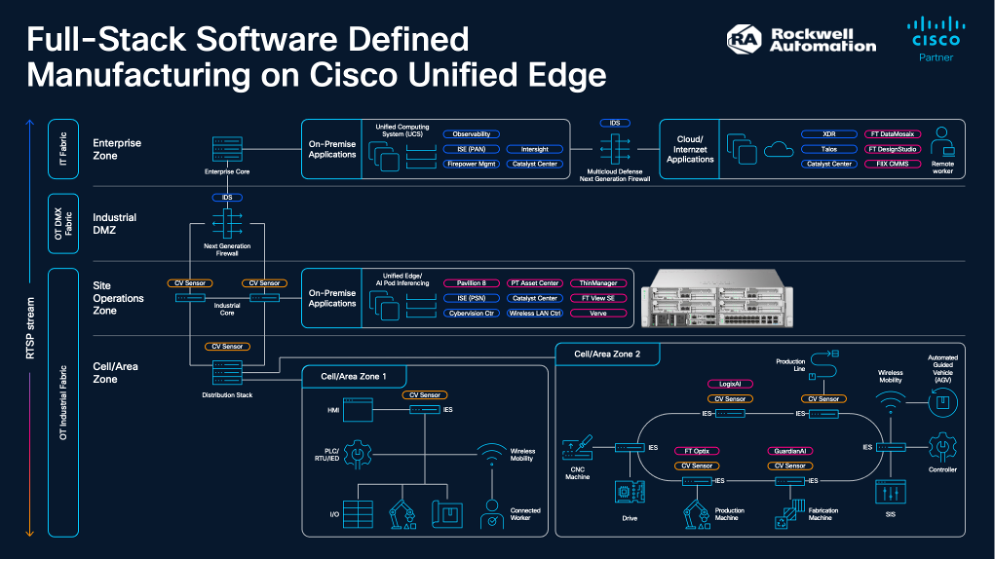
Figure: Example industrial architecture showing cell area, site operations, and edge compute placement across the factory floor.
From machine-level control in the cell area, to coordination in the site operations zone, to integration points across factory and enterprise systems, workloads are distributed intentionally.
The Factory Floor is Becoming a Compute Platform
As AI and software-defined control converge, the factory floor itself is evolving into a new kind of compute environment. Historically, industrial systems like programable logic controllers (PLC) or human machine interfaces (HMI) operated independently. That separation worked when workloads were fixed and predictable.
But AI changes that.
Modern manufacturing requires systems that can ingest data, analyze in real time, and act immediately. That’s driving a shift toward consolidated platforms where multiple workloads operate together within the same environment. Manufacturers are now bringing together:
- Control logic (PLC/virtual PLC)
- Visualization (HMI)
- Monitoring with supervisory control and data acquisition (SCADA) systems
- AI workloads (vision, prediction, optimization)
Advances in compute, including GPU acceleration, now make it possible to run these side by side without compromising performance or reliability. As Blake Moret noted, “Where you get the real benefit is when you combine and integrate these capabilities into a cohesive system.”
This is more than consolidation. It’s a shift toward a platform model, where the factory floor itself becomes the place where data is processed, decisions are made, and actions are executed in real time.
Real-World AI on the Line
These changes aren’t theoretical. They are already taking shape in real production environments.
In high-speed manufacturing lines, such as beverage production, AI systems can monitor fill levels, detect anomalies, and adjust processes instantly; ensuring consistency at scale without slowing throughput. In food production environments, AI can analyze visual and sensor data to maintain quality and consistency, adjusting variables like temperature or ingredient levels in real time.
Regardless of the specific use case, the pattern remains consistent: continuous data ingestion, immediate AI-driven inference, and automated, low-latency execution. Whether it’s identifying a microscopic defect or triggering a safety stop before equipment overheats, the value of AI is directly tied to the speed of the closed loop.
As Rajat Arora, Global Head of Networks at PepsiCo, noted in a recent conversation with us, “The value really comes from being able to act on the data quickly.”
In addition to new levels of automation, GPUs at the edge can help workforces maximize uptime and production by applying self-service Generative AI Assist Tools to obtain answers to problems with machine set-up or equipment repair in seconds rather than minutes or hours.
This the human-in-the loop approach ensures that AI not only acts autonomously but also augments the people responsible for keeping production running. These patterns are already being adopted at scale across global manufacturing operations.
“It’s about bringing compute closer to where the data is generated so we can make faster decisions and operate more efficiently,” Arora added.
An Ecosystem Driving Industrial AI Forward
Industrial AI is not built in isolation. It is delivered through an ecosystem of automation leaders and software providers. This is already taking shape through close collaboration between Cisco and industrial automation leaders, where software, control systems, and AI workloads are being brought together on a shared edge platform.
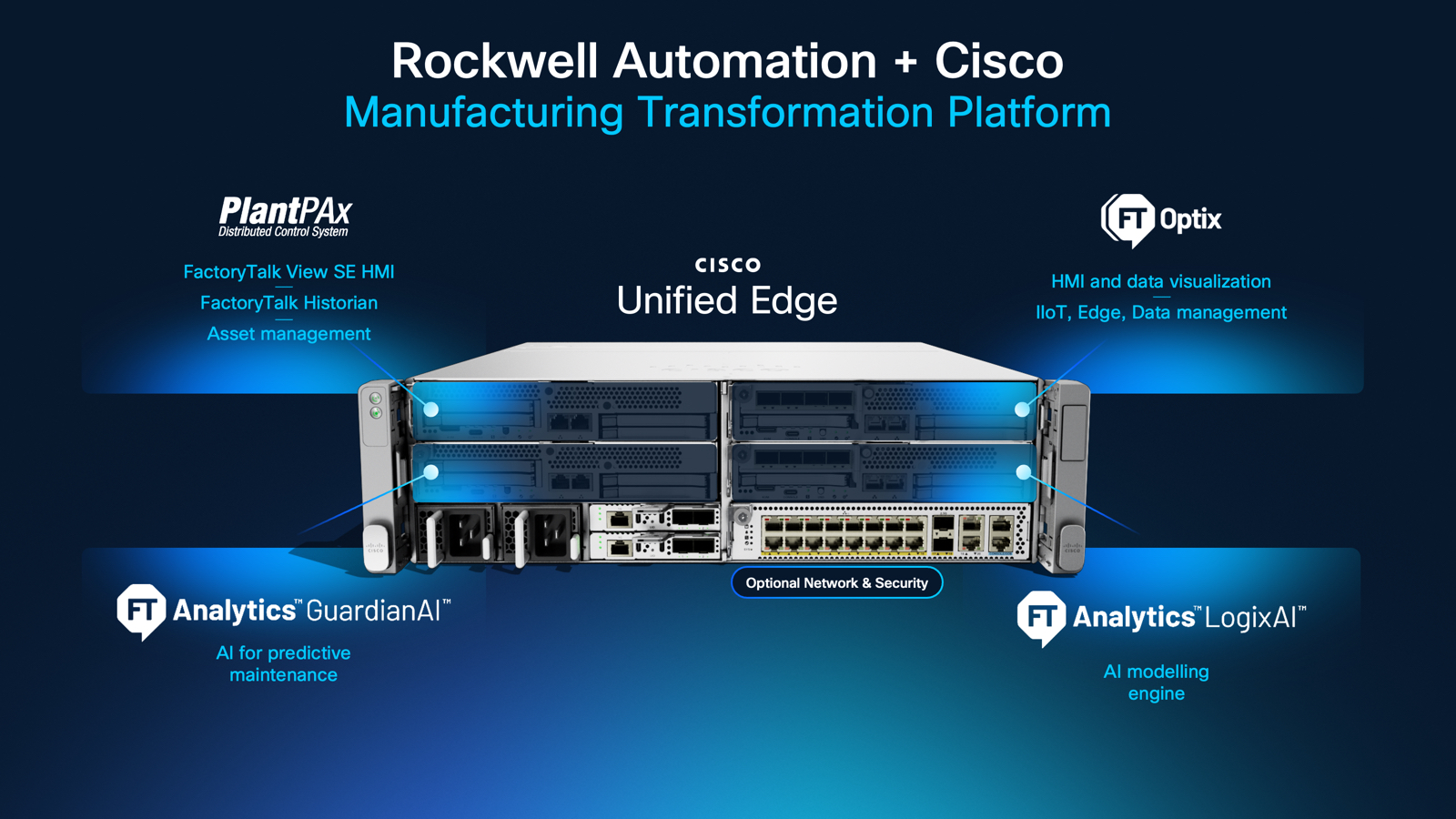
Figure: Example architecture showing how industrial control, visualization, and AI workloads are integrated on Cisco Unified Edge through partnerships with Rockwell Automation.
Companies like Rockwell Automation, Siemens, and Schneider Electric are developing the control systems, software platforms, and AI-driven applications that power modern factories. As these workloads evolve, they require infrastructure that can support them reliably within the constraints of industrial environments.
Platforms like Cisco Unified Edge are designed to provide that foundation; bringing together compute, acceleration, and secure operations in a form factor suited for the factory floor. We’re particularly excited to see this in action through our new strategic partnership with Rockwell Automation.
Why Architecture Matters Now
As manufacturing moves toward autonomous operations, infrastructure is no longer a background consideration. It is a determining factor.
AI workloads in industrial environments require:
- Deterministic performance, not variable latency
- Local execution, not dependency on external connectivity
- Strong isolation, not shared-risk architectures
- Scalable operations across multiple sites
This is about supporting a new model of operation where decisions are made continuously, and outcomes are shaped in real time.
The Path Forward
At Hannover Messe and beyond, the direction is clear. Manufacturing is moving toward a world where:
- Control systems are software-defined
- AI is embedded into operations
- Decisions happen at the edge, not at a distance
The question is no longer whether AI can improve manufacturing outcomes. It’s whether infrastructure can operate at the speed, precision, and reliability the factory floor demands.
Increasingly, that means bringing intelligence directly to where work happens, and building architectures designed not just for insight, but for action.
If you’re attending Hannover Messe 2026, you can join us at the Rockwell Automation booth to see our our joint demonstration of FactoryTalk® Optix™ and GuardianAI™ running on Cisco Unified Edge, or you can learn more about the partnership in recent blog from Jeremy Foster.
To learn more about how Cisco Unified Edge is supporting the next generation of AI in manufacturing, connect with our team and explore our manufacturing solutions portfolio. We’ve also developed industry-specific at-a-glances (AAGs) that outline practical deployment models for manufacturing and other distributed environments.