In case you missed the news, the 2017 E-rate filing window opened on Monday, February 27th and it will close on May 11th. This means that applicant Form 470s must be posted by April 13th in order to allow the minimum 28-day competitive bidding process.
If E-rate is new to you, or if you need a refresher, there are many resources available to help you understand the program and process. Read on for some helpful tips and information.
How Are Other Schools Using E-rate for Success?
El Centro Elementary School District in rural California used E-rate funding to help them adopt a one-to-one learning environment with a better network and curriculum. They now have some of the highest performing schools in the county and their new solutions have led to unforeseen innovation throughout the district. (Learn more)
The Director of Technology at El Centro Elementary, Antonio Romayor Jr., shared some of their experiences and successes during a recent Cisco event, where we also had John Harrington, the CEO of Funds for Learning, provide an E-rate update. (Watch the recording)
So, What Next?
Visit the USAC website (the E-rate program administrator) for program information and application forms, visit our Cisco E-rate website here, browse and search our database for Cisco product E-rate eligibility, and send any questions to our help desk.
Be on the lookout for more blog posts in the coming weeks that highlight the great things that some of our Cisco customers have been able to do with their E-rate funding!
Analytics are the backbone of any good decision. If you don’t have all of the numbers, you’re not getting the full picture. Sometimes it’s hard to get the right numbers though. But that’s all changed, getting the numbers is easier than you think – you just need to look to your wireless network. That’s what Australia’s University of Melbourne recently did and the results have been spectacular.
With more than 65,00 students and 6,500 staff, the University of Melbourne is ranked as Australia’s leading research-intensive seat of learning and among the world’s top 50. With this amount of people traipsing through campus each day, the administration was more than curious to know about their activities. What do they do all day? Where do they go? What are the busiest intersections? Which parts of campus sees less foot traffic? The answers to these questions would be helpful when it came time to determine which buildings and services should be developed next or how should the university engage with visitors and prospective students.
With a wireless infrastructure made up of over 4500 Cisco Aironet 1500, 3500, 3600 and 3700 Series Access Points plus Cisco Catalyst 3650, 3750-X and 3850 switches spread out over 250 buildings, the school was able to extract the data available in these devices to help them. To facilitate these numbers, all of the devices were running Cisco Customer Mobile Experiences (CMX) solution.
Using CMX, the university was able to examine traffic patterns from multiple angles and saved a bundle doing so.
“CMX allowed us to gain an insight into traffic activities on campus through the wireless infrastructure and enable plans to minimize disruption,” said Gianni Frigenti, University of Melbourne’s wireless architect. “To get an accurate footfall snapshot, we would have had to spend $15,000 per day on video-based traffic monitoring.”
CMX was an invaluable tool in shaping the school’s five-year plan. The University of Melbourne were able to determine the most and least popular areas on campus and were able to better determine which buildings were used more so that they would be among the first to be modernized.
For more on how the University of Melbourne used Cisco wireless products and CMX, please read the entire case study here.
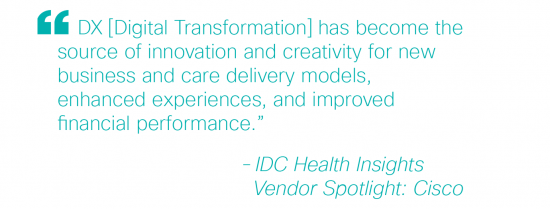
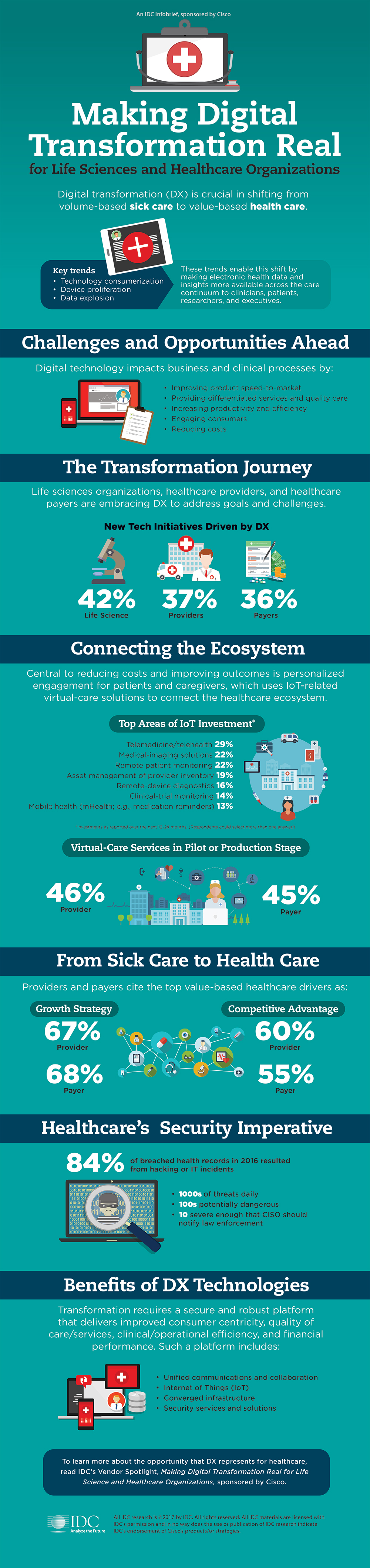
For most healthcare organizations today, new business models and market pressures are presenting major challenges. In the shift from volume-based sick care to value-based healthcare, providers are aiming to improve the quality of care and patient experience while reducing costs. Life sciences organizations aim to speed time to market in the face of increasingly complex global regulatory requirements while undergoing dramatic changes in development. Digital transformation is playing a crucial role in the success of healthcare organizations amidst these market shifts.
Cisco Healthcare is committed to helping healthcare and life sciences organizations face the challenges and excel. The IDC Vendor Spotlight, sponsored by Cisco, sheds light on these industry trends and challenges from an analyst perspective, and shares how the Cisco Healthcare portfolio can help.
Download the full vendor spotlight or check out industry insights from IDC below.
The Domain Name System (DNS) is one of the most commonly used Internet application protocols on corporate networks. It is responsible for providing name resolution so that network resources can be accessed by name, rather than requiring users to memorize IP addresses. While many organizations implement strict egress filtering as it pertains to web traffic, firewall rules, etc. many have less stringent controls in place to protect against DNS based threats. Attackers have recognized this and commonly encapsulate different network protocols within DNS to evade security devices.
Typically this use of DNS is related to the exfiltration of information. Talos recently analyzed an interesting malware sample that made use of DNS TXT record queries and responses to create a bidirectional Command and Control (C2) channel. This allows the attacker to use DNS communications to submit new commands to be run on infected machines and return the results of the command execution to the attacker. This is an extremely uncommon and evasive way of administering a RAT. The use of multiple stages of Powershell with various stages being completely fileless indicates an attacker who has taken significant measures to avoid detection.
Ironically, the author of the malware called SourceFire out in the malware code itself shortly after we released Cisco Umbrella, a security product specifically designed to protect organizations from DNS and web based threats as described here.
It’s hard to get into a good university. Even qualified students are turned away because there’s not enough space on campus. Cisco Solution Partner Lone Rooftop is changing that. Wageningen University in the Netherlands is educating more students by increasing the classroom capacity they have by 15% using data analytics. It’s working so well that Lone Rooftop is now in 50% of the universities in Holland. And they’re in talks with dozens more in other parts of Europe.
Lone Rooftop says…
For 11 years, the students at Wageningen University have voted it the best in the Netherlands. Every day, over 16,500 people flood the campus. It’s become so popular that they had a big challenge to accommodate all students in the available classroom space.
Some classes were too full but many classrooms remained under-utilized – a classroom of 80 people might only have an average of 20 students or less attending. And other classrooms were reserved but remained empty because the class, for various reasons, didn’t take place, called a no-show. It was difficult to assign rooms to fit class size and to limit the number of no-shows.
That’s when they met us at Lone Rooftop. Back then, we were still small – our name comes from the rooftop terrace we worked from before we had an office. And we’d just started using Wi-Fi to figure out how many people were in a building at a given time.
We spent a few weeks getting our Position Intelligence Engine (PIE) up and running all over campus. It uses the university’s existing Cisco Wi-Fi network to count the people in a room. Because it only listens to signals, it doesn’t clog up the bandwidth. And it’s anonymous, so everybody’s private data stays private.
The results are even better than we’d imagined. The timetabling team can see at a glance which rooms are being used and how full they are. So, they can schedule 15% more classes. And as an unexpected bonus, they’re now working on making cleaning truly smart because they know which rooms are used and which ones are empty. And, we’re in the process of making their energy system adaptive based on the real time and predictive occupancy metrics we provide their BMS, and we’re going to launch many other Intelligent Campus apps based on the PIE data.
The best bit for us? Wageningen have told their friends about Lone Rooftop. Our PIE technology is now in use in over half of all universities s in the Netherlands and we’re expanding into other education institutions across Europe.
Thanks, Lone Rooftop! And we’re glad you spent last week with us at Cisco Live Berlin.
One in four organizations are exposed for six months or longer due to a lack of qualified security workers. And in Europe almost one-third of cyber security job openings remain unfilled. That’s the challenging picture reported by ISACA at this year’s RSA Conference.
You’re thinking, “tell me something I don’t know.”
The Benchmark study in our 2017 Annual Cybersecurity Report, takes a broader look at the obstacles to security and finds that budget, compatibility issues with legacy systems, and the struggle to find talent top the list. The truth you know is we have to resource people, process, and technology. You’re living the reality that process support and resourcing capacity are not keeping pace with the technological changes brought on by the larger innovation curves that drive our digital businesses.
The budgets you do invest in technology, in particular, need to work harder to reduce the press on overstretched staff even as you re-calibrate processes to changing business models.
The effective way to do this is with solutions that are simple, open, and automated. Simple can help your staff get up and running fast with products that are simpler to deploy or scale. Open addresses compatibility challenges so products integrate seamlessly for more powerful security responses. And integration delivers automation with products working together to offset limited manpower. This is how security becomes a force multiplier that helps your budget work harder while your people work smarter.
Over the past several we talked about how Cisco is making security more effective with solutions that are simple, open, and automated. At RSAC and Cisco Live Berlin we continued down that path, unveiling more solutions that push this strategy forward. Here are just five highlights:
We have launched the industry’s first Secure Internet Gateway (SIG), Cisco Umbrella, providing a seamless first line of defense against bad domains, URLs, IPS, and files – blocking malicious connections before they are even established. It is simple – you can deploy it in under an hour and it doesn’t require an agent. It’s a type of initial force field that employees don’t even notice as it protects them regardless of where they are located, on and off the network. Published APIs allow it to get threat intelligence from any source to ensure up to date protection.
Cisco Cloudlock is a simple way to get ahead of the business and mobile users that are increasingly moving to SaaS applications and bypassing protections offered by the corporate network. It provides visibility and control for SaaS apps both on and off the network so you can more easily protect this increasingly targeted threat vector.
Cisco Firepower 2100 Series NGFWs are ideal for midsized organizations to deploy from the Internet edge to the data center, without having to choose between protection and performance. Network operations teams can stay true to job one – keeping the network blazing fast – because our NGFWs won’t become a network bottleneck or lose effectiveness when you turn on additional defenses. And Cisco NGFW management has never been easier. The 2100 keeps security simple however – and can go from connection to protection in just 5 minutes with Firepower Device Manager, a crisp web-based local manager.
Cisco Defense Orchestrator, now available in Europe and including support for Cisco Web Security Appliance, simplifies policy management while making security policy stronger. Network operations staff can easily manage thousands of security devices (Cisco ASA, Cisco NGFW, Cisco Umbrella, Cisco WSA) from a simple cloud-based portal. Without being a security expert, you can optimize, configure, and manage policies across your entire network, whether you have dozens or thousands of locations.
As I discussed at length in my last post, Cisco Threat Intelligence Director uses open industry standards to easily ingest third-party threat feeds and data from Threat Intelligence Platforms (TIPs) to your network sensors and NGFWs. It provides an open, automated way to operationalize threat intelligence from multiple sources across our environment to deliver even more effective security.
You can expect to see more solutions from Cisco throughout the year that are simple, open, and automated. It’s a resourceful and effective approach to address the talent shortage and keep your business more secure.
Last week at Cisco live! 2017 EMEA in the historic city of Berlin, we shared the early availability of Contiv 1.0 with almost 14,000 customers and partners. Today, we are excited to share the milestone with our broader community.
Additionally, I am thrilled to report that Docker has certified Contiv as the very first certified container networking product, and it is now available in the Docker Store. Docker Certification Program recognizes products that excel in quality, collaborative support and compliance. Integration and testing by Docker to certify Contiv is yet another data-point for our customers about its production readiness which enables them to adopt containers with confidence and low risk.
What is Contiv?
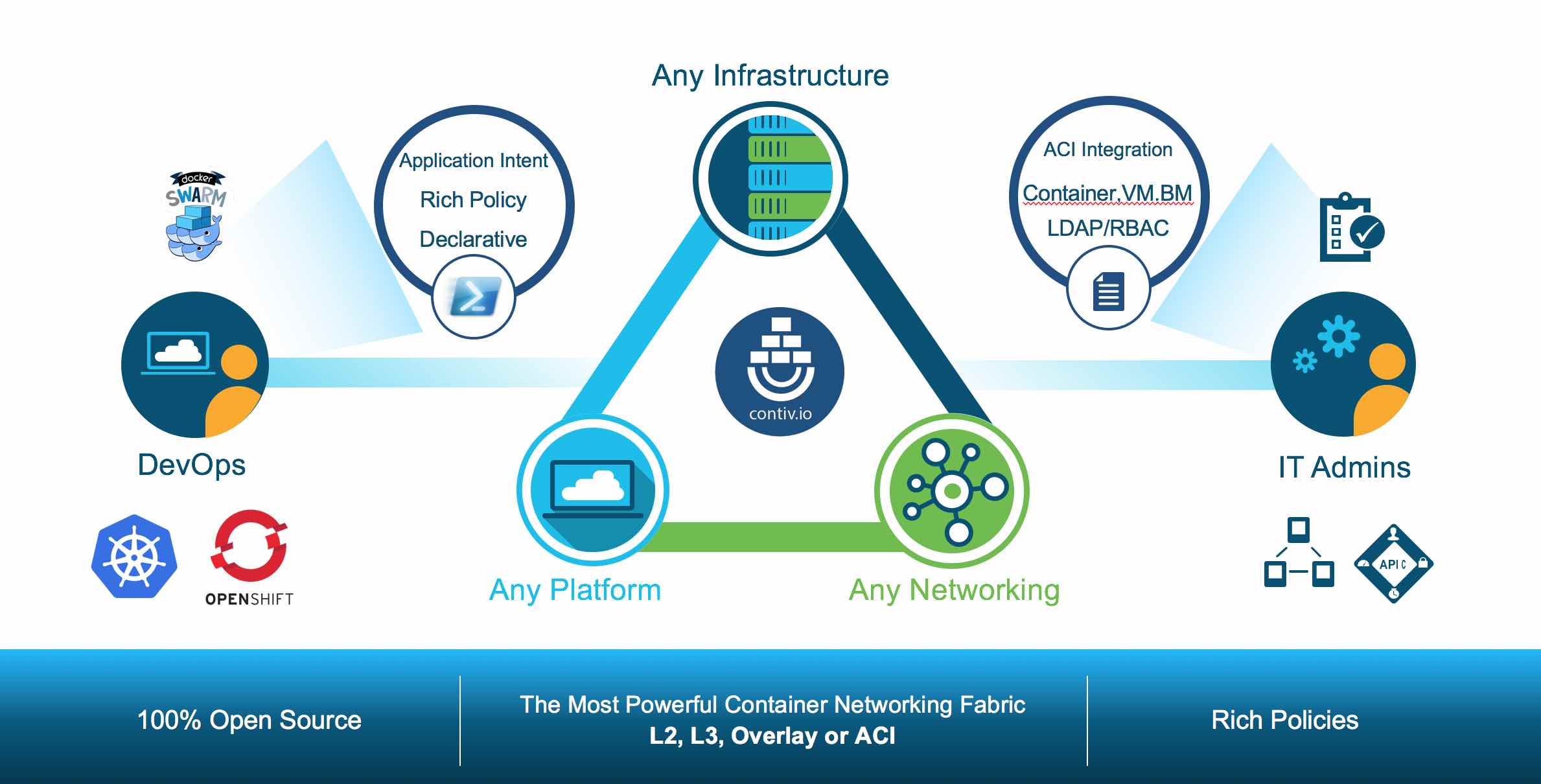
Contiv is an open source container networking fabric for heterogeneous container deployments across virtual machines, bare-metal, and public or private clouds. As the industry’s most powerful container networking fabric, Contiv, with its Layer 2, Layer 3, overlay and ACI modes, natively integrates with Cisco infrastructure and maps the application intent with the infrastructure capabilities using rich networking and security policies.
Any Infrastructure, Any Platform, Any Networking
Every application has unique requirements such as compliance, security, scale, performance etc and can be deployed across heterogeneous hybrid models – on-premises bare-metal, virtual machines or private clouds or public clouds. Getting locked to only one of these is no longer an option. Contiv provides consistent networking on all of the above giving you the choice and flexibility to deploy your containerized on any infrastructure.
Contiv brings production-grade networking to containers running on any platform – Docker Swarm, Kubernetes or OpenShift
Contiv supports Layer 2, Layer 3, Overlays and ACI mode as networking backends to meet your application needs or infrastructure topologies. With ACI mode, Contiv provides the unified networking fabric – a single networking pane for your cloud native and traditional applications deployed on containers, virtual machines and bare-metal. By natively integrating with industry-leading Cisco infrastructure, Contiv enables DevOps teams to declaratively take advantages of infrastructure capabilities.
Rich Networking and Security Policies
Scale and speed requirements for containerized workloads are unique and policy-based automation is key. With Contiv, cloud architects, and IT admin teams can create, manage and consistently enforce operational policies such as multi-tenant traffic isolation, microsegmentation, bandwidth prioritization, latency requirements, and policies for L4-L7 network services. Further, Contiv’s policy constructs enable portability so it doesn’t matter whether developers are experimenting with containers on their laptops or Ops teams are deploying in production environment across hundreds of nodes, there can be one common and consistent view of operational policies.
What’s New in Contiv 1.0?
Identity and Access Management
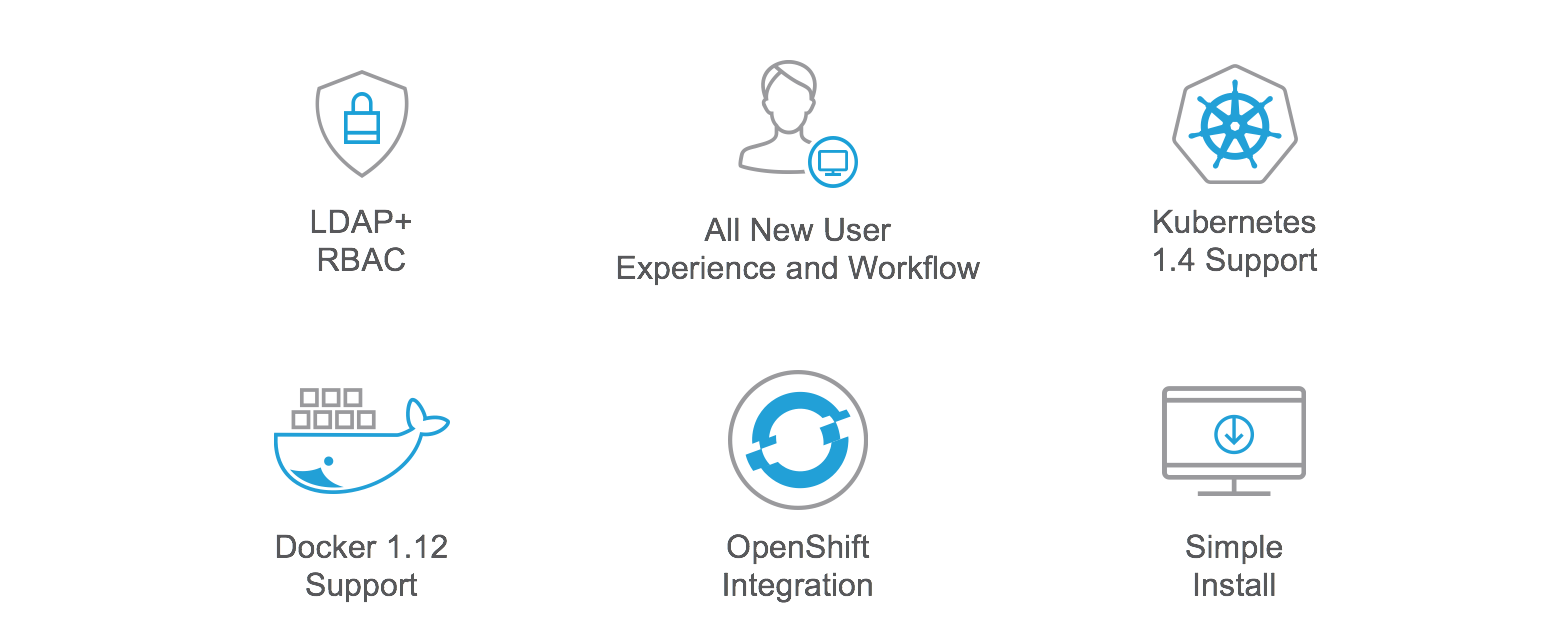
Working with hundreds of customers and Contiv community, we heard loud and clear that enterprise grade features such as identity and role based access control are a must have. We have delivered just that. Users get appropriate privileges to create, manage and consume policies depending on their role as administrators, DevOps or developers.
Dramatically simplified experience
With all new user interface, simpler installation, much-improved documentation and step-by-step tutorials, Contiv 1. 0, elevates user experience to entirely new level.
Contiv 1.0 is feature packed. To review all the newly added features, and bug fixes, please visit contiv.io.
Earlier today, Cisco and Docker announced a strategic alliance for worldwide engineering, sales and support to deliver essential container capabilities for application-centric datacenter and cloud infrastructure. Read more.
In case you missed Contiv sessions @ Cisco live! EMEA, my previous blog summarizes the key sessions. They will be available on-demand at ciscolive.com.
Virtual Network Function (VNF) Test and Validation initiatives are being touted by many vendors at the moment. Service providers have been challenged with the interoperability, scale and performance of the early generation VNFs. There should be no question on whether software VNFs should be “held to account” – that is, tested in large scale environments as hardware networking elements have been for years. Cisco’s VNF Onboarding Framework, which we’ll discuss in this blog, will help service providers address these challenges.
I’m writing this blog with Ranga Maddipudi, Manager of Product Management in Cisco’s NFV Business Unit. We will give you our perspectives on Cisco’s VNF On-boarding Framework, all the way from the industry collaborations driven from our NFV R&D team, all the way to real world deployments and technical support. We’ll describe why there has never been a better time for you to exploit Cisco’s investment in test and validation of NFV solutions involving Cisco and third party VNFs.
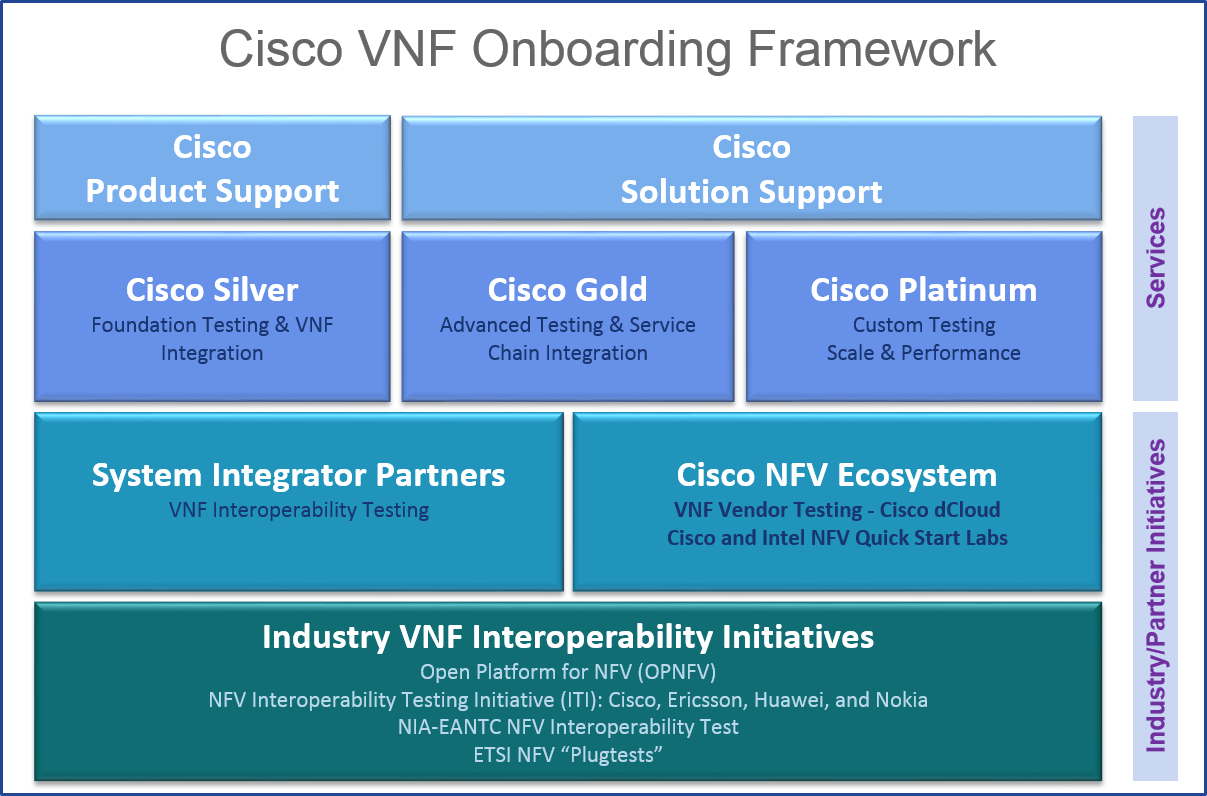
One of the major challenges service providers have in today’s world of NFV and virtual network functions, is that of integration: how do they pull together a complex software solution, across multiple layers of hardware, software including OpenStack, virtual network functions from Cisco and other third party vendors, orchestration, service catalog portal and associated OSS integration. It’s not straightforward. The good news is that Cisco can help you integrate such a solution for NFV, including NFV Infrastructure (NFVI), Virtual Managed Services (VMS), and other areas like Mobility (vEPC, vPCRF, vIMS) and of course the relevant Orchestration (Cisco NSO and ESC). In this blog, we’ll update you on how we are integrating Virtual Network Functions (VNFs) – from both Cisco and third parties – with Cisco NFV solutions. A high level view on Cisco’s VNF Onboarding Framework is shown below. Ranga and I will follow this up in future blogs with more details specific components.
Figure 1: Cisco VNF Onboarding Framework
We’ll now explain this framework at a high level, starting with a summary of the Cisco VNF solution architecture.
Cisco NFV Solution Overview
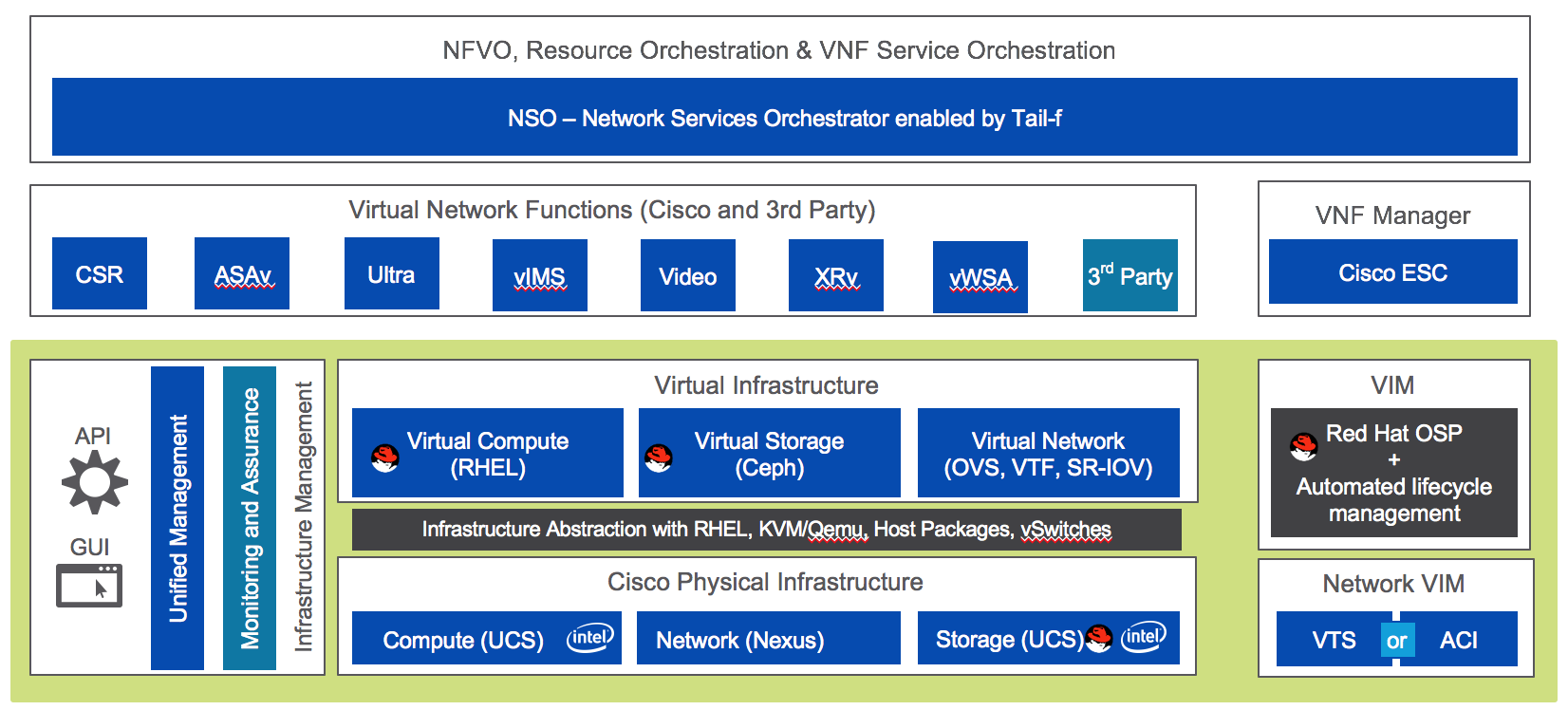
The Cisco NFV Solution is built on industry standards supporting Virtual Network Functions (VNFs) from Cisco and 3rd party vendors, and addresses a wide range of use cases – Business Services, Mobility, etc. The solution has been tested to on-board simple and complex VNFs from over 20 vendors spanning different network services – routing, application delivery, firewalls, session border controllers, virtualized evolved packet core (vEPC), virtualized Policy and Charging Rules Function (vPCRF), virtualized IP Multimedia System (vIMS). Cisco Services has also invested in the architectural, open source and orchestration skillsets required to these NFV solutions to life for our customers.
Figure 2: Cisco NFV Solution
Industry VNF Interoperability Initiatives
Underpinning all of our NFV initiatives are the cross-industry collaboration efforts which Cisco has driven and participated in, including
NIA-EANTC NFV Interoperability Test – which verified interoperability of various VNFs from Cisco, Huawei, Ineoquest, Metaswitch, Netrounds, and Nokia with Cisco NFV Infrastructure.
We’ve worked with a number of partners to validate interoperability of third party VNFs on Cisco NFV Infrastructure. We provide Cisco NFV Ecosystem partners access to different lab setups to accelerate the interoperability testing process:
Cisco NFV Ecosystem members such as F5, Kemp, NetRounds, NFware and others have validated interoperability via the Cisco dCloud environment.
System Integrator Partners
Partners are an integral part of Cisco success. So it should be no surprise that we collaborate with systems integrators and others to deliver customer solutions. For example, the recent announcement of WWT with Cisco, Intel, and RedHat ensures that customers have choice when it comes to VNF on-boarding interoperability test and verification.
Cisco Services – Silver, Gold and Platinum Service Levels
Cisco Services have already been well recognized for expertise in NFV: an earlier survey by Ovum found Cisco rated #1 for Professional Services in SDN and NFV. We recognize that one size does not fit all and many customers place specific requirements on the integration of VNFs into their environment.
Cisco Services helps customers address these requirements. And we include service chain integration, customer-specific testing including security, large scale performance and scale testing as our customers have come to expect. These customers have very exacting “certification” or Network Ready for Use (NRFU) testing that we have worked jointly on achieving for many years. Our “Silver”, “Gold” and “Platinum” levels of service will test VNFs – Cisco and Third Party – to multiple level of customer-specific test specification. In the Gold and Platinum levels, Cisco’s world-leading Cisco Solution Validation Services (SVS), where we have built and tested the world’s biggest and most complex networks, are engaged by the most demanding customers. With these three levels of due diligence, coupled with continuing investment in our SVS labs, we’ll bring focus on testing software VNFs -including third party VNFs – to the same level of diligence that our customers have come to expect from our large scale hardware network testing.
Test and validation is, of course, an ongoing requirement, as new VNF vendor software iterations are released. Subsequent versions also require validation. And even more so in this DevOps world with customers moving to Continuous Integration and Continuous Delivery models. Cisco Optimization Services for NFV Infrastructure for example are already available, and help customers with the ongoing process of VNF test and validation.
Cisco Support Services
Completing the picture are Cisco Technical Support Services. With all components of this strategy, Product Support options are available (from Cisco and third party VNF suppliers respectfully), covering each product in the solution. For customers who have chosen to validate VNFs via the Cisco Gold and Platinum levels, customers have the option to purchase Cisco Solution Support. This is where our Technical Services team (including Cisco TAC), provide a single point of contact for case management (a single “throat to choke”, if you will) of your entire solution – including being the first point of contact for third party elements, including VNFs, as part of the solution based upon Cisco NFVI.
Wrapping Up
We’ll expand on specific aspects of the Cisco VNF Onboarding Framework in future blogs. In the meantime, feel free to contact us via the comments below or via Twitter. follow @rangacm follow @StephenSatCisco





 Analytics are the backbone of any good decision. If you don’t have all of the numbers, you’re not getting the full picture. Sometimes it’s hard to get the right numbers though. But that’s all changed, getting the numbers is easier than you think – you just need to look to your wireless network. That’s what Australia’s University of Melbourne recently did and the results have been spectacular.





 The truth you know is we have to resource people, process, and technology. You’re living the reality that process support and resourcing capacity are not keeping pace with the technological changes brought on by the larger innovation curves that drive our digital businesses.
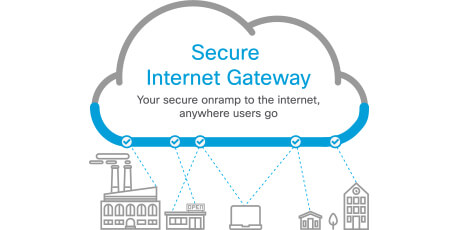 efore they are even established. It is simple – you can deploy it in under an hour and it doesn’t require an agent. It’s a type of initial force field that employees don’t even notice as it protects them regardless of where they are located, on and off the network. Published APIs allow it to get threat intelligence from any source to ensure up to date protection.
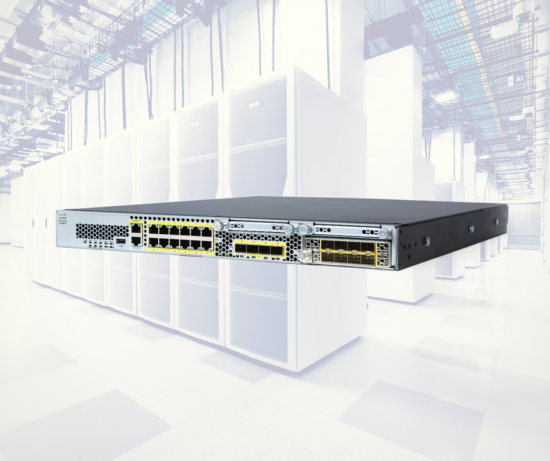 performance. Network operations teams can stay true to job one – keeping the network blazing fast – because our NGFWs won’t become a network bottleneck or lose effectiveness when you turn on additional defenses. And Cisco NGFW management has never been easier. The 2100 keeps security simple however – and can go from connection to protection in just 5 minutes with Firepower Device Manager, a crisp web-based local manager.