Avatar

Welcome to Cisco Live US – whether you are attending in person or amongst the many thousands attending virtually this week, thank you for the opportunity to spend time together. As our largest of our customer gatherings every year, this flagship event has something for all types of our customers, most certainly including service providers.

On Thursday at 11.30 am local time in Las Vegas, please plan on attending or tuning into our Service Provider innovation-Talk session with Yvette Kanouff, who heads our service provider engineering team, as well as Joe Cozzolino who heads Cisco services. They will be discussing strategy as well as giving first-hand previews of many of the new technology and service innovations spanning fields such as virtualization, automation and orchestration that will enable so many of the new business opportunities we speak of in this forum. There also will be a range of other sessions throughout the week such as hands-on demonstrations and discussions with experts at the service provider area in the World of Solutions that can help to provide more insights as to what Cisco is doing and, even more importantly, what we can do together to help craft the next era of telecommunications. Should you be in Las Vegas, I hope to meet you there! (Carbon based lifeform interaction is far too much of a rarity these days…!)

New this year to Cisco Live is one of our next generation strategic partners, Ericsson. While many in our audience know them from their leading role with service providers (after all, they support networks that carry over 2.5 billion subscribers…), they also are playing an increasing role in enterprise and public sector segments which they will be focusing on this week. In fact, our joint partnership, which initially just focused on service providers, has moved into its second phase ahead of schedule to cover these other segments as well due to customer demand. In fact, while we have well over 200 active deal engagements with service provider customers, the enterprise and public sectors represent an incremental 10+% of the number of engagements, representing their recognition of the benefits delivered by our combined portfolio of technology and services. In fact, we’ve already won our first deals there, with much of the initial interest arising from IoT, which I’m sure Chuck will invariably talk about in his opening keynote Monday morning. I encourage you to learn more by stopping by the Ericsson stand this week, as well as taking time to visit so many of our other partners at the World of Solutions as all have some very compelling value propositions to help businesses of all types.

This is always a busy week, and it is both a renewal and in some cases a new beginning both with our service provider customers, partners, influencers and more. We’re honored to be a part of it, as annually, this infusion of customer interest and activity represents a new beginning for us in many respects as well.

Viva Las Vegas, but more importantly, Viva to the future we can build together.

Vegas Sign

Authors

Doug Webster

Vice President

Avatar

Cisco’s Global Retail team announced a new paper at the Cisco Live show in Las Vegas from Cisco and our retail research partner PSFK, Inc. “The Future of Retail” report supplement defines ten pillars of customer experience, showing how brands, retailers, and solution providers are finding new ways to engage, connect, and create a vibrant store destination. Click here to download a copy of the paper and see how it can help define your retail strategy!

https://www.youtube.com/watch?v=M1MPiFEJ0S8&list=PLE122E9E4108CAEBE&index=5

PSFK’s CEO Piers Fawkes joined me recently to share his reflections upon which the paper is based.

Overall, we agree that digital transformation is requiring companies to take a different approach to retail, regardless of channel or platform. Mobile, collaboration, and automation technologies are allowing retailers and brands to scale new services such as always-on assistance, intelligent transactions, and on-demand delivery to make the purchase path as seamless as possible. And, with each interaction, advanced analytics solutions gather data that provides a more nuanced understanding of the shopper – in real time, at the moment of decision.

“Over the last five years we have witnessed a radical shift in shopper behavior fueled by the seismic impacts of mobile and social,” Piers says. “Over that time, our team at PSFK Labs have documented ideas and identified trends that reflect how retailers and brands are using new technologies to engage the always-on, hyper-connected, and all-powerful consumer.”

The question remains: Which technologies should retailers invest in?

PSFK worked with Cisco to identify the trends and technologies that help build the best experiences possible. The paper describes how leading retailers are using today’s exciting capabilities to respond to customer demands and differentiate themselves from the competition.

While the findings challenge companies to look beyond traditional systems and focus on the design of an intuitive and customized shopper experience, Cisco provides solutions that can help brands and retailers accomplish this task. I’d like to call out Cisco Connected Mobile Experiences (Cisco CMX), which let you create apps that build shopper relationships with real-time information, advice, and promotions.

And there’s Cisco analytics, which helps you achieve new levels of insight to understand and act immediately on customer behavior. Associate Productivity tools make personnel more productive, improve customer service, and achieve significant operational savings. All of this is built upon the digital-ready Cisco Unified Retail Platform, a secure, single, integrated IT platform for the store.

Download a copy of the PSFK report, “The Future of Retail,” to learn about other trends and technologies! And the video introducing this research is here.

Follow us on @CiscoRetail or Facebook, and join our Cisco Retail LinkedIn Group.


Authors

Brian McDonald

Global Retail & Hospitality Industries Marketing Lead

Private Sector Industry Marketing

Avatar

At Cisco Live in Las Vegas, more than 25,000 technology innovators will converge to network, have fun, and learn about the latest solutions from Cisco. There has never been a better time to hear how Service Providers can keep their business and their customers safe from cyber attacks. We have lots to share! Read on for a quick preview.

Your business depends on delivering innovative services to your customers. The growth in video, mobility, Internet of Things (IoT), and cloud services have opened new business opportunities, but also introduce new vulnerabilities and security risks. Whether you are a broadcaster delivering on-demand video to millions of subscribers or cloud provider delivering business critical services to enterprise clients, your business cannot exist without pervasive security deployed at the right place at the right time throughout your cyber infrastructure.

For those in the broadcast media industry, you know that financially motivated hackers are targeting your content and video feeds. A recent nScreenMedia report found that 28% of media organizations admit to experiencing a cyber attack. Finding and dealing with the fallout of the Sony hack was costly – upwards of $171M.  The social media and broadcast hijack at TV5Monde sent chills through the industry. At Cisco Live, we are showcasing comprehensive solutions that can help lower your risk of costly asset thefts and hijacked broadcast feeds.

Service provider’s customer data are squarely in the crosshairs of cyber criminals. Data thefts like the one at T-Mobile netted the personal identity information of 14M customers. This year, the average cost of a data breach hit $4 million, representing a 29 percent increase since 2013, according to a new report from IBM. Imagine your customer’s personal data being stolen from your servers and the damage that could do to your reputation. After an October customer data theft, UK broadband provider Talk Talk reported losing 250K customers due to “brand-reliability” issues.

You may also worry about cyber threats hiding inside your organization. Could one of your employees unknowingly been infected by malware while on-line at Starbucks? See how user identity and group segmentation can be effectively used to limit access to confidential data and applications to lessen the risk of business losses.

Cisco Security solutions can shorten the time to discover breaches from the 100-day industry average to less than 1 day. Hear how we can help you layer these highly effective security solutions together to quickly contain advanced threats before they disrupt your business and impact your customers.

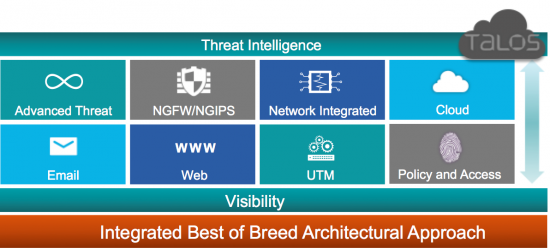
Visit the security booth to see how Cisco’s threat-centric security solutions are designed to protect your assets and critical business systems from advanced cyber threats. Our security solutions are powered by Cisco Talos, the industry’s largest threat intelligence backbone of 260+ researchers that identify close to 20B global cyber threats daily – – and share that threat telemetry across all Cisco security products. See how granular access control and enhanced visibility of everyone and every device on your network, helps you lock down your infrastructure to stop potential threats before they can cause damage and quickly remediate if they do manage to get in. And with Cisco Cloud and Managed Security offerings, security can be a business enabler to help you create new revenue streams and increase profits.security clus

Stop by and take a look at the SP Security demonstrations in the Service Provider and Security booths at Cisco Live and engage in one-on-one conversations with our security experts to see how our solutions can meet your organization’s specific needs.

Authors

Sam Rastogi

Senior Product & Solutions Marketing Manager

Avatar

JayAlamo

You know the show Cheers, “Where everybody knows your name?” That’s just like Huron, California – where I grew up.  It’s one of the great things about living in a small town – everybody really does know everybody, and growing up in a small town really did shape my future in many ways.  But I had dreams of something a little larger too…a little something we like to call Silicon Valley.

I was different from most kids my age. While other’s wanted to play sports, watch TV, or ride bikes – I was the kid in the 80’s tinkering with computers and video games. We had a Commodore 64/128 with no internet. Once I was bored playing all the games it had, I picked up the computer’s user manual. Simple experimentation led to my strong interest in computers and technology today.

When I found one of my dad’s computer magazines – I started reading about the Internet. I would read stories of people connecting from one place to another, they could message each other! Then I saw the movie War Games, and the rest was history.

I wanted to be ONLINE.

In 1993, I got my first taste. I was in the 7th Grade and our library’s computer was finally setup for dial-up. We were the first ones in town entering cyberspace! Netscape was the browser and nobody had a clue of how to use it. I took the lead among my peers, and showed them the way. I typed in the complete web address for Yahoo, and it took minutes (yes, minutes) for the webpage to completely load up.

It was then I knew I wanted to work in the computer field.

JayAlamo2

I took a different path than most. At 18, instead of going to college, I joined the United States Navy and worked in their Advanced Electronics Computer Field. What I learned from the Navy was how to be accountable, dependable, and remain motivated. I then took my wide variety of skill sets and went back to college to earn my degree in Computer Networking.

I completed the Cisco Academy in Fresno, and always imagined myself working either for or with Cisco products.  It didn’t happen overnight, but I kept working towards my dream.

One day I got a call telling me that there was an opening for a project manager on a Cisco account. A quick interview turned into an hour long conversation. Then I was relocating in just 3 days for a new opportunity.

Almost a year later, and after a simple post on Instagram, I’m being asking why I love working for Cisco so much.  First and foremost, I love the team spirit of Cisco – I am constantly fueled by the energy of those around me. It makes me work smarter, plan better, and provide better service. Sometimes I work long hours but it doesn’t feel like I do because I truly love what I am doing, and the team I am a part of.

Time flies here and that goes with everything in life that I love. It feels like I’m just helping a family member, and Cisco feels like a big healthy family. I love that Cisco trusts me with the flexibility to work the way I work best, and I love being able to speak my mind appropriately with other business professionals. I love that I’m able to use all my varied skill sets, while sharing knowledge with others to enable their personal and professional success. I can really go on and on!

The best move I made was putting myself out there and jumping on the opportunity.

So how does one transition from small town living to Silicon Valley tech life?  Well, it’s a journey.  Here’s some advice I’d like to pass along:

  1. Maintain a positive and professional attitude, always.  This goes a long way, day after day.  Sometimes we can have things going on at home that can be stressful, but knowing how to deal with these issues at home and not bringing them to work is key. If this is something that is affecting your work, talk with a trusted supervisor.
  2. Be open and honest. Share experiences, give advice, and support to your co-workers and their decisions.
  3. Go the Extra Mile. Clients and customers love feeling appreciated.  This also helps co-workers to trust you
  4. Think Outside the Box. Brainstorm with your co-workers, don’t be afraid to throw out an idea you have. Someone else might be able to build upon that idea – that’s how innovation is fueled!
  5. Learn from Your Mistakes and Be Accountable. Cisco allows their employees to fail forward. Learn from your mistakes, and be accountable.  This is how you build trust, not only with your co-workers, but everyone in your life.

Is your dream job at Cisco? We’re hiring!

Authors

Jay Alamo

IMAC Project Manager

Workplace Resources

Avatar

Today, organizations have many choices in how they architect their data centers and network. Innovative companies are increasingly taking a bimodal approach to IT. A bimodal approach combines Mode 1—Traditional IT focused on “doing IT right” and optimizing price-for-performance with Mode 2—Agile IT that supports “doing IT fast” for rapid prototyping, iterative development, and rapid delivery of services.

For many organizations, an on-premises private cloud is the ideal way to extend their Mode 1 data center with Mode 2 capabilities. A private cloud offers more than just security and data sovereignty. Services can be delivered in minutes rather than weeks or months. Dramatically increased hardware utilization is possible as well, enabling organizations to defer or even eliminate the need for near-term hardware purchases.

Many organizations are using OpenStack for their Mode 2 environment. OpenStack is an open source platform that gives IT centralized control of large pools of compute, storage, and networking resources. It offers the same flexibility and API-centric control as a public cloud in an on-premises environment.

OpenStack is available for download at no charge. However, it’s important to realize that free software does not equate to a free cloud. Keeping current with OpenStack requires one or more full-time internal personnel dedicated to its continuing development. In addition, each new feature and functionality upgrade needs to be evaluated to make sure it meets your needs and, when it doesn’t, your team will need to create custom code. Time-to-market is also a consideration as deploying your own OpenStack implementation can take two to four quarters.

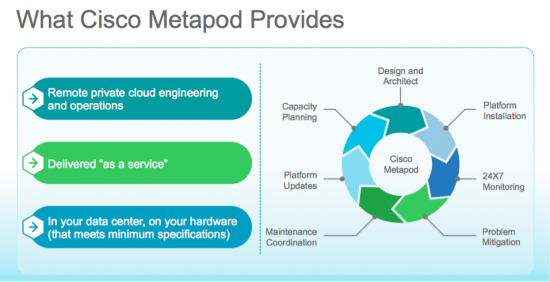
Rather than manage your own OpenStack environment, Cisco offers Metapod, a remotely engineered and operated private cloud solution built for developers. Metapod radically simplifies the process of getting started by providing a bundle that includes the controller portion of your cloud and the SaaS-delivered operations service subscription. The bundle includes a fully validated combination of Cisco Nexus 9000 switches, ASR routers, and Unified Computing System (UCS) technologies so you have a simpler installation and more consistent user experience.

Cisco Metapod brings the flexibility of the public cloud into a private deployment along with choice, so you can build the private cloud that best suits your organization:

Choice of Access: For ease of use, Cisco Metapod includes full self-service access to resources available through a web
portal, OpenStack APIs, the command line, or integrated out of the box into your DevOps and development platforms.metapod blog image

Choice of Developers: As you move your operations into a cloud-native world, Metapod, based on OpenStack, gives you access to an extensive community of developers and tools.

Choice of Managed Service: Metapod delivers the engineering and ongoing operations required to host a public cloud experience behind your organization’s firewalls. We take on the burden of engineering and operating your private cloud environment, so you can focus on the testing, deployment, and scaling of your applications. We remotely monitor your environment, troubleshoot hardware issues, deploy updates, and implement feature enhancements so you receive outstanding levels of service. In a cost analysis, Cisco Metapod can be more than 65% less expensive compared to a custom deployment.

Choice of Visibility: Cisco has extensive experience with managing large-scale operations. Metapod includes tools so you have visibility into your network at all levels of the stack. You’ll be able to assess and optimize performance of applications without having to be an expert in how they work.

Choice of High Availability: A core component of the design and architecture of Metapod is the Cisco Control Point (CCP). CCPs provide the high availability, data resiliency, and rapid scale-out capabilities for each availability zone. All core OpenStack cloud services are highly available and dynamically balanced across all controller nodes.

Choice of Agility: The Metapod solution is production-ready in weeks rather than months. Compare this to other private cloud solutions that generally require new hardware as well as lengthy and tedious testing before they can be deployed for mission-critical applications.


Learn more about how you can experience the best of both public and private clouds with Cisco Metapod. Come see our partners who are pioneering this technology at Cisco Live! in the Cloud Partner Village (#2445). A full schedule of presentations is available at the information desk.

Authors

Xander Uyleman

Senior Manager

Global Partner Marketing

Avatar

Until recently, the promise of Network Function Virtualization (NFV) was largely confined to service providers who were looking to improve efficiencies by leveraging Virtualized Network Functions (VNF) running on x86 machines. Not anymore. With the Cisco Cloud Services Platform (CSP) 2100, mainstream enterprises now have an opportunity to take advantage of NFV quickly and easily.  The CSP 2100 is also being used by service providers in non-OpenStack environments.

Let us look at the first principles of NFV that make it attractive to enterprises. NFV is designed to support fully virtualized networking components with a goal to automating network services through:

  • Standard x86 servers
  • Virtualized/software-based functions
  • API-driven approach
  • Elastic scale

The challenge has been the level of expertise required to deploy network functions on generic hardware. The CSP 2100 and Avi Vantage together provide a turn-key solution for the rapid deployment of application services such as load balancing, on an elastic NFV platform, without requiring any additional expertise. The centralized management – key to both Avi Vantage and the CSP 2100 – ensures that administrators can efficiently roll out elastic, high-performance, load balancing and application monitoring capabilities.

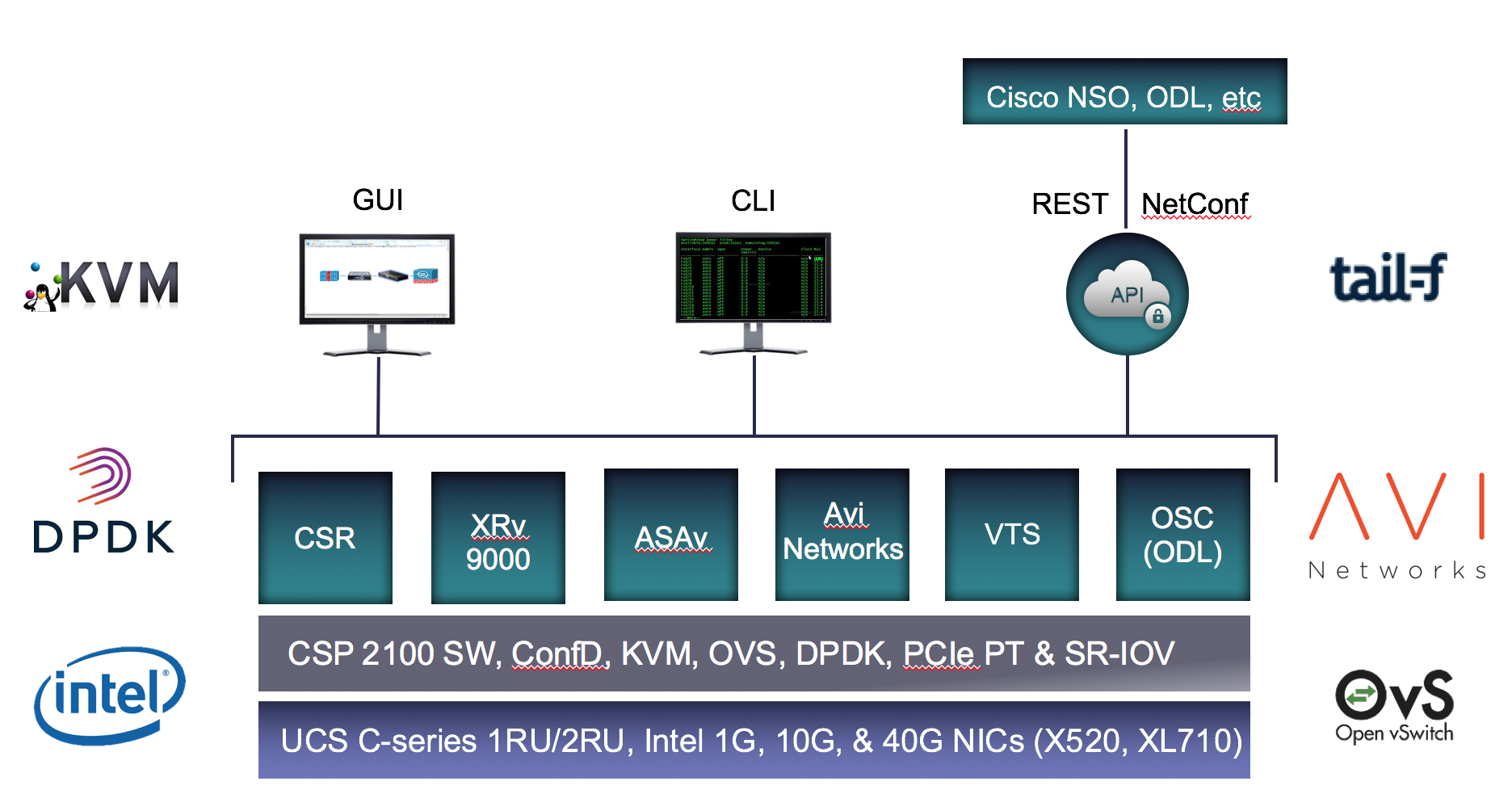
The CSP 2100 delivers turn-key NFV capabilities on an open x86 Linux/KVM software and hardware platform delivered in a convenient appliance form factor that provides the agility of software with the performance benefits of hardware. The figure below summarizes the best-in-class processing and networking capabilities of the CSP 2100 platform. With a single CSP 2100 appliance supporting 10s of Gbps of throughput, 10s of thousands of SSL TPS, and several million concurrent connections, performance in no longer a concern for network functions – especially when combined with the ability of the system to seamless scale to several Terabits per second of throughput, and millions of SSL TPS as a single elastic load balancer!

CSP 2100 – High Level Architecture

Screenshot 2016-07-09 21.33.18


So, how do you take advantage of this power and make this easily consumable and deployable by network teams?

Software-defined ADC meets NFV

Perhaps one of the most obvious network functions where the flexibility of the CSP 2100 can be put to immediate advantage is load balancing. ADCs have a long history of requiring proprietary hardware. In the past, you couldn’t argue with this – purpose-built physical network appliances were needed to deliver the throughput that high-traffic applications demanded. After all, load balancers sat in the traffic path and if they were to avoid being a choke point, they had better deliver solid performance. But, the same market forces and technological changes in x86 performance that have made technologies like NFV and software-defined networking (SDN) possible, are also driving innovative changes in load balancing – now enabling high performance implementation of load balancing and application delivery functions on standard x86. With its software-defined architecture of separating the control and data planes, Avi Vantage is best positioned to leverage the power of the NFV capabilities that the CSP 2100 delivers. Avi Vantage provides the capabilities of an enterprise and carrier class ADC in an elastic, software-only solution, which goes beyond load balancing to deliver pinpoint application analytics, security, application visibility, and predictive autoscaling. The platform provides central management (control plane) over distributed load balancing resources (data plane) that are deployed close to applications.

Avi Vantage – High Level Architecture

Avi - Fig 2


Avi Vantage in the Cisco CSP 2100 environment 

(Avi Controller and Avi Service Engines can be deployed on a single or multiple CSP 2100s)

Avi - Fig 3


Turnkey, scalable ADC/LB for NFV deployments

With Avi Vantage and the CSP 2100, enterprises and service providers are no longer confined to the use of proprietary, purpose-built appliances or their poorer virtual appliance cousins. Avi provides an ADC/Load Balancing solution that truly enables the promise of NFV. With Avi, new load balancers can be provisioned within seconds and virtual services configured instantaneously with a single REST API call. The platform also leverages the inline location of the Avi Service Engines to gather application data, processes them with a big data engine in the Avi Controller and presents insightful performance, security, and end-user analytics about applications. The Avi Vantage GUI and CLI deliver a single point of management and control across all the load balancing resources in the data center or hybrid cloud deployments. With its software-defined architecture and real-time analytics, the platform enables predictive and intelligent autoscaling of load balancing resources through analysis of traffic thresholds. Enterprises and Service Providers can autoscale network services within a single CSP 2100 or across a cluster of several CSP 2100s.

Large customers of Cisco and Avi Networks have already seen the flexibility and agility that the combination of the CSP 2100 and Avi Networks provide. Avi Networks will be showing the capabilities of the Avi Vantage Platform, running on the CSP 2100 platform, at booth #1024 at Cisco Live in Las Vegas this week as well as in the Cisco investment partner pavilion (booth #1721). Avi Networks welcomes the opportunity to share more with you at the show.  Also, you can get hands-on with the CSP 2100 Platform software at the Walk-in Self Paced Lab #2011.

Many thanks to Guru Chahal, VP of Products at Avi Networks, for his help in writing this joint blog. And thanks to several members of Avi Networks engineering and Cisco’s CSP 2100 engineering team who have been working closely together the last several months to integrate and optimize the combined solution.

Authors

Gunnar Anderson

Product Manager

CNSG Product Management

Avatar

Did you know that about 60 years ago, “Sensorama” the first virtual reality (VR) machine was invented by Morton Heilig?  And 50 years ago, the first VR and augmented reality HMD (head-mounted display) was created by Ivan Sutherland. [Source: Timeline of Virtual Reality]. Today, virtual reality technology is becoming reality. How do I know? For one, virtual reality is now a subject you can major in at universities. Plus, colleges and start-ups around the world are hosting events such as Virtual Reality Festival and Demo Days where people can showcase their VR videos and win monetary prizes.

Even closer to home, the Cisco Internet of Things (IoT) marketing group has created the first Cisco virtual reality demos to help showcase what IoT technology can do to help factories, transportation, and utilities digitally transform their business. The VR demos are exciting and show you some of the possibilities and opportunities of how IoT can help to accelerate business further by exchanging data that has not been available before and bringing users information securely.

For example, in manufacturing, customers can work with machine tool providers, such as Mazak, to increase manufacturing line availability and improve machine utilization by bringing intelligence in the form of fog applications running on the network infrastructure to achieve real-time detection of anomalies and operator alerts. By processing the data locally rather than in a data center or cloud, Mazak provides manufacturers with secure, real-time processing right next to their critical data sources.

IoT Virtual Reality Demo Introduction

In transportation, Linz AG Telekom in Austria had an innovative vision for city transit. They wanted to further digitize transit operations and rethink core processes as the city upgraded its tram system. By using Cisco IoT as a part of its infrastructure, Linz was able to engage and personalize the experience of its riders including self-diagnosing ticketing machines, dynamic displays to improve transparency, and analytics to drive improvement.

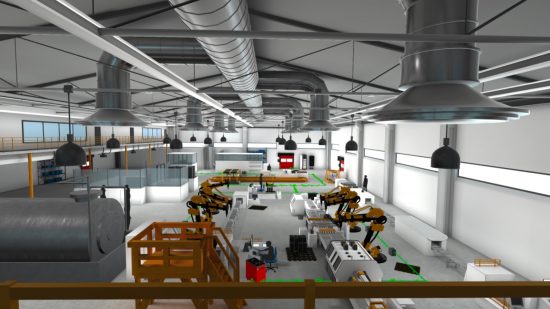
Many of these use cases are demonstrated in the online IoT VR demos which can be viewed with your smart device.  Some of my favorite parts include flying through space in the introduction (hold on if you have motion sickness!) and I really like the computer-generated factory floor with all the robots whirring around.

Cool robots on the factory floor

Don’t get too scared during the lightning storm in the utilities demo and be sure to look for the airplane flying around in the transportation demo.

Look for the plane in the transportation demo

The new VR technology coupled with Cisco IoT technology will help customers, prospects, partners and even our employees better understand how IoT can affect their everyday lives. It’s amazing!

Watch out for the lightning in the utility demo

If you are at Cisco Live, be sure to stop by the IoT Zone in the World of Solutions. We have an experience bar where you can try the demos using Oculus Rift glasses for a robust and interactive experience.  And, we are giving away a free pair of cardboard VR 360 glasses to all who stop by, which will enhance your online experience. Best of all, be sure to enter our raffle to win a free pair of Oculus Rift glasses and a Dell Alienware X51 R3 computer so you can have your own personal VR equipment (must be present to win).

To find out more about the Cisco IoT VR demos, visit the Cisco IoT 360 VR web site and view our demos on YouTube (for the best experience, view with cardboard VR 360 glasses). Be sure to download our product and solution sheets to find out how IoT technology can help digitally transform your factories, transportation, and utility business today!

Authors

Jaishree Subramania

No Longer with Cisco

Avatar

1 CiscoIBMBlog

Being first definitely feels good! Once again our Cisco UCS compute family showcases its leadership capabilities with two new TPCx-HS benchmarks. Cisco was the first vendor to publish TPCx-HS (The industry’s first Big Data benchmark standard for Hadoop) results in 2015 and we continue this leadership trend today with more top tier results.

Our new results leveraging the architectural, scalability, and performance superiority of Cisco UCS was accomplished with our strategic partner IBM and their BigInsights software solution. The joint offering brings together Cisco UCS and IBM’s industry compatible Open Platform with Apache Hadoop. We will be  highlighting this work at Cisco Live this week in Las Vegas. IBM is a Platinum sponsor at the show – they are in booth #1536 – stop on by and feel the speed!

2 CiscoIBM Blog

Image 1: Why IBM and Cisco Continue reading “There Has Never Been a Better Time to Be 1st – Cisco, IBM Speed Up Big Data Performance”

Authors

Rex Backman

Senior Marketing Manager, Big Data Solutions

Data Center and Cloud

Avatar

These days, every customer I meet with is “going digital” And with research showing that mastering digital can result 26% greater profitability who wouldn’t want to? But, if you are evolving to a digital business, you must build on a rock-solid foundation. Otherwise, you’ll simply be playing with a house of cards, and your digital ambitions may never be realized.

The Network Is the Foundation for Digital Transformation

As we move from the Information Era to the Digital Era the network continues to grow in relevance. It connects all things digital and is the lifeblood of digital business. If the network foundation crumbles, the business will be crippled.

According to Forrester, nearly 4 of 5 business leaders believe that it’s IT’s responsibility to ensure the network can support the company’s digital plans. And yet, 67% of businesses believe the current network is the bottleneck. And, they are likely right. The highly reliable and resilient networks that have served the business for the past 30 years simply cannot scale for the digital demands of 5.4 billion mobile users by 2020, 30 billion IoT devices by 2020, big data storage reaching 73 ExaBytes by 2019 and 57 percent of organizations using or planning to use the Cloud.

And we’re not just making up numbers here. A recent IDC study  showed that while only 1/5 of global organizations have a strong degree of alignment between their network and business strategy today, those who are more aligned have doubled the rate of revenue growth relative to companies with only partial or no alignment.

https://youtu.be/ggxfjlYmU08?list=PLB54CED506CFECDC3

Reinventing the Network

A successful digital transformation requires a network transformation. The network must elevate beyond a platform of connectivity, to a platform for automation, security and analytics. It starts by changing our paradigm for designing and building networks:

    • From hardware-centric to software-centric
    • From manual to automated
    • From physical to virtual
    • From closed to open
    • From complex to simple

This is precisely what we introduced with the Cisco Digital Network Architecture (DNA). Cisco DNA is a monumental shift on how to design and build networks. It provides an open environment for IT to automate and innovate with a software-driven approach that provides speed and simplicity without compromising security.

It’s a big change for IT and the networking industry but it’s more than technology innovation. Cisco DNA provides a clear roadmap for evolution of professional skills — expanding from NetOps into DevOps and a clear ability to deliver the future network. Even though it’s only a few months old, Cisco DNA, is already delivering innovations in industries from healthcare to education, financial services, retail and manufacturing.

Cisco DNA Double Downs on Securing the Enterprise

Back in March, we announced several new automation, virtualization and analytics technologies, all supporting core principals for the DNA architecture. Today, we have the spotlight on security. Why? Because the best security starts with the network and more importantly, is unachievable without the network.

The Cisco Integrated Services Router (ISR) is already one of the most effective security devices on the planet. In fact, it has more powerful security capabilities than many next-generation firewalls on the market today. Today, we’re introducing new sophisticated security software that runs on our popular branch office routers.

  • With the addition of OpenDNS technologies like Cisco Umbrella Branch, we allow customers to confidently access the ever-growing number of SaaS applications through direct Internet access without introducing more risk. With Umbrella Branch now running on the ISR, companies can give access across all devices, protecting your branch network from vast swathes of emergent threats.
  • In addition, ISRs can now run the new Stealthwatch Learning Networks License that provides a machine learning approach for detecting threats and enforcing security policy right at the branch edge. As soon as a device connects to the network and makes web requests via the router, we can tell whether the traffic displays anomalous behavior, consistent with malware and drop it like a hot stone.

Customers and Partners Embracing DNA

While DNA is a multi-year journey, it is already serving as the blueprint for many early adopter customers. Over 11,000 customers are buying Cisco ONE Software, which provides customers greater software value and ongoing innovation. We already have nearly 600 customers deploying our DNA controller to optimize their networks. And, over 10,000 networking professionals have joined our DevNet building DevOps skills for learning software programmability.

We have several customers and partners who are making tremendous progress evolving to DNA. In fact, three of those companies joined me onstage today in a news conference at Cisco Live:

  • IBM Aviation is working with Star Alliance Partners like Lufthansa to help them simplify operations at remote sites and lower IT operations and bandwidth costs. They have automated branch deployment down to days and have reduced bandwidth utilization by 30 percent. Their continued success is allowing the team to expand their services to other organizations.
  • Deakin University, Australia’s eighth largest public university leverages Wi-Fi-based location service to help students’ book study rooms, navigate to resources, receive notifications on local events, and request assistance on campus. They are implementing the DNA controller to automate operations across the network to deliver new services faster.
  • Nectar is a US-based ISV that’s using the DNA Controller to ensure quality of service for voice and voice communications that run across a Cisco network. Nectar is using network-based APIs to ensure the network can dynamically respond to application demands.

We’re very excited about the progress of Cisco DNA, and echo the Cisco brand in saying there “Never Has Been a Better Time to Do Amazing Things.” No one is better poised for the success and impact digital brings than today’s networking professionals. I encourage you and your IT team to embark on the Cisco DNA journey with us. A great place to start is The Future of the Network is Here iTalk. During this iTalk, Todd Nightingale and I will be joining our new leader David Goeckeler and a few others, to share Cisco DNA innovations and resources we’ve built to help you navigate the journey. Here are a few tips on how to get started today:

Join the DevNet Community

Sign up for new CCIE certification and programmability courses

Get your hands on the DNA controller (APIC-EM)

And keep us posted on your journey so we can jointly lead to success together, faster!


Authors

Jeff Reed

SVP/GM of Cloud and Network Security

Security Business Group