Avatar

For me, the SCTE IP Challenge is an opportunity to learn, grow and network (in more ways than one). I have only participated in one year, however I plan to compete in the years to come. It gives me an avenue to challenge myself, meet my peers in the industry and have a good competition with skilled opponents.

This was also my first year attending the Cable-Tec expo. The sessions that I was able to attend were informative and were presented by experts in the industry. While these were fantastic for getting a deep dive for what’s to come (and the associated growing pains), the show floor offers a great place to look at new technologies and ask questions to those who are creating the devices to both learn more and give input from a customer perspective.

In my current role I don’t get the opportunity to wear the customer hat as often as I used to, so it was refreshing. Both the sessions and time spent on the floor helped to give me big picture view of where my industry as a whole is moving for the future.

SCTE_2009(10-12-15)[1]

The IP Challenge itself has its own series of events that end at the finals within the Expo halls. A few months beforehand there are two virtual qualifier rounds where you need to answer fairly difficult questions that I had to research.

While the main questions can be difficult, their weakness is that you have the entire qualifier to answer all of them. The real challenge comes from the limited-time questions (BONUS, Tok3n, Quick Draw, you know them). With these you need to pay attention and be able to get the answer very fast, as missing a beat can drop your place in the ranking. I am not going to sugarcoat this.

I forgot what the word “Sleep” meant during those weeks. The questions in the Semi-Final rounds are not as hard or exact on the responses as the qualifier, however the pressure of being in front of the judges and an entire room of people can make even the strongest of Network Engineers begin to sweat (the spotlights don’t help either).

The victors from the Semi-Final rounds move to the Hands-On Final round, where you’re “gifted” a CMTS that someone thought a good idea to play with and see what would “work”. And by “work” I mean I found several issues within the first few minutes of looking at it.

The ability to succeed in the Final round is very much dependent on your ability to quickly identify what you need to do and execute your solution. During this time, you have no idea how far along your competition is, so you’re definitely feeling the pressure as you’re trying to navigate to the answer.

In the end, it has been completely worth the cost of the sleepless nights and hitting the books like a mad man. When up on stage, we are all business. When the round was over though, we all resumed what came naturally to us. Even though we all worked for different providers (or different regions of the same provider), it would have been hard for someone to tell that we weren’t on the same team.

Being able to speak to my peers in the other Cable Operators (MSO and Single System alike) allowed me to see from a new perspective, and discover that what happens to my team isn’t limited to just my company. Having these opportunities are something that makes the IP Challenge an experience I will be looking forward to not only this year, but in the years to come.

Even with all of this, the IP Challenge Qualifier rounds are open to everyone with an Internet connection. So if you’re reading this you can participate. I would recommend anyone in the network field at least look into it to see what it’s about. And if you’re in the Cable industry, do your best and I’ll see you in the Finals.


Authors

Robert Peiers

IP Specialist II

Cable One, Inc.

Avatar

The vast majority of customers I speak with are senior line-of-business leaders, C-level executives, and boards of directors. They urgently want to know how technology can transform their businesses because they understand the risks of being displaced by digital disruption. In a recent conversation, the CFO of a leading worldwide retailer told me that the company is preparing for a future when their customers may never have to leave their cars.

“Digital disruption” sounds like another business buzzword – until it happens to your company. Out of nowhere, startups and other tech-savvy disruptors attack. Customers flee and revenues stall. In months instead of years, you’ve gone from market leader to also-ran. In Digital Vortex, you will learn how to use the business models and strategies of startups to your own advantage. Armed with this knowledge, you can build a company that anticipates threats, seizes opportunities, and beats disruptors to the punch. - From the cover of Digital Vortex
“Digital disruption” sounds like another business buzzword – until it happens to your company. Out of nowhere, startups and other tech-savvy disruptors attack. Customers flee and revenues stall. In months instead of years, you’ve gone from market leader to also-ran.
In Digital Vortex, you will learn how to use the business models and strategies of startups to your own advantage. Armed with this knowledge, you can build a company that anticipates threats, seizes opportunities, and beats disruptors to the punch.
– From the cover of Digital Vortex

While many executives acknowledge the threat of disruption, very few are aggressively digitizing their businesses, and even fewer are doing so in a way that positions them for sustainable success. Digitization is a business-led transformation that requires cross-functional execution. Executive leadership must unite around the need to digitize (a theme I will address in an upcoming blog).

Listening to the market is key in this. To help our customers understand the enormous challenge digital disruption poses to all industries around the world, and the steps needed to meet this challenge, I initiated a partnership between Cisco and IMD, a Swiss business school renowned for executive education and applied research, to create the Global Center for Digital Business Transformation.

This partnership is already having an impact.  We have just released a book, called Digital Vortex, written by three members of the Cisco Digitization Office (CDO) and a professor from IMD. It is based on original research and engagement with hundreds of executives from some of the world’s biggest companies. It also exemplifies the daily conversations I have with customers.

Digital Vortex provides prescriptive insights and the “next practices” that mature companies can use to go on the offensive and become disruptors themselves. More specifically, the book shows how to develop the strategies and capabilities that innovative, disruptive companies employ.

When companies combine these techniques with leveraging their unique culture, assets, intellectual property, processes, and solutions, they will fundamentally re-engineer how they operate to become a digital business.

I’m excited about Digital Vortex because it can help executives move past inaction, and start making the cross-functional changes that will make them agile enough to compete with disruptors and win. I’m also excited because the network is the foundation for this agility, and Cisco is evolving our offerings and ourselves as we continue to listen to the market.

Authors

Kevin Bandy

No Longer with Cisco

Avatar

Email continues to be the number one business communication method and is still the number one threat vector. This ubiquitous communication technology also provides an effective path for criminal actors.

Today, customers are more concerned about targeted and other advanced attacks rather than spam capture rates. Well-funded, educated criminals employ a wide range of attack methods in order to target the end user. Their goal is to infiltrate the network and access intellectual property, steal corporate or personal funds or tarnish their target’s brand reputation. Old methodologies used for fighting the spam wars will not be effective in today’s threat battle. Security professionals must implement integrated layers of methodologies in order to protect their users and their assets.

Blended threats combining email and web have been around for a long time, but are now being deployed in unique combinations. Early on, users and attackers integrated web links into their emails. Outside of email, web security products cover a full gamut of requirements. Everything from acceptable use policies to deep malware and virus scanning have been deployed in the offerings from many web security vendors including Cisco. Why not do the same for URLs embedded within an email? Administrators have to deal with spoofed email components as well as HTML-based emails that allow the URLs to be spoofed to end users. What users see is not what they get! HTML does a fantastic job in allowing complex messaging to be delivered over email, but with that high level formatting, we have obscured the true links. End users must be protected against these types of obfuscated attacks. Security teams must understand the threat posture of the websites and make informed decisions on end user access. These decisions also include categorization. Why would I block a web request going to something like hate crime, while I allow said link or content to be delivered over email. In any email security product, web integration and its potential negative impact must be evaluated.

Attachment-based attacks continue to plague end users. Embedding malicious content in business appropriate files is most common for attachment-based attacks. Criminals have many options to leverage for these attacks – from inexpensive malware that can be used in mass attacks, all the way up to the specifically crafted payloads targeting a business vertical or single company. Specifically crafted attacks come in targeted messages that include these malicious attachments. Do these files have hidden intent? Email security solutions today must quickly understand the threat posture of an attachment and if not known, then perform deep malware analysis. Actors know that the infected payload will go through some point in time malware analysis and many of the more complex attacks leverage sandbox avoidance techniques. To protect against these types of attacks, effective solutions must leverage ongoing and deep threat analysis, retrospection and detailed tracking and reporting.

Social engineering data harvesting is the latest scourge for end users. Carefully crafted emails with elaborate spoofing techniques have caused massive financial losses to many unsuspecting customers. Techniques that have tricked end users into getting compromised change on a daily basis. But what happens if there is no attachment or url to scan? What happens if there are no telltale signs that the email is spam? The different components of an email and how they can be leveraged have been covered: attachments and web links. One of today’s most reported attack is what the FBI calls Business Email Compromise or BEC. This type of attack takes content spoofing to the next level. These emails look like they are coming from trusted sources with the authority to make the request. These requests usually entail some form of money transfer or sharing of critical data. This attack has several components that must be protected against. The true sender of the email must be validated in all forms that could show up in the “mail from.” Relationships and contextual identity must be defined and validated. While this can be a daunting task for email administrators, it is up to the security vendors to make this an achievable goal.

To learn how Cisco can protect against these three methods: url, attachment and social attacks, please visit cisco.com/go/emailsecurity.

Authors

Scott Bower

Technical Marketing Engineering and Business Development Manager

Security Business Group

Avatar

Last week, Gartner named Cisco a leader in its 2016 Magic Quadrant for Unified Communications. Gartner placed our “dot” highest and furthest right for vision and execution among the participating vendors. In a related post, Tom McCafferty provides insight about the process of participating in Gartner’s analysis. As he puts it, Gartner doesn’t just “drop some dots on a chart,” but uses detailed data to assess vendors.

Gartner uses this same data in its 2016 Critical Capabilities for Unified Communications report. This report digs deeper into the vendors represented in the Gartner UC Magic Quadrant. In Gartner’s words, it’s “intended to help organizations define their requirements and select specific products that match their needs as aligned with one of the use cases.”

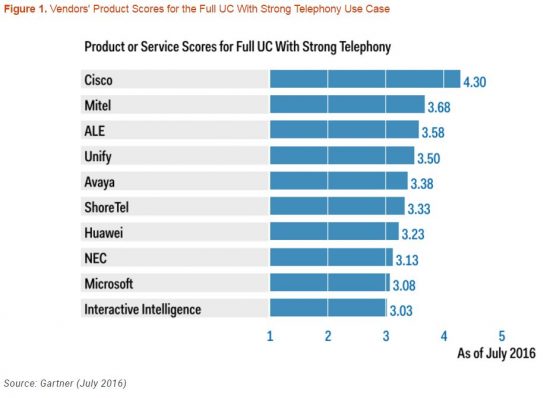
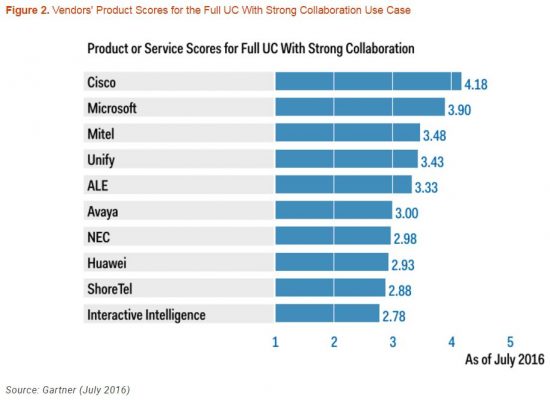
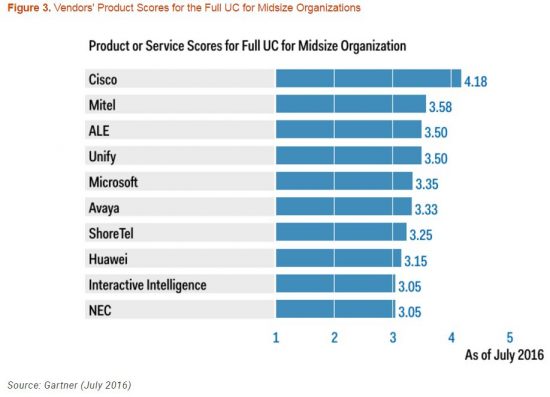
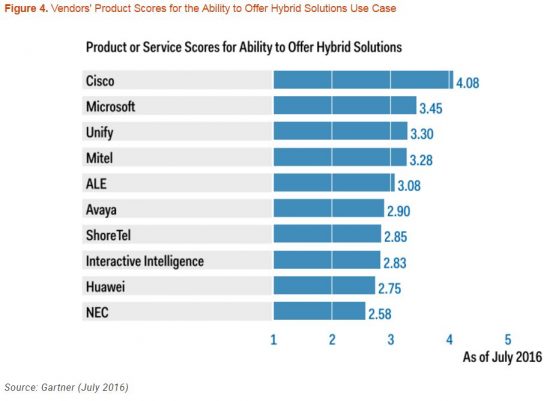
Cisco received the highest scores across all the use cases Gartner defines as critical for unified communications:

  • Full UC with Strong Telephony
  • Full UC with Strong Collaboration
  • Full UC for Midsize Organizations
  • Ability to offer Hybrid Solutions

These critical capabilities are important components of our overall mission to provide the best user experiences for both users and IT teams. We’re making continual efforts – and progress – toward this mission. Some highlights over the last year, as they relate to these four capabilities, include:

Full UC with Strong Telephony: We’ve made considerable R&D investment into telephony and video. Our aim is to make it reliable and available for users as they become more mobile and for organizations they move to cloud. We added resilient and adaptive audio codecs like OPUS; implemented forward error correction; further minimized latency; improved metrics, monitoring, management, and more. All this is to ensure that the experience to access these services over the internet are as delightful as those on your WAN/LAN.

Fig 1

Full UC with Strong Collaboration: Cisco Spark is a cloud-based collaboration service that provides message, meet, and call capabilities delivered through Cisco partners and hosted in Cisco data centers. It’s a holistic service and mobile-first offering. It’s a complete telephony, video and web conferencing, and secure business messaging within an integrated experience centered around the messaging app. We’ve built Cisco Spark on an open, extensible API-centric platform to foster custom solutions, new experiences, and innovation.

Fig 2

Full UC for Midsize Organizations: It’s not all about the enterprise. We’ve focused more on bringing cloud- and premises-based services to midsize (and small!) organizations so that you can have the same tools and capabilities to drive business forward at the right price with the right feature set.

Fig 3

Ability to offer Hybrid Solutions: Cisco Spark Hybrid Services can help you connect the Cisco Cloud to on-premises investments like Cisco Unified Communications Manager, Business Edition, and even Cisco Hosted Collaboration Solution. Our goal is not only to help you extend value, but also use prem and cloud together to drive new and better experiences.

Fig 4

These highlights, among many others, are what we shared with Gartner during the evaluation process.  We believe that these are some of the primary reasons why we received the highest critical capability scores. And maybe even why our “dot” was placed highest and furthest right in the 2016 UC Magic Quadrant.  Regardless, we pleased to see that the industry recognizing our capabilities and our vision.

Learn more about what Gartner and other analysts think about our Collaboration portfolio. Visit our Collaboration Analyst Reports listing.

This graphic was published by Gartner, Inc. as part of a larger research document and should be evaluated in the context of the entire document. The Gartner document is available upon request from Cisco.

Gartner does not endorse any vendor, product or service depicted in its research publications, and does not advise technology users to select only those vendors with the highest ratings or other designation. Gartner research publications consist of the opinions of Gartner’s research organization and should not be construed as statements of fact. Gartner disclaims all warranties, expressed or implied, with respect to this research, including any warranties of merchantability or fitness for a particular purpose.

Authors

Patty Medberry

Senior Manager, Product Marketing

Cisco IoT

Avatar

We’ve all been on WebEx calls, video calls, and IM chats. Maybe we have been sophisticated enough to have more than one of these communications methods turned on at once using WebEx or Jabber. However, what happens when the call ends?  What happens to the files that were shared, the chats that were exchanged?  They seem to disappear in the ether.  And how can you get that information back when you need it?  Say, when there is a tornado impacting power in your areas?  Or, water mains have been broken??

With Spark, Collaboration has taken a huge step forward, allowing all of that information to be captured and stored into a single Spark room. I think of it as a “tiger team room” for my critical projects. Everyone can come together to share information, update each other on the latest status, collect details from the sensors, and chat live.  We can also easily add new team members and allow them to quickly catch up on past chats, files, and the latest details.  Then, when we step offline to continue working on the project, the information is still there, waiting for the next update.  The next team discussion can then be easily started by video or chat at the touch of a button.

Operators are embracing collaboration services to deepen their relationships with their enterprise customers, as Kit Beall outlined in his March 2016 blog. For our Service Provider customers, it’s about more than just simple connectivity.  It’s about using the tools to improve productivity and effectiveness for their enterprise customers.  Not only are our SP customers looking at new revenues by offering Cloud Collaboration services like Spark, they are also embracing the new Digital opportunities to marry collaboration services with analytics and device information. They now want to incorporate all of that data intelligence and analytics from IoT devices to help enterprises make decisions faster.

At CiscoLive Las Vegas last week, we presented how companies like Verizon are marrying collaboration technology with IoT technology to help utility companies easily access IoT sensor information and set up virtual command posts. Utility companies can use all of the IoT information to address general maintenance or emergency situations like a broken water main, as shown in Verizon’s diagram below. For Service Providers, their new revenue opportunities are three-fold – more SIM cards sold for the IoT sensors, private mobile broadband with guaranteed bandwidth for the utility company or emergency services, and ongoing revenues for collaboration services sold to utilities. The more value they can provide to their enterprise customer, the deeper their relationship can be.

maywun

Extending the scenario beyond the utility industry, can you imagine the possibilities with SP Collaboration and IoT in verticals such as healthcare, public safety, customer care, and others?  Ponder that the next time you are on a conference call or video chat and how much more our Service Providers can offer. To start, hear what other operators are doing with Cisco Cloud Collaboration services and Service Provider Cloud Services.

Authors

Maywun Wong

Manager, Market Management

Avatar

The innovations Chuck, Rowan, and team shared at Cisco Live opened yet another chance for us to share the limelight on the digital transformation stage.

Cisco is clearly leading this production, and providing the Digital Network Architecture and partner ecosystem to deliver the enormous benefits of digital business for our customers, securely. You heard Chuck and others talk about how connectivity, security, collaboration, automation and analytics are core attributes for successful digitization.

Collaboration is a critical member of the digital ensemble cast. And we’re certainly playing our part. We’re innovating faster than ever, putting all of our capabilities in the cloud while enabling hybrid integration that extends the value of our customers’ existing investments. It’s easier than ever for customers of all sizes to adopt collaboration and consume it in the way that makes the most sense for their unique business, whether that’s via the cloud, on-premises, or both. And our commitment to delivering the simplest, most delightful user experience continues.

  • Rowan announced that all of our video desk and room systems can now register to Cisco Spark and Video Communications Server (VCS), in addition to Cisco Unified Call Manager (CUCM). Customers can now adopt pervasive video collaboration with or without infrastructure investment to meet their needs.
  • Simple, Magical, and Open still underpin everything we do:
    • SIMPLE – Rowan demonstrated how simple it will soon be to use Apple devices for work with Cisco Collaboration. And Jonathan Rosenberg showed how we continue to enable that big green “Join” button.
    • MAGICAL – Jens Meggers gave us an early introduction to Monica, who will be able to assist, participate, take action and more. And what’s more magical than unboxing that DX80, registering it to Cisco Spark in minutes, hitting that green button and collaborating face to face with your team right away? (Wait… don’t answer just yet. Let’s see what our work with IBM Watson)
    • OPEN – Jens announced the Spark Video SDK, in limited beta soon. “We’re committed to openness,” he said. “Why would we keep all this technology to ourselves?”

Collaboration is the big buzz. Six quarters of growth and counting. Rapid innovation. Consistently center stage or up for “Best Supporting.” We’re playing our part alright, and the spotlight continues to shine brightly upon us.


What’s Next?

So much more from Cisco and Collaboration. But I know you’re also asking that of yourselves. There’s no doubt, you will be play a defining role in this digital movement. It is such a big production that no one could do it alone. I like the way my boss, Nirav Sheth, Senior Director, Global Partner Organization, said it in his recent post, Changing the World Together, “Cisco will lead some of the time. Other times our broad ecosystem of trusted partners will be in the driver’s seat.”

Next up, we’ll talk about what it means to be the Collaboration Partner of the Future (future is now, BTW). There’s so much to consider as you seek to keep ahead of the trends and innovations to profit and grow: addressing new customers, new consumption models, lifecycle services, delivering outcomes, marketing, and selling for traditional and volume go-to-market models. Until then, the first thing you can do is use and know the new technologies so you can sell better.

Are you on Cisco Spark yet? If not, well then that’s what’s next!

Sell Spark. Get started at www.cisco.com/go/sparkpartner.

  1. Review the partner playbook
  2. Take required training (2 people required, but all should complete. Just 4-5 hours on demand.)
  3. Follow simple steps to get qualified to sell.

In the process, you can get access to the full capabilities of Cisco Spark for your organization through the Cisco Unified Workspace for Partners, Cloud (CUWP Cloud) program. Be sure to connect your video room systems to Spark when you do.

Authors

Gary Wolfson

Director, Global Partner Software Sales

Avatar

You’re headed into the office, and your mind is on everything you need to finish today. Sometimes there just aren’t enough hours in the day! It’s a good thing you’ve gotten an early start this morning…

But as you approach the office, you notice something strange: Are all of the blinds closed? Your heart races as you fumble for your access card. Red light. Access denied! What’s going on? At this early hour you have trouble comprehending what’s actually happening. You can’t think clearly, and have trouble deciding what to do next.

Most of us know the three tenets of cybersecurity by heart: Confidentiality, Integrity, and Availability. According to 44 United States Code §3542, here are some definitions:

  • Confidentiality: Preserving authorized restrictions on information access and disclosure, including means for protecting personal privacy and proprietary information.
  • Integrity: Guarding against improper information modification or destruction, and includes ensuring information non-repudiation and authenticity.
  • Availability: Ensuring timely and reliable access to and use of information.

Cybersecurity these days seems to be all about Confidentiality and Integrity, and not so much about Availability. It’s easy to think like this: As long as we’re preventing our data from being stolen, changed, or destroyed, then we’re doing our jobs, right?

Wrong.

Ransomware is changing the game. Cybercriminals have learned how valuable our data is to us, and how much we’d pay to get it back. So rather than stealing sensitive data and then having to sell it on black markets, why not just lock it up? Hackers can simply hold it hostage — by encrypting it — so that it’s completely unavailable to you. Then they’ll demand a fat payment for the decryption key. And if you pay the ransom, there’s no guarantee that the key will actually work. They might even demand a second payment!

CoverSecurity
Photo via Shutterstock

Ransomware means that everyone is locked out. For the education community, it means no registrar or bursar information. No online learning, class schedules, or student grades. No graduations! When ransomware strikes, you’ll have trouble comprehending what’s actually happening. It’ll be hard to think clearly, and it’ll be difficult deciding what to do next.

In our upcoming webinar, we’ll explore the ransomware problem and explain how it gets in. We’ll show you how to protect your school, college, or university from this increasing threat, and how to recover from it, should the unthinkable happen.

Let’s not forget the importance of availability, while also maintaining the confidentiality and integrity of our educational systems and critical information. To learn more about webinar in education, sign up for our webinars for K-12 education and higher education!

Authors

Steve Caimi

Industry Solutions Specialist

US Public Sector Cybersecurity

Avatar

The following is a guest post from Christopher Isak, founder of TechAcute.com, who joined us for a #CiscoChat on collaboration. We had a lively conversation with insightful contributions from around the Twittersphere. Check out his recap below and visit the Storify link to revisit the full conversation. It will be just like being there – almost.
Kim Austin

From Christopher Isak 
Collaboration is important. You need to collaborate. These are phrases often heard in the workplace, but the true value of collaboration can often get lost in translation. And how to go about properly implementing and executing is often not given the attention it deserves.

If you are a leader in your organization, what can you do? I was invited by Cisco to join a #CiscoChat on July 18 around the subject of collaboration. We had a great time discussing this minefield between innovation and change resistance. We had an amazing crowd and some really hard-hitting questions for the participants to answer. While there are usually no single right answers and no one-size-fits-all solutions, the participants had a great understanding of the balance between collaboration technology and methodology. Below are a few questions asked in the #CiscoChat with my personal thoughts on each topic.

What makes collaboration effective? 
I’ve seen many enterprises establishing projects for better collaboration, backed by the CEO and communicated from top to bottom. A collaboration platform should be used and backed by the organization’s leaders, but there should be no mandate. It needs to grow organically based on personal recommendations from users. Employees need to use collaboration platforms and feel that value is added to their work day, without strict structures and frameworks to restrict them. Leave the hierarchies flat, keep spaces open and available, and people will collaborate effectively.

Why must collaboration and security work hand-in-hand to enhance digitization?
The short answer to that is: Everything must be integrated with security. For instance, the world’s most innovative collaboration solution will get nowhere if it’s unsecure. Even if solutions are already deployed, enterprises are more likely to shut it down altogether than risk data leakage, intrusion or other types of cyberattacks.

It’s like Kim Austin from Cisco said in the #CiscoChat, “Collaboration was once with people at the next desk, now it’s global and between companies. Security is crucial.” Even the best idea won’t help you disrupt the market if it’s exposed all over the Internet years before you can bring it to a market-ready state.

How do you nurture a collaborative & digital culture in your workplace? 
Neither collaboration nor digitization can become a directive from management. If you try to push these subjects too hard, employees might develop a resistance against that type of culture.

The value of being collaborative and digital needs to be clear to everybody. Usually some early adopters will pick up “a new tool” or a “new way” of working. If the early adopters feel the value, they will share their experience and the “new way” will organically grow. Leaders should always lead by example and walk-the-walk, but let employees experiment on their own without direct instruction.

What does the future of digitization look like to you?
Technology, the Internet, IoT, all the devices in the world and all the infrastructure alone won’t make a difference single-handedly. As John Chambers said, “… infrastructure is the vehicle to get us there.” We need to prepare our children for the digital future, so it won’t become the digital dawn of mankind. We should frequently question and verify the subjects we are teaching our children in school and make sure they learn what will be relevant for them in the future.

STEM and technology subjects in particular need to play a stronger role in our education systems in my opinion. They need to be able to control, maintain and improve the technology which we have already designed and deployed in order for us to better live our lives. If current legacy occupations someday get replaced with artificial workers, our children need to be the ones who automate, not the ones who are being automated.

You know my opinion now, but there are many others with equally great or even better answers. Check them out in our Storify here, and learn why there’s never been a better time to collaborate and digitize by visiting Cisco’s collaboration site.

This post was sponsored by Cisco.

Authors

Kim Austin

No Longer with Cisco

Avatar

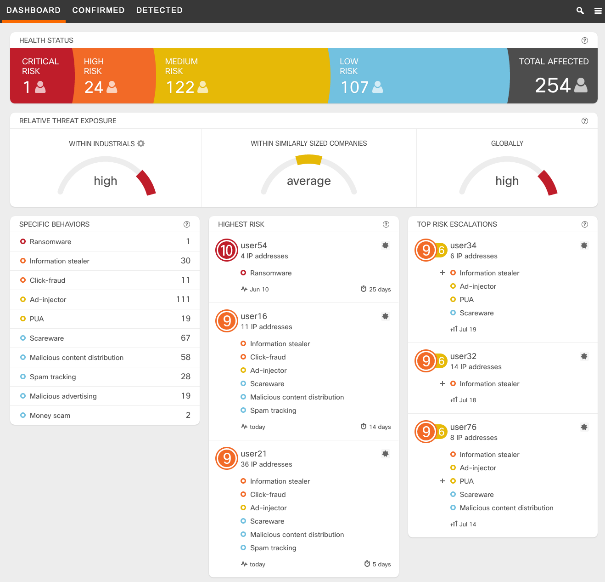
No security risk assessment is complete without the executive summary section. Something that can answer the high level questions security teams get asked including “how secure are we?”, “what threats are affecting our network today?” and “how healthy is our network?” We have recently revamped the Cognitive Threat Analytics dashboard to provide answers to these questions and more.

Cisco Cognitive Threat Analytics (CTA) is a breach detection and analytics platform. It analyzes web traffic to discover command-and-control communications, data exfiltration, and potentially unwanted applications operating in your infrastructure. All without the need to deploy any additional software or hardware.

Cisco Cognitive Threat Analytics (CTA)

At the very top, the health status section displays an overall summary of threats discovered in your network by their risk level, ranging from “critical” to “low,” allowing anyone to quickly see how many threats are affecting them right now.

The next section, relative threat exposure, puts these absolute numbers into perspective. It answers the question, “how is my organization doing with respect to others?” The benchmark takes into account the number and risk of your incidents as well as your organization’s network size. It then compares to trends measured across the entire customer base, across customers with similar network size, and across other customers in the same vertical. The exposure benchmark in each case can range from “low” (best), through “below average,” “average,” “above average,” to “high” (worst).

The three vertical sections start with a list of specific behaviors, giving a high-level breakdown of the detected threats, organized by risk they pose to your organization. Specific behaviors, as opposed to generic behaviors are identified by CTA within “confirmed” and high confidence “detected” threats. This shows you if ransomware is operating in your environment, or data is being exfiltrated right now.

We follow with the highest risk list outlining the top incidents that require immediate attention. Each incident includes user name, list of specific behaviors and a time frame information. In the example shown, the top risk is an infection for user54 with risk level 10 and a specific detection of ransomware. The infection was first detected on June 10, and lasted for 25 days.

Low risk infections will eventually escalate. Last, but not least, is a list of top risk escalations, which draws attention to the infections that have recently escalated. This list includes a user name, old and new risk levels as well as the “diff” in case new specific behaviors associated to the threat have been identified. In the example above, user34 had an escalation on July 19 from risk level 6 to risk level 9. There was a new “information stealer” specific behavior observed, as well as continuation of the existing ones, e.g. “ad-injector”, “PUA”, and “scareware.” This is an example of a multi-stage attack that begins with a relatively benign file, downloads additional components to a malicious payload, and becomes much more severe.

The CTA dashboard is fully interactive. By clicking on an incident, you can navigate to the incident detail and begin investigating. And like a true executive summary, it’s perfectly ok to print it!

Cisco Cognitive Threat Analytics (CTA) has been recently integrated with Cisco Advanced Malware Protection (AMP) for Endpoints. To learn more, please visit http://www.cisco.com/go/ampendpoint-cta, and be sure to to see how it works.

Authors

Michal Svoboda

Technical Leader

Cognitive Threat Analytics