Avatar

You may be pretty familiar with Segment Routing and I bet you’re likely tying it to MPLS as the industry at large has been mainly focused on driving awareness and adoption of MPLS Segment Routing.

But did you know Segment Routing could work in a native IPv6 environment? Sounds interesting to you?

Let’s first go back to some IPv6 basics.

IPv6 packet header has been designed from its inception to offer flexibility by augmenting the IPv6 header with a set of instructions, called “Extension Header”. There are six different types of Extension Header as per RFC 2460:

    • Hop-by-Hop Options
    • Routing
    • Fragment
    • Destination Options
    • Authentication
    • Encapsulating Security Payload

Each of these Extension Headers have been defined for specific purposes. The one of interest here is the Routing Header.

What is this Routing Header all about?

RFC 2460 gives the following definition: “The Routing header is used by an IPv6 source to list one or more intermediate nodes to be “visited” on the way to a packet’s destination.” It looks pretty similar to Segment Routing’s intent … That’s exactly why a new type of Routing Header has been defined, called the Segment Routing Header (SRH) in this IETF draft. If you are interested in getting a deeper understanding of SRH, just read the IETF draft previously mentioned. Otherwise, keep in mind SRH contains a list of Segments that defines the network path. Segments are mere IPv6 addresses.

At this stage, some questions may pop up in your head …

  • Does each node in my IPv6 network need to understand SRH?

The answer is NO! Only the nodes in the Segment Identifier (SID) list through which the traffic must strictly pass need to support SR-IPv6.

  • Is SR-IPv6 supported in Hardware?

The answer is YES! As an example, it is supported on ASR 9K, ASR 1K and cBR8. For further details, contact your Cisco sales representative.

  • Is it supported as a virtualized router?

Yes. Cisco CSR1000v and FD.IO

  • Do I also get advanced features as in MPLS SR?

You liked Disjoint Traffic Engineering service, you liked BGP Egress Peering Engineering, you liked TI-LFA (Automated 50ms protection) … The good news is you get them all with SR-IPv6!

But what about any noteworthy Use Cases?

There are actually many but I would like to outline one as I believe it should be of interest to many Service Providers. Let me start with this “provocative” question – Should Service Providers keep on relying upon Multicast to deliver Linear TV? If I would have asked this question 10 years ago, the answer would have undoubtedly been: YES! And for an obvious reason … No other efficient and cost-effective solution was available at that time to deliver IPTV services to customers. 10 years later … It would be a mistake not to consider any alternative solution! But what has really changed in the meantime?

Well, a couple of things actually.

  • First and foremost, broadband customers consume TV services differently. Linear TV remains, of course, very important for many consumers but more and more video is being consumed on-demand. Isn’t Netflix’s worldwide success exemplifying this change?
  • IPv6 has finally crossed the chasm from early market to mainstream market. Cisco Visual Networking Index (VNI) estimates that globally, IPv6 traffic will grow 16-fold from 2015 to 2020, a compound annual growth rate of 74%.
  • Finally, Segment Routing has made its way from lab demonstrations to real live implementations in major Service Providers’ networks.

What does this all mean?

The proportion of Linear TV traffic to overall IP traffic is decreasing year over year. Consequently, the balance between the complexity inherent to Multicast protocols (states in the network) and the cost benefits (bandwidth savings) is broken!

SR-IPv6 enables a new paradigm! Get rid of multicast in the core of your network and maintain it where it makes the most sense – in the Access network.

See some details about this Use Case below:
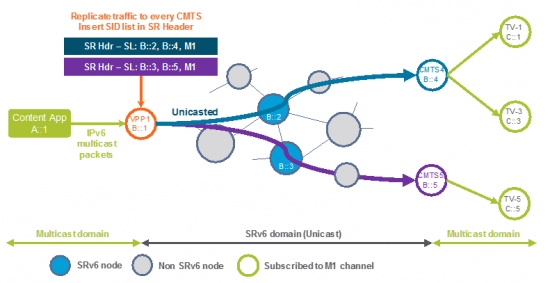
ipv6The video server is unicasting linear TV content to each and every Access Node (be it a DSLAM, an OLT or a CMTS). There’s absolutely no use of IPv6 Multicast in the core of the network.

From an IPv6 standpoint, packets streamed by the server have a unicast destination – the first segment on the path to the Access Node to which the video is unicasted – with the Segment Routing Extension Header containing the remaining segments and the multicast destination address. Once the video traffic hits the Access Node, it is treated as normal multicast traffic. That could seem rather simple but this is the unique combination of IPv6 and Segment Routing that makes this Use Case possible!

Service providers – particularly those that are far-along in their IPv6 deployments – are actively exploring the potential of IPv6 Segment Routing. Comcast was the first major ISP to deploy dual-stack IPv4/IPv6 connectivity throughout its network, and has discussed the potential for Segment Routing. Added Comcast Vice President of Network Strategy John Leddy: “We’ve only begun to scratch the surface of IPv6 as a tool for building smarter, more programmable networks. We’re excited about the potential of IPv6 segment routing and working on several trials observe how it performs.”

I find it eye-opening as this positions IPv6 as a programmable infrastructure well beyond the traditional – you’re running out of IPv4 addresses, switch to IPv6 – mantra. This is the first blog from a series of blogs dedicated to IPv6 and Segment Routing. The upcoming ones will go deeper into the technology and the use cases as we’ve only scratched the surface here.

In the meantime, stay tuned and feel free to share on your preferred social media channels. Additional content you can get access to:

Authors

Frederic Trate

Marketing Manager

Service Provider Business Architecture, France

Avatar

I’m excited to share that today Cisco announced its intent to acquire ContainerX, Inc., Cisco’s first acquisition in the rapidly emerging container market. ContainerX is an early stage, privately held company focused on building technology to help enterprises manage, orchestrate and integrate containers across data centers.

Many of our customers are starting to use containers to build, deploy and manage cloud native applications. Containers provide an easy, flexible way to build, test, deploy, and move applications across a variety of environments, including public clouds, private clouds and hybrid environments. Today the container space is in an emerging phase with Enterprises experimenting with adoption but at the same time wanting to see the level of security, manageability and interoperability they need within their IT environment.

ContainerX has been around for less than two years, and in that time, the ContainerX team has demonstrated strong technical expertise in developing enterprise-class container management technology that works across a range of platforms. With today’s announcement, the ContainerX and Cisco teams will work together to continue to develop a comprehensive cloud-native stack for our customers.

Containers should be simple for customers to deploy and include secure, interoperable solutions that can integrate across the data center stack with existing infrastructure. Cisco is uniquely positioned to integrate the next generation data center with cloud-native and containerized environments that customers are demanding, all while still delivering advanced features such as security, analytics and management. With ContainerX, Cisco is continuing to invest in innovative technology and talent to help our customers in their transition to cloud native architectures using containers. This clearly supports our broader strategy to build and deliver secure hybrid cloud infrastructure, platforms, and services that offer our customers the freedom to choose the best environments and consumption models for their traditional and cloud native applications.

The ContainerX team will join Cisco’s Cloud Platform & Services Group led by Vice President Kip Compton. The terms and purchase price of the acquisition are confidential.

Authors

Rob Salvagno

Vice President

Corporate Development and Cisco Investments

Avatar

The VP of Data Center Operations at a B2B cloud provider cannot guarantee that his enterprise customer’s sensitive records are protected from attacks — even with his arsenal of threat detection and mitigation tools. Amongst rows of opaque racks with thousands of consolidated workloads, he cannot fully catalog the vulnerable machines nor the processes running on them, nor the data bases they are accessing, nor their owners.

This is the irony of Digital Transformation is — that its actually making many data center operational tasks harder. We see three broad causes.

  • First, there is too much new or transient traffic due to the rising internal bandwidth, new Hadoop workloads and many more endpoints including micro-services and containers. Over 70% of data center traffic is internal and growing.
  • Second, there is business pressure to move applications to new resources with security – to hybrid clouds, programmable networks, hyper-converged infrastructure or, simply, to fewer data centers (as in the case of a merger). How do architects and security admins know what dependencies to move with the application or whether they can trust the flows on newly consolidated resources.
  • Third, the rapid dev-to-deploy cycles for applications is outpacing compliance and audit controls, in addition to creating production instability. For example, we see large development teams inadvertently mis-applying communication policies in the process of re-using them resulting in major compliance violations and vulnerabilities.

In each case, digital transformation promises high agility and ROI but the actual “transforming” journey is fraught with risk.  The root cause is the lack of real-time, actionable visibility in increasingly dynamic environments. We see this in every enterprise but particularly in regulated industries, such as service providers, financial services, healthcare and government agencies.

Tetration Analytics delivers real-time, actionable visibility

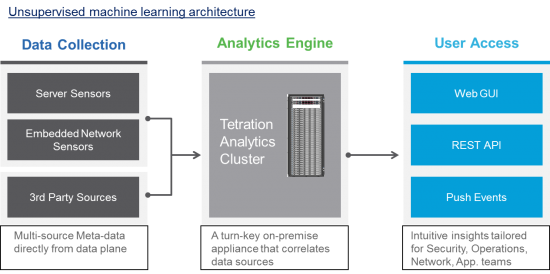
Cisco Tetration Analytics was designed to see every activity in the data center, every flow, every packet coming from every source, going to every destination. Operations can instantly see traffic as its occurring, at line rate, and forensically analyze flows and packets a year in the past, with no loss of information. (watch video)

TA Arch2

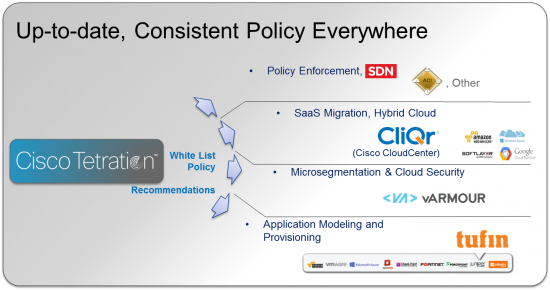
Deep visibility to all traffic enables Tetration to discover all the application policies and dependencies in real-time, even as they change in dynamic environments. This means you can see vulnerable machines, check compliance, maintain correct micro-segmentation and dramatically reduce the risk of application migrations. Tetration APIs enable export of consistent, up-to-date policies everywhere.

WL Policies everwhere

To see how Tetration does this and its key use-cases, watch my short video talk at CiscoLive Las Vegas.

For additional information link to www.cisco.com/go/tetration

Authors

Sandeep Agrawal

Sr. Product Line Manager

Security Business Group

Avatar

Most people don’t think of a school bus as a place that would get your heart racing. But then again, most people haven’t experienced iSchool’s “Escape the Bus” adventure. iSchool Initiative has introduced a fun new exhibit to help students, teachers, and administrations learn firsthand how technology can improve the classroom experience. Each group gets “locked” inside the iSchool bus, which is equipped with Cisco mobility and collaboration technologies. They have to use teamwork, problem solving, and logic to uncover clues and escape in time.

You can learn more about the iSchool “Escape the Bus” adventure in Daryl Coon’s fantastic post over on the Cisco Mobility blog! And make sure you check out the video below to see firsthand how much fun students, teachers, and administrators alike are having with iSchool’s latest venture.

Authors

Mary Schlegelmilch

Business Development Manager

Education

Avatar

Do you remember what first inspired you to follow the road into the tech industry? A mentor or person that pushed you to take the first step?

My road to tech is a twisty, curvy one. I’ve had many firsts along the way – a secretary becoming a network technician, a network technician becoming a webmaster, a webmaster becoming a server administrator – then yet another twist when I joined Cisco as part of the Cisco IT Digital Transformation Program. I joined Cisco as a project manager in 2015, after 10 years of wanting to work here!

The map leading me down the continued road to success is still a bit murky but I feel like I’m “home” now at Cisco because of my colleagues.

I am flat-out inspired by the women here at Cisco. I have my map but am now blessed with guides who help interpret the map, let me know which fork to take – and, most importantly, lead the way as they experience “firsts” in their careers.

Lisa Lockhart, a program manager for GIS Network Services, is one of those inspiring women and helped 15 young women take the first step of their journey into tech. Lisa helped organize the first-ever Girls in ICT Day at Cisco’s Richmond, Virginia, sales office, providing the students with inspirational speakers and a Women in STEM /IoT Scavenger hunt.

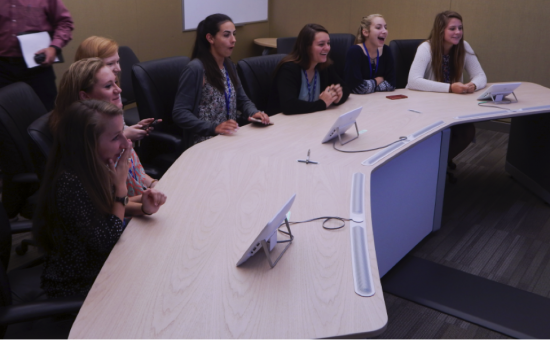
The students got another first – the immersive, lifelike experience of the Cisco TelePresence® IX5000.

Girls at the Richmond STEM event
The girls got to experience Cisco tech and see themselves changing the world with it!

As Cisco employees, we use these products every day and forget just how cool they are. Take a look at the picture – the “oh wow!” expressions on the faces of the students.

Lisa said, “It was a deeply gratifying experience… Our mission of further raising awareness about and interest in STEM opportunities was accomplished.”

Some comments from the attendees:

“Today strongly increased my knowledge of technology and different job opportunities brought by STEM fields. Today made me want to learn more!”

“I thought the lectures today were very inspiring. Not only did they inspire me to pursue a career in STEM, but they compelled me to work even harder at pursuing my goals.”

“I learned that women can have amazing, impactful jobs in STEM-related careers.”

Cisco employees not only take a lot of first steps, leading the way in innovative products, but we’re definitely Joe Cool while doing it.


Want to join the WeAreCisco tribe? Look for openings here.


More on Girls In ICT at Cisco

See photos from the global Cisco Girls Power Tech Day
Inspiring Girls to Careers in Tech
Anything is Possible for Women in Tech

Authors

Elizabeth Brummond

IoT Program Marketing & Communications PM

Cisco IT

Avatar

The internet has finally made anytime, anywhere video consumption a reality. But for service providers that means facing down a new set of security challenges to keep content and customer data out of harm’s way.

Things used to be simpler. There was a time when content providers and broadcasters had one pipe to manage. That pipe lead to one set-top box for every household, which had one screen. That was a long time ago.

Now video is consumed any time and anywhere on multiple screens and delivered via the internet. This has opened up not only a whole new world of revenue-making opportunities. But it’s also borne a raft of potential security headaches.

The key to success is to keep your content and viewer data safe while maintaining a smooth and faultless service.

digital thieves

You’re under attack

Hackers have made it their business to get inside your data center to steal content or just create havoc. Here are a few common scenarios:

  • A hacker sends a data center employee a phishing email loaded with malware. The employee then unwittingly opens and downloads the malware. This provides the hacker with remote access to the data center. From there they could:
    • Steal content straight from the database and distribute it.
    • Steal customer access codes to sell on the dark web.
  • With internal access, a hacker turns on ‘premium channels’ for all users.
  • A hacker steals customer identity information held in other databases to sell online to fraudsters.
  • A hacker holds the data center to ransom. This doesn’t even require internal access. One way to do this is via a Distributed Denial of Service (DDoS) attack. It floods your servers with internet traffic so that they can’t broadcast.

Lock down risk

So how can you protect your revenue streams and reputation? You need layered protection in place to provide defense in depth, wherever the attacker tries to target. Here are a few essentials:

  • Restrict each employee’s access only to necessary systems to do their job. And migrate from password-based log-ins to two-factor authentication. It’s much harder to crack.
  • Stop known cybercriminals and threats by checking against web and email reputation databases.
  • Stateful firewalls will help to stop malicious traffic.
  • Intrusion prevention systems can block any attempts to exploit software flaws.
  • Advanced anti-malware will track malware that got in and identifying suspicious behaviour of files originating from the internet or emails. Once that behaviour has been noted, the software can wind back the clock to see what damage it has done and remediate the infection.
  • DDoS prevention services will help to ward off or neuter these attacks.

A single pane of glass

Managing all of these components can be a headache for staff. Security admins will be forced to monitor multiple screens, and attacks could slip between the cracks. The answer is to find a technology vendor that can offer best-of-breed protection, and offer threat visibility from a single pane of glass. It will lower the management burden and improve your ability to block threats. It could even reduce your staff costs.

Install this, and you’ll be well on your way to securing the video data center from piracy, disruption and customer data theft.

Find out more

The explosion in IP-based video delivery and smart devices has created huge commercial opportunities. But fail to protect your most important assets and it could be game over. That’s why you need the right technology partner to lock out the bad guys and keep you on the fast track to success. Join Cisco at IBC 2016 to see what’s possible. There’s never been a better time to do something amazing…

Authors

Sam Rastogi

Senior Product & Solutions Marketing Manager

Avatar
Izzy
Izzy

Today is National Dog Day. There seems to be a day for just about everything these days. Which makes today a perfect day to let you all know about three new videos our wonderful team at the University of Santa Cruz just posted.

These short videos show just how easy the process is to get our wireless access points installed. As you know, we do take great care in understanding our user’s experience with our products. This goes for the installation, configuration, and overall network use. We take this further with our support team if an issue were to arise. We think this experience is the best in the industry.

So here you go:

Cisco WAP150

Cisco WAP571

Cisco WAP571E

We hope you agree that the process to get these installed is simple and straight-forward. Sometimes things do not go the way we plan, but we hope these videos will help keep your plan straight.

We will have some very exciting new coming in the next few months, but for now take care.

From everyone on the Business Team here at Cisco (including Izzy), have a great weekend.

Marc

Authors

Marc Nagao

Product Manager

Small Business RV Series Routers

Avatar

Securing institutional assets is a critical step in a college or university’s ability to embark on the road to digital transformation. A unique operating environment and mission for the higher education industry makes this a particularly difficult task.

For institutions to be successful, they must commit to investing in security solutions and strategies that enable long-term flexibility and agility without compromising on performance.

AS43242

In global industry analyst firm Ovum’s new white paper, they advise colleges and universities partner with service and solution providers in order to access best-in-class capabilities from experts dedicated to the IT security market, freeing them to focus on their business transformation initiatives.

To read more about Ovum’s view on the role of security services in education, read the full white paper here.

Authors

Lyanne Paustenbach

No Longer with Cisco

Avatar

One of Cisco’s crown jewels is its fantastic team of female Systems Engineers (SEs). From Millennials, moms, mentors, and innovators to business consultants, salsa dancers, world travelers, strategic sellers, and technology geniuses, our SEs run the gamut of talents, hobbies, and expertise.

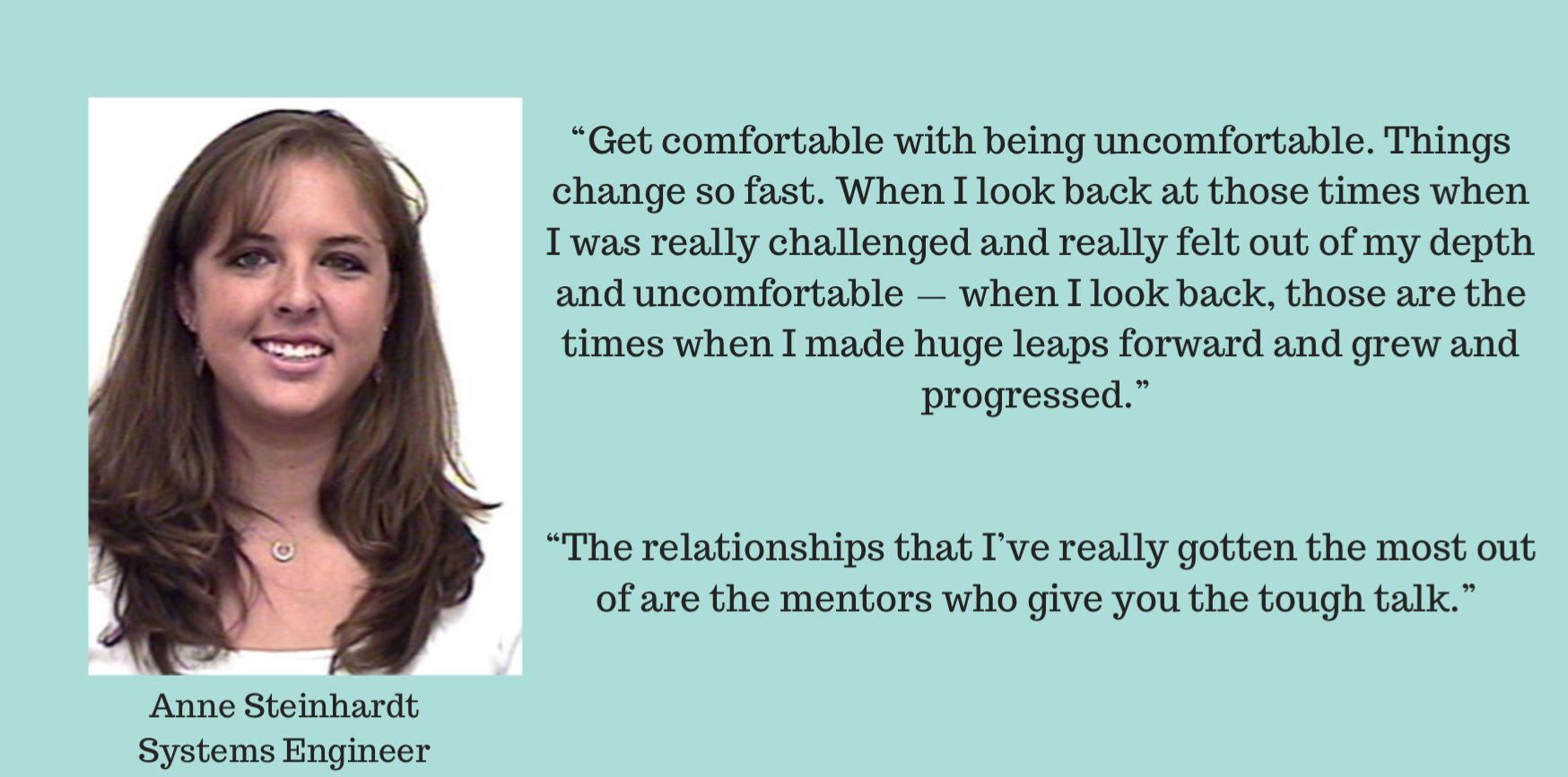
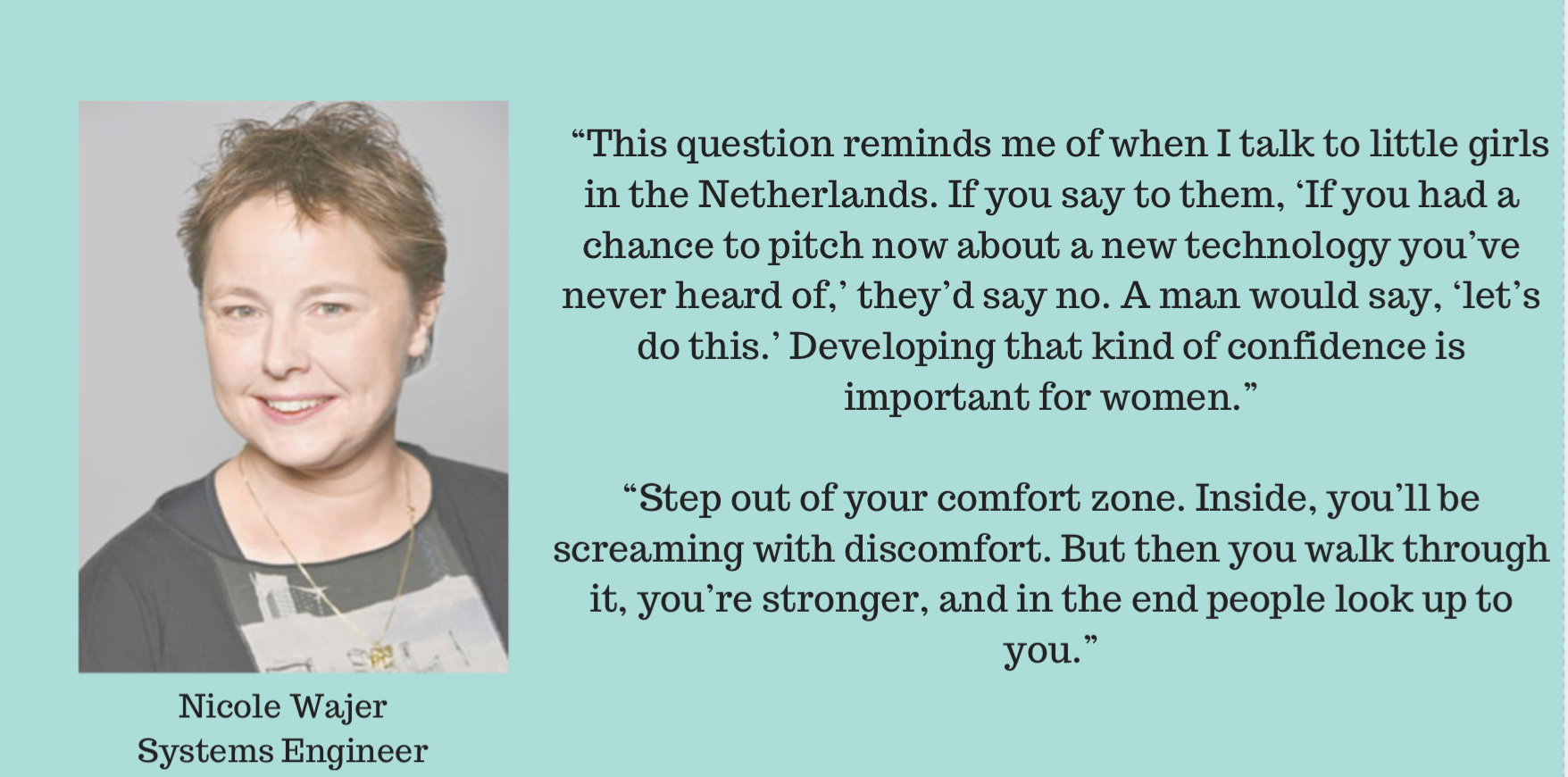
Last Thursday (August 18th), Michael Koons (Vice President, WW Systems Engineering, Sales) hosted a #CiscoChat with Cindy Goodwin-Sak (Director, Strategy & Operations, WW Systems Engineering, Sales), Nicole Wajer (Consulting Systems Engineer), and Anne Steinhardt (Systems Engineer) to answer questions, address the growing presence of women in STEM and business, and touch on the lives of women SEs at Cisco.

The conversation was enlightening with each woman sharing insights about navigating careers and finding tremendous success in high-tech, a traditionally male-dominated industry.

Here’s a brief recap of some of the highlights from the conversation:

Screen Shot 2016-08-26 at 11.11.38 AM


Anne Steinhardt

Nicole Wajer

Key Links-

 Join us for the next SE #CiscoChat – October 26th, 2016. To learn more about the CiscoChat program, click here.

Authors

Rehana Rehman

No Longer with Cisco