We are just a few days away from Pure//Accelerate conference in San Francisco. For one thing, I’m excited about going to a San Francisco conference that is not held at the Moscone Conference Center. Pier 48 is a great location, just across from the San Francisco Giants’ ballpark where I spent many a cold and foggy night. I am actually willing to bet on the Giants’ even year World Series Championship pattern, 2010, 2012, 2014 and 2016? Any taker?
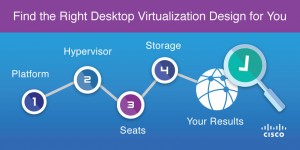
Upcoming Reference Architecture for 5,000-seat Desktop Virtualization Deployment on FlashStack
Cisco is currently working on a Validated Design for deploying a 5,000-seat desktop and app virtualization architecture on Pure Storage all flash arrays with VMware Horizon 6, which we expect to publish soon. Cisco engineers invest thousands of hours in design and testing in every Cisco Validated Design. These Cisco Validated Designs deliver great agility by lowering the risk of deploying a specific VDI solution and increase the speed of deployment by providing prescriptive guidelines. These validated solutions offer a scalable, reliable and predictable foundation on which to build business value and lower TCO.
For the 9th year in a row, Cisco has been honored by the Ethisphere Institute as one of the World’s Most Ethical Companies. This year, Ethisphere honored 131 companies representing 54 industry sectors, 21 countries, and five continents. Cisco is one of four honorees in the Technology category.
Qualifying companies are measured on five key categories: ethics and compliance program (35%), corporate citizenship and responsibility (20%), culture of ethics (20%), governance (15%) and leadership, innovation and reputation (10%).
We believe that preserving an ethical workplace is critical to our long-term success as a company. We provide employees many ways to learn about and understand our policies and processes that help us manage within the law and maintain an ethical culture, including a Policy Central website, reporting and disclosures tools, ethics-related training and our annual employee Code of Business Conduct (COBC) certification.
Kelly Crothers, director of marketing, talks about how ‘expand selling’ best practices can generate new revenue and build brand loyalty in this latest video blog from the Global Customer Success team.
Back in 2010, not long after I started blogging here on Cisco.com, I discussed some of the challenges customers were fearing regarding the feasibility of cloud adoption. In my market research work, the survey I ran back in 2010 came up with some interesting concerns: that lack of bandwidth and internet reliability was an impediment to cloud adoption. I discussed this later when I wrote about Cisco’s “Network on Wheels”: “… one of the things we learned that in certain parts of the world, the access bandwidth to the cloud was a significant concern – in terms of reliability, cost and bandwidth available”.
Having lived my life in urban areas with reasonable network services (although it’s only a year ago we managed to get fibre-based broadband – more precisely Fibre-To-The-Cabinet), this survey result was a bit of a surprise to me. Yes, I rationalised, looking at the countries which reported this issue, I can see that is an issue in some parts of the world that would impede adoption of cloud services. But not here in the UK, Europe or North America. How naive and arrogant was I!
Fast forward to 2016 – I can’t believe I’m writing this about my own country!– in my very own back yard in Scotland, my local mountain ski centre, Glencoe Mountain, is experiencing real pain from customer dissatisfaction – they can’t process credit card payments fast enough, which is resulting in long 30 minute+ queues at their ticket office on busy days, preventing enthusiastic yet impatient skiers from getting up the mountain to enjoy the snow. And all because of the lack of reliability and bandwidth in their so-called “high speed” internet access to credit card paymentservices.
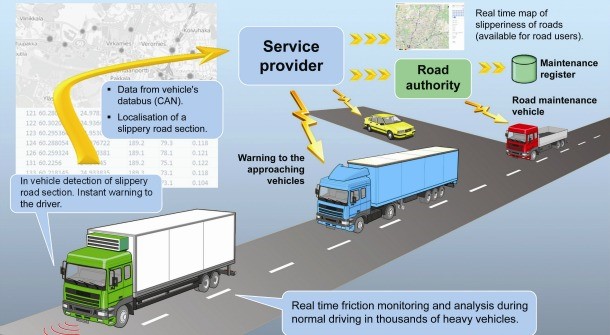
The Bigger Picture: Connected Transport Internet of Things (IoT) Services that Service Providers Can Drive (Source: http://www.supplychaindigital.com/)
I’ll structure my discussion into 3 areas. First, mountains are inaccessible, provision of high speed internet is a challenge. Right? Wrong! So I start with a discussion on the digital transformation of ski resorts as proof of that. Then I’ll discuss the economic impact on the broader community in internet-poor locations, and finally I’ll cover the bigger picture – the Internet of Things (IoT) opportunity available to innovative and forward-thinking service providers who seek to transform their business models from data pipe providers to “connected experience” IoT solution providers. Continue reading “The Connection between Long Ski Centre Queues and the Cloud: The Service Provider Internet of Things Opportunity”
With the E-rate filing window deadline rapidly approaching (Form 471s are due April 29th), it’s time to get those applications in. If E-rate is new to you, there are many resources available to help you understand the program and process, including several Cisco resources we’ll discuss below.
What Do You Need to Know Now?
The E-rate program provides $3.9B worth of discounts each year on certain services and products that are essential for classrooms and libraries to obtain high-speed Internet access and telecommunications equipment. The discount ranges from 20% to 85% for Category 2 on premise equipment, which means that in some cases, schools can make technology purchases using their budget to fund just 15% of the overall cost. What is especially important to know this year is that USAC has added $1.9B in rollover funding from previous years. Experts anticipate that all 2016 Category 2 applications that are done correctly and on time will be funded. This is an unprecedented opportunity for schools and libraries to take advantage of E-rate funding!
What Can E-Rate Do for You?
Schools today are becoming increasingly digitized – that is, leveraging technology to help improve outcomes for students, teachers, and administrations alike. Using digital tools in the classroom is improving the learning experience, expanding access to education, and creating new opportunities for students all across the country. But often, schools don’t have the technological infrastructure needed to support digital tools like online courses, digital textbooks, or video streaming and conferencing. And the necessary infrastructure upgrades can often be costly. That’s where the E-rate program comes in – it can help your school and district afford the necessary infrastructure upgrades you need to embrace the digital revolution!
So What Next?
Visit the USAC website (the E-rate program administrator) for program information and application forms. Form 470s must be posted a minimum of 28 days prior to the Form 471s, so be aware that the 470 deadline is April 1st. Also, check out this special report from Cisco and eSchool News for a brief overview of the E-rate Modernization Order and to learn how E-rate can be used to help lead a digital transformation in K-12 education. You can learn more about E-rate and alternative funding options here, you can browse and search our database for Cisco product E-rate eligibility, and if you have any questions you can ask our helpdesk.
Be on the lookout for more blog posts in the coming weeks that highlight the great things that some of our Cisco customers have been able to do with their E-rate funding!
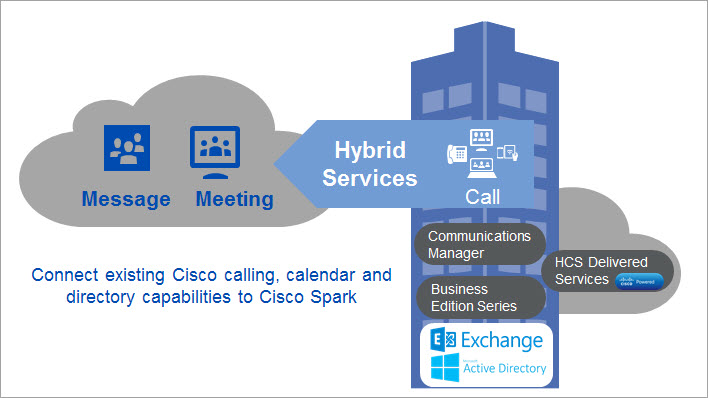
If you like the idea of Cisco Spark, you will love it with Cisco Spark Hybrid Services. On its own, Cisco Spark is a compelling tool: I can message, meet, and call and get my work done with all my teammates. Pretty cool. But, not everyone or everything is in Cisco Spark. So to be really compelling, we realized that it needed to work with other key tools. And that is where the Cisco Spark Hybrid Services come in.
Connect existing Cisco calling, calendar, and directory capabilities to Cisco Spark.
Cisco Spark Hybrid Services give you control on how and when you want to embrace the cloud. If you have existing Cisco Unified Communications Manager, Business Edition 6000 and 7000, or Cisco HCS deployments, you can simply add Cisco Spark message and meeting capabilities for the full Cisco Spark experience. Or you can choose to deploy all the capabilities (message, meeting and call) of Cisco Spark.
You can also integrate your existing Microsoft Active Directory and Microsoft Exchange with Cisco Spark in the cloud so tightly that they virtually look, feel, and act as one system to users. Best of all, they provide a better user and IT experience.
Today, the Cloud Native Computing Foundation (CNCF) announced that their first project accepted is Kubernetes. This is an important initial milestone as this represents the first core functional component of a CNCF solution. There will me more core functional components to come as the TOC is busy already investigating projects. This is not validation that CNCF is a Google foundation by any means, however we recognize the features of apps, services, network storage, cluster management, performance, and stability features are important for cloud native development.
We are looking for other projects that have these type of capabilities:
Application definition and orchestration
Resource scheduling
Distributed systems services
A local agent that integrates CNCF into a local computing environment
Compute node definition
Infrastructure provisioning and integration
Standard interface and plugin model to request additional
infrastructure
Provide a standard interface and plugin model for network (SDN) and
storage (SDS) integration with clusters
Core services (common capabilities made optionally available to all CNCF sub-systems)
Tools and Visualization
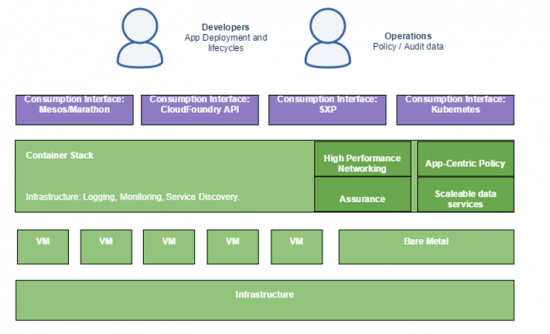
At Cisco, we are extending mantl.io to support Kubernetes. Last week we announced a Cloud Native Platform based on a container-specific stack with Mantl, Cisco’s PaaS framework for managing containerized microservices. Mantl uses Mesos and Kubernetes for scheduling. This stack forms the foundation for the cloud native developer experience. Our primary goal is to provide faster innovation to product delivery with enhanced policy, security, and networking built in.
Here is a list of specific issues we are addressing:
Mesos/Kubernets: for now the idea is to have the cluster workers on separate nodes and share common mantl services like service discovery (consul), load balancing (traefik), and overlay networking (calico). https://github.com/CiscoCloud/mantl/pull/881 We are already integrating Contiv.io and fd.io for application centric policy and high performance user space networking with segmentation.
We have been working with Google on Kubernetes and Consul integration. We decided to take on this project at Cisco and contribute to the console and Kubernetes communities https://github.com/CiscoCloud/mantl/issues/836
There was a time when the network was thought of as a bottleneck to innovation. It is the weakest link in the chain. Its rigid, inflexible and labor-laden infrastructure inhibits growth for the business, productivity for its workforce, and diminishes the experiences for customers. Those days are long gone. The network has been reimagined.
https://youtu.be/cFI5IdTcarM
The Era of a Digital Network
Last week, with Cisco Digital Network Architecture (#CiscoDNA) announcement, we shared how an open, extensible, software-driven and services-centric network design not only enable, but also propel digital transformation. In two blog posts by Raakhee Mistry, she highlighted the design principles behind Cisco DNA and the market applications. Key take-away message: innovation requires IT agility. IT agility is powered by a software-driven network. Continue reading “Your Network (re)Imagined – Now with More NET, Less WORK”
Hybrid Cloud. These two words are individually or collectively on the minds of just about every business today, regardless of size. Why? If you’re implementing a private cloud, you will inevitably ask yourself if you should be leveraging public cloud for dev/test or an alternative place to deploy workloads.
Traditional people think of hybrid cloud as something that only enterprise customers would be utilizing. But the fact is that hybrid cloud consumption is not just for large organizations but for everyone. Even non-profits. To learn more, watch this video:
https://www.youtube.com/watch?v=nYEA-nstGxM
As individuals, we all watch our personal and family spending. But for non-profit organizations, the term “doing more with less” has extra special importance.
Working in over 120 countries, the Salvation Army has the mission of meeting human needs without discrimination. Accomplishing this vision in a cost-effective, economical way comes with a unique set of challenges as the Salvation Army needs to rapidly deploy applications and services on a very limited budget.
To scale rapidly into hybrid cloud, the Salvation Army looked to augment their private virtual environment with several public cloud services. However, what looked good on paper resulted in a different story when it came to implementation. “Our first deployments were difficult and took months to move even one service,” said Randy Haan, Director of Infrastructure.
The Salvation Army quickly realized that a number of questions needed to be addressed before deployment. Such as:
How do I secure my assets in the public cloud?
How do I deliver the same security to my public instances that I have in my private instances?
How do I make my public cloud system and services manageable from my private environment?
Not answering these questions first resulted in lengthy deployment cycles and problems for the Salvation Army.
“Cisco Intercloud Fabric for Business is the silver bullet,” says Haan. “With Cisco Intercloud Fabric for Business, we can deploy into over a dozen public cloud providers with very little effort.” It allowed the Salvation Army to securely extend development and test environments across public cloud providers all while ensuring the consistency of these environments.
A component of the Cisco ONE Enterprise Cloud Suite, Cisco Intercloud Fabric works with the self-service portal contained in the Enterprise Cloud Suite to provision infrastructure in the public cloud instance. Then utilizing the self-service portal, developers, line of business managers or IT professionals can seamlessly manage both private and public instances seamlessly from a single user interface.
Looking to take advantage of hybrid cloud? Trust Cisco to enable your organization to utilize the cloud strategy that best works for your business. The combination of Cisco Enterprise Cloud Suite and Intercloud Fabric take care of the underlying complexity of individual clouds to ensure consistency across environments.















 Working in over 120 countries, the Salvation Army has the mission of meeting human needs without discrimination. Accomplishing this vision in a cost-effective, economical way comes with a unique set of challenges as the Salvation Army needs to rapidly deploy applications and services on a very limited budget.