Security is a hot topic around here. Our customers want it. Our businesses need it. Our partners can provide it. And none of us can be successful without it.
Recently I was talking with colleagues about how in a relatively short amount of time Cisco has established a market-leading position that was, in part, reflected by the number of industry awards we received. My colleagues were excited about winning (I was too), but what’s more important than the awards is what they represent: the success of our customers.
We have a long-standing (some would say obsessive) tradition of measuring our customers’ satisfaction. We benchmark this quarterly and use the findings to fine-tune everything we do. From product development and support, to acquisitions and corporate strategy. So when leading industry institutions – Gartner, Piper Jaffrey, Frost & Sullivan, to name a few – call out Cisco’s strength in security, we feel good about the validation. But we feel great that these accolades mean: that we are achieving our mission of helping customers keep their networks safe, secure and protected. And helping our partners grow their security practice with a highly regarded, award-winning portfolio.
Collectively, our customers are blocking nearly 20 billion threats every day. And they’re detecting these threats much faster. What used to take about 100 days, they’re now doing in less than one. We’re making this happen. OUR PARTNERS are making this happen. Together we are protecting networks, keeping people and businesses safe and secure, and winning together.
This is made possible by our security team. Our game-changing architectural approach, where all the security elements integrate and work together, help improve our customers’ security effectiveness and drives cost and complexity out of their environment. In today’s hyper-connected digital environment, this architectural approach provides unprecedented protection from the network to the cloud, across all of the attack vectors and across the entire attack continuum – before, during, and after.
One of my favorite movie lines is from Jerry Maguire when Jerry, as the consummate sports agent, pleads with his star NFL client “Help me help you.” This kind of sums of how I look at our success. We go to great lengths to hear from our customers so that we can help them be successful. Winning awards and being recognized in the industry are solid indicators that we’re listening.
Congratulations to Cisco’s security team for creating industry-leading solutions that win awards.
Thank you to our partners for building your security practices with our portfolio and protecting our customers. And thank you to our customers for your trust and confidence in Cisco and our partners. Please keep the feedback coming.
Want to learn more about Cisco security and some of the awards we’ve garnered? Click here.
What could these three things possibly have to do with each other?
A fundamental concept of quantum mechanics is that the position of sub-atomic particles like electrons orbiting the nucleus of an atom is defined as a probability function… and when we started thinking about how to measure people moving through a building, the models became eerily similar.
Designers, architects and facilities teams are always striving to create spaces that align to the activity of the occupants. Over the years, we’ve built models based on surveys, counting people, and time studies, but all of these models tend to fall apart because:
What people need today isn’t what people will need tomorrow
Work styles change due to technology like laptop computers and Wi-Fi, as well as new practices like AGILE
How people use space is influenced by the space itself
So a building that lasts for decades is designed and constructed based on data from a snapshot in time that’s probably out of date before the doors open.
Utilization heat map of a building
Enter IoT, Big Data, and Cisco’s Connected Mobile Experience (CMX). By using the Wi-Fi signals from the cell phones, laptops, and tablets of the occupants of the building, combined with other data sources such as security system badge-in data, Outlook Meeting data, and other facilities information, we can create a model of building utilization over time – a quantum mechanics probability function that tells us how many people are in a space at any given time. This model is more accurate than any one of these individual data sources, and the error continues to decrease as we gather more data over time. All of this data for over 40 buildings and almost 7 million square feet of Cisco’s global facility portfolio is being collected and analyzed in Optimo, a Software-as-as-Service (SaaS) tool from Cisco Solution Partner Rifiniti. This solution provides facilities teams the ability to quickly visualize the data on demand as needed during building designs, people movement discussions, and conversations with business leaders.
The output of the model is a building heat map that shows how individual work spaces are used. This heat map can then be used to answer these long unanswered questions, and lead to action plans to improve utilization by:
Moving people based on actual availability of space
Changing space configurations – from furniture to hard walls
Bringing teams who collaborate extensively into the same physical space
For example, if we construct a meeting room with an occupancy of 12 people, but the average utilization of that room is only 4 people and the peak is 6 people, then we can propose splitting the room into two rooms. These two new rooms will end up with higher utilization and provide the occupants a new collaboration space.
The key success factor – and the difference from prior measurement solutions – is the ability to leverage CMX. By using the Wi-Fi network, there is no need to install additional sensors or to upgrade the building automation or lighting systems (although we can and plan to integrate those data streams as well!). There is also no addition of stand-alone sensors which often require batteries that need to be monitored and replaced.
So what’s next? We continue to add buildings to the system as well as looking for other existing data streams which will enable us to collect occupancy and activity data at little to no cost. An example is leveraging video endpoints and security camera analytics to provide people counts. And as we add these data streams, we continue to deliver more accurate and timely information for our facilities management processes
The pace of change in business is accelerating so fast, that many IT professionals may not have fully recognized and internalized the enormity of the changes happening in the networking space right now. We’re talking about taking a huge leap forward in the way networks will be designed, deployed and managed compared to the last 20 years or more. This is not simply a change in the technologies we use, but also an evolution in the skills IT professionals must develop and a shift on how they run their operations. Evolving our networks so that they understand what the business requires – and then just deliver on those requirements.
I know it sounds like science fiction at times. But with controller-based networking, virtualization, analytics and cloud-enabled services, this future is where the industry heading. The question is less if, and more how and when. And maybe the more important question is what are you doing to get ready now?
Many federal, state, and local government agencies are operating old, outdated and end-of-life network equipment. You may think this just means slower, less efficient operation – not worth the cost to refresh your infrastructure, right? Wrong. Outdated network equipment is actually a major cybersecurity risk, particularly for government agencies, as it makes networks more susceptible to hacks and other forms of cyber-attacks.
Why, exactly, is it so bad to use old IT equipment? During a technology’s supported life, vendors routinely issue security patches and updates to protect them against evolving threats. But once unsupported, the equipment loses this protection and obsolete platforms are unable to support current cybersecurity needs.
Agencies that continue to operate this equipment not only are missing out on the efficiency and economy of up-to-date technology, but also are expending resources to maintain weaknesses in their networks that are vulnerable to exploit. Refreshing your network infrastructure, then, is a win-win situation: your agency will have more efficient technology and you’ll be able to better protect your network from cyberattacks. When you look at it this way, why would you risk not doing it?
But many agencies are continuing to use out-of-date equipment. To bring awareness to the issue, and help the public sector address it, we partnered with GovLoop to develop a whitepaper on the subject, Cybersecurity Risk: The Driver for IT Modernization. In the report, Anthony Grieco, Senior Director of Cisco’s Security and Trust Organization, gives his take on the need for government to modernize. To download the full report, go here. And to learn more about Cisco’s resources for network refreshes, visit our Don’t Risk IT page
Data Storytellers: Each month we’ll be highlighting experts and advocates to share their data stories, knowledge, and insights into the future of data and analytics. Subscribe to the RSS feed to get the latest updates.
Analytics today faces many challenges and opportunities, making the journey toward insights murky. We at Cisco have spent twelve months seeking ways to address analyst productivity by focusing on the initial stages of data wrangling, data discovery and investigative analysis. This process occurs prior to random forest, algorithms, regression, modeling, and other analytics approaches.
Why, you may ask, are we focusing at the early stage of the analytics journey? Well just like you, our own experiences have proven analytics is only as good as the inputs, and we have inherited approaches that are not optimal.
So, let’s go back to the future with data analytics by embracing where the journey starts and finding better ways of doing data discovery and investigative analysis.
1. Focus on discovery initially, not predictions
All stakeholders seek predictions to make better decisions, especially on complex problems we have yet to tackle. Cisco’s emerging capability uses an unsupervised machine learning approach to rapidly discover columnar relationships ranked on a five star level of connectedness. No upfront coding, modeling, or querying is required. It provides an objective view of what variables are connected, which in turn, improves quality of data, quality of algorithms you will create, and eventually will improve predictions later in the analysis flow.
2. Enhance data quality
The output of your analysis is only as good as the data you input. Address the cause, not the symptom of poor analysis. Oftentimes the cause is poor data quality, for example, misspellings, duplicates, blanks, inconsistencies, gaps, and more. Preparing data often consumes valuable analysts’ time, and many tools cannot handle massive data sets. Cisco Data Preparation delivers enterprise-grade self-service data integration and preparation capabilities for non-technical business users.
3. Treat tools as inputs, not as outputs
No tool can promise to provide you the final answer and solve all of your challenges. Tools are meant to augment analysts and data scientists and serve as an input to your analysis. The process to getting to the output is iterative and evolving with your collaborative and collective business context.
4. Focus on unleashing the legions of data scientists and spreadsheet jockeys
The question I hear most from Fortune 500 companies, public sector agencies, and commercial businesses is “how do I find more data scientists to hire?” Though there is a lack of data scientists or analytics experts, you do have a deep bench of business analysts who understand the key business problems their executives need to solve. Rather than requiring business analysts to be dependent on data scientists, unleash them with tools for data discovery and investigation.
It’s time to break from the accustomed approaches and realize going back the future, going back to the data, has the potential to dramatically enhance the time, output, and impact of predictive analytics.
A wise man once told me, “There’s no better title than ‘Dad’.” We were talking about career achievements and family, and how to balance the two. I have to hand it to him — he definitely put things into perspective for me.
That title carries a lot of responsibility, not only in providing for a family, but more so in educating the younger generation. ‘Dad’ and ‘Mom’ are titles given to us as soon as our children are born. It’s a very simple, straightforward process. But, how do you earn that title?
One of the things I enjoy most about working at Cisco is the company’s commitment to the community, to volunteering and to inspiring others to pursue an education in science, technology, engineering, or math (STEM). Educating the next generation and inspiring them to learn, create, and innovate is in Cisco’s DNA!
When I received an email from We Teach Science about a year ago, I immediately knew I wanted to volunteer my time and earn the title of ‘mentor.’ The nonprofit pairs high school students who struggle in math and science with IT employees, who mentor the students in STEM education over the Internet.
With the school year coming to an end, I reflect back on my time mentoring a high school student — for privacy’s sake, let’s call her ‘M’ — and what we learned together this past year.
We talked about the importance of linear equations and how we use them on a daily basis.
M: “Why do we need to graph y=10+7x if I solved it for y=59?”
E: What happens when you get $10 from your parents and make $7 an hour babysitting? How many hours do you need to work to make $100? $200? And how much do you really need?…
We talked about how often I use math in my job and day to day life.
E: Every day!
We talked about Cisco and what the company does, how the Internet works, and how new technologies are enabling digital experiences in companies every day (Starbucks, for example).
M: “That’s pretty cool, I never thought about how I’m able to get to Google or Facebook from my iPhone or computer. I just took it for granted…”
We talked about jobs in the IT industry.
M: What do you do?
E: I’m a product manager
M: What’s that?
E: I manage a product. Let’s say you go to Target, and you’re looking for a broom. A broom can come in different sizes, handle lengths, colors, packaging, instructions, and prices. Someone needs to decide what the size, length, color, package and price are, who would buy that broom, where to sell it, and a million other decisions that need to be made about that broom. That’s what a product manager does.
M: “That’s a really cool job! I think I’d enjoy that…”
And at our last meeting, ‘M’ said to me in her shy demeanor, typical of a high school freshman: “I really learned a lot from you. You helped me quite a bit this year. I was thinking maybe I’ll go to engineering school in college…”
And that is a title earned — the title of a mentor.
It’s a title more precious than any grade level or promotion; it’s the knowledge that you have helped and inspired another person to learn more, to push themselves further, and to aspire to more.
Ultimately, my friend was right, but not quite. ‘Dad’ or ‘Mom’ is the greatest, most precious title. But equally important is the title of ‘mentor.’
There has never been a better time to volunteer and mentor the next generation of global problem solvers.
Learn how you can volunteer with one of Cisco’s many partners as part of the US2020 initiative!
By Leonard Luna, Senior Marketing Manager, Cisco Service Provider Solutions
Cisco, and the international transport community, will converge on the Acropolis Convention Center starting this Tuesday in Nice, France – June 28, through July 1, for the 18th annual NGON conference. NGON is considered by many to be the primer DWDM/Optical conference in Europe. Hot topics this year will include:
Optical evolution & differentiation – the start & progression of the 200-400G market
Transport SDN & the true potential of the transport layer
Intra & Inter data center connectivity and the role of optical networks
Photonic integration & Telco components
Those attending NGON this week will learn how Cisco, a gold level sponsor, is driving innovation in all areas listed above, including transport rates that include and exceed 200 Gigabit per second, leading edge Cloud-Scale DCI solutions with the Cisco NCS 1000 series, and the new Cisco NCS 4200 series of circuit emulation solutions. The NCS 4200 is the first-of-its-kind, economical in-service solution designed to help networks evolve to a fully IP-MPLS transport core, while enabling uninterrupted SONET/SDH service until customers, on a case-by-case basis, are ready to make the move to packet.
Plan on spending some quality time with our executives and experts in the exposition area (booth 26/31) to discuss leading edge Packet and Optical convergence innovations, transport network modernization, cloud-scale networking, and much, much more.
We also encourage attendees to attend our NGON speaking opportunities:
Day 1: Wednesday, 29th June, 12:35 p.m. to 1:05 p.m.
DCI Enabling Transport Technologies Comparisons
Panel Session: Maurizio Gazzola, Senior Manager, Product Line Manager, Optical Systems and Transceiver Group, Cisco
Day 2: Thursday, 30th June, 3:15 p.m. to 3:40 p.m.
Optimizing Capacity and Reach with ROADMs, Flexgrid, and Superchannels
Panel Session: Lorenzo Ghioni, Senior Manager, Product Line Manager, Optical Systems and Transceiver Group, Cisco
Day 2: Thursday, 30th June, 4:20 p.m. to 4:40 p.m.
Anticipating the Future: End-to-End Packet Optical
Architecture for Convergent Network Modernization
Executive Speaker: David Bianchi, Senior Business Development Manager, SP EMEAR, Architecture, Cisco
Day 2: Thursday, 30th June, 4:30 p.m. to 5:15 p.m.
Debating the Photonic Integration Alternatives: InP, Silicon, Both or Something else?
Panel Session: Mauro Macchi, Director SP EMEAR, Architecture, Cisco
Finally, we hope you can join us for our attendee appreciation reception in the common exhibition area to wrap up day-1 on Wednesday, June 29, from 6 to 7 p.m.
We look forward to contributing to the international exchange at NGON 2016 in Nice, and we look forward to seeing you at NGON, 2016.
Borrowing the signature song from the Lego Movie for an enterprise service management blog post is a stretch, but I couldn’t resist. If you’ve seen the Lego Movie you’ll know that the song is extremely catchy, you can’t stop singing “Everything is awesome, everything is cool when you’re part of a team”. The “bad guys” in the movie aim to have everything packaged and boxed into exactly what they want, while the “good guys”, workers, struggle every day to build Legos from these pre-defined packages. With a very happy and up-beat ending, the workers eventually defeat the pre-defined system such that people are able to live free and create their own Lego structures.
As I had mentioned in my previous ITSM blog, hybrid & public cloud adoption, software-defined infrastructure and wide spectrum of customers – from LOBs to infrastructure operations to developers – are driving the ITSM 2.0 transformation, causing the domain being managed by enterprise IT to become so diverse, complex and specialized. The Lego movie keeps coming to my mind, when I think of how “pre-defined” template based ITSM tools provide specific outcomes for IT departments, however, they actually fall short to deliver innovative enterprise services to businesses with agility, creativity and freedom to choose any data center or cloud platforms.
What are we announcing today?
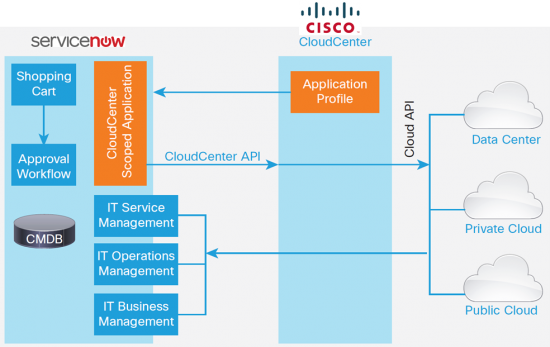
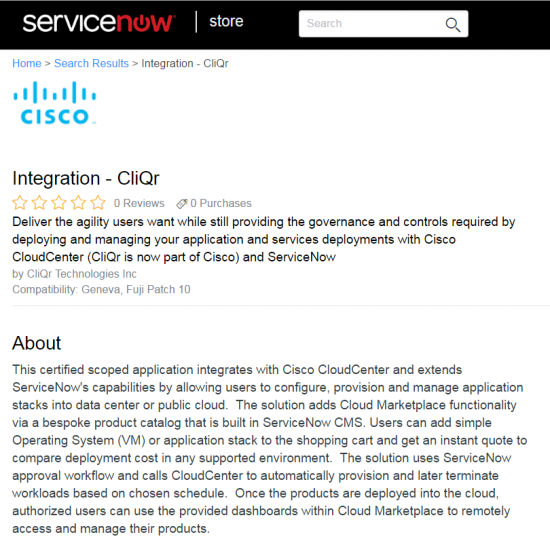
I am ecstatic to announce that ServiceNow has certified our integration with Cisco CloudCenter. The CloudCenter integration is the most extensive ServiceNow certified integration to date. The integration enables the full lifecycle management and self-service on-demand deployment of application stacks and their underlying infrastructures to a wide range of public cloud providers such as AWS, Azure, Google, IBM SoftLayer, Rackspace, as well as private and hybrid cloud providers including Cisco, VMware, OpenStack, CloudStack and HPE Helion.
The CloudCenter integration provides ServiceNow customers the ability to give users on demand fully automated deployment of full application stacks to datacenter or cloud environments. As a result, a user can select a single item, see side-by-side cost comparison of deployment cost in each available environment, and choose where to deploy before submitting their request. This avoids having multiple environment specific items to build and maintain.
The CloudCenter Integration is available as free download in the ServiceNow Store. Services partners such as EngageESM are trained and available to help install and configure the integration in the Americas and EMEA, and already helping CloudCenter customers get integrated. Other partners are coming on board for regional coverage.
How does it work?
The typical IT service request and delivery cycle now looks like:
Publish Application Profile—A service manager can “One Click” publish any existing CloudCenter application profile. A ServiceNow admin then links the application profile to pre-defined groups of users.
Demand Service Request—In ServiceNow, the requestor selects the appropriate item, adds it to their shopping basket, supplies start and end dates, then receives a side-by-side cost comparison for each available cloud. An optional Purchase Order feature lets users identify specific accounts for internal billing.
Approval Workflow—The deploy request is routed via ServiceNow approval workflows including projected cost to help guide their decision.
Automated Deployment—Cisco CloudCenter provisions cloud infrastructure resources through direct communication to the target datacenter or cloud API, and then deploys and orchestrates application images, services, and data.
Status Updates—CloudCenter updates the CMDB. And ServiceNow can receive status and ongoing infrastructure performance updates from Cisco CloudCenter. Combined with information from third-party application performance monitoring and service assurance tools, ServiceNow can log an incident or start a new remediation workflow.
Closing the loop—CloudCenter can scale out applications based on pre-defined rules. At the end of life, CloudCenter manages the termination of the application and infrastructure. CloudCenter updates ServiceNow with any changes.
Early Customer Success
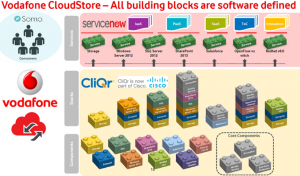
Our customers are telling us that Cisco CloudCenter and ServiceNow bring together two key enablers needed for IT transformation – service management and cloud brokering. One very compelling and representative use case comes from Vodafone. Vodafone has recently launched its
own global cloud platform called Vodafone CloudStore enabled by Cisco CloudCenter and the ServiceNow integration. The Vodafone CloudStore is a self-service cloud service brokerage solution that automates end-to-end 1-click service delivery on any cloud.
Using our integrated solution, Vodafone CloudStore provides its customers with a single global point of access that automates access and consumption of cloud services with streamlined governance and greater visibility of what and how cloud is being used across the business.
The integrated solution provides the following unique benefits:
Model based deployment to any environment (as opposed to script based deployment hard wired to single environment) removes need for cloud specific expertise when creating and publishing application profiles
Side-by-side comparison of expected cost to allow service requestor to choose best deployment environment
Automated management of infrastructure and application lifecycle to reclaim unused datacenter and cloud resources through horizontal scaling application tiers (adding/removing instances) and time-based auto termination
Policy based automation “guardrails” to guide placement and deployment decisions, and run-time actions all through simple policy tag features giving enterprise IT visibility and governance across data centers and clouds
Self-service shopping cart integration that provides deployment to multiple clouds from one ServiceNow catalog item
The key message from the Lego movie is basically this: We don’t succeed or thrive as humans, if we are stuffed into “boxes” with our freedom and creativity constrained. With Cisco CloudCenter and ServiceNow “certified” solution, the “good guys” at IT organizations no longer have to sweat away daily at building and maintaining multiple environment specific service catalog items based on pre-defined templates designed for each specific data center and cloud platform. Let us live free and create our own “Lego” structures on any data center or cloud platform!
Submitted by Kelsey Kusterer Ziser, the Editor of Upskill U at Light Reading.
As more OTT players emerge and consumers demand for mobile video increases, service providers are tasked with rethinking their content delivery infrastructure strategies to ensure quality of experience, performance and reduce latency. The emergence of 5G promises to increase network capacity to better cope with rising video demand, but deployment of 5G is still several years out. In order to meet current bandwidth demands, operators are working more closely with content providers, developing video delivery strategies with virtualization and next-gen technologies in mind, and are seeking out solutions that balance the business case with the bottom line.
In order to take a closer look at the future of video delivery, Light Reading and Cisco are launching a series on Video on June 29 at Upskill U, a free online university providing must-have education on themes relating to the overall business transformation taking place in the communications industry. The Video module will cover how next-gen wireless technologies, 5G, virtualization, OpenStack, and new content delivery practices will shape the future of video delivery.
Tune in to Upskill U for this exciting Video series:
Video: The Next Generation (Wednesday, June 29, 1:00 p.m. ET): Asfaw Negeri, Senior Manager, Solutions Engineering, Tata Communications Transformation Services (TCTS) North America, will explain how the next generation of wireless networks, including 5G, has the potential to broaden broadband data networking and boost demand for mobile video exponentially. This course will give an overview of those next-generation wireless networking technologies, the impact on customers and what they mean for service providers as they look to rule the airwaves.
Video: The OpenStack Approach (Friday, July 1, 1:00 p.m. ET): Matt Caulfield, Principal Engineer, OpenStack, Cisco, will explore the OpenStack approach to transforming the development, integration and implementation of video networking infrastructure for powering some of the most innovative services in the pay-TV market.
Video: Boosting Customer Experience (Wednesday, July 13, 1:00 p.m. ET): Alan Breznick, Cable/Video Practice Leader, Light Reading, will examine how service providers are addressing critical performance enhancements, the impact of video demand on the network and what those enhancements might mean for customers.
Video: The Case for Virtualization (Friday, July 15, 1:00 p.m. ET): In this lecture, Rajeev Raman, Senior Director for Infinite Video, Cisco explains how the key to transforming video delivery is the virtualization and orchestration of video processing and secure delivery of content. This course will highlight the benefits and approach to implementing virtualization and orchestration by focusing on a recent customer case study.
Service providers need flexible, forward-thinking strategies to keep pace with the rapid changes afoot in video demand and delivery. Upskill U is here to provide insight from industry experts on the technology and market drivers shaping the future of video. Join us as we explore the challenges and solutions to better video delivery, and secure your seat for the rest of the exciting courses in Upskill U’s curriculum. I’ll see you on the chat boards: www.lightreading.com/upskillu.










 Data Storytellers: Each month we’ll be highlighting experts and advocates to share their data stories, knowledge, and insights into the future of data and analytics.



 I am ecstatic to announce that ServiceNow has certified our integration with Cisco