We all know the right cloud solutions help organizations improve agility, accelerate time to market, and deliver cost savings. But for customers, it’s not always easy to know where to start. Between public, private, and hybrid cloud solutions, they need to know which choice is best for their business and what to do first. They need a cloud strategy.
According to a new Cisco-sponsored IDC report (“Don’t Get Left Behind: The Business Benefits of Achieving Greater Cloud Adoption”), only 1% of organizations have fully-optimized cloud strategies in place. Only 1%.
Help Customers Build Better Cloud Strategies
Here’s where customers need your expertise. And we want to help you develop this expertise.
Based on in-depth IDC market research and insights from over 3,400 organizations across 17 countries, we developed the Cisco Business Cloud Advisor — a framework to help customers translate in-depth research into actionable cloud adoption plans.
Consider the benefits of showing customers how much they will gain and how much more competitive and productive they will be with a cloud strategy. Collaborating with IDC, we analyzed cloud adoption levels by geography, industry, and company size. Using the Cisco Business Cloud Advisor, you can provide cost and time-to-market improvement estimates based on an organization’s cloud adoption.
Once your customers understand the business benefits of cloud adoption, you can offer concrete recommendations, and strategy that includes real solutions and services — from your portfolio and ours — to help them meet their business needs.
Ecosystem partners are an important adjunct to Cisco Connected Mobile Experience (CMX). They augment the analytic and customer engagement capabilities of the solution with innovative business outcomes. This blog is one in a series that highlights our CMX Ecosystem Partners. Today—Nevotek.
Nevotek integrates IP voice, data, and video into a robust suite of solutions that help companies make the most of their IP assets. Nevotek’s V/IP Connect hospitality solution is focused on enhancing guest experience and has been compatible with Cisco IP phones and Unified Communications Manager for more than fifteen years. Over the last year, this partnership has extended to Cisco Connected Mobile Experiences (CMX). Working with CMX, Nevotek’s V/IP Connect Solution provides the opportunity to offer more personalized location based services to hotel guests.
Ron Graham had served as a Data Center Architect and Systems Engineer for some of the largest IT companies in the U.S. including Cisco Systems, NetApp, Sun Microsystems, and Oracle. He is currently working for Cisco Systems as a Big Data Analytics Engineer.
What I mean is, is your data not being used that much or is the temperature of the data going from hot to cold? Hot data is being used a lot and cold data is being used sparingly. I think every one runs into this problem at some point where they are store cold or frozen data on high performance compute resources. Does it make sense to move unused data to an archive directory as long as it is still in the same cluster and can still be accessed? In the majority of cases this makes sense.
We have hot data and cold data, so what about warm data? Warm data is giving off a moderate degree of heat and data is used less frequently than hot and more than cold. Take a look at the graph below. I interpolated the graph based on tech posting from Ebay and interviews with a former Disney admin.
On the business side, my analysis proved a 15.9% saving in CAPEX for a 1 petabyte (PB) Hadoop cluster. With a hot and cold storage ratio of 4:1, which means that 80% of my data will be on high performance storage platforms and 20% of my data on storage optimized platforms.
A networked connection of people, process, data, and things is transforming healthcare through developments like electronic health records that are customized and secured for each user, giving patients more information about their own medical care.
For consumers, IoE has given rise to an ecosystem of user-enabled health monitoring wearables like Fitbit and Apple Watch, which deliver personalized, data-driven health insights. And healthcare organizations are developing a range of point-of-care technologies to improve patient care and access to needed healthcare.
As we recognize National Breast Cancer Awareness Month in October, we celebrate the survivors and honor those we’ve lost to breast cancer. An area of hope against this cruel disease is the ability of IoE to provide us with data insights to help diagnose and treat breast cancer.
The need is more urgent that ever. The World Health Organization says breast cancer is the most prevalent cancer, killing more than a half million women globally in 2011. The rates of breast cancer are increasing, particularly in developing countries where most cases are diagnosed in late stages.
We see our customers across a range of industries are striving to become digital enterprises. Easier said than done in today’s hyper distributed environments. With over 14 billion devices online today and 50 billion expected by 2020, the exponential increase of data is being created by people and processes connecting from everywhere. It is becoming harder to reach that data, secure that data, and much less draw an insight and enable a person or process to take action on the data. The ability to secure, aggregate, automate, and draw insights from an organization’s own data – with speed – will define value for that organization.
At Cisco, we are making investments in software for analytics and automation to enable our customers to pull data from everywhere for real-time insights, integrate and automate increasingly complex systems and processes, and engage people in context. This is what it means to be a digital enterprise. This new blog platform will serve as an open forum for discussion on multiple topics related to analytics and automation, news and updates from Cisco as well as stories of success from our customers and partners.
I encourage you to actively participate by sharing your own challenges, best practices and topics you would like to see explored.
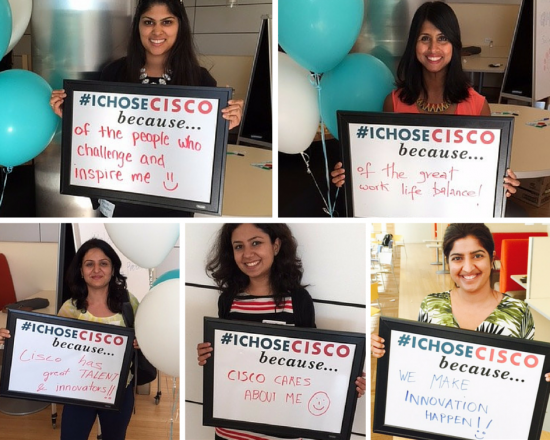
Cisco employees, who also happen to be women technologists, are gearing up to attend/speak/participate in the Grace Hopper Celebration of Women in Computing in October. During the conference, upcoming women technologists will be receiving lots of career advice.
Some members of the Cisco WISE employee resource organization (Women in Science and Engineering) are already prepared. Their advice works not only for women in technology, but for all technologists.
Never give up. You’ve worked so hard and don’t let it stop you from reaching your goal. – Cisco IT AnalystSabina Chaudhuri
Network. This is how I got into Cisco. – Cisco Software Engineer Sharmila Palani
Believe in yourself. Understand your capabilities and do not be afraid of exploring new opportunities. – Sr. IT Engineer Noela Botelho
Be yourself and SPEAK UP! – Cisco Software EngineerDena Madhwani
Be confident, be passionate, achieve! – Cisco Manager Software Development Engineering Nita Laad
Never give up on your dreams. –Cisco Software Engineer Rehka Rawat
Be Fearless! – Cisco Software Engineer Avni Baveja– (who came to Cisco through a previous Grace Hopper event!)
Pay it forward – all of the Cisco WISE members share a passion for inspiring the next generation of women in tech. Cisco Software Engineer Sheetal Bhogale says “ We NEED to see more women in Technology.” And Cisco Software Engineer Rimu Bhardwaj, says “Cisco has a wide variety of fields that people can work in. It is hip and has lots of perks! Cisco is definitely cool!”
…We lived in a world where each and every child has equal access to a quality education…
…A place where all students can learn new and innovative skills, setting them up for success, even in this ever-changing world that we live in today…
With the amazing technological advancements that have happened in what seems like the blink of an eye, shouldn’t you ask yourself ‘why not’ rather than ‘what if’?
We’re now faced with an unprecedented wealth of data, and the exponential growth in the development of new knowledge is challenging institutions to rethink teaching and learning on a massive scale. The global population is booming, and there is a need to reach each student and prepare the next generation for an increasingly complex and competitive work environment.
The digital era and the Internet of Everything are already radically changing the way most of us live our lives. Technology is allowing us to take a fresh look at the challenges that we face and opening our eyes anew. Whether it’s ensuring access to education in the most remote corners of the globe or using technology to complement traditional learning in fun and creative ways, a digital classroom experience is helping to ensure that students all around the world can truly learn without limits.
Guest Blog by Igor Dayen, SP Product and Solutions Marketing
Optical transport has been transformed as integrated high-performance Digital Signal Processing has enabled vendors such as Cisco to squeeze more capacity at greater distances than ever before. Advanced modulation techniques and Forward Error Correction are now commonly deployed. Cisco NCS 2000 platform can drive up to 140 channels, ranging up to 200 Gbps each, with the ability to drive 100 Gbps channels to over 4000 km.
Now we’re seeing the same concept appear in the cable space as DOCIS 3.1 sets the stage for new levels of both HFC throughput and capacity optimization. Imagine being able to get an extra 20%-30% of bandwidth out of your existing cable plant without replacing it? DOCIS 3.1 promises to make this a reality.
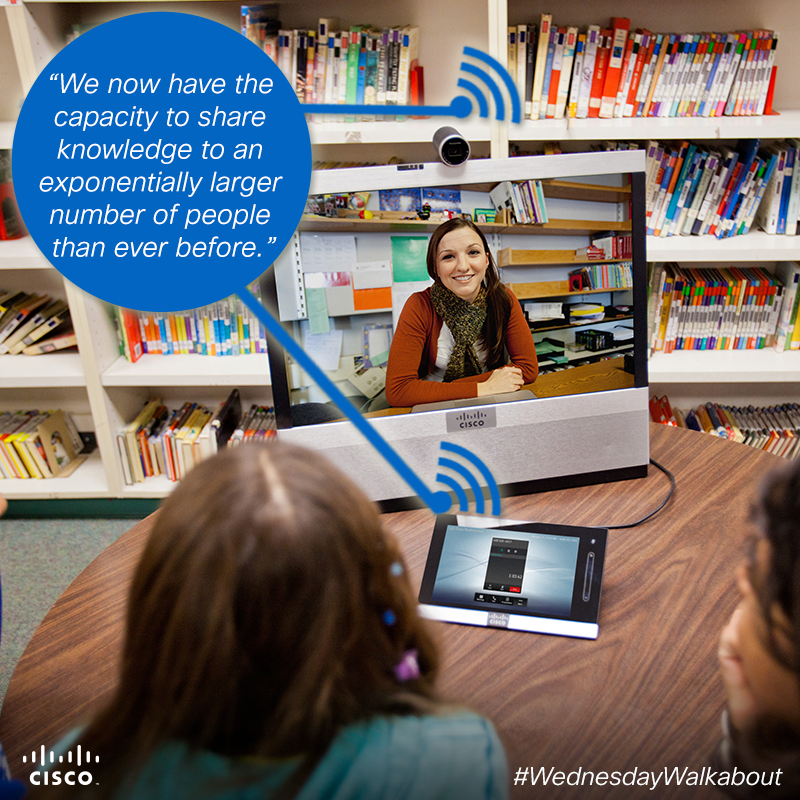
Today’s new technology trends, particularly those around digitization and the Internet of Everything, present education with an unprecedented amplifier. We now have the capacity to share knowledge to an exponentially larger number of people than ever before.
Literacy and the quest for knowledge are basic human rights that are currently unequally distributed among the world’s population. Despite global efforts, access to basic schooling and life-long learning is still far from a reality for many in today’s environment. And a lack of foundational education hinders economic prosperity, perpetuating levels of poverty in the world’s poorest societies. However, the digital age is shining new hope. Technology advancements offer significant opportunities to improve access to learning and opportunities to address the learning disparities in underserved populations, encouraging the movement toward wider education equity. Not only is technology closing the knowledge gap, but it is also providing new and innovative ways to teach and to learn. In complementing traditional methods, technology can truly be a value-add on how you provide and absorb knowledge.
https://www.youtube.com/watch?v=UVOsnat-19E
All Those in Favor of Learning Say ‘Aye’
Last week, we met brave ten-year-old Thorben, who is battling cancer. The Internet of Everything is connecting Thorben to his classmates in a way that is as close as possible to being there in person. For Thorben and many UKE Hamburg patients, digital technologies are creating a quality of life and reducing the feelings of isolation from normal life prior to their diagnoses.
This week, our digital citizen, like Thorben, is a child in pursuit of connecting with teachers and platforms for learning. Education is the foundation of any modern society; and in today’s post, we’ll explore how digital learning is an evolutionary step in education.
For our citizen, like many around the world, conventional classrooms can be prohibitively expensive, both to build and to attend. However, open access to improved technology is changing that and allowing for learning to be undertaken from anywhere at anytime. India’s Amrita University experienced similar challenges in educating those in remote locations. To address this, the University staff conducted both online and onsite courses, walking attendees through the same lesson plan as if the physical and digital worlds had merged into one.
Skip forward a few years and our digital citizen is struggling with balancing a job and finishing a university education. However, like in what San Jose State University (SJSU) is calling the “next-generation classroom”, many learning institutions are removing the need to attend a course in person, eliminating travel time and costs. Immersive video lecture systems allow universities like SJSU educators to exchange teaching opportunities with students and visiting lecturers around the world within the classroom. Participants can see and hear one another, and participate live in the education process regardless of location.
So what about ingenious ways of educating young minds? Our digital citizen, like so many young people, is looking for new and exciting ways to learn. Schools, like Camberwell Girls Grammar in Australia, are taking advantage of the digital movement and creating an environment for students to thrive by teaching them new skills of creativity, collaboration, and how to be innovative in their approach to learning.
Speaking of those new and innovative skills, our citizen is on the career hunt and the need for Information and Communications Technology (ICT) professionals is rapidly increasing. Workforce training programs are helping to provide unparalleled economic and societal contributions to communities and countries by having a more skilled and entrepreneurial workforce. Like Cisco’s Network Academy, which provides critical ICT education to more than 1 million students a year throughout the world – using that very technology to deliver the curriculum content.
The digital era is propelling us into a world where learning is embedded into daily life and no longer associated with traditional classrooms and school buildings. And education is on the move. The traditional model of knowledge-transfer is adapting to a collaborative, self-directed, engaging, and even customizable method that is helping to prepare students to succeed in today’s learning society.
Next Stop
Stay tuned for next Wednesday’s post. And be sure to check back each week as we explore new themes, challenges and observations.
Additionally, you can click here and register now to get your questions answered on how to become the next digital community.
Finally, we invite you to be a part of the conversation by using the hashtag #WednesdayWalkabout and by following @CiscoGovt and @CiscoEDU on Twitter. For more information and additional examples, visit our Smart+Connected Communities, Education, and our Government pages on Cisco.com. Enjoy the Wednesday walkabout!






![Ron_graham[1]](https://blogs.cisco.com/gcs/ciscoblogs/1/Ron_graham1.jpg)



 secure that data, and much less draw an insight and enable a person or process to take action on the data. The ability to secure, aggregate, automate, and draw insights from an organization’s own data – with speed – will define value for that organization.