Avatar

digitalindustries banner

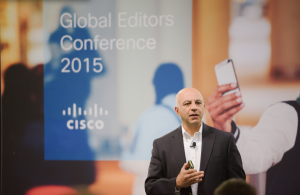
Today’s announcement of Cisco’s Digital Solutions for Industries at the Global Editor’s Conference highlights our unique approach to help customers capture the promise of digitization. As Tony Shakib’s blog notes, “Digital transformation necessitates a combining of business and IT strategy that connects everything, embraces analytics, and takes a holistic approach to data security that spans technology and operations.”

Digital disruption is already happening across manufacturing and other industrial sectors, and we’re stepping up to help businesses in these segments harness the benefits of digitization across their value chains. For example, using innovative models like machines securely connected (thru Cisco Connected Machines) for real-time monitoring and analytics across Cisco’s Intercloud, digital manufacturers are optimizing their plant operations with improved control, increased efficiency, less downtime, higher productivity and duty cycles, and more flexible manufacturing.

Research suggests that a significant number—as many as 40 percent—of incumbents will be left wounded, probably mortally, by digital disruption over the next five years. In the face of these pressures, CEOs recognize that those companies who can leverage digital technologies and business models will come out ahead. This video provides an overview on the challenges, opportunities and benefits of Digital Manufacturing:

https://www.youtube.com/watch?v=EFcjyc-Dlqk&feature=youtu.be

For forward-thinking manufacturers, digital transformation is not just a new challenge but a major opportunity—maybe the most significant in decades—to pull ahead of competitors. Digital Manufacturers are seizing the opportunity Continue reading “Digital Manufacturing: Transforming Your Business Model”

Authors

Chet Namboodri

Senior Director

Global Private Sector Industries Marketing

Avatar

“Networking is my idea of hell.”

These are the exact words spoken by a woman attendee at a recent event where I gave a talk about the importance of networking.

Her sentiments are echoed by many professional women who have experienced a traditional networking approach, which is:

a) based on entering a crowded room full of strangers and making small talk

b) scheduled on evenings and weekends, making it impossible to fit in around family commitments and

c) centred on male-oriented activities like rugby and golf

No wonder so many women shudder when they’re told they need to “network” in order to advance their careers. What’s more alarming is that this approach doesn’t even work for us. A recent HBR article, Why Networking More is Bad Advice For Women,” dissects several research studies which prove that standard approaches to getting ahead fail women – and can even backfire. The article’s author, Sarah Green Carmichael, concludes: “To me, the upshot of all of this research is increasingly clear: we need to stop telling women to follow a male playbook.”

What if women rewrote the playbook?

Clearly, there has to be a better way. But what does “good” networking look like? How can we make it more palatable to – and productive for – professional women. Here are five strategies that have worked for me:

1. Start with giving

The key to successful networking for women is adapting a completely different mindset: one that is based on giving vs. getting.   The famous law of reciprocity! A Fast Company article, “A Networking Paradigm Shift: Focus on Giving Not Taking,” explains it quite well: Networking from a giving rather than a getting perspective is “a much more empowered way to think about your career: It forces you to realize that you are not a needy person who has to rely on others to succeed, and focuses on the many things you have to offer the world.”

2. Join a women’s networking group

By design, many women-centric networking groups provide a supportive environment and operate according to the “give vs. get” philosophy. At Cisco, I’m the global and EMEAR co-lead for Connected Women, a global community at Cisco formed by volunteers to attract, develop, retain, and celebrate talented women as part of a competitive and diverse workforce.  It isn’t an “HR initiative” – it’s run by women who all have a day job and who give up their time to proactively share experiences and to help and support other women.

Another terrific women’s networking resource is WeAreTheCity, a website and organisation that promotes female-related networks, events, and training in the UK. In a recent BBC Radio 4 interview, WeAreTheCity’s Founder Vanessa Vallely offered this advice:   “Don’t put too much emphasis on the word networking. It’s the art of having a conversation with someone and being inquisitive and getting to know them.”

3. Embrace digital networking

Many women who don’t enjoy traditional in-person networking are absolutely daunted by digital networking. But this need not be the case – especially if you take a “what can I give/what can I learn” stance.

Using social platforms like LinkedIn, Twitter, and Facebook is a brilliant way to surround yourself with supportive, varied, and incredibly knowledgeable people –not just people who can “deliver.” Vanessa DiMauro, CEO of Leader Networks, has just published a great article “Who’s afraid of Digital Networking? Women?”. She advises us “what works in-person also works online.  So when you approach the social world, put aside your fears and misconceptions and remember that there’s a person behind every worthwhile social media account”.

In fact, a diverse network may be critical to generating innovative ideas, according to a new recent study on Twitter conducted by MIT’s Sloan School of Management.   Another study, by Facebook’s data team, shows that it’s easier than ever to find and make connections with interesting people – regardless of where in the world they’re located.

The takeaway? People are on social networking platforms because they want to share. There’s very little small talk. And, because you can do it wherever, whenever, it may be a better fit for working mothers.

4. Stay in touch

Everyone has a pre-existing network of colleagues, former classmates, and industry acquaintances. But, like any relationship, your network needs attention in order to thrive. So stay in touch with people – through both physical and virtual means – on a regular basis, not just when you need something.

Connect with people on LinkedIn to see what they’re up to. Have drinks with people you used to work with. Go to your university reunions – or give talks at alumni events. Retain the mind-set of having conversations instead of extracting favours. And remember – treat people well, up and down the food chain. After all, your former employee could be your next boss.

5. Perform random acts of kindness

To be successful at “give-driven” networking, you have to actually care about other people’s success instead of just your own – and you have to show it. Strengthen your network through small, day-to-day acts: help head-hunters when they call, recommend people on LinkedIn, tweet about people’s books or blog posts, send a congratulatory note to someone who received a promotion or started a new job.

This process does not have to be overly time consuming. Keep your finger on your network’s pulse with a service like Newsle (now part of LinkedIn) – it scans your contacts and notifies you when someone you know is “in the news.” Random acts of kindness have a boomerang effect – the goodwill you extend will eventually come back to you.

Where to from here?

Personally, I’ve always placed huge value on networking and have made the effort, even when sometimes I didn’t feel like doing so. The kind of ‘old-style’ networking that is driven by uncomfortable, inconvenient, needs-based transactions quite frankly is my idea of hell too. So let’s invent a new way of networking that doesn’t fill us with dread, based on supportive, dynamic, relationship-building interactions. Sounds much more like my cup of tea. What do you think?

Authors

Dr. Christine Bailey

Marketing Director

EMEAR

Avatar

Steam Carnival

High-tech games. Creation zones – where you can create to your heart’s content – aerialists, food (of course) and . . . a dunk booth with fire?! These are all things you’ll find at STEAM Carnival, November 6-8 in San Francisco at AT&T Park. You’ll also find Cisco there, as a key sponsor (along with Cartoon Network!) of all the fun.

Like any carnival, there’s fun for the whole family, but there’s a specific focus on getting kids excited about making, learning, arts, technology, science, invention and innovation. In other words, just having a grand time!

There are going to be so many cool Cisco happenings at the STEAM Carnival. Discover, Explore, Play and Create are the three areas you’ll find Cisco participating – with over 50 employee volunteers. There will also be 8 Cisco Net Academy students to help with the Cisco network at the event, but also to talk to their peers and younger students about where technology can take them.

STEAM Carnival

In the Discover area, we’ll have TP tents to demonstrate the technology behind Cisco’s telepresence. (Maybe you’ll get to connect to other makers locally, or around the globe!) When you visit the Explore area, you’ll find “secret society” workbooks where there are puzzles to unlock, and ways to think about what the future could hold. In the Create area, you’ll find Cisco’s own Shubha Govil, senior manager of products for Webex and her son Omkar showing kids how they can become creators (more on them later this week on the blog. Stay tuned!)

What gets our employees excited about the event?

“It’s about unstructured learning and exploring things on their own,” Shubha says. “The insight gained by trying, failing, and re-trying to make things work brings a great level of confidence in kids to keep them innovating and creating.”

“We are thrilled to partner with 2BC and the Cartoon Network to ignite the interest and curiosity of young minds through play,” says Karen Morris, Head of Talent Acquisition Strategy and Innovation (with a focus on STEAM). “Our industry and partners are in need of talent that are problems solvers, creative, collaborative, and that have critical and design thinking skills.  STEAM Carnival is a place where children will exercise all these skills in a playful environment.   We can’t wait to meet and engage with our next generation of talent at STEAM Carnival, and to see them experience critical aha-ha moments.”

“STEAM fuels the innovations that we need to progress as a society, preparing the next generation of entrepreneurs, doctors, rocket scientists, developers and more,” Says Lauren Cooney, senior director, strategic programs for Cisco’s Chief Technology & Architecture Office.  “STEAM Carnival is a great way to jump-start the next generation’s interest in this movement.”

If you’re in San Francisco, meet us at AT&T Park for three days of family fun, employee fun and learning fun. If you’re not in San Francisco or can’t join us there for the fun, here’s a fun STEAM activity either you can try, or try with your family. It’s Art Bot! Learn how to create him.

Authors

Carmen Shirkey Collins

Social Media Manager

Talent Brand and Enablement Team, HR

Avatar

Today, Cisco is pleased that the United States and 11 other countries in the Asia Pacific region concluded negotiation of the Transpacific Partnership (TPP) Agreement. We are eager to review the details of the Agreement when the Office of the United States Trade Representative (USTR) releases the final text in the coming weeks.

“TPP represents an important opportunity to lower trade barriers on technology goods and services, which benefits not just the producers, but more importantly, the users of cutting-edge technology,” stated Jennifer Sanford, Cisco’s Senior Manager of International Trade Policy.

“Cisco congratulates Ambassador Froman and the entire interagency team for securing commitments that will benefit the tech sector and the growth of digital trade in the region,” added Sanford.

“We look forward to working with our counterparts in the tech sector to evaluate the final deal and to engage Congress in its consideration of TPP implementing legislation,” concluded Sanford.

For more information about TPP, see the USTR Fact Sheets.

Authors

Jennifer Sanford

Senior Director, International Trade Policy

Cisco Global Policy and Government Affairs

Avatar

Cisco is committed to protecting customers by sharing critical security-related information in different formats. Guided by customer feedback, Cisco’s Product Security Incident Response Team (PSIRT) is seeking ways to improve how we communicate information about Cisco product vulnerabilities to our Customers and Partners.  As John Stewart mentioned on his blog post, the Cisco PSIRT has launched a new and improved security vulnerability disclosure format. The new Cisco Security Advisories can be accessed at http://www.cisco.com/go/psirt and at http://cisco.com/security

The intent is to make it easier for Customers and Partners to access information about all security vulnerabilities in Cisco products. Each vulnerability disclosed through our new security advisories are assigned a Common Vulnerability and Exposures (CVE) identifier to aid in identification. Additionally, Cisco will continue to assess all vulnerabilities using the Common Vulnerability Scoring System (CVSS). Check out the sites for CVE, CVSS, and this CVSS scoring calculator if these terms are relatively new to you or you simply need a refresher.

Continue reading “Improvements to Cisco’s Security Vulnerability Disclosures”

Authors

Omar Santos

Distinguished Engineer

Cisco Product Security Incident Response Team (PSIRT) Security Research and Operations

Avatar

All of us have hobbies and some have passions. And then there are causes, which many of us are passionate about. I have a special place in my heart for making a difference in anything to do with healthcare.

I obtained my Master’s degree in Child Psychology. I realized that most of my student projects pivoted around activities like spending time with and reading stories to sick children in hospitals. And teaching families in rural areas about healthy living and good nutrition. My project reports were quoted as examples of near ideal written pieces that other students could emulate. The seed was sown.

I started my career with writing, mostly on health, fitness, nutrition among many other topics. I critiqued books on health, care, and life. As I progressed in my career, I moved into IT marketing. I could feel my satisfaction levels peaking when I could bring technology and healthcare closer together. Technology can improve healthcare access and delivery. It’s especially impactful in rural areas where the nearest hospital or clinic could be hours away.

The Promise of Technology-driven Healthcare
There is no doubt that technological advancements are transforming the entire healthcare industry. The proliferation of new collaboration technologies is helping to address issues such as:

Continue reading “Changing the Future of Healthcare with Collaboration”

Authors

Smita Dave

Sr Marketing Manager

Collaboration Solutions Marketing

Avatar

In a recent blog  written by Mala Anand, she discussed how hyper-distribution of assets in organizations is creating demands for new insights and enabling new interactions and experiences across every industry. Mala shared how our hyper-distributed world has created remote centers of data which require access by people and processes within and beyond your organization. And, it is your ability to connect data, connect processes and connect experiences that will be the cornerstone to succeeding in this new digital era. Through this blog, I want to focus on some of the top considerations when deploying and integrating systems and processes in today’s complex hyper distributed environment.

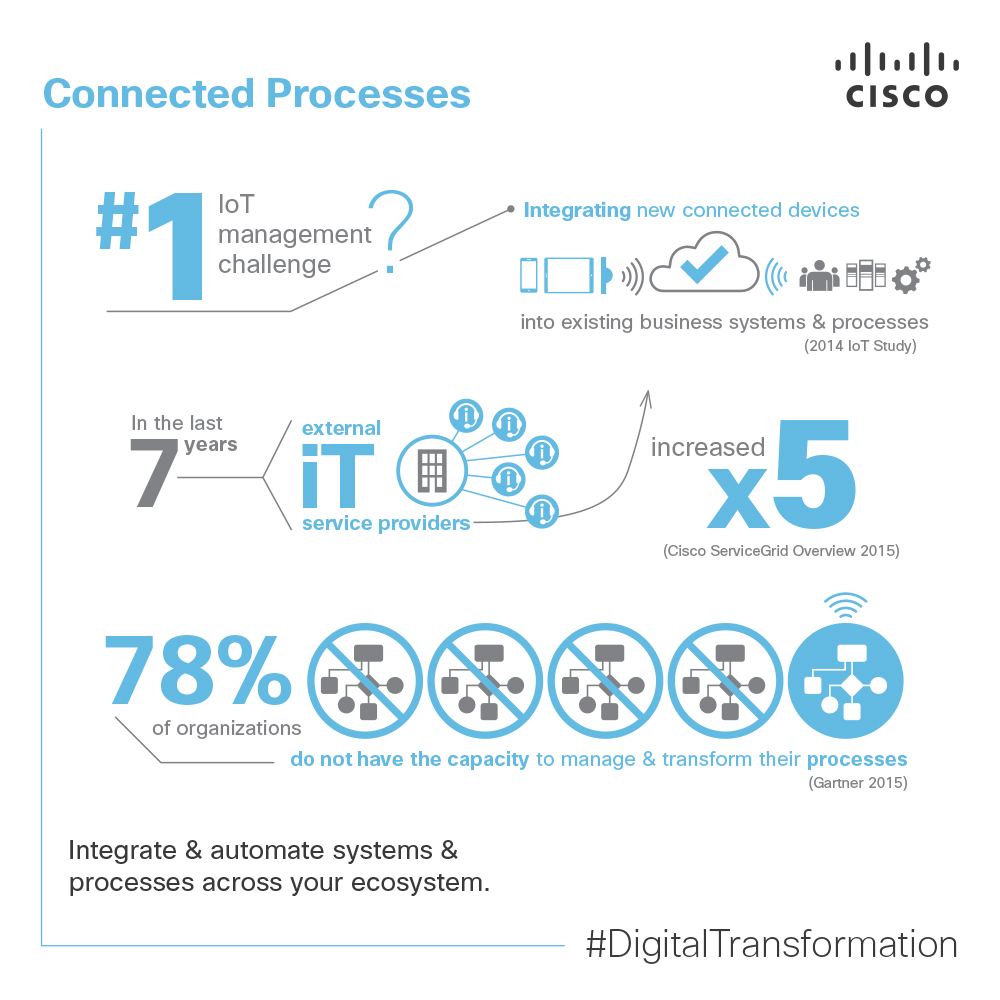
Surviving in this hyper-distributed and digital era requires new levels of business agility and re-imagining existing processes. Yet there exists a big divide. A report published by Gartner Research Consulting—Cisco IoE Engagement Findings, December 2014 states: “78% of organizations have not yet established the capability to manage and transform processes across different parts of their organization.” This transformation requires extending the value of existing infrastructure; integrating partner ecosystems to streamline and automate processes within your enterprise and across your value chain of partners, service providers and customers.

Cisco_DigitalBusiness-Infographic1 process
Figure 1: The importance of integration.

Here are some key considerations as you embark on this journey:

Continue reading “A New Approach to Connect Processes in a Hyper-distributed World”

Authors

Hari Harikrishnan

Vice President

Application Platforms Group

Avatar

Since taking over as CEO, I have spent a lot of my time listening. I’ve met with customers, partners, government leaders, investors, and Cisco’s employees.   Each conversation yielded new insights and fueled my continued optimism about our future. What I have learned has not only helped solidify my thinking, but has enabled our entire leadership team to move quickly to define our differentiated strategy to lead the digital future.

Today, it’s a given that every customer is using technology to enable their business. But some customers view technology as a real differentiator for their business, and the most progressive define their strategy in the context of what technology makes possible.  In doing so, they drive competitive differentiation and, in many cases, define new business models.

On a visit to our Customer Experience Center in San Jose last week, one of our financial services customers told me he defined his organization as an outstanding technology company that secondarily happens to be very good at banking. This customer, like many others, has recognized the role that technology can play in enabling phenomenal customer experiences. In his case, the reach of financial expertise and the ability to securely deliver differentiated services is only limited by the reach of his private network and the Internet. Based on this understanding, he wants Cisco to be his partner in this digital transformation.

The strong belief in technology’s transformative power isn’t just restricted to business leaders. It extends to governments as well.  India’s Prime Minster Narendra Modi is laser-focused on leveraging technology to improve the lives of India’s citizens, and he recognizes his partnership with Cisco as critical in moving his Digital India agenda forward and creating a fully connected society, a knowledge economy, and unlocking the power of India on a global scale.

Our opportunity is clear: Cisco can be the most strategic partner to cities, countries and all of our customers on this digital journey.  Frankly, every organization recognizes the transformative power that technology can provide, but our research shows that only 25 percent of companies and governments say they have a plan to execute on that opportunity. These organizations that have a plan need our help to deliver the ultimate benefits. The remaining 75 percent need our help in clearly defining the opportunity that exists for each one of them.

Continue reading “Why Cisco is the Most Strategic Digital Partner”

Authors

Chuck Robbins

Chair and Chief Executive Officer

Cisco Systems, Inc.

Avatar

I am thrilled to be the first to announce our 15 semi-finalists in Cisco’s second annual Innovation Grand Challenge. Culled from more than 3,000 entries in over 100 countries since June, I can sum up the semi-finalists’ innovations in one word: Disruptors.

Innovation signI want to congratulate all the semi-finalists for making it this far. It gives me tremendous pleasure to identify them below. I wish all of these bold pioneers much success in the weeks ahead as we begin the countdown to the three winners in early December at the IoT World Forum in Dubai.

Will One Be the Next Uber?

Will one of the semi-finalists emerge as the next Uber, Airbnb or Pandora that disrupts and transforms whole markets with unforeseen business models? By looking over these entries, which leverage the possibilities of the Internet of Things (IoT), I can easily imagine this distinct possibility.

These IoT trailblazers also validate my view that today’s daring new developments can come from anywhere in the world. These 15 are dispersed throughout North and South America as well as Europe, including Argentina, Canada, Finland, France, Germany, the United Kingdom and the United States.

Another observation is the power and potential of converging technologies around IoT have captured the attention and imagination of the entrepreneurial community worldwide, reflecting the growing trend of globalization and diversity of technical talent.

Continue reading “IoT Disruptors: Announcing Innovation Grand Challenge Semi-Finalists”

Authors

Alex Goryachev

Senior Director, Innovation Strategy & Programs

Corporate Strategic Innovation Group