Thank you for your service to our country. Thank you for the sacrifices you make for all of us. And thank you for our freedoms.
With all of you, past and present, we have an amazing country in which to live, liberties many others do not experience, and the opportunities many others are not afforded. You’ve made this great country possible from those that dreamed what it could be.
As a National Honoring, every November 11th at exactly 11am, a color guard comprised of a member from each of the military branches, at the Tomb of the Unknown Soldier in the Arlington National Cemetery salutes and honors our Veterans. It’s a beautiful ceremony and true dedication to our Veterans.
So today, I ask that we all take the 11 o’clock hour and stop checking off our ‘to do list’, hang up the phone, put down our computer and honor, thank, and support our Veterans any way you can.
It does not have to be big; the littlest of gestures often have a far greater impact. Buy a cup of coffee for a Veteran. Walk over to your fellow co-worker who happens to be a Veteran and thank them for their service. Maybe find a veteran cause such as Wounded Warriors or Operation HomeFront and make a donation.
And while I know many of you already keep our service men and women in mind and honor them daily, today is their day, like a birthday, so let’s make it special.
As a company, supporting Veterans is a key priority of our culture and employees. We are involved in and have many wonderful programs that focus on supporting our Veterans.
This November 19th (November 13th in San Jose), we are hosting a Veterans Career Transitioning Day across various Cisco locations: San Jose, CA, San Antonio, TX, Research Triangle Park, NC,Englewood, CO, and Washington DC. Local employee groups and some of our supporting Partners are holding this event to provide Veterans with information and resources to help them transition from service into civilian life.
EDUCAUSE is always one of my favorite conferences, and this year was no exception. While many of the discussion topics weren’t new, they did focus on issues that are gaining steam, such as mobile device management (MDM) and how to prevent cybersecurity breaches. Last week, I shared some of the things I was hearing on the show floor. Now that EDUCAUSE 2015 has wrapped, and I’ve had some time to reflect, I wanted to share a little more about what I learned.
I was lucky enough to speak with a number of educators, IT professionals, and members of the media about trending topics in higher education IT. One of the highlights included a conversation with Campus Technology and Dr. Lance Ford. Dr. Ford is a former teacher and technology coordinator for Howe Public Schools in Oklahoma. The Campus Technology team joined us to discuss the complexity of cybersecurity for students, faculty, and staff. Additionally, the Cisco team was interviewed on-camera by EdTech: Focus on Higher-Ed to discuss the use of collaboration tools in higher education. Check out the photo above and video here of our senior engineer, Kevin Livingston, talking shop with EdTech!
In all of my conversations, I repeatedly heard the challenge that university leaders are having with the demands that mobile technologies are placing on universities. Today, students are bringing an average of seven to 10 devices to campus, which puts a huge strain on university networks. My conversations with reporters included solutions on how campuses can prepare for the burden of mobility with new technologies to better manage and support mobile networks. Additionally, as classrooms swell with students who are connected 24/7, faculty are wrestling with how to integrate mobility into their courses. How can educators benefit from mobile integration, without creating distractions? It will be interesting to see how universities address mobile expansion, and it’s something we’ll be hearing a lot more about in 2016.
While I loved talking with different educators about how Cisco technology can help them meet their goals, one of the topics that grabbed attention on the floor was the Cisco Network Academy. Cisco is an education company, and the Cisco Network Academy is an IT skills and career building program that helps students succeed in the post-graduate world. Today’s digital natives are tomorrow’s global citizens, and to bring our students into leadership roles, we must give them opportunities – as early as possible – to build skills essential to their future. Check out more about the Cisco Network Academy here!
Overall, EDUCAUSE 2015 was filled with enlightening and engaging conversations between universities, technology companies, and the media about the major trends in education IT. What new problems are universities facing? And how can we use technology to address these issues? By thinking creatively about how technology tools that support education, we all have the power to help our students Learn Without Limits. If you attended EDUCAUSE this year, let me know about your experience – I’d love to hear your thoughts!
Partners often ask me, “How much can I make on services?”
It’s a great question. The answer is almost always, “More than you’re making right now!”
Let’s start with the sheer size of the services market. According to IDC, this will be over a $1 trillion market in less than five years.
Partner service bookings are growing—that’s the great news. Rebates are growing even faster. But most partners are still only getting 20-50% of the rebates they could be earning. We’re working harder than ever to make it easy to earn your share of the services market.
How much opportunity can you realize with smart services? Axcess, a Cisco partner, says, “We’re seeing growth of more than 40% smart services in a market that’s more or less static.”
When you take advantage of incentives on top of your base services rebate, the money adds up fast. Right now, there are several additional incentives available to registered partners:
Innovative services that strengthen your relationship with customers
Selling smart services is really being more proactive about network health. Instead of reacting to problems, smart services collect information that can help prevent network issues from happening in the first place. They identify products that are not covered by service contracts, which can have major consequences if the device fails.
You can also provide customers with reports that can help prioritize network optimization and planning. This can lead to more strategic, forward-looking discussions about a customer’s business and technology needs—which means new product sales and enhanced services offers.
Today in the United States is Veterans Day, where we give thanks to the millions of veterans who have served our country in wartime and peace. Originally called Armistice Day in honor of the cessation of hostilities between the Allied nations and Germany in World War 1 on the 11th hour of the 11th day of November 1918, Congress changed the name to Veterans Day in 1954 to honor American veterans of all wars.
In June 2011, Cisco started a corporate veterans program focused on helping veterans find career jobs and establishing career training resources. The veterans program augments Cisco’s successful employee organization, the Veterans Enablement and Troop Support Employee Resource Organization (Vets ERO). The Vets ERO consists of eight chapters and supports service members, active and retired, here and abroad, by creating greater awareness of veteran causes and helping veterans connect in our workplace and their local community. Two key activities of the Vets ERO are their annual mid-November Veterans Career Technology Day and mentoring.
Cloud applications are revolutionizing the way your employees can do their work. They enable Bring-Your-Own-Device (BYOD), are inherently mobile, can be up and running in minutes, and allow users to collaborate with anyone from anywhere to get their jobs done. It’s no wonder that cloud app adoption is growing at unprecedented rates. According to Forrester, breakthrough productivity gains are expected to drive the cloud app market to reach over $130 billion by 2020. But along with these benefits, cloud apps also carry unseen dangers: data leakage, insider threats, and compliance failures. These risks stem from four challenges that IT administrators face as cloud apps become a standard tool to help employees get their jobs done.
1 – Cloud App Visibility. Because cloud apps are so fast, easy, and affordable to deploy, many IT administrators are facing a problem of Shadow IT – employees using unsanctioned apps and bypassing IT security controls. Even Line of Business heads can approve cloud apps for entire departments to use, rolling out a new tool without the IT team knowing anything about it. Shadow IT inhibits SaaS visibility; IT can’t see which apps are being used so they can’t identify risky apps and are powerless to set informed app controls.
Cisco Cloud Access Security (CAS) provides visibility by presenting a complete list of all cloud apps that employees are using. This is a major step toward solving the Shadow IT problem. But CAS goes even further, providing a risk score associated with each cloud app based on 60+ attributes that are weighted according to the risk profile of the business. A cloud app that is considered “enterprise quality” supports multiple enterprise security requirements. With a complete list of cloud apps and their associated scores, IT administrators can decide whether a cloud app should be sanctioned or should be blocked.
One of the biggest disruptions in the IT world is upon us. 10 years ago it was server virtualization, more recently the adoption of cloud – both private and public. One could argue that cloud adoption is still ongoing. But I think a more fundamental disruption is happening with the way applications are going to be built, deployed and operated in the future.
By now, almost everyone is familiar with the industry buzzwords such as containers/Docker, microservices and DevOps, etc. We are in some ways skeptical of these buzzwords as we have seen many fizzle over longer term. But, these technologies/architectures enable the enterprise to build cloud-native applications and run them at scale. They will help organizations make the most of public and private cloud deployment and will result in cloud adoption increasing exponentially.
Many still believe that the primary benefits of containers come from the technology optimizations that they bring when compared to Virtual Machines (VMs). For instance, the significant scale increase (more than 10x per host density), smaller footprint (memory, CPU, hard disk) or the faster creation and destroy cycle (milliseconds vs. minutes). But while these things are indeed very relevant, the real benefits are broader than just infrastructure advantages. The two main benefits are, first how the container technology is ideally suited to enable newer ways to develop applications (continuous integration and development) and secondly how you can scale applications (through microservices architecture) and port them between different infrastructure environments (public or private).
Microservices architectures are transforming the way applications are architected and built. I can remember the days when I could never wait for our IT to role out an update to my favorite application because the timelines were always in multiple months if not years. Hopefully, those days are going to be a thing of the past with the current ability to construct applications in a more easily developable/updatable/scalable microservices framework.
Although there are numerous projects and tools available in the market place in order for IT to set up the infrastructure, there is still need for admins to be able to specify the infrastructure operational policies around network, storage, security, compute for the containerized applications in an automated way and have those policies be implemented across infrastructure consistently. If no such mechanism exists, we could have resource contention between production and development applications or security violations between different applications/tenants and overall unpredictable application performance. We believe there has to be better way for containerized applications to run in a shared infrastructure.
Introducing Project Contiv
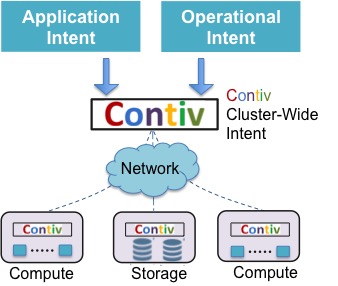
Project Contiv is an open source project defining infrastructure operational policies for container-based application deployment. Application intent, such as docker compose, allows for declarative specification for an application’s microsevices composition. Project Contiv compliments application intent with the ability to specifyinfrastructure operational policies for network, storage and compute elements of the physical and virtual infrastructure by directly mapping the application intent, with the infrastructure policy required.
Project Contiv Architecture
So what are some of the infrastructure operational policies that most IT organization expects to specify for containerized applications?
Security policies for applications for inbound/outbound as well as within application tiers
Physical infrastructure policies around bandwidth limit/guarantee per container, latency requirements, etc.
IP allocation management (IPAM) policies
Storage policies around persistence storage, volume allocation, snapshotting etc.
Compute policies around performance requirements/off-load (to NIC or Network) and SLA etc.
Corporate and government compliance policies
So with Project Contiv, we hope to help you optimize and achieve saner shared infrastructure for your various containerized applications.
We believe the best way to go about achieving this objective is to build a community of similar minded people to join the Project Contiv and contribute at http://contiv.github.io/ to enable enterprise grade applications to be adopted more rapidly.
Currently there are two projects that enable networking and storage for docker based container deployment.
Contiv Networking is a container network plugin to provide infrastructure and security policies for a multi-tenant microservices deployment, while providing integration to physical network for communicating with non-container workload. Contiv Networking implements the remote driver and IPAM APIs available in Docker 1.9 onwards. For more information, visit https://github.com/contiv/netplugin
Contiv Volume plugin is a docker volume plugin that provides multi-tenant, persistent, distributed storage with intent based consumption using ceph underneath. For more information, visit https://github.com/contiv/volplugin
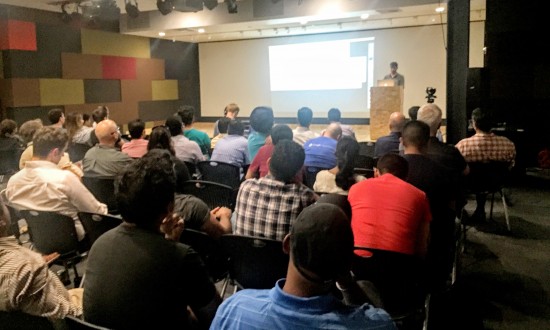
We got a very encouraging start to our introduction talk by Vipin Jain (@jainvipin_), core developer of Project Contiv at Docker Meetup in Palo Alto last month with 250 registered attendees (with about 100 on waitlist). If you are visiting DockerCon Europe 2015 at Barcelona next week, make sure you visit Project Contiv booth for a demo and connect with us in person. We are looking forward to your contributions in the container community and Project Contiv github.
Project Contiv at Docker Palo Alto Meetup
I also encourage you to visit Cisco’s open source project Mantl around microservices infrastructure. Project Contiv will soon be part of the Project Mantl to bring better infrastructure for your microservices applications.
It’s almost the holiday season and it’s time for your customers to host that special dinner party, where they can make memories and share stories with loved ones. What if they could also share the story of where that holiday meal came from?
This is now possible using the power of the Internet of Everything (IoE). The ability to monitor and assure food quality, safety, and provenance is probably one of the fastest-emerging applications of IoE – and the fastest-growing differentiator for grocers. With IoE, even the minute details of products can be tracked from source to shelf. Providing access to data across the entire agricultural food chain is sometimes now referred to as the “Internet of Food.”
Your party host can share with guests where the wheat was raised to produce the pasta, describe exactly where and how the olive oil was pressed, serve a salad that was bought at guaranteed optimal ripeness, and enjoy a glass of wine from the region of France visited by the host on his last trip to Europe.
Today, your customers are closer than ever to getting this extreme level of detail:
The pasta brand Barilla is already making this a reality. They have placed QR codes on select boxes of pasta and sauces. This code connects customers to a website that tells the story of the farms where the wheat was grown, the co-ops and factories where it was processed, and how much water and carbon dioxide were involved in production. To learn more about how Barilla did it, please read the press release.
Sensors also give retailers the ability to identify and monitor the freshest, healthiest produce. This is done using sensors that monitor the temperature and humidity of your products. You can measure concentrations of gases and even use a pocket-sized spectrum analyzer like the SCiO to determine chemical composition. Based on levels of ripeness, retailers can even develop dynamic pricing and promotional campaigns to react to changes in demand or ripening speed.
Through the Internet of Everything (IoE), retailers can break through information silos across supply chains and give customers transparency into the journey of their food, from field to fork. To see how other retailers are embracing digital transformation, see our customer stories.
Cisco UCS® Integrated Infrastructure for Big Data delivered industry’s first-ever 100-terabyte (TB) and best 3-TB and 30-TB results on the TPC Express Benchmark HS (TPCx-HS).
These results demonstrate Cisco’s leadership with best performance at the scale factors of 3 and 30 TB, and Cisco is the first vendor to publish results for a scale factor of 100 TB. The results are made possible with Cisco UCS Integrated Infrastructure for Big Data, an industry-leading platform widely adopted across industry vertical markets that provides a fast and simple way to deploy big data environments.
These world-record results were achieved using Cisco UCS Integrated Infrastructure for Big Data powered by Cisco UCS C240 M4 Rack Servers interconnected using two Cisco UCS 6296 96-Port Fabric Interconnects with embedded management using Cisco UCS Manager and a Cisco Nexus® 9372PX Switch. Check out the Performance Brief and UCS Industry Benchmarks Summary for additional information on the benchmark configuration. The detailed official benchmark disclosure report is available at the TPC Website.
TPCx-HS Benchmark Results with Cisco UCS Integrated Infrastructure for Big Data Summary:
Scale
Number of Cisco UCS C240 M4 Rack Servers
Performance and Price/Performance
Availability Date
3 TB1
16
11.76 HSph@3TB
US$44,052.98/HSph@3TB
September 24, 2015
30 TB2
32
23.42 HSph@30TB
US$36,800.52/HSph@30TB
October 26, 2015
100 TB3
32
21.99 HSph@100TB
US$39,193.64/HSph@100TB
October 26, 2015
The industry and technology landscapes have changed. IT is being extended far beyond traditional transaction processing and data warehousing to big data and analytics. Foreseeing the industry transition the TPC has developed TPC Express Benchmark HS (TPCx-HS) – industry’s first (and so far the only) standard for benchmarking big data systems to provide the industry with verifiable performance, price-performance and availability metrics of hardware and software systems dealing with Big Data. TPCx-HS provides an objective measure of hardware, operating system, and commercial software distributions compatible with the Apache Hadoop Distributed File System (HDFS) API. This benchmark can be used to asses a broad range of system topologies and implementation of Hadoop systems in a technically rigorous and directly comparable, in a vendor-neutral manner.
Although all vendors have access to same Intel processors, only Cisco UCS unleashes their power to deliver high performance to applications through the power of unification. The unique, fabric-centric architecture of Cisco UCS integrates the Intel Xeon processors into a system with a better balance of resources that brings processor power to life. For additional information on Cisco UCS and Cisco UCS Integrated Infrastructure Solutions please visit Cisco Unified Computing & Servers web page.
Disclosure
The Transaction Processing Performance Council (TPC) is a nonprofit corporation founded to define transaction processing and database benchmarks, and to disseminate objective and verifiable performance data to the industry. TPC membership includes major hardware and software companies. The performance results described in this document are derived from detailed benchmark results available as of October 23, 2015, at http:// www.tpc.org/tpcx-hs/results/tpcxhs_perf_ results.asp
Your mom and dad are on Facebook, your Grandma has a cell phone and your Uncle Oscar reads the morning paper on his tablet. If you haven’t noticed yet, it’s not just young people who are connected to their devices anymore. Erickson Living—one of the United State’s largest operators of continuing-care retirement communities—knows this fact only too well.
“There’s nothing new about the need to remain connected,” said Hans Keller, Vice President, IT Operations, Erickson Living. “It’s just that our residents have moved way past traditional family phone calls. They’re active in social media and part of the new wave of connectivity.”