Avatar

stliemThis post was written by guest blogger Stephen Liem, IT Director, Global Quality and Support Services

There is no limit to what education can bring. It opens up many opportunities that otherwise may not be available.

In the past 10 weeks I‘ve had the privilege of teaching journalism to the middle school students in Joseph-George School in East Jan Jose, California. Cisco has been partnering with Citizen Schools, a nonprofit organization, to deliver after school educational programs to low-income schools across the country.

Citizen Schools aims to prevent students from dropping out of high school through its Extended Learning Time (ELT) model, which provides after-school mentoring and support to low-performing middle schools. Volunteer professionals, or “Citizen Teachers,” teach 10-week after-school apprenticeships on topics they are passionate about, from blogging to filmmaking to robotics.

On average the schools Citizen Teachers visit do 300 hours less of after school programming compared to their counterparts. In East San Jose, where the graduation rate is at 79%, providing more meaningful educational programs has certainly helped not just the students themselves but also the community.

As a "Citizen Teacher" with the nonprofit Citizen Schools, Stephen Liem helped sixth graders create their own newspaper
As a “Citizen Teacher” with the nonprofit Citizen Schools, Stephen Liem helped sixth graders create their own newspaper

In my journalism class, students in the sixth grade learned how to interview and collect data, how to write an article well, and how to express and publish their opinions honestly and truthfully. Collectively they decided on the name of the newspaper – the East San Jose News — and the subject of their stories.

The results were both eye opening and touching at the same time.

Continue reading “How I Helped Middle School Students Make a Difference in Their Community”

Authors

Alexis Raymond

Senior Manager

Chief Sustainability Office

Avatar

In the go-go-go marketplace that is pay television, one of the most important raw ingredients for success is the ability to rapidly respond to competitive interlopers of all stripes — online and over-the-top, in addition to the “known” / traditional video purveyors. This is particularly true for satellite video providers. Their ability to quickly upgrade the installed base of consumer premise equipment (CPE), and all the associated services, is somewhat trickier than their competitors, for many reason reasons.

Most of the installed base of boxes lacks a two-way or “return” channel, and where there is one, it doesn’t necessarily operate in a “managed” environment. Meaning the satellite provider doesn’t control it, and there is no guarantee of connectivity.

So how can satellite-based service providers efficiently build Continue reading “How Can Satellite Service Providers Deliver At The Speed Of The Web?”

Authors

David Yates

as Director of Service Provider Video Marketing at Cisco

SP360

Avatar

A new whitepaper from IDC, “The Workspace-as-a-Service Opportunity: Why Now is the Time for Desktop as a Service” is a must-read for any organization facing the challenge of delivering applications and services to employees on mobile devices.  According to IDC, corporate-liable smartphone shipments will reach 110 million units in 2014.  In comparison, employee-liable smartphone shipments will exceed 220 million in 2014.

The increased productivity and collaboration that mobile technologies offer businesses is substantial.  The ability to access the full workspace experience anywhere, anytime, on any device gives organizations incredible flexibility and agility.  However, maximizing the benefits of mobile technology comes at the cost of adding significant complexity to IT operations.   Minimizing cost and risk is challenging as well, considering that many organizations simply don’t have the expertise to deploy, manage, and scale client virtualization in an efficient and effective manner.

For these reasons, IDC has determined that “it makes more sense than ever for IT leaders to consider a cloud-based client virtualization offering.”  This can be achieved through remote access of a centralized virtual desktop through the cloud, commonly known as Desktop as a Service (DaaS).

The whitepaper explores key topics relating to when desktop virtualization is an option, benefits organizations can gain from cloud-based DaaS, integration challenges IT will need to meet, and important considerations to keep in mind when selecting a cloud provider.

Read the IDC whitepaper for yourself.  You can also learn more about Desktop as a Service as well as locate providers offering enterprise-class DaaS tailored to meet your specific business needs.

Authors

Xander Uyleman

Senior Manager

Global Partner Marketing

Avatar

The FCC, acting on a petition from the hotel industry, has begun an interesting debate: when or whether hotels (or in principle, other enterprises) could ever block Wi-Fi on consumers’ personal devices, like smartphones.

For the record, Cisco’s view is that — absent a security threat, attack, or other compelling interest — enterprises should not block personal Wi-Fi hotspots to promote their commercial interests, or for other purposes.

However, in limited cases where there is a significant security threat, attack or other compelling interest, enterprises should be able to defend their network, data and devices. We should be clear: the mere presence of personal hot spots at a facility does not represent a security threat or interest.

As with any issue involving technology, there’s a lot of confusion over what the issues and facts are.

Let’s take a look at the facts:

1. Under federal law, no one entity “owns” or “controls” access to unlicensed airwaves. Consumers can use unlicensed airwaves (on devices that have been certified for use by the FCC) wherever they want, whenever they want. As Wi-Fi “hot spot” capability is added to our smartphones, this is becoming much more common and is great for consumers.

2.  Enterprises, particularly those which are open to the public or where the public is routinely invited, are increasingly installing their own managed Wi-Fi networks for the use of the visiting public, their own operations, or for other customers, such as businesses that lease space on a convention floor. And this development, too, is great for consumers and great for our economy, enabling business to get done at Internet speed.

Now, the wonderful thing about Wi-Fi is that everyone can use it, and, especially with blazing-fast new technologies such as IEEE 802.11ac, there’s plenty of capacity for all to share.

Consequently – as a general rule — enterprises should not block access to personal hot spots as a routine matter. Using security technology to shut down Wi-Fi signals that are not a threat to the co-located network is a bad practice that Cisco does not support.

In our filing at the FCC, Cisco asked the FCC to declare that “the mere presence of a personal hot spot or ad hoc client does not constitute a security threat in any venue or physical location where the public is routinely present or invited. “ This is consistent with our view that everyone should have the expectation of using unlicensed airwaves on FCC-approved devices.

But what if the enterprise’s managed Wi-Fi network comes under cyber attack, such as a denial of service attack by another Wi-Fi transmitter or a “honeypot” where the enterprise’s own client devices are lured away by an unmanaged access point for nefarious purposes?

What if some bad actor uses Wi-Fi technology to attack the enterprise’s Wi-Fi network, its data or devices?

Then of course, network administrators should be able to protect against such attacks. Making sure the enterprise network can operate in the face of an attack is beneficial – to the public as well as to the enterprise.

Additionally, there are other limited cases of enterprise regulation of Wi-Fi that should be allowed to stand. A hospital may not want Wi-Fi in portions of its facilities. An enterprise may have a secured lab or portions of a government facility may be “off limits” to consumer electronics, including Wi-Fi. Those are fair constraints, and the FCC should permit reasonable exceptions when there is a compelling interest, particularly in locations where the general public is not routinely present.

As Wi-Fi continues to become the leading form of Internet access, questions like this one will surely arise.

The FCC and interested parties must take steps to ensure that Wi-Fi continues to thrive for the benefit of consumers, businesses and the economy.


Authors

Avatar

Business requirements define Applications. Applications run on IT infrastructure. If the IT infrastructure is more responsive to the needs of applications, then, it almost certainly guarantees better business outcomes. That is the premise of Cisco’s next Data Center webcast to be broadcast on January 13th at 9 AM PST/ 12 EST – Is your Data Center Ready for the Application Economy? (Click Link to Register!)

Today, more than ever as the pace of change accelerates and disruption is the name of the game, CIOs and IT infrastructure leaders from all over the world are taking a closer look at how data center infrastructure can be better tailored to fit the needs of applications. Can the pace of change become an opportunity?

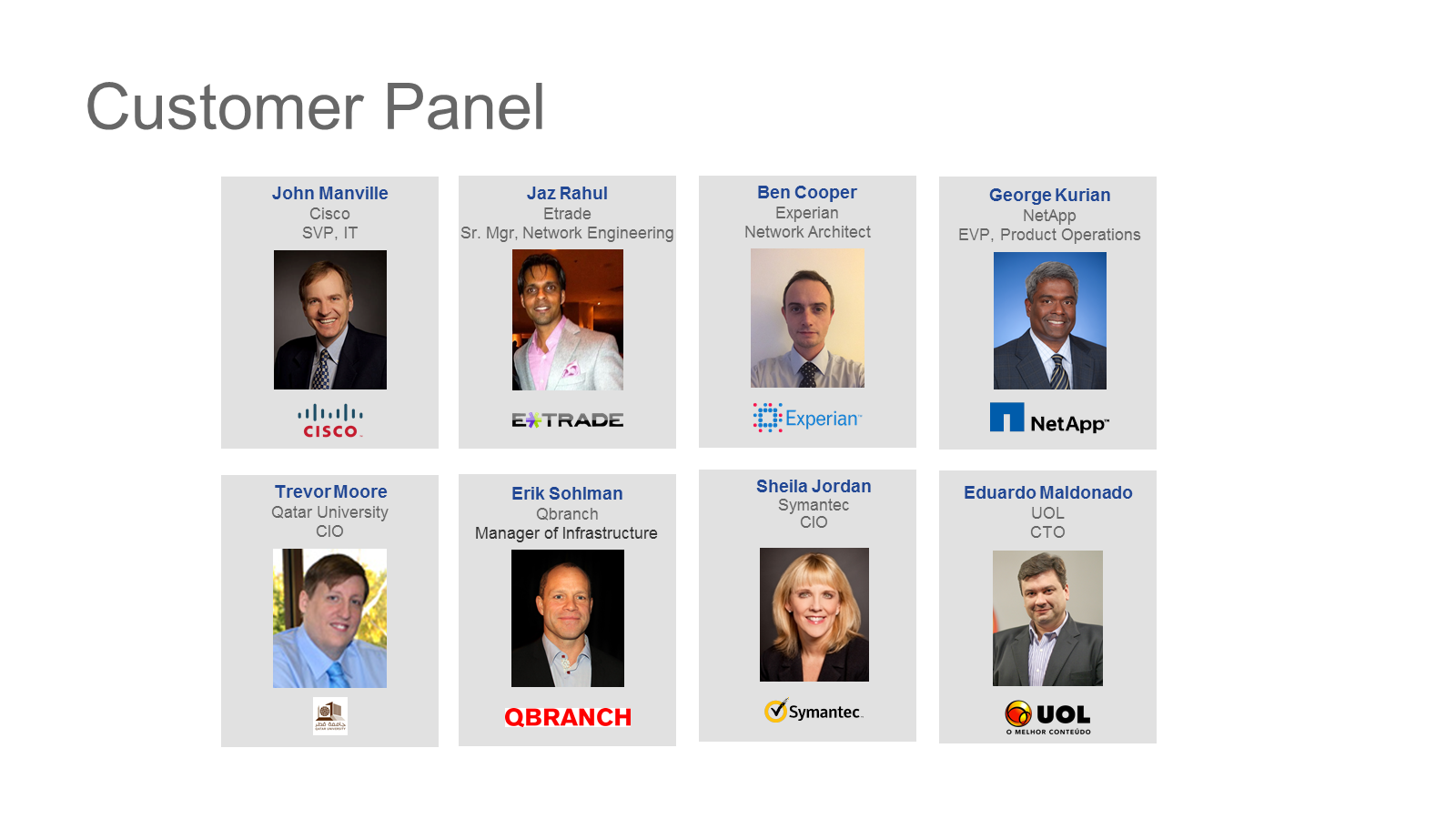
Eight global customers in production (including Cisco IT) from countries like Brazil, Qatar, Sweden, United Kingdom and the United States that have deployed the Nexus 9000 and APIC come together to answer this question in our webcast focused on Cisco’s Application Centric Infrastructure (ACI). This will be followed by an ACI Ecosystem partner panel coming together to discuss the benefits of multi-vendor collaboration.

SDN, ACI, Nexus
Nexus 9000 and ACI customers

Continue reading “New Data Center Webcast – Cisco ACI and Nexus 9000 Production Customers Discuss Game Changing Business Outcomes; E …”

Authors

Shashi Kiran

Senior Director, Market Management

Data Center, Cloud and Open Networking

Avatar

Amid the technological sizzle at this week’s Consumer Electronics Show is a special line of equipment and services, developed entirely for satellite video providers. And, as you might expect, it’s a solution set being heavily fortified by the cloud.

That’s why a strong undercurrent this week in Las Vegas (and in our suite, at the Wynn), are the innovations that can infuse satellite video providers with agility. Innovations in content, user experience, and services, specifically.

In our suite, at the Wynn, we’ll have on hand everything Continue reading “What’s In Store for Satellite Video Purveyors at CES?”

Authors

David Yates

as Director of Service Provider Video Marketing at Cisco

SP360

Avatar

[Note: If you like hearing these customer perspectives, register today for our upcoming live ACI webcast: “Is Your Data Center Ready for the Application Economy”, January 13, 2015, 9 AM PT, Noon ET, featuring more ACI customers and several key ACI technology partners.]

Happy New Year to everyone! I thought this would be a great opportunity now that everyone is back into the swing of work to highlight a couple of customer presentations from last month at the Gartner Data Center Conference in Las Vegas. Cisco hosted a 30 minute session on our Application Centric Infrastructure (ACI) and we invited two customers, Acxiom and Symantec, to present their use cases and experience in deploying ACI so far.

These Gartner conferences attract primarily CIO and high-level IT executives, and it’s no secret that they prefer hearing from industry peers rather than vendor product pitches. Kamal Kharrat from Acxiom and Vince Spina from Symantec both do a great job talking about real benefits from their deployment and the reasons they chose ACI as a primary platform for their SDN strategy.

http://gartner.mediasite.com/mediasite/play/52a862bd7f1b42d5ba9166ccf2505917?autoStart=true

Gartner ACI Session

Continue reading “ACI Customers Share Experiences at Gartner Data Center Conference”

Authors

Gary Kinghorn

Sr Solution Marketing Manager

Network Virtualization and SDN

Avatar

At CiscoLive Milan this year, we’re going to be doing something a little different with Engineers Unplugged.

Traditionally, Engineers Unplugged has been this awesome video series featuring two speakers, a whiteboard, and great Data Center discussions. It also included drawing a unicorn. This year, we’re opening it up to topics including branch routers, campus switching, mobility, and (potentially) some IoT folks. Basically, we’ll cover everything in Data Center, Mobility (including Meraki… oh yeah!), Enterprise Networks, and Internet of Things for those of you who follow our naming silos.

What this means for you: If you’re going to CiscoLive Milan, you should sign up to join in on the Engineers Unplugged fun. Or, let me know about pairings you’d like to see. Continue reading “#EngineersUnplugged Going Rogue At #CLEUR”

Authors

Lauren Friedman

Marketing Manager

Enterprise Networks

Avatar

This post was authored by Andrea Allievi and Earl Carter.

Ransomware holds a user’s data hostage. The latest ransomware variants encrypt the user’s data, thus making it unusable until a ransom is paid to retrieve the decryption key. The latest Cryptowall 2.0, utilizes TOR to obfuscate the command and control channel. The dropper utilizes multiple exploits to gain initial access and incorporates anti-vm and anti-emulation checks to hamper identification via sandboxes. The dropper and downloaded Cryptowall binary actually incorporate multiple levels of encryption. One of the most interesting aspects of this malware sample, however, is its capability to run 64 bit code directly from its 32 bit dropper. Under the Windows 32-bit on Windows 64-bit (WOW64) environment, it is indeed able to switch the processor execution context from 32 bit to 64 bit.

Continue reading “Ransomware on Steroids: Cryptowall 2.0”

Authors

Talos Group

Talos Security Intelligence & Research Group