This post was written by guest blogger Emma Reid, marketing manager for Cisco’s Social Innovation Group, Asia-Pacific region
Today’s Cisco Networking Academy students will become tomorrow’s IT professionals, using technology in innovative ways to solve social problems around the world.
We want to inspire and encourage our Cisco Networking Academy students to understand and embrace the technology that will shape our future and advance economies across the Asia Pacific region.
The widespread adoption of the Internet of Things, connecting sensors, equipment, machines and assembly lines to the network is driving a manufacturing industry transformation. In fact, nearly 30 percent of all manufacturing-related firms are in some stage of piloting, implementing, or expanding IoT deployments. By 2017, an expected 80 percent will have implemented an IoT solution.
Many manufacturers are in the process of figuring out how to deploy a Connected Factory, or perhaps pilot a smaller scale wireless network pilot project in their manufacturing facility. In fact, ARC analyst Greg Gorbach who covers ‘Industrial Internet of Things’ recently wrote a blog, ‘Let’s just try it’, focusing on a panel presentation that I was part of at their recent conference. This blog focuses on the Stanley Black and Decker success story at their Reynosa factory in Mexico and how a ‘let’s just try it’ approach yielded these results: “OEE increased 24%, defects decreased 16%, labor utilization is up from 80 to 92%, and line throughput is up 10%. In addition they now have empowered employees, improved labor ergonomics, reduced labor training, and better visibility for line supervisors.”
If you are in the midst of this decision process on ‘where to start’, I’d like to encourage you to access our webcast on demand titled “IoT: Oppportunities and Momentum in Manufacturing”, A part of the IoT in Action series, this webcast covers key learnings from industry thought leaders from Forrester Research, AeroScout Industrial, and Cisco. These experts, Michelle Pelino from Forrester, Priya Vijayakumar from AeroScout and Chet Namboodri from Cisco discuss what it takes to make the transition to IoT and how companies are reaping the benefits of efficiency, cost savings, better data analysis, and faster time to market. Check out this webcast and let me know what you think.
At the Women of Impact Conference this year on March 19th, our focus is to empower attendees to Be Fearless – by taking risks, overcoming obstacles and blazing new trails in their personal and professional lives. The Conference focus is to connect, develop and inspire the women in technology at Cisco.
We have all been inspired by various individuals throughout the different stages of our lives. Esther, an Engineer on the Data Center solution team, has been motivated by admiring the examples set by others. As a matter of fact, Esther considers Monique Morrow, another Fearless Female nominee for the 2015 Women of Impact Conference, as someone she holds in very high regard.
Last week at Mobile World Congress was incredibly busy and there were many compelling announcements. In case you missed it one that we’re especially excited about was about how Light Reading commissioned the European Advanced Networking Test Center (EANTC) as an independent party to validate Cisco’s Cloud Managed Business Solutions.
The MPI Forum met for our quarterly meeting last week in Portland, Oregon.
The main goal of the meeting was to pass the MPI-3.1 standard into law. MPI-3.1 contains a bunch of errata from MPI-3.0, and a small number of new things.
Tomorrow is Pi Day! We make this a fun day in our household, where we celebrate the mathematical constant of π—or 3.1415—on March 14. To celebrate, we will make (and eat!) pie and see who can recite the most digits of pi. This year math fanatics are thrilled because it falls on 3/14/15, which aligns to the first five digits of pi. This has created even greater interest in what already is a global phenomenon.
Beyond pie eating and making YouTube videos, Pi Day provides the perfect opportunity to talk about our need for Science Technology Engineering and Mathematics (STEM) education. The gaps we have in highly trained and skilled workers for the next wave of the Internet—or the Internet of Everything—are real. According to research, by 2018 the U.S. will face a projected shortfall of 230,000 qualified advanced-degree STEM workers.
We must get children engaged in STEM earlier and cultivate that interest throughout their entire educational journey. The National Center for STEM Elementary Education notes that a third of students lose interest in science by the fourth grade, and by eighth grade, almost 50 percent have lost interest. By the time students reach high school, only 16 percent of American high school seniors are proficient in mathematics and interested in a STEM career.
To ensure we are ready for the new digital era, Cisco is participating in a number of programs to engage and educate students in STEM areas. One program, US2020, is dedicated to igniting movement of STEM mentorship across the United States. Cisco has pledged that by 2020, 20 percent of our workforce will volunteer in STEM mentoring. We also provide funding for innovative programs like the MIND Research Institute, which is fundamentally changing how math is being taught in underserved communities from coast to coast.
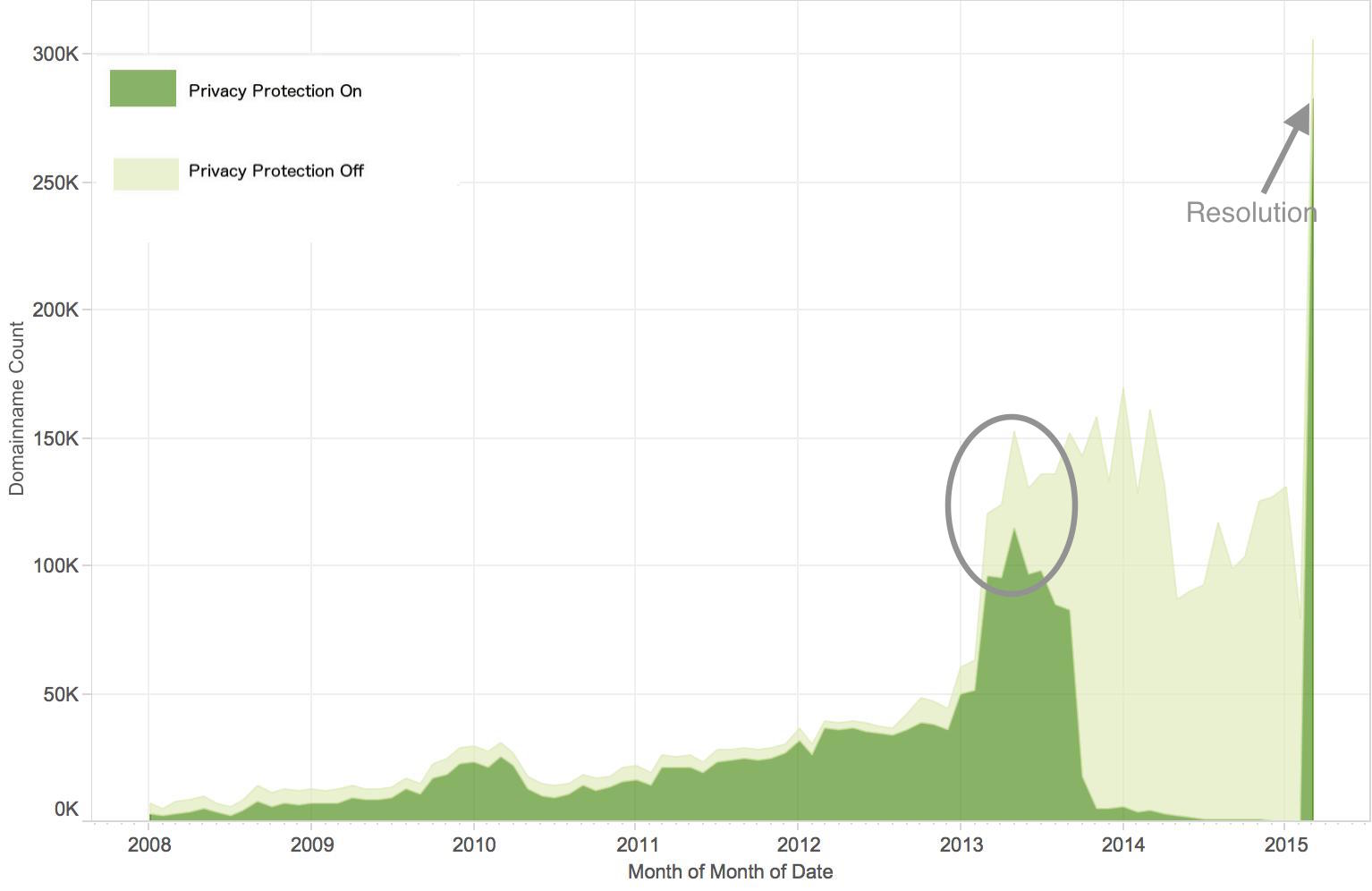
In mid-2013, a problem occurred that slowly began unmasking the hidden registration information for owners’ domains that had opted into WHOIS privacy protection. These domains all appear to be registered via Google App [1], using eNom as a registrar. At the time of writing this blog, there are 305,925 domains registered via Google’s partnership with eNom. 282,867 domains, or roughly 94% appear have been affected [2]. (Google reports that new domains which have not faced a renewal period are not affected and many businesses do not opt into their privacy service.) The information disclosed included full names, addresses, phone numbers, and email addresses for each domain. The information was leaked in the form of WHOIS records.
The graphic above illustrates the drastic shift in domains utilizing privacy protection (dark green) to those with WHOIS information exposed (light green). At its peak at least 90% of the domains registered were utilizing privacy protection which plummeted to less than 1%. The grey circle indicates the initial shift occurring. The arrow notes when resolution had occurred.
“Let the buyer beware” is a sentiment that dates back well before consumer protection and truth-in-advertising laws. Yet, the issue of trust continues to permeate all areas of society today. A few weeks ago, I wrote about the “trust cliff” that affects the amount of information consumers are willing to share with retailers in order to have more relevant interactions.
Now, a new Cisco study on retail banking in 12 countries reveals a different kind of trust problem: consumers are getting less value than they expect from their banks, and this “value gap” is impacting customer trust.
The global financial crisis of 2007-2008 greatly damaged consumer trust in financial institutions, and brand equity has fallen along with it. In 2009, one year after the financial crisis, the world’s top 500 brands saw the value of their brands drop by 32 percent. For many banks, their brand value has yet to recover from pre-crisis levels.
But the roots of distrust go deeper than that. Our study shows that there is a fundamental disconnect between banks and their customers, and many customers no longer look to their banks to help them meet their financial goals. In fact:
43 percent of customers say their bank doesn’t understand their needs
One in four would choose another provider for their next account or service
Only 40 percent of respondents worldwide turn to a financial professional for advice, and of these, 28 percent believe the advice is ineffective
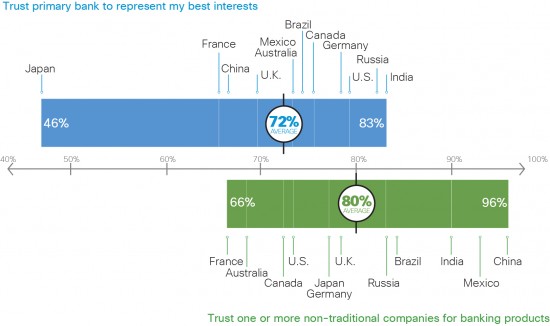
Meanwhile, a growing cadre of disruptive “non-bank” innovators is exploiting this value gap between banks and their customers. They range from technology companies such as Apple and Google, to retailers such as Amazon.com and Tesco, to mobile and digital-only banking services, payment companies, and automated investment services. A surprising 80 percent of consumers surveyed said they would trust a non-bank for their banking services. In eight out of the 12 countries surveyed, more consumers would actually trust a non-bank than their own bank.


 This post was written by guest blogger Emma Reid, marketing manager for Cisco’s Social Innovation Group, Asia-Pacific region

 The widespread adoption of the
 Guest Blog and Interview by Roxanne Edwards



 The MPI Forum met for our quarterly meeting last week in Portland, Oregon.