Avatar

One of the most exciting, yet challenging opportunities companies face today is related to data. Every year, they have to deal with about 40% more data than the year before. At this rate, by 2020, there will be 40 zettabytes of data in the world (40 trillion gigabytes) – that is 5,200 GB of data for every person on the planet Earth. If these volumes were not enough to make you dizzy, think about the variety of sources and format that is inherent to the Internet of Everything. There are currently more than 15 billion devices connected to the Internet, creating billions of connections between people, processes and things, in hundreds of different formats – how to analyze all this?

Cisco, Hortonworks and Red Hat have partnered to develop industry leading solutions that can help you make the most of this data by delivering three fundamental aspects: performance, scalability and manageability. These solutions are built up on modern and agile data architectures that rely on modular building blocks, adapts to the business demands and integrates today and tomorrow’s technological advances. With these solutions enterprises can capture, store and analyze data efficiently at lower cost and gain a powerful competitive advantage.

To learn more about the collaboration between Cisco, Hortonworks and Red Hat, and see how you too can benefit from their experience, vision and validated architecture, attend the webinar on April 30.

Authors

Raghunath Nambiar

No Longer with Cisco

Avatar

January this year witnessed the largest healthcare breach to date in which the personal records of 80 million individuals were compromised. It also marked an apparent change in focus from attacks on delivery organizations to healthcare payers. Last week two additional health insurers reported that they too had been hacked, resulting in the possible compromise of a further 11.25 million personal records. In a period of less than 3 months, the US has seen over 91 million records and personal identities stolen from healthcare insurers alone.

The health insurers appear to have been the target of highly sophisticated cyber attacks perpetrated from China, which involved the use of advanced persistent threats (APTs) and spear phishing. This allowed them to gain administrative credentials that were used to exfiltrate stolen data via the use of common cloud data services.

Continue reading “The Rise in Healthcare Cybercrime”

Authors

Richard Staynings

Cybersecurty Healthcare Leader

Cisco Security

Avatar

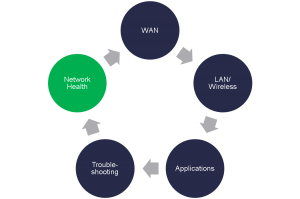
Last week, I concentrated on how to use Cisco Prime Infrastructure to do troubleshooting for your network. Today, as the 5th and final post of my 5-part blog series, I’ll look at how to maintain network health for your branch site users with Prime. As a quick recap, here’s my blog series on how to set up networking with Prime for a new branch site.

WAN deployment – blog 1
Converged wired and wireless  – blog 2
Application performance – blog 3
Troubleshooting – blog 4
Network health – blog 5 (this blog)
 steve song blog 5 pic 1

As designed, you have successfully brought up your new branch site and the network is now in production. And you are well prepared to troubleshoot if anything goes wrong. Before you declare “mission accomplished”, there is one more step you can take to achieve long-term success. Just like preventive healthcare can help a person to stay healthy, Prime gives you a number of tools to monitor and maintain your network health. By making full use of these tools, you are prepared to address potential issues before they impact your network.

With Prime, you can
– Keep track of network changes with network topology maps and Device 360
° Views;
– Maintain centralized visualization across multiple Prime instances with Operations Center ; and
– Stay engaged with Cisco support integration
.

One of the things that always excites network engineers and managers is an accurate network topology map. Prime Infrastructure can provide such a map for you, which includes all your branch sites and main campus site. If there are any changes, you’ll know right away. Or, if you want to know more details, you can drill down to each networking device with Prime Device 360° View. The chart below shows a portion of Cisco’s production network topology map. Continue reading “Bringing Up a New Branch Site the Easy Way with Prime Infrastructure – Part 5”

Authors

Steven Song

Business Manager

Avatar

In this short series of blogs, we’re spending some time looking at the lesser known but undeservedly underappreciated amendments to 802.11 and the features/benefits they provide.

The first blog explained the basics of 802.11k “WLAN Radio Measurements” and specifically zoomed in on the Neighbor Request/Report.

This blog will focus on the 802.11r amendment.

Fast BSS Transition (802.11r)

Fast BSS Transition (often abbreviated to Fast Transition or FT) describes mechanisms by which a mobile device can reestablish existing security and/or QoS parameters prior to reassociating to a new AP. These mechanisms are referred to as “fast” because they seek to significantly reduce the length of time that connectivity is interrupted between a mobile device and Wi-Fi infrastructure when that mobile device is connecting to a new AP. Please note that the process of disconnecting from one AP and connecting to another AP is formally designated as a “BSS transition”. Therefore, the protocols established by FT apply to mobile device transitions between APs only within the same mobility domain and within the same ESS (ESS transition is out of scope for FT). Since both reassociation and reauthentication are time critical processes, removing time consuming message exchanges between the mobile device and the infrastructure help reduce interruption to high value services (e.g., voice and/or video) when transitioning from one AP to another especially in a strongly secure WLAN (i.e, one using 802.1x and EAP methods for authentication).

Because Fast BSS Transition reestablishes existing parameters, the protocols require that information be exchanged during the initial association (or at a subsequent reassociation) between the mobile device (formally referred to as the FT Originator (FTO)) and an AP. The initial exchange is referred to as the FT initial mobility domain association. Subsequent reassociations to APs within the same mobility domain are expected to utilize the FT protocols.

Two basic FT protocols are described:

  1. FT Protocol. This protocol is performed when a mobile devices transitions from one AP to another AP but does not require a resource request prior to its transition. The AP selected by the mobile device for reassociation is referred to as the “target AP”.
  2. FT Resource Request Protocol. This protocol is performed when a mobile device requires a resource request prior to its transition.

For a mobile device to transition from the AP it is currently associated with to a target AP, the FT protocol message exchanges are performed using one of two methods:

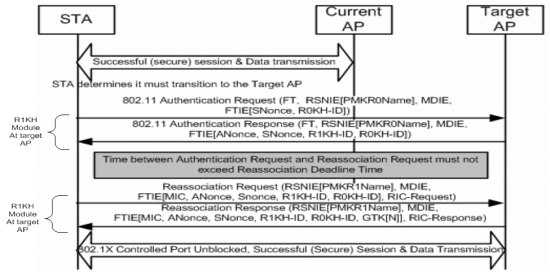
  1. Over-the-Air. The mobile device communicates directly with the target AP using IEEE 802.11 authentication with the FT authentication algorithm.
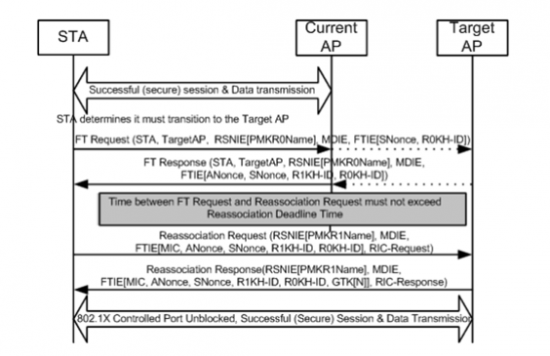
  2. Over-the-DS. The mobile device communicates with the target AP via the current AP. Communications between the mobile device and the target AP are encapsulated within FT Action frames between the mobile device and the current AP. Communications between the current AP and the target AP, occurs via a different encapsulation method. The current AP converts between the two encapsulation methods.

802.11r image 1

Over the Air message exchange (excerpted from IEEE 802.11-2012)

802.11r image 2

Over the DS message exchange (excerpted from IEEE 802.11-2012)

Benefits of Fast BSS Transition

As mentioned above, the primary benefit of 802.11r is to significantly reduce the length of time that connectivity is interrupted between a mobile device and Wi-Fi infrastructure when that mobile device is connecting to a new AP.

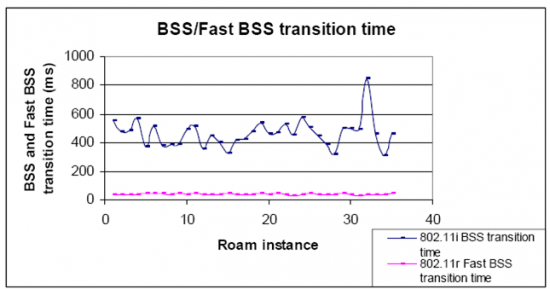
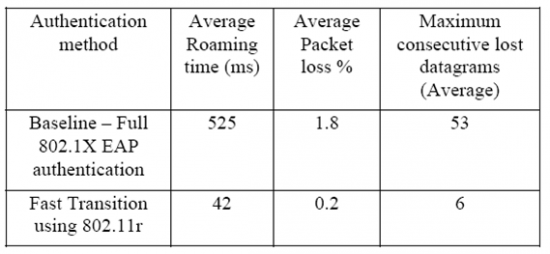
This is especially useful for real time interactive services (e.g., voice and video). In a strongly secured WLAN (i.e., one that uses 802.1x and EAP methods), but without 802.11r, the mobile device would need to go through a complete reauthentication after reassociating. This can cause a significant interruption to a media flow. But with 802.11r, the reauthentication is effectively performed prior to reassociation (effectively establishing a “make before break” as opposed to “break before make”).

802.11r image 3

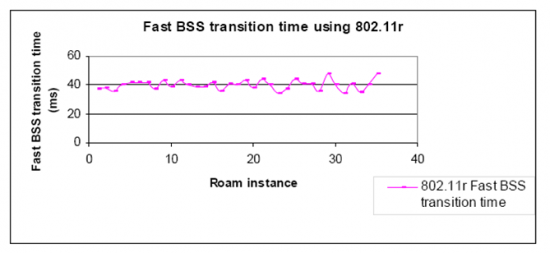
Above excerpted from: “Performance Study of Fast BS Transition using IEEE 802.11r” by Sangeetha Bangolae, Carol Bell and Emily Qi802.11r image 4

Above excerpted from: “Performance Study of Fast BS Transition using IEEE 802.11r” by Sangeetha Bangolae, Carol Bell and Emily Qi802.11r image 5Above excerpted from: “Performance Study of Fast BS Transition using IEEE 802.11r” by Sangeetha Bangolae, Carol Bell and Emily Qi


The additional benefit is that without reauthentication, far less traffic is generated between the WLAN and the AAA authentication server. This improves both the scalability and reliability of the link between the WLAN and authentication server.

Better Together: 11k Neighbor Report and 11r Fast BSS Transition

As discussed in the previous blog The “Neighbor Report” request for 802.11k is sent from a client to an AP. The AP returns a “Neighbor Report” report containing information about neighboring APs that are known candidates for the client to reassociate with (should the client choose to do so). Therefore, the Neighbor Report request/report pair enables the client to collect information about the neighboring APs of the AP it is currently associated to and this information may be used as identification of potential candidates for a new point of attachment while roaming.

This is important for 11r because this list identifies the candidates for “target APs”.

Cisco support for Fast BSS Transition

Cisco WLAN infrastructure has supported 11r since release 7.2.110.

Fast BSS Transition has also been a fundamental feature in our VoWi-Fi solution and is further testimony as to Cisco’s pioneering work in making WLAN reliable for all types of IP traffic.

Cisco believes that 802.11r should be used in high density deployments where “roaming” between APs is frequent. This will result in a superior user experience.

Of course this means that mobile device vendors need to adopt Fast BSS Transition. But Cisco sees this as an increasing trend and we’re expecting to see this feature continue to proliferate in the industry with VoWi-Fi.

Authors

Allen Huotari

Product Management

RF Excellence and Wireless Innovation

Avatar

So Spring is finally here in the New England Area, the snow is finally gone after a record breaking snow fall totals, and the flowers are starting to sprout.

Last week, we announced that ACG Research again confirmed that Cisco continues to be the leading provider of Mobile Packet Core and Mobile IP Infrastructure over the past several quarters. Now another analyst firm, Infonetics Research highlighted that Cisco has indeed garnered the Packet Core Lead at 21.7% based on EPC / 3G Packet Core data in their report “Mobile Infrastructure Equipment for Q4 2014.

So where is this customer momentum coming from you ask? Well last month Continue reading “Cisco Continues Mobile Core Momentum: Leads in Packet Core Market Share according to Infonetics Research Data.”

Authors

Jim O'Leary

Sr. Manager Mobile Solutions Marketing

Avatar

In order to push the boundaries of research we must turn to innovative technology. And since much of research is being fueled by academic organizations, Cisco is making an investment in our partners and in higher education.

This month in Washington, D.C. the brightest minds in technology will gather for the second annual Internet2 Global Summit, a meeting that brings the scientific and academic communities together to explore the synergy between research and scholarship. The 2015 meeting will focus on collaborative innovations in information technology (IT), infrastructure and next generation applications.

So, what is Cisco’s role in Internet2?

Cisco and Internet2 are advancing the fields of research and education through cutting-edge technology. Together we realized the challenges facing higher education decision makers and conducted a survey with 1105 Media to identify the main challenges facing researchers, professors, staff and students around collaboration technologies. The survey revealed that a mixture of collaboration tools is important for research projects to be successful. We discovered that 88% of faculty and 86% of administrators see value in web conferencing and webinars while students favor mobile video collaboration (70%) and web conferencing (63%). The survey results are also represented in an infographic, which exposes the value of cloud technologies on campus.

Additionally, Cisco’s UCS Research Appliance is being leveraged by the Internet2 community to address the need to share large files between institutions faster and in a more collaborative manner.

Cisco will join the Internet2 community from April 26—30 at the Renaissance Hotel Downtown in Washington D.C. During this event, we will explore a number of conversations including “what’s next” for research institutions, and how global Internet governance can work with digital technology to meet growing demands in education.

We invite you to join Cisco and our partners in higher education at the following happenings:

  • Cisco Booth/Exhibit Area demonstrating Cisco Collaboration for Education (DX80, Spark, CMR), Science DMZ and the announcement/introduction of a new Cisco line rate research appliance that was developed in collaboration with I2, SanDisk and CompuCom (Booth #36)
  • Opening Keynote presented by Rich Seidner (Monday at 1:30 PM)
  • Community Showcase: Building a Private Cloud Based on Openstack – Presented by Dmitry Dukhan (Tuesday at 1:30 PM)
  • Research Enablement Panel – Rich Seidner to participate with Michael Harttree there to help (Tuesday at 4:30 PM)

Cisco is proud to be an active partner with Internet2 in the university research community and we look forward to continuing to provide valuable solutions that benefit research and education around the world.

To learn more about Internet2, you can visit the consortium’s website here: http://www.internet2.edu/. Also, don’t forget to follow the hashtag, #i2summit15 from on April 26—30 as key insights from featured keynotes, breakout sessions and showcases are shared live!

We will be back to report on the Internet2 Global Summit next week, so keep your eyes on this space!

Authors

Dan Kent

Director

Public Sector Engineering & CTO

Avatar

Driving the discussion of collaboration.

Today, the federal government is still heavily involved in placing people on an airplane and flying key decision makers across the world to meet in person. While face-to-face interactions are important, long-term productivity requires the flexibility and capabilities to facilitate immediate, impromptu meetings without technological restrictions. The fact is, being tethered to a desk or having to rely on transportation and conflicting time zones significantly impact communications. Further, amid shrinking budgets and fewer resources, agencies are also being asked to do more with less.

Collaboration technologies break down those boundaries, bringing the right resources to the right meeting at the right time. The value of these tools for government agencies can, at times, be stunted by the tendency to place them into silos. We must move beyond the siloed thinking of video to video, voice to voice and web-conferencing to web-conferencing to embrace a more integrated approach. In the end, the goal of every meeting is to connect people and share information. Collaboration technologies can help agencies meet this objective while lowering costs and increasing efficiency.

Collaboration: Taking a Unified Approach

The value of collaboration is seen when you move beyond the traditional tether of your desk. Collaborative environments are expanding as federal agencies no longer operate in silos. Federal agencies are complex, highly strategic environments where decision makers need to work together to improve citizen services and national security. Many programs are tapping subject matter experts (SMEs) to leverage the best talent for their technical missions—reaching across regions, silos, environments, and in multiple time zones.

By taking a unified approach with technologies, agencies are improving information sharing within and between individual departments and entire federal agencies.

Virtual training provides significant value to both trainers and trainees. A recent Govloop survey members found that 90 percent of respondents attended a virtual training in 2014. This Virtual Training Playbook outlines the benefits of hybrid training environments and offers a roadmap for arranging effective and engaging online trainings.

  • Many federal agencies have offices spread throughout the country and around the world. Cohorts from multiple locations, multiple entities, and multiple sites are using various collaboration solutions to connect interagency.
  • Key decision makers are also connecting across multiple disciplines. For instance, government agencies can connect to business leaders with niche skillsets that can help agencies accomplish their objectives. Think of it as bringing together some of the top minds in several relevant designated fields to collaborate on better solutions.
  • Managers can more effectively interacting with teleworkers face-to-face, improving relations with those employees and lessening the resistance to telework environments.
  • Lastly, and perhaps most importantly, collaboration solutions are being used to support citizen engagement and improve communication between agencies and the public. This is also helping provide new perspectives on the delivery of various government agency services.

Cisco offers a unified collaboration toolkit that provides customers with flexible solutions to meet end users’ needs regardless of the circumstance. To improve efficiency, agencies should identify the various stakeholders they communicate with and the collaboration tools that are best suited to interact with each of those groups. This enables agencies to adopt a unified approach to collaboration and build customized hybrid meeting environments. Furthermore, collaboration is helping push agencies to modernize their IT systems with architectures that serve the needs of today and help build a foundation to support the growing needs of tomorrow.

Government organizations are using collaboration solutions to enhance information sharing, boost employee productivity and increase citizen satisfaction while reducing costs and driving greater efficiencies. It’s important to remember that it’s just a meeting, and you should have access to the resources your team needs—no matter the form of collaboration—for successful business and mission outcomes.

To learn more about Cisco’s government collaboration solutions, visit http://www.cisco.com/web/strategy/us_government/collaboration.html.

Authors

Matthew G. Schneider

No Longer at Cisco

Avatar

This post was authored by: Andrea Allievi, Earl Carter & Emmanuel Tacheau

Update 4/28: Windows files recompiled with backward compatibility in Visual Studio 2008

Update 5/8: We’ve made the source code available via Github here

Update 6/9/2016: We’ve released a tool to decrypt any TeslaCrypt Version

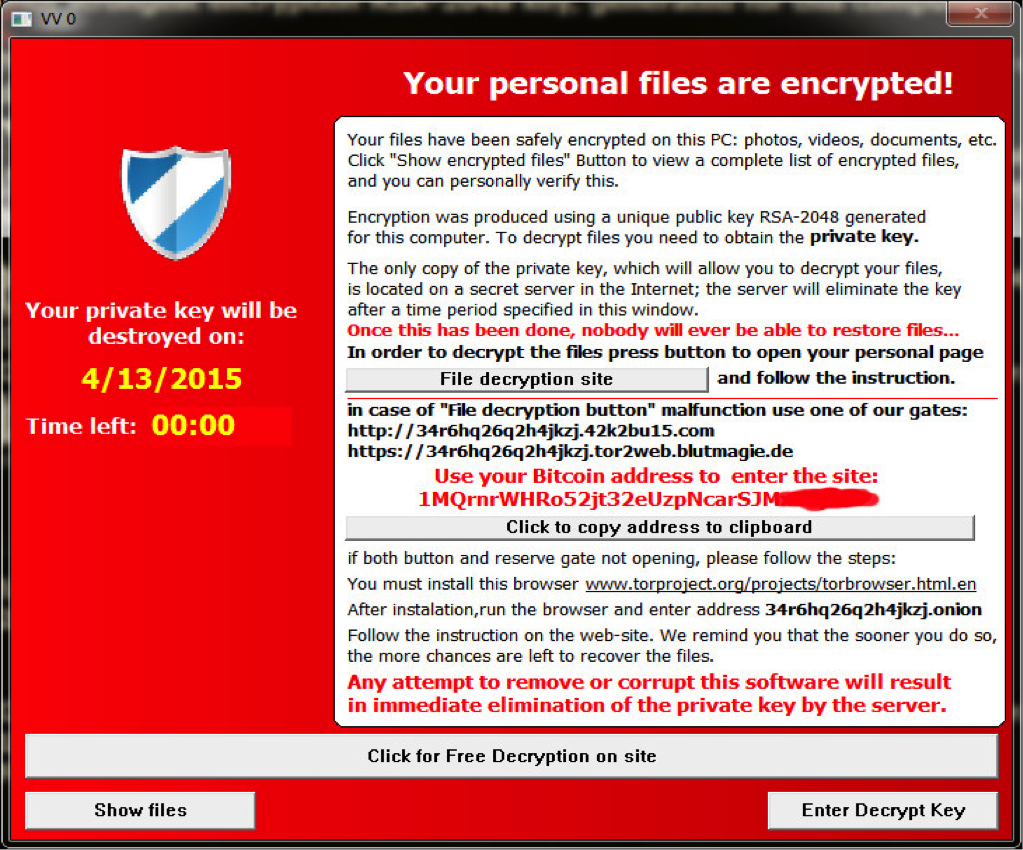
After the takedown of Cryptolocker, we have seen the rise of Cryptowall. Cryptowall 2 introduced “features” such as advanced anti-debugging techniques, only to have many of those features removed in Cryptowall 3. Ransomware is becoming an extremely lucrative business, leading to many variants and campaigns targeting even localized regions in their own specific languages. Although it is possible that these multiple variants are sponsored by the same threat actor, the most likely conclusion is that multiple threat actors are jumping in to claim a portion of an ever increasing ransomware market. One of the latest variants is called TeslaCrypt and appears to be a derivative of the original Cryptolocker ransomware. Although it claims to be using asymmetric RSA-2048 to encrypt files, it is making use of symmetric AES instead. Talos was able to develop a tool which decrypts the files encrypted by the TeslaCrypt ransomware.


TeslaCrypt-1
Click for Larger Image

Continue reading “Threat Spotlight: TeslaCrypt – Decrypt It Yourself”

Authors

Talos Group

Talos Security Intelligence & Research Group

Avatar

The American Telemedicine Association (ATA) Annual Meeting and Tradeshow is fast approaching!  If you’re planning to attend ATA from May 3-5 in Los Angeles, be sure to visit the Cisco booth to see products and solutions that connect patients and care teams so they can easily engage anytime from anywhere.

Print

You’ll find us in booth #1301, where we’ll showcase innovations that overcome the barrier of distance while improving the patient experience. Highlights include:

      • Extended Care:  Browser-based health and wellness collaboration solution platform
      • Telepresence Showcase:  DX Series (Android-based touchscreens), SX Series, and Jabber endpoints designed for maximum collaboration
      • Cisco Virtual Patient Observation: A centralized approach to patient sitting that can help improve efficiency, staff satisfaction, and staff safety
      • Avizia:  Mobile telehealth cart that connects physicians, specialists and patients at the point of care
      • And more!

Gift cardWhile you’re in our booth, let us scan your name badge so you’ll be entered for a chance to win a $250 American Express gift card!

In the meantime, learn more about Cisco Care-at-a-Distance solutions for telehealth. Also take a second to download, Cisco Telehealth Report: Connecting Brazil’s Children to a Healthier Future.

See you in Los Angeles!

Authors

Mike Haymaker

Healthcare Industry Marketing

No Longer with Cisco