As you probably know, Cisco Connected Mobile Experiences (CMX) enables businesses to develop engaging mobile experiences with personalized guest onboarding, engagement, and location analytics. CMX leverages Wifi network intelligence and provides IT departments the creative opportunity to produce new revenue-generating, end-consumer solutions.
But I’m often asked what the difference is between MSE & CMX. I’m likely to blame for some of the confusion since I use the terms “MSE” and “CMX” interchangeably. Let’s clear up the confusion once and for all with a breakdown of MSE and CMX.
What if a private cloud could give your developers the easy, fast, and predictable experience that public cloud delivers, but inside your own data center, behind your own firewalls? It’s what more and more companies are looking to provide.
Different clouds for different crowds
Innovative organizations are increasingly deploying two modes of IT — traditional IT and agile IT. Traditional IT is what we’ve all know. The focus is on “doing IT right,” with approval-based governance, and price-for-performance. Agile IT is focused on “doing IT fast,” supporting prototyping and iterative development, rapid delivery, continuous, and value to the business. Gartner calls this model “bimodal IT” and estimates that 45% of CIO’s already deploy a second, agile mode of IT.
Cisco has a long history of providing infrastructure for traditional enterprise private cloud environments. In fact, we lead the industry with Cisco UCS Integrated Infrastructure solutions such as vBlock Systems, Flexpod, and VersaStack. With the acquisition of Metacloud in September 2014, we now offer an agile IT environment for developers.
Enter Metacloud
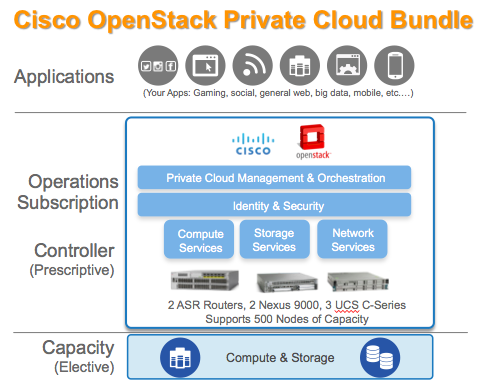
The Metacloud product, now available worldwide as Cisco OpenStack Private Cloud, delivers the engineering and ongoing operations to provide a public cloud experience within the firewalls in an organization. The advanced operations subscription to Cisco OpenStack Private Cloud takes the burden of engineering and operations of the private cloud environment away from your teams, so they can focus on automating the testing, deployment, and scale of your applications.
Metacloud solved the challenges of running a sophisticated OpenStack® private cloud that delivers an easy, fast, predictable “public cloud-like” experience to developers. But under our original model customers are still left with the challenge of building an OpenStack private cloud—cobbling together the data center components of your private cloud, using traditional IT models for getting those set up and configured.
Collaboration is all about enabling diverse and distributed team members, both inside and outside your organization to effectively communicate, share information, and work toward a common goal. The benefits of collaboration show up as:
Productivity gains
Better and faster decision making
Improved communication and teamwork
The ability for remote and virtual team members to take part meaningfully
Before investing in new collaboration technology, it pays to take a moment and define your goals: What do you want collaboration to deliver, and to whom?
I’m not talking about departmental or point-to-point focused goals that will address only an immediate need (like deploying video endpoints to several offices to enable better team interaction for a particular group, say an engineering team). I am talking about looking beyond that.
There is no question that we’re on the cusp of rapid IT evolution. Ten years ago, a small subset of IT managers and system administrators defined and drove infrastructure and services with a finite set of management tools for everyone’s use. In the emerging cloud world, the control of the data center has become segregated into individual hardware components (compute, network, storage) and become more available to the masses.
Today developers are building and running cloud services and next generation applications. As users, we are also composing our own cloud services to get our job done and combining all the various things we can consume in the cloud. That means the number of users and developers that touch IT systems and services has grown exponentially, which is why automation, programmability, and light weight development environments have become critical in the IT landscape. By definition, the consumption of these varying services have also driven the requirements for fast, hybrid IT and given the opportunity to companies like Amazon Web Services to capitalize on the users.
You Ain’t Seen Nothing Yet!
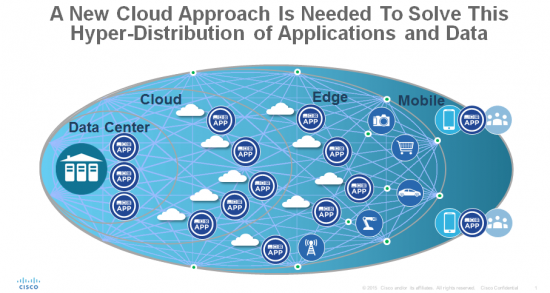
But we are anticipating a much bigger wave in IT – one that we all have to be prepared for – which is digitization. With all things of value connecting to the network, we are walking around with super computers in our pockets and in our cars and homes. These “things” (e.g. FitBit, Nest, and the Telsa smart traffic mapping application) are the new “users” that are consuming services and data from our surroundings and using these services to get their jobs done. This is another order of magnitude greater than the system administrators who drove the IT revolution and the users like us who drove the initial cloud revolution. We need to find a way to push the intelligence and services all the way out to the edge and tie this uber-distributed compute fabric together to support the “things” while giving the developers and users the automated, secure platform, intelligence, and analytics that they need.
Hyper-distributed Application Environment
This means in the current cloud economy, enterprises will need a bimodal IT model to take advantage of this uber-distributed compute fabric – one that supports their existing legacy applications AND one that supports hyperscale applications (those cloud-native applications built for mobile, gaming, ecommerce, etc.). We need to allow enterprise to deploy those new applications in hundreds of clouds and not just on their own private cloud. Enabling this kind of distributed application environment will require an agile, FAST IT development strategy combined with the right cloud platform to manage it. In addition, this cloud platform needs to be hybrid as well to allow full workload mobility across any cloud, from any vendor in a way that guarantees visibility, security, compliance and full open standards.
We believe that Intercloud, the global network of connected clouds that we’re building with our partners, is the right hybrid cloud platform to help users take advantage of digitization and IoE in the near future. Our partners are going to play a major role in making this a reality for their customers.
Oh là là
Earlier today on main stage during Cisco Partner Summit in Montreal, I gave more than 7,000 partners a preview of this Intercloud-enabled journey to Fast IT and digitization, and the role they’ll be able to play with customers. Within this journey there are a few different Cisco solutions that partners can sell to their customers and monetize today or in the near future:
Discover True Cloud Usage Before enterprises race to embrace the world of many clouds and eventually digitization, it is critical that they understand their own cloud usage and what services are within their control. Most CIOs think they know how many cloud services they are using within their enterprise, but they’re usually way off base. In many organizations, line of business (LOB) managers lease and use multiple IT and cloud services without the IT department’s knowledge. After analysis, CIOs usually discover they are using 5 to 10 times more cloud services than they were aware of, called “Shadow IT” or “Shadow Cloud.” This creates exponentially more hidden costs than are visible to the IT department, and a host of other security risks. Our new Cisco Cloud Consumption as a Service not only helps customers find out how many Shadow IT services they’re actually using, but which applications are in use, whether the data stored on those applications is encrypted, and how much it is costing them.
Build a Hybrid Cloud Platform Once CIOs realize the extent of the cloud fragmentation, they need a hybrid cloud model that gives them control over this hyperscale distribution of applications and data. Cisco ONE Enterprise Cloud Suite helps customers build their own hybrid private cloud and functions like an internal cloud store while still guaranteeing visibility, control, security, policy management, and compliance. Since it already contains a combination of Cisco Prime Service Catalog, Cisco Intercloud Fabric, and UCS Director, Cisco ONE Enterprise Cloud Suite is the one-stop shop for Cloud Builders who want to help enterprises build their own private hybrid cloud and manage the IaaS, Paas, and SaaS services applications inside it, whether those applications are their own or purchased from a partner marketplace or a public cloud.
Link IT to OT 50 billion new things will be connected to the Internet and all of these “things” will create data that will be stored in clouds and will need to be managed by the IT department. This is the world of hybrid IT – not just hybrid cloud. Cisco Energy Management Suite is an example of an Intercloud application that links IT to OT to solve this problem. It helps identify the customer’s energy use and provides benchmarks for their cloud, IT, and OT assets. Partners will wrap their own professional services around this offer to perform an assessment of the customer’s environment and automatically create and deploy policies to better manage their customers’ energy consumption all through the cloud.
Sell a Private OpenStack Cloud Managed Service As I mentioned earlier, a new IT approach is needed for enterprises to deploy cloud-native applications. Centralized computing models won’t work for many of the IoE solutions today. The time-sensitive nature of these solutions requires localized analysis and processing, which requires a distributed intelligence that only the network can deliver. This distributed applications approach leverages the intelligence network as a platform to deploy many IoE applications closer to the decision point and the data so it can enable people and processes to take near real-time informed action. Partners can help enterprises build their own distributed application cloud environment and deploy cloud-native applications using Cisco OpenStack Private Cloud Bundle based on Cisco’s Metacloud acquisition. This OpenStack-based private cloud development application is designed to radically simplify the private cloud start up process for enterprises, deliver a public cloud experience for developers, and provide a reoccurring subscription revenue opportunity for partners. Not only that, but it allows enterprises to create, deploy, and modify these cloud-native applications built for mobile, gaming, or ecommerce (such as the Angry Birds game) that can become a new source of revenue and customer analytics for enterprises.
In conclusion, CIOs need to solve the problem of hybrid IT – not just hybrid cloud. Their new remit is to manage everything from data centers to the cloud, to edges, to mobile devices. Cisco Intercloud is the only solution that has been designed from the ground up to solve this problem while leveraging the power of the network.
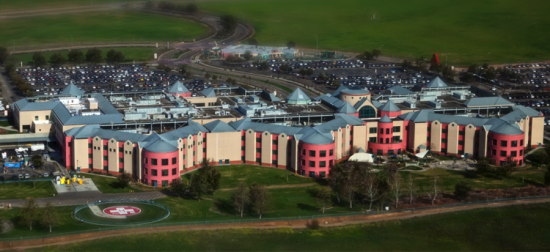
Valley Children’s Hospital is a nonprofit, state-of-the-art, children’s hospital on a 50-acre campus in Madera, California, with a medical staff of more than 550 physicians. With 356 licensed beds, Valley Children’s Hospital is one of the largest hospitals of its type in the nation. One of the core values the hospital embraces is incorporating new ideas, technology and methods to improve the care and services it provides.
Internet of Everything has led to an explosion of wireless devices in the hospital from patient care to guest access. The following blog highlights how the IT Support and Technical Services staff enable the following business outcomes using best-in-class, highly available wireless technology from Cisco:
Deliver Emergency Health Records to emergency staff on hundreds of virtual desktops and tablets from the patient’s bedside.
Keep nurses connected to patients, doctors and staff via Cisco IP Phones and
Provide free internet access to patients, family members and friends
We’ve been talking for a while about Cisco ACI’s leadership in SDN security features (like here), and in the design of our fine-grained security policy enforcement between individual workloads, sometimes called microsegmentation. Today, here at Interop, Las Vegas, Cisco is reaffirming its thought leadership in data center security and SDN automation with a couple of announcements, including the integration of Cisco FirePOWER next generation intrusion prevention system (NGIPS) into the ACI security framework. In other news, another ACI ecosystem security partner was announced last week at the RSA Security Conference: Fortinet, who will be integrating their Fortigate firewall platform with ACI.
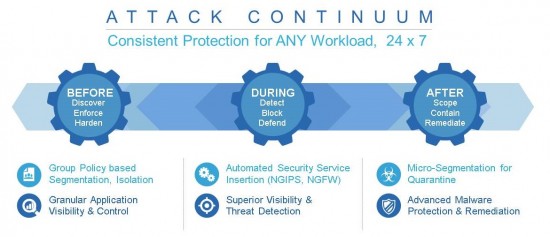
The Cisco ACI + FirePOWER solution enables real-time detection, mitigation and remediation for advanced security threats inside the data center by combining granular application visibility and control, threat detection, advanced malware protection (AMP) capabilities of FirePOWER NGIPS with ACI microsegmentation, advanced security service insertion, and L4-7 policy automation. To quickly summarize how this all comes together and a sample use case for ACI security, we created the following video:
https://www.youtube.com/watch?v=0kcXhm9Vbyw
Available in June, 2015, new ACI advanced security works to protect data centers before, during, and after attacks, dynamically detecting threats and automating incident responses. The Cisco FirePOWER family of security appliances consists of industry-leading NGFW, NGIPS appliances offering best-in-class threat effectiveness, superior visibility and global threat intelligence.
FirePOWER + ACI = Automated Security with Advanced Protection Across Attack Continuum for Physical and Virtual
The Best of Interop Awards for 2015 were announced today at 5.30 PM, at the Interop Theater. Cisco APIC won the Best of Interop award in the SDN category.
To learn more about this unique product, you can refer to the following posts:
I want to extend my congratulations to the entire team at Insieme Network Systems Business Unit and recognize their hard work in developing this award winning Product.
Cisco appreciates the recognition from the Interop judges and it’s a great compliment to the recognition Cisco APIC is getting from its customers.
Please visit Cisco demo booths at the Expo Hall for a live demo of APIC and its integrated solutions with industry-leading partners.
#CiscoChampion Radio is a podcast series by Cisco Champions as technologists. Today we’ll be talking about CCIE Wireless exam updates with Cisco CCIE Program Manager Erik Vangrunderbeek, Cisco Engineering Technical Leader Jerome Henry, Cisco Distinguished Systems Engineer Stephen Orr, and Cisco Consulting Systems Engineer Carlos AlcAntara.
Learn about the Cisco Champions Program HERE.
See a list of all #CiscoChampion Radio podcasts HERE. Ask about the next round of Cisco Champions nominations. EMAIL US.
Cisco SMEs Erik Vangrunderbeek, Cisco CCIE Program Manager
Jerome Henry, Cisco Engineering Technical Leader
Stephen Orr, Cisco Distinguished Systems Engineer
Carlos AlcAntara, Cisco Consulting Systems Engineer
Has your wireless network help you identify the closest Printer to you? That’s exactly the kind of problems Cisco wireless is helping solve at Vanderbilt University.
Located in the heart of Nashville, TN, the Vanderbilt campus consists of Vanderbilt University (VU) and Vanderbilt University Medical center (VUMC).
Cisco Wireless at Vanderbilt serves about 33,000 users (12,500 students and 20,500 staff) everyday from the University and medical center. Vanderbilt spans across 324 buildings, which includes 35 medical centers.
One of the key elements about the wireless network at Vanderbilt is the requirement to support stringent standards to serve as a Medical Grade Network (MGN).







 Oh là là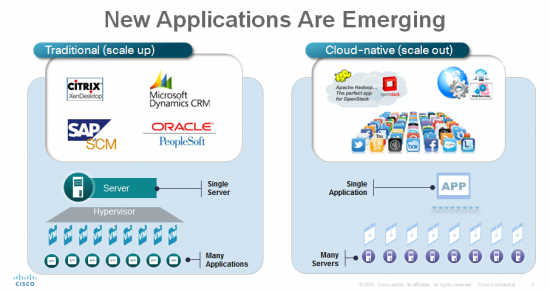






 #CiscoChampion Radio is a podcast series by