By Yves Padrines, Vice President & General Manager Cable, Media and Video, Cisco EMEAR
The summer trade show cycle wheels into Cologne, Germany this week for ANGA COM, expected to draw around 17,000 attendees and 450 exhibitors from 34 countries. Cisco is excited to be there to spend time with customers and partners, and showcase our latest innovations.
With the exception of regulatory considerations, the scene is pretty much constant across North America and in Europe: The need for accelerated broadband speeds is sparking innovation in the Continue reading “Cisco at ANGA COM 2015”
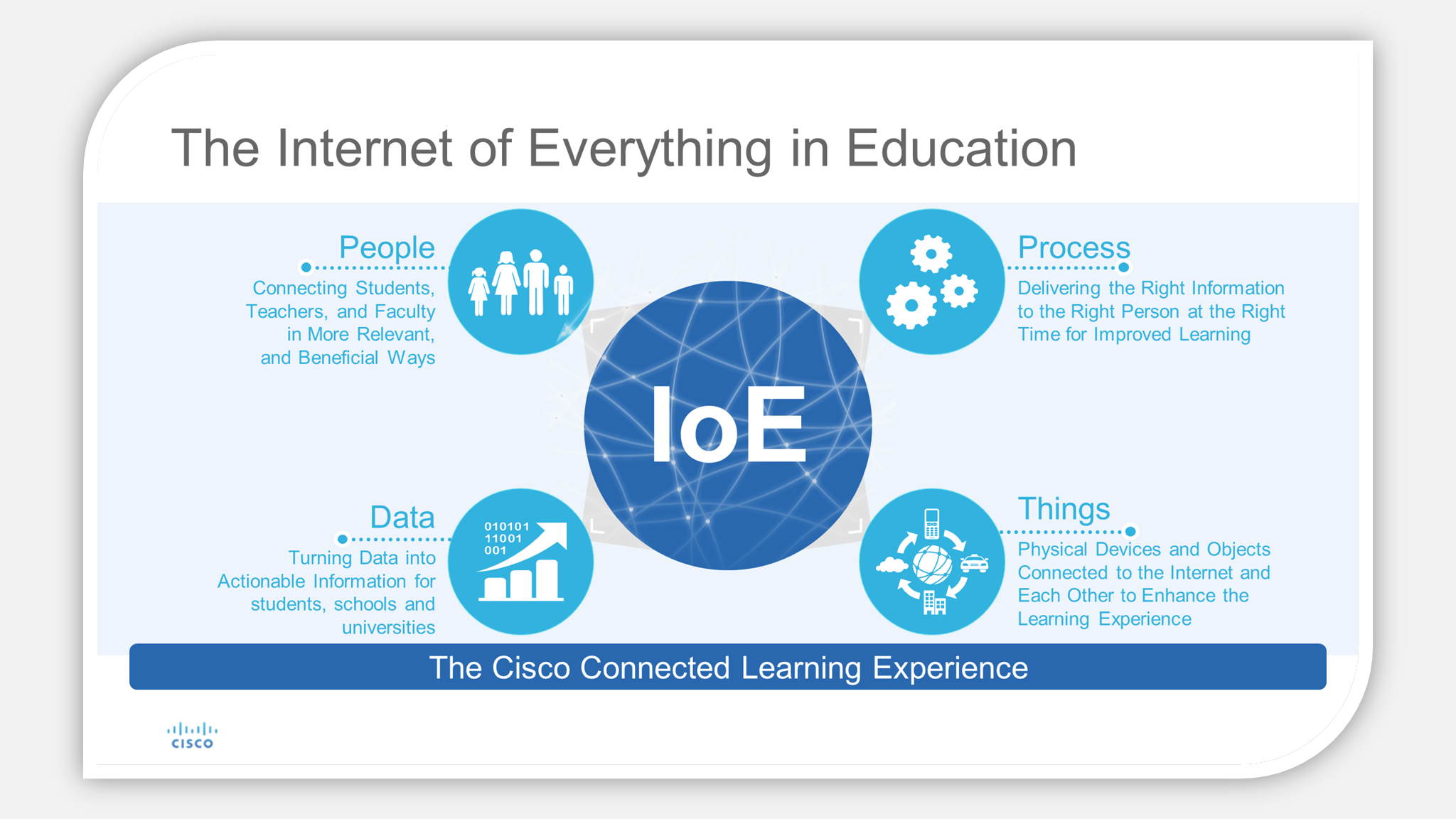
Analysts agree that academic institutions worldwide face more complex challenges than ever before and are under tremendous pressure to cut costs. At the same time, they also need to provide greater access to education, increased security, and improved outcomes and services, among others.
Through solutions enabled by the Internet of Everything (IoE), these academic institutions can successfully address their challenges, transforming schools and universities into connected campuses and taking them to the next level of an improved and digitized learning experience.
One of the most captivating technology use cases to emerge in recent time is the use of Bluetooth Low Energy (BLE) devices (also see Bluetooth Smart™), distributed in a venue, to provide proximity services advertisement and discovery. The best known instantiation of BLE is the Apple iBeacon (although as a branded technology, this is literally a subset of the broader category of devices available).
A very interesting ramification of deploying these devices is how to manage and inventory them. How does a venue prevent these from being moved? Or stolen? Or having additional devices added (either as pranks or for malicious intent)?
The answer to these questions is that it is nearly impossible to prevent – therefore the next best thing, which is still pretty good, is to provide the ability for monitoring the BLE devices.
But Cisco did one better. We figured out how to do this with our existing products and we’re showcasing this in software release 8.1.
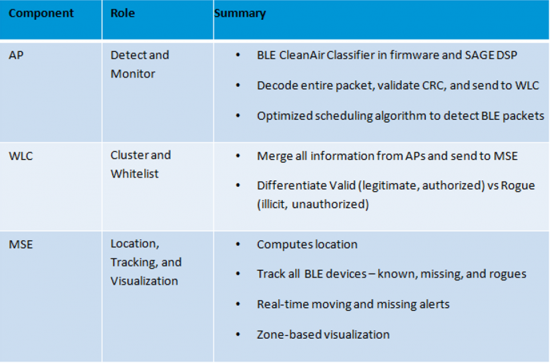
As an extension to the existing ability of CleanAir to monitor, detect, locate, and report on Bluetooth devices as interferers, this new feature enables a venue owner to both prevent the illicit deployment of BLE devices and provide asset tracking for legitimately deployed BLE devices.
The breakdown of the entire feature is tabulated below.
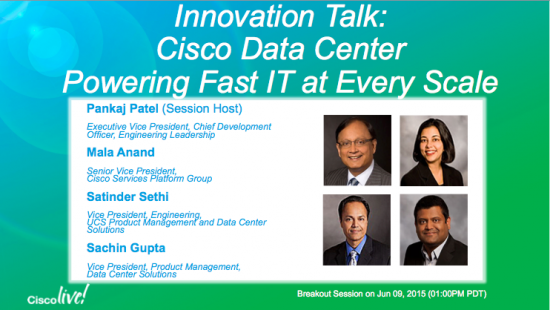
Digital transformation hinges on the performance of the datacenter.
Cisco would like to share how digital transformation is turning traditional business models on their heads, enabling new innovative customer experiences. This is creating new business dynamics where speed is vital for organizations to stay competitive.
Talos has found a new SPAM campaign that is using multiple layers of obfuscation to attempt to evade detection. Spammers are always evolving to get their messages to the end users by bypassing SPAM filters while still appearing convincing enough to get a user to complete the actions required to infect the system. The end payload for this campaign is Cryptowall 3.0. Talos has covered this threat repeatedly and this is another example of how the success of Ransomware has pushed it to one of the top threats we are seeing today. Whether its Exploit Kits or SPAM messages threat actors are pushing as many different variants of Ransomware as possible.
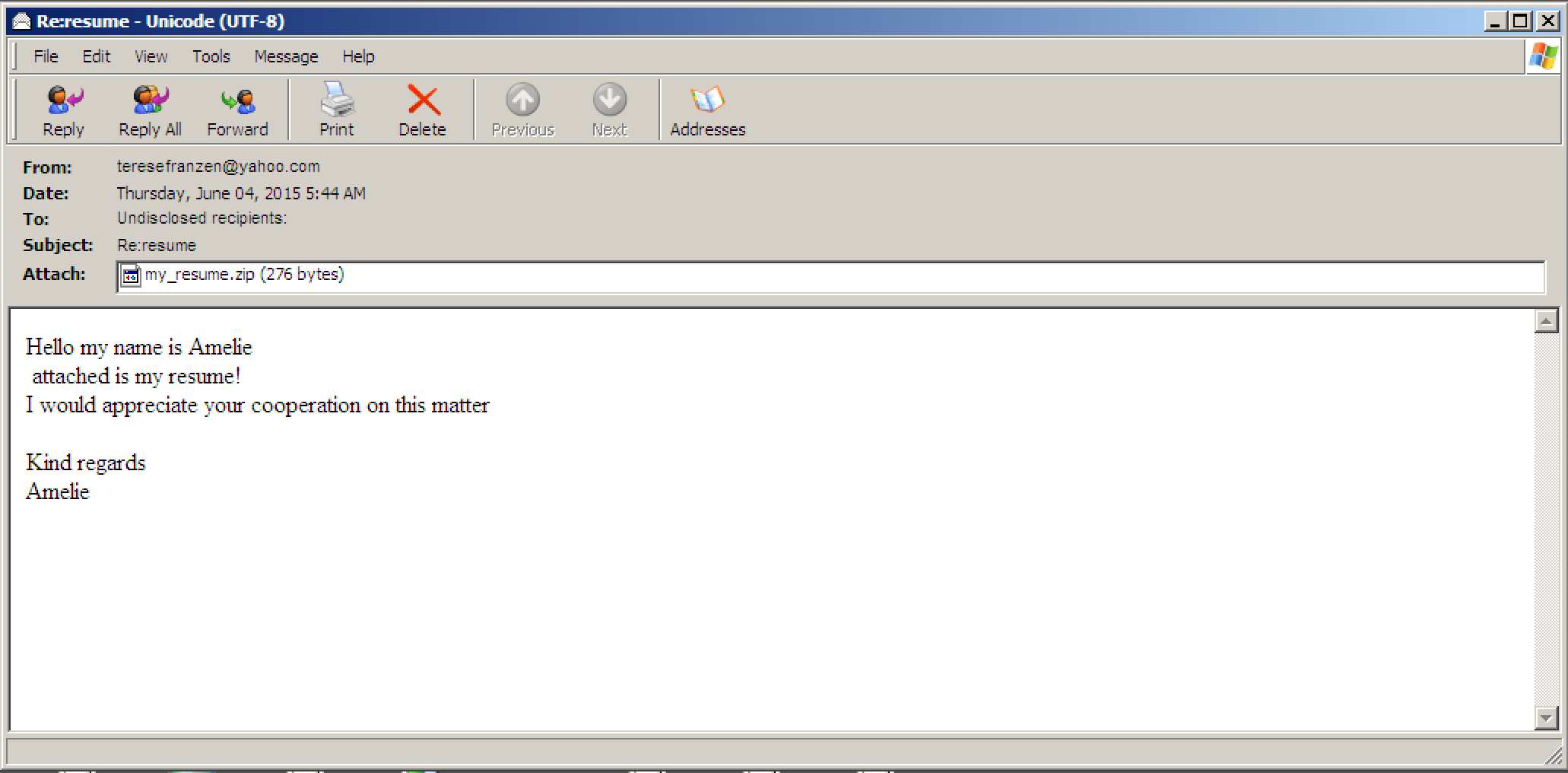
Email Details
The use of resume based SPAM isn’t anything new. An analysis of our telemetry has found countless messages in the last 30 days related to Resumes. Threat actors have tried many different techniques associated with these messages including using password protected zip files, word documents with embedded macros, and malicious URLs redirecting back to a malicious sample. This threat combined a series of techniques to try and avoid detection that has been surprisingly successful against some products. Below is a sample of one of the emails that we saw in our telemetry.
Every market and every industry is moving from the Information Age to the digital age, and the pace of change is happening faster than ever before. Every company, city and country is realizing they must transform to survive and thrive in this new era. I predict this race to go digital will be more like a marathon sprint; however, not everyone will make it to the finish line. Gartner predicts that only 30 percent of digitization efforts will be successful[1], with the inability to reinvent as the number one reason companies will fail in this new era.[2]
As a leader of a company that has successfully seen around corners and reinvented itself, I’ve learned a lot about what it takes to win in an environment of exponential change. Here is my advice for other leaders as they move to the digital age:
Digitize and Disrupt.
Now, more than ever, you must reinvent yourself to embrace the opportunities that digitization presents. It used to take almost 20 years for a company to show commodity-like behavior, but now it only takes a matter of two to three. Spotify and Square, for instance, have disrupted music and point-of-sale respectively. These are only a couple of the innovative companies that are putting increased pressure on businesses to disrupt themselves by challenging traditional models.
Late last week Talos researchers noticed a drastic uptick in Angler Exploit Kit activity. We have covered Angler previously, such as the discussion of domain shadowing. This exploit kit evolves on an almost constant basis. However, the recent activity caught our attention due to a change to the URL structure of the landing pages. This type of change doesn’t occur often and was coupled with some other interesting tidbits including how the HTTP 302 cushioning has evolved and the payload of another ransomware has changed.
During research Talos identified several active Angler campaigns delivering different payloads via different methods. The first campaign was delivering Cryptowall, which will be covered in detail here. The second delivered Bedep with click fraud and illustrates the variety with which Angler can be used to deliver different payloads. The details of Bedep with click fraud has been covered thoroughly and will not be specifically discussed in this article.
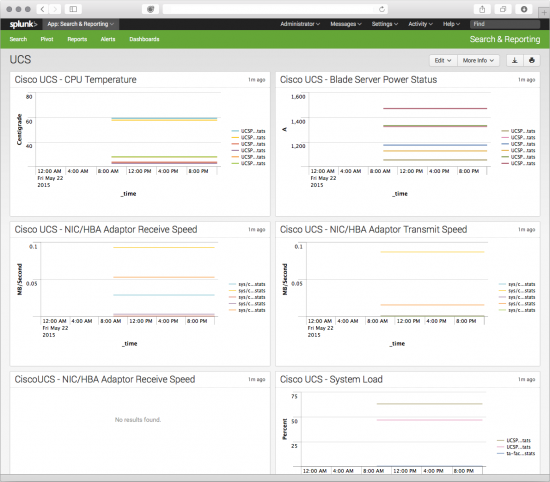
IT infrastructures are increasingly complex and include a broad range of technologies and platforms hosted in physical, virtual and cloud environments. Cisco UCS has become a world leading server platform in large part because the unique UCS architecture enables organization to harness the power of virtualization and dramatically simplify infrastructure management.
Splunk is a great complement to Cisco UCS because Splunk also helps organizations deal with the complexity of vast multi-vendor, multi-product, and multi-site environments. Splunk is a platform for real-time big data analytics which enables end-to-end, cross-tier visibility across applications, physical, virtual, and cloud infrastructure.
Do you need insights into your UCS server performance? Would it be valuable to troubleshoot application issues across server, storage, networking, and other domains? Are you already using Splunk to “… make machine data accessible, usable and valuable…”? Then you need to be using the just updated Splunk Add-on for Cisco UCS.
Splunk’s first (and only) out-of-the-box integration for server environments, Splunk integration with Cisco UCS provides real-time operational visibility not just across Cisco UCS domains but across multiple applications and infrastructure tiers. This enables organizations to identify & resolve problems faster, proactively monitor systems & infrastructure, track key performance indicators & understand trends & patterns of activity & behavior.
The Splunk add-on for Cisco UCS allows a Splunk Enterprise administrator to collect UCS performance, inventory, and fault data from Cisco UCS Manager using the UCS XML API. All the data is and can be integrated with other Splunk applications for products such as Cisco ASA Firewalls or Cisco Nexus Switches or Microsoft Exchange. Did you know that Splunk has over 20 integrations for Cisco products?
If you are thinking about adding Splunk insights into your environment, this is even more of a reason to do it on Cisco UCS servers. Last November, Ragu Nambiar blogged about a joint reference architecture with Splunk that improves performance up to 25x over the Splunk reference hardware. Cisco also published a Solution Brief. Look for updates on the reference architecture from Ragu soon.
Will you be at Cisco Live next week? Be sure to go to Splunk’s booth (#2319) to see the UCS app in action (or a number of the other integrations) or join the Big Data Analytics Demonstrations Booth Tours and find Splunk in Cisco’s Connected Transportation IoT, Security Solutions and Enterprise Networks Pavilions.
If every click made by a shopper on an online store can be considered valuable information, surely every step taken by a shopper in a physical store is also a similar wealth of data. While clearly this is valuable input that many stores would like to have, the means to collect and process it is not available everywhere. This fact has resulted in a significant gap in the information available in an online as opposed to a physical store.
Can the power of Internet of Everything and real-time analytics bridge this gap? Can it help capture the shopper behaviors using sensors in the store? Can real-time analytics at the edge transform this data into shopper insights?
Yes indeed. While we see the need for granular and enhanced analytics, we clearly see that many physical store retailers are yet to start their journey in capturing such shopper insights. Let’s take a 3D view of your shoppers.
You need to gather:
Door Traffic: This is the total traffic coming into your store. This metric is very valuable for understanding loyalty, conversion, staffing needs, and much more use cases as highlighted in the Cisco white paper on Retail Analytics. By filtering new and repeat visitors, we can understand your shopper’s loyalty – but when we bring together this data with point of sale data, it helps us to understand conversion. When we correlate this with marketing campaigns, it helps you get a sense of your store’s and campaign’s effectiveness.
Dwell Time: This is the time that your shoppers are spending in the store and in different areas of the store. It highlights the engagement of shoppers with your products and displays. For example, this metric can be used to understand products that are getting more attention from your shoppers, or can be used to determine more advanced metrics, such as balk rates and predicted wait times.
Demographics: This is the breakdown of segments among your shoppers. The granularity of this data can vary and can provide insights for customer segmentation and the ever changing dynamics of your shoppers, helping you to match shopper preferences and targeted promotions.
While there are no questions about the value of these data to the retailers, achieving it is currently a challenge due to the combination of technologies and sensors required to capture them precisely, effectively, and economically.
The Cisco Connected Analytics for Retail solution focuses on making this journey easier for retailers to capture the data and derive insights. Leveraging Wi-Fi, video, social, PoS, and other sensor data, and bringing together the power of real-time edge analytics, the solution provides retailers a 3D view of their shoppers.
If you are attending Cisco Live 2015 at San Diego, come by to check out the Connected Analytics for Retail solution demo in the World of Solutions pavilion. I look forward to seeing you there!