When was the last time you had a team meeting with someone outside your usual circle of colleagues?
This is a question – and a challenge – laid down by Peter McDonald, a collaboration expert that I met with last week.
Peter works for a consultancy that focuses on helping people collaborate. And they go about it in a pretty radical manner.
One of the things they do is run workshops with people with different profiles, roles and jobs (and often diametrically opposed perspectives). Many of their workshops involve going into charities and finding solutions to their most challenging business problems.
The results are fascinating. Given often really difficult and complex challenges to resolve, often the more diverse and potentially conflictive the group is, the more disruptive the thinking. And the more creative and interesting the ideas, suggestions and solutions are.
Often we focus on the challenges associated with IT with little consideration of the end user viewpoint. In Cisco’s Work Your Way Global Study, completed in January of 2013, we polled over 1300 IT professionals and business-focused end users around the globe to investigate how BYOD is not only affecting IT, but how the challenges directly impact the end user experience. We were curious to compare and contrast the different viewpoints to understand if the difficulties IT was facing had an impact on how end users get their devices on the network, access business applications and perform day-to-day activities on the move. Check out the Borderless Blog to see our awesome infographic!
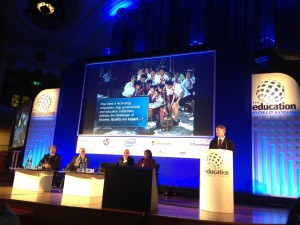
Michael Stevenson, VP Global Education addressing delegates at EWF 2013
About a week ago, I posted a blog sharing my expectations on the Education World Forum 2013, as well as key details on Cisco’s participation as Platinum sponsor of this event. After what was a very interesting gathering, I think it is time to share with you some of the learnings and outcomes I took from the meeting.
This year, I was particularly struck by the vast predominance of attendees coming from Africa, the Near East, as well as other emerging regions of the globe. One of the reasons behind this pattern could be that many of these countries are starting to adopt a more visible position in the education debate (as it is the case for Brazil, now a major player in the global education dialogue and a major Cisco role viaGELP) or that regional economic progress (with Africa housing 7 of the fastest growing economies in the world) is paving the way to more active engagement. Another reason could be that the Forum’s intention was rather to reflect more on how to improve access to achieve education for all and less so on leveraging lessons from more mature countries.
Cisco continues to roll out innovations that will enable the next generations of multi-cloud computing. I’m a product manager working on Cisco’s Cloud Management software, and we’re all about the high-level, self-service, automatic provisioning of services that the end-user cares about. The network just moves ones and zeros, and all protocols of interest (HTTP, SSH, RDP, SQL, etc.) work fine over TCP/IP. The hypervisor takes care of putting that pesky motherboard chipset and storage bus into a black box, right? The end-user doesn’t care about that stuff, or at least doesn’t want to have to care about it.
A common perspective, except among the engineers who manage the network, is that network infrastructure is a bunch of mysterious plumbing that “just works” and how it does what it does doesn’t matter. Indeed, many vendors in the “cloud” arena would like to perpetuate this perspective on the network. They would like you to believe a bunch of dumb pipes can carry traffic and that determination of the traffic (content, flow, etc.) is determined at higher levels in the stack.
In some cases, this is true, but operating this way doesn’t unlock anything new. The model they describe would be brilliant if all of your network requirements were defined in 1998. Few companies can afford to operate technology today like they did in 1998 and remain competitive.
Cisco is announcing a newNexus 1000V(N1KV), and this one changes the game.In brief, the Nexus 1000V is the foundation of the networking services that Cisco brings to virtual computing. The N1KV can be managed using the same NX-OS commands and practices used to manage the Nexus 5K and 7K switches, and extends network control down to the VM and virtual port into which a VM is “plugged in”, even across different vendors’ hypervisors.
The N1KV is also the platform for additional L2 and L3 network services such as those provided by the vASA Firewall, vNAM, and VSG. The new Nexus 1000V InterCloud extends this ability to cloud service providers, such as Amazon, but is “cross-provider” (in fact, it doesn’t even depend on the Cloud Service Provider). For me, in my role as a Cloud Product Manager, this is an important new addition to basic networking capabilities, and is exactly the kind of thing that Cisco can and should do in its role as “Networking Giant” to open up the promise of hybrid or multi-cloud.
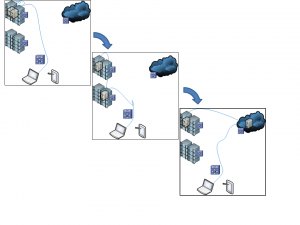
I have a mental image of what this can do, and I tried to put this into images to the right. Animation would have been better, I just don’t have the Flash skills to put it together for a quick blog post. I envision a virtual machine as a ghostly “physical” server tower with network cables plugged into it. These network connections can come from end-users in a client-server model, or any of our web-and-mobile constructs. After all, we still are end-users connecting to machines. Of course, the “client” for a compute function could be another compute function, so there is a network cable coming from another nearby ghost server. These ghost servers can today float from blade to blade thanks to most mainstream virtual machine managers (VMM) and a virtual switch like the N1KV, and the cords stay connected throughout. With the new N1KV, that VM can float right out of that VMM and into another VMM (such as across VMware datacenters, or even from VMware to Hyper-V), or out to a public or hosted provider. The cord just magically uncoils to remain connected wherever that machine goes! I love magic.
The N1KV provides that cable that can float after its ethereal virtual machine. It also provides the platform to maintain monitoring by the vNAM, even as the machine moves. You simply can’t economically achieve this using basic dumb pipes. Add to this the new Virtual Network Management Console (VNMC) InterCloud management capabilities. In order for that cord to stay connected, there do have to be network switches or routers along the way that understand how to make that network cable follow the machine. VNMC InterCloud manages these devices, but adds another particularly important capability: actually moving the workload.
VNMC InterCloud adds the ability to discover virtual machines, and convert them to a cloud-provider’s instance format, move what could possibly be a fairly large set of files, and get that machine started back up in a far-away environment, with seamless network consistency. VNMC InterCloud is like a puff of wind that pushes the ghostly VM from my corporate VMWare-based cloud to float over to my hosted private cloud. Remember, ghosts can float through walls.
This is groundbreaking. Workload mobility is one of those hard-to-do core capabilities required for all of us to realize the promise of multi-cloud, and it requires a network that is both dynamic and very high performing. I’ve been looking forward to this from Cisco for some time now.
Often we focus on the challenges associated with IT with little consideration of the end user viewpoint. In Cisco’s Work Your Way Global Study, completed in January of 2013, we polled over 1300 IT professionals and business-focused end users around the globe to investigate how BYOD is not only affecting IT, but how the challenges directly impact the end user experience. We were curious to compare and contrast the different viewpoints to understand if the difficulties IT was facing had an impact on how end users get their devices on the network, access business applications and perform day-to-day activities on the move. Based on these results we created an Infographic that talks about the challenges and provides key insight to what the results mean. Continue reading “Work Your Way is Not Just an IT Challenge [Infographic]”
The future of television may well include holographic, multisensory experiences worthy of science fiction. But many other visionary predictions are closer to the horizon, if not already upon us. These are creating exciting opportunities, while forcing all players in the television value chain to adapt quickly.
Recently, I met via Cisco® TelePresence® with more than 50 journalists from 11 countries—all in Central and Eastern Europe—to discuss the future of television and its impact on these mostly emerging markets. I participated with two of my colleagues: Kate Griffin, from the Cisco Internet Business Solutions Group (IBSG) service provider practice; and Guillaume de Saint Marc, from Cisco’s service provider video technology group (SPVTG). The roundtable took place over two days and used a Cisco IBSG study, “The Future of Television: Sweeping Change at Breakneck Speed,” as a springboard for discussions that were lively and free-spirited. Continue reading “The Future of TV: Coming Soon to a Wall Near You”
As demand for hosted technology in the Australian enterprise increases, we are pleased to announce that we have teamed with ASX-listed Amcom to deliver our Hosted Collaboration Solution (HCS) to the Australian market (see press release here). Offering IT and Unified Communications-as-a-Service is a growing trend in the market as customers look to reduce capex and lower risk.
Cisco HCS allows customers to unify their communications enabling telephony, video-conferencing and instant messaging across multiple devices for the end user, as well as delivering enterprise-grade security via the cloud. Amcom will be delivering the service over its national data network.
Secure access continues to be paramount for a connected world. People connect to the Internet for business and for personal use, from wired, wireless or mobile devices—locally and remotely. The Internet is a global system of interconnected networks. User devices, the Internet, and all computer networks are the target of a growing number of increasingly complex security threats. Let’s take a look at some recent trends from the Cisco Connected World Technology Report that speaks to the need for secure access:
Three devices is the average per end user with the desire or mandate to work anywhere and anytime—how do we ensure control of all these devices?
71 percent of the next generation workforce will not obey the policies—how do we enforce policy?
60 percent will not be responsible for protecting corporate information and devices—how do we protect sensitive data?